
 100% FREE ACCESS
8th Standard CBSE Syllabus & Materials
8th Standard CBSE
CBSE 8th Social Science Theme D - Factors of Production - New Model Questions Papers Study Material - QB365 Set A
NEW8th Standard CBSE
CBSE 8th Social Science Theme C - Universal Franchise and India's Electoral System - New Model Questions Papers Study Material - QB365 Set A
NEW8th Standard CBSE
CBSE 8th Social Science Theme B - The Rise of the Marathas - New Model Questions Papers Study Material - QB365 Set A
NEW8th Standard CBSE
CBSE 8th Social Science Theme B - Reshaping India's Political Map - New Model Questions Papers Study Material - QB365 Set A
NEW8th Standard CBSE
CBSE 8th Social Science Theme A - Natural Resources and Their Use - New Model Questions Papers Study Material - QB365 Set A
NEW8th Standard CBSE
CBSE 8th Science Keeping Time with Skies - New Model Questions Papers Study Material - QB365 Set A

Published on: 29/10/2025
Download CBSE Class 8th Standard CBSE Social Science question papers, sample papers, important questions, and previous year solved papers in PDF format. Get free study materials, NCERT solutions, and exam preparation resources for Class 8th Standard CBSE Social Science
Questions + Answers key
Take MCQ Social Science Test
1.
The places well known for Bandanna designs were:
(A)Rajasthan
(B) Maharashtra
(C) Gujarat
(D) Madhya Pradesh.
A, B
A, D
B, C
A, C
2.
The appropriate source of energy for coastal area is:
Tidal energy
Solar energy
Biogas
Wind energy
3.
Sulabh, a non-government organisation, enters into contract with municipalities to construct toilet blocks. It charges for the use of latrines. The charges are :
Rs 1
Rs 1.50
Rs 2
Rs 2.50
4.
The term' domestic' in 'Domestic violence' means:
House in which people live
House in which people do not live
Ahouse where a nuclear family lives
It includes all women who live or have lived together in a shared household with the husband.
5.
Union Carbide was a/an
American company
English company
Government-owned company
None of the above
6.
Why did Mr Shinde go to the police station?
To meet his friend
To see the police officer
To get his wife's gold chain
To file an FIR
7.
Complete the statement: Non-renewable resources are ___________________
those which have limited stock
made by human beings
derived from non-living things
8.
Who among the following was/were members of the Constituent Assembly?
Jawaharlal Nehru
AK Ayyar
Sardar Vallabhbhai Patel
All of the above
9.
The hunter-gatherer tribes got their supplies of rice and other grains
by buying these grains with their meagre earnings from selling forest produce
by exchanging them for forest produce
by doing odd jobs
All of the above
10.
When New Delhi was built, the National Museum and the National Archives were both located close to the
Supreme Court
Parliament House
Viceregal Palace
Red Fort
11.
Write the different techniques used to conserve water.
12.
Where was the first textile mill successfully set up in India? What was the reason of its success?
13.
How did the mutiny become a popular rebellion?
14.
By whom were the following demands being made on forest land?
Forest land for mining
15.
List the different types of religious practice that you find in your neighbourhood. This could be different forms of prayer, worship of different gods, sacred sites, different kinds of religious music and singing etc. Does this indicate freedom of religious practice?
16.
Why were Christian missionaries attacked by many people in the country? Would some people have supported them too? If so, for what reasons?
17.
How did the assumption of Diwani benefit the East India Company?
18.
The right mix of ________ and __________ makes the soil fertile.
19.
Indians were --------with British rule.
20.
Who was Gangadhar Rao ?
21.
Birsa spent some time in the company of a prominent ___________ preachers.
22.
Petroleum deposits of West Asia are an example of actual resources.
23.
Mahatma Gandhi visited Champaran in 1917.
24.
Coffee does not require warm and wet climate and well-drained loamy soil.
25.
Rashsundari Debi secretly learned to read and write in the flickering light of candles at night.
26.
Delhi was made the capital of British India after 1911.
27.
What was a "Spinning Jenny" ? Explain.
28.
What was the outcome of partition of Bengal?
29.
What is a Parliamentary form of government?
30.
Complete the sentences below using some of the following words. (sparsely, favourable, fallow, artificial, fertile, natural. extreme, densely)
When people are attracted to an area, it becomes ___________populated.
Factors that influence this include ____________climate; good supplies of ____________resources and _____________land.
31.
Define conventional power resources.
32.
Name the man-made and natural fibres used in the textile industry
33.
When was Battle of Plassey fought?
34.
What was the reason behind the division of Pakistan into two states?
35.
What are the sources of water in rural areas?
36.
What were the initial demands of Congress?
37.
What are Madarsas?
38.
What do you mean by a fair trial?
39.
Name the artist of the painting named the 'Storming of Seringapatam'.
40.
Why is Rajya Sabha called the permanent body?
41.
Agro based industry
42.
Sword of Tipu Sultan
43.
First Governor General of India
44.
Cholera
45.
Offence
46.
What guidelines have been laid by Supreme Court for police during investigation?
47.
Do you think water is available in Chennai and affordable by all? Discuss.
48.
Describe the differences of opinion between the Orientalists and the Anglicists.
49.
Which party do you think will form the government? Give reasons why.
50.
In the given outline map of India, identify and name the five major manganese producing states .
51.
With the help of an atlas, identify some iron and steel industries in India and mark their location on an outline map of India
52.
Read the source and answer the questions given below: According to a report of the Geological Survey of India: Iron smelting was at one time a widespread industry in India and there is hardly a district away from the great alluvial tracts of the Indus, Ganges and Brahmaputra, in which slag heaps are not found. For the primitive iron smelter finds no difficulty in obtaining sufficient supplies of ore from deposits that no European ironmaster would regard as worth his serious consideration.
(i) What do you understand by slag heaps?
(ii) Why did the process of iron smelting decline by the late 19th century?
53.
Write down some advantages of biogas.
1.
(d)
A, C
2.
(a)
Tidal energy
3.
(a)
Rs 1
4.
(d)
It includes all women who live or have lived together in a shared household with the husband.
5.
(a)
American company
6.
(d)
To file an FIR
7.
(a)
those which have limited stock
8.
(d)
All of the above
9.
(d)
All of the above
10.
(c)
Viceregal Palace
11.
The different techniques which can be used for water conservation are:
(i) Afforestation.
(ii) Sprinklers.
(iii) Dam construction.
(iv) Linking of rivers.
(v) Rainwater Harvesting.
(vi) Watershed management.
12.
The first successful textile mill was set up in Mumbai in 1854.
The reasons for its success were:
(i) This place has warm and moist climate which is suitable for cotton textile.
(ii) The port was situated nearby for importing machinery and easy availability of raw material and skilled labour influenced the expansion of cotton textile in Mumbai.
13.
(i) A very large number of people begin to believe that they have a common enemy and rose up against the enemy.
(ii) Sepoys mutinied at several places beginning from Meerut and a large number of people from different sections of society rose up in rebellion.
(iii) After a hundred years of conquest and administration, the English East India Company faced a massive rebellion that started in May 1857 and threatened the Company's very presence in India.
14.
Private and public sector companies.
15.
Following is a list of the different types of religious practices followed in my neighbourhood:
Religious Practice Religion
(i) Jagran/SatsanglKirtan/Yajna - Hinduism (singing of religious songs, chanting of hymns)
(ii) Ajan/Namaj (call to the faithful for prayers) - Islam
(iii) Holy Mass/Carols (singing - Christian religious songs in honour of Christ)
It does indicate that different religious communities do enjoy the freedom of religious practice.
16.
Christian missionaries were attacked by many people in our country because people did not support the activities of Christian missionaries. Further many Hindu nationalists felt that Hindu women were adopting Western ways and this would corrupt Hindu culture and destroy our y family values.
Some people have supported the activities of Christian missionaries because:
(i) Christian missionaries, during the 19th century began setting up schools for tribal groups and 'lower caste children'.
This education made them capable to adjust with the changing world.
(ii) Christian missionaries condemned sati system and child marriage. They set-up many schools for women, where women were trained so that they could support themselves economically.
17.
In 1765, the Mughal emperor appointed the East India Company as the Diwan of Bengal. The Diwani allowed the Company to use the vast revenue resources of Bengal. This solved a major problem of the Company. From the early lSth century its trade with India had expanded. But it had to buy most of the goods in India with gold and silver imported from Britain. This was because at this time Britain had no goods to sell in India.
The outflow of gold from Britain slowed after the battle of Plassey and entirely stopped after the assumption ofDiwani. Now, revenues could be used to purchase cotton and silk textiles in India, maintain Company troops and meet the cost of building the Company fort and offices at Calcutta.
18.
()
Humus and water
19.
()
discontended
20.
()
He was the king of [hansi, who died in 1853
21.
()
Vaishnav
22.
(a)
23.
(a)
24.
(b)
25.
(a)
26.
(a)
27.
A machine by which a single worker could operate several spindles on towhich thread was spun. When the wheel was turned, all the spindles rotated.
28.
The partition of Bengal infuriated people all over India. All sections of the Congress opposed it. Large public meetings and demonstrations were organised and new methods of protest developed. Its outcome was the Swadeshi Movement.
29.
A parliamentary form is a system of government where Parliament is supreme and the Council of Ministers are collectively responsible to the Parliament. The head of the state has nominal powers.
30.
Densely, favourable, natural, fertile
31.
()
Conventional power resources are those that are in use for a long period of time and are extensively used by the common people. Firewood and fossil fuels are the two main conventional energy sources.
32.
()
The natural fibres include wool, silk, cotton, linen, jute. The man-made fibres are nylon, polyester, acrylic, and rayon.
33.
()
It was fought on 23rd June 1757.
34.
()
Pakistan was divided into two states (Pakistan and Bangladesh) when the Bengali speakers of the East felt that their language was being suppressed.
35.
()
In rural areas the sources of water are-wells. hand pumps. ponds and sometimes borewells.
36.
()
The initial demands of Congress were reduction of revenue, cut in military expenditure and more funds for irrigation.
37.
()
Madarsas are institutions which provide education to Muslim children.
38.
()
A fair trial refers to a trial which has taken place in full compliance with the law of the land
39.
()
The Storming of Seringapatam was painted by Rober Kerr Porter in 1800.
40.
()
Rajya Sabha is never completely dissolved. That is why it is a permanent body.
41.
()
Cotton textile
42.
()
Wootz steel
43.
()
Hasting
44.
()
Water-borne disease
45.
()
Crime
46.
(i) The Supreme Court has laid down guidelines that the police must follow at the time of arrest, detention and interrogation. These are also known as D.K.Basu guidelines.
(ii) Police investigation always has to be conducted in accordance ith law and with full respect for human rights.
(iii) The police are not allowed to torture or beat or shoot anyone during investigation.
(iv) They cannot inflict any form of punishment on a person even for petty offences.
(v) Police officials carrying out investigation should wear, clear and visible name tags with their designations.
47.
(i)Water supply in Chennai is marked by shortages.
(ii)Municipal supply meets only about half the needs of the people of the city, on an average.
(iii) There are areas which get more water regularly than others. Those areas that are close to the storage points get more water, whereas colonies further away receive less water.
(iv) Apart from the availability of water, access to 'safe' drinking water is also available to some people and this depends on their afford ability.
(v) The burden of shortfall in water supply falls mostly on the poor.
(vi) The middle class, when faced with water shortage, are able to cope through a variety of private means such as digging bore wells, buying water from tankers and using bottled water for drinking.
48.
Orientalists :
(i) Orientalists thought that in order to understand India, it was necessary to discover the sacred and legal texts that were produced in the ancient period.
(ii) They thought that Eastern education would help Indians rediscover their own heritage and understand the lost glories of their past as well as, it would help the British to become the guardians of Indian culture and masters.
(iii) They also believed for the British, in order to win a place in the hearts of the "natives", Indians ought to be taught what they were already familiar with once what they valued, and not subjects that were alien to them.
Anglicists:
(i) Anglicists said that knowledge of the East was full of errors and unscientific thought. Eastern literature was no-serious and light-hearted.
(ii) Anglicist thought the aim of the education ought to be to teach what was useful and practical. So Indians should be made familiar with the scientific and technical advances that Europe had made.
(iii) They felt that knowledge of English would make the Indians aware of the developments in Western science and philosophy. Teaching of English could thus be a way of civilizing people, changing their tastes, values and culture.
49.
The Congress party will form the government because it has got clear majority in the Lok Sabha.
50.
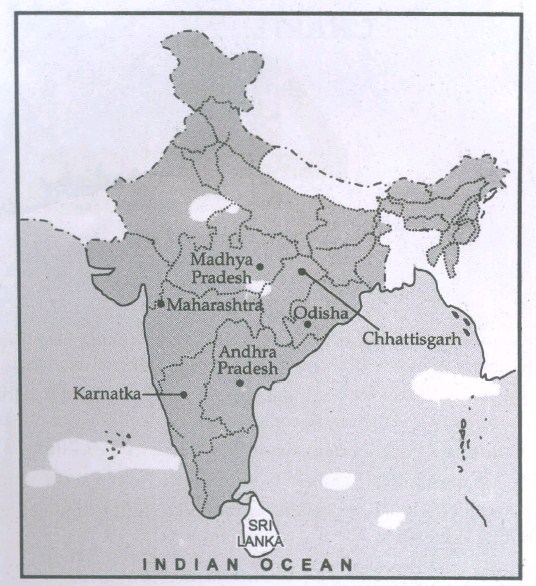
51.
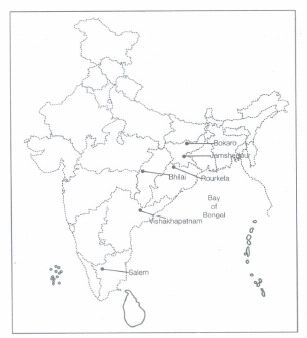
52.
(i) Slag heaps are large mounds of waste material left after smelting of iron.
(ii) Various factors led to the decline of iron smelting by the late 19th century :
(a) People were denied access to the forests by the colonial government under the new forest laws.
(b) In areas where the access was granted, the iron smelters had to pay high taxes to the forest department for every furnace they used.
(c) Import of iron and steel from Britain increased, which lowered the demand for the iron produced by local smelters.
53.
Some advantages of biogas are:
(i) It is very cheap to produce.
(ii) Biogas can be easily generated.
(iii) It can be produced by making use of bio-wastes.
(iv) It is largely used in rural areas.

8th Standard CBSE Syllabus & Materials
8th Standard CBSE
CBSE 8th Science Particulate Nature of Matter - New Model Questions Papers Study Material - QB365 Set A
NEW8th Standard CBSE
CBSE 8th Science Pressure, Winds, Stroms and Cyclones - New Model Questions Papers Study Material - QB365 Set A
NEW8th Standard CBSE
CBSE 8th Mathematics Quadrilaterals - New Model Questions Papers Study Material - QB365 Set A
NEW8th Standard CBSE
CBSE 8th Mathematics A story of Numbers - New Model Questions Papers Study Material - QB365 Set A



NCERT Books

Syllabus

Exam Pattern

Sample Question Papers

Previous year Question Papers

Important Notes

MCQ Practice test

NCERT Exemplers

Case study Questions

Image Based Questions

Passage based Questions

HOT Questions

Value Based Questions

Model Questions Papers
NCERT ( Book Back ) Questions

Assertion and Reason
Important Questions And Answers

CBSE 8th Standard CBSE Subjects
CBSE Standards


