
 100% FREE ACCESS
8th Standard CBSE Syllabus & Materials
8th Standard CBSE
CBSE 8th Social Science Theme D - Factors of Production - New Model Questions Papers Study Material - QB365 Set A
NEW8th Standard CBSE
CBSE 8th Social Science Theme C - Universal Franchise and India's Electoral System - New Model Questions Papers Study Material - QB365 Set A
NEW8th Standard CBSE
CBSE 8th Social Science Theme B - The Rise of the Marathas - New Model Questions Papers Study Material - QB365 Set A
NEW8th Standard CBSE
CBSE 8th Social Science Theme B - Reshaping India's Political Map - New Model Questions Papers Study Material - QB365 Set A
NEW8th Standard CBSE
CBSE 8th Social Science Theme A - Natural Resources and Their Use - New Model Questions Papers Study Material - QB365 Set A
NEW8th Standard CBSE
CBSE 8th Science Keeping Time with Skies - New Model Questions Papers Study Material - QB365 Set A

Published on: 12/09/2019
Being Prepared-A Vital Part of Disaster Management
Download CBSE Class 8th Standard CBSE Social Science question papers, sample papers, important questions, and previous year solved papers in PDF format. Get free study materials, NCERT solutions, and exam preparation resources for Class 8th Standard CBSE Social Science
Questions + Answers key
Take MCQ Social Science Test
1.
The raw material of textile industry is/are
cotton only
silk only
fibres
None of these
2.
These industries are owned and operated by the producers or suppliers or both
Private sector
Public sector
Joint sector
Co-operative sector
3.
The textile industry at Osaka imports raw cotton from:
Egypt
India and China
USA
All of these
4.
Maruti Udyog industry comes under
Private Sector
Public Sector
Joint Sector
Cooperative Sector
5.
Silicon valley is located in
Bangalore
California
Ahmedabad
6.
What do you understand by secondary activities?
7.
Explain the favourable factors for the location of steel plant at Jamshedpur.
8.
What are the inputs, processes and outputs of cotton textile industry?
9.
Distinguish between the following: Public sector and Joint sector industries
10.
Distinguish between the following: Agro-based and mineral based industry
11.
The process of smelting is done in a_____
12.
Basket weaving handicrafts and pottery are examples of _______ industry.
13.
The river Yodo provides sufficient water _______ textile industry.
14.
Co-operatives: _______ and _____
15.
Cottage industries: ______ and ____
16.
Report Factors/ Resources affecting the location of a proposed Iron and Steel Plant on Developen Dweep.
17.
"The iron and steel industry is the basic as well as heavy industry." Support the statement with suitable examples.
18.
With the help of an atlas, identify some iron and steel industries in India and mark their location on an outline map of India
19.
Name the important cities of information technology in India.
20.
Discuss the distribution of cotton textile industry in India.
21.
What does industrial system consists of?
22.
What are the two stages of making notebook from pulp?
23.
What do you understand by the word manufacturing?
1.
(c)
fibres
2.
(d)
Co-operative sector
3.
(d)
All of these
4.
(c)
Joint Sector
5.
(b)
California
6.
In the secondary activities or manufacturing there is change of raw materials into products of more value to people.
For example pulp changes into paper and paper into notebook. These represent the two stages of the manufacturing process.
7.
Iron and steel industry is located at Jamshedpur due to the following factors:
(i) Manganese is obtained from Keonjhar district of Odisha.
(ii) Well-developed network of transport is available.
(iii) Kolkata provides port facilities.
(iv) Cheap and skilled labour is available from the nearby states.
8.
Inputs, processes and outputs of a cotton textile industry are:
Inputs Cotton is the main raw material that is used in this industry. Other inputs needed are human labour, machinery, infrastructural facilities etc.
Process Process includes ginning or separating cotton from the seed, spinning, weaving, dyeing and printing.
Output The fabric that is manufactured by the factory is the output. For example shirts, sarees etc.
9.
| Public sector industries | Joint sector industries |
| 1.The industries which are owned and operated by State Government or Central Government are called public sector industries |
1.The industries which are owned and operated by government and an individual or a group of individuals are called joint sector industries. |
| 2.They involve huge capital investment | 2.Capital investments are generally less than the pubtic sector industries |
| 3.These industries are managed run by workforce appointed by government |
3.Both government servants and private employees run these industries |
| 4.For example Steel Authority of India Limited (SAIL), Hindustan Aeronautics Limited (HAL) etc |
4.For example Maruti Udyog Limited (MUL). |
10.
| Agro-based industries | Mineral based industries |
| 1.Agro-based industries use plant and animal based products as raw materials. |
1.Mineral based industries are those that use mineral ores as their raw materials. |
| 2.These industries provide employment in rural areas |
2.They provide employment to both rural and urban areas. |
| 3.Agro-based industries are mostly in private or co-operative sectors |
3.These industries are mostly in public sector because of their large investment requirement |
| 4.Examples of suchindustries are-jute, cotton-textile, dairyproducts, leather industries etc. |
4.Examples of such industries are iron and steel, capital goods industries etc |
11.
()
blast furnace
12.
()
Small-scale
13.
()
Osaka
14.
()
Amul butter ,Khadi industry
15.
()
Candle,mats
16.
1. Iron ore: This is a very large deposit of low grade iron ore. Long-distance transportation of the ore would be uneconomic.
2. Coal: The only coalfield contains rich deposits of high grade coal. Transportation of the coal is by railway, which is relatively cheap.
3. Limestone: This is widely available over the island, but the purest deposits are in the Chuna Mountains.
4. Water: Both the tributaries of River Neel carry sufficient water to supply large iron and steel plant in all seasons. The sea water because of its high salt content is unsuitable.
5. Market: It is expected that the chief market for the Plant's products will be the engineering works of Rajdhanipur. Transport costs for the products mainly small steel bars and light steel plates would be relatively low.
6. Labour supply: This will have to be recruited mainly from the unskilled workers in the 3 fishing villages of Hil, Rah, and Sing. It is expected that most workers will commute daily from their present homes.
7. Port facilities: These are at present minimal. There is a good, deep natural harbour at port Paschimpur developed to import metal alloys.
| Resource | Distance from X | Distance from Y | Weighting*1-10 | Distance X weight for site X | Distance X weight for siteY |
| Iron ore | 100 | 25 | 10 | 1000 | 250 |
| Coal | 200 | 275 | 10 | 2000 | 2750 |
| Limestone | 200 | 100 | 8 | 1600 | 800 |
| Water | 25 | 25 | 8 | 200 | 200 |
| Chief market | 300 | 375 | 8 | 2400 | 3000 |
| Labour supply | 50 | 25 | 9 | 450 | 225 |
| Total = | 7650 | 7225 |
The larger the pull, the higher the weighting.Looking at the above statistics, the steel plant should be located at site Y.
17.
The iron and steel is called basic industry because all other industries depend on it for their machinery.
Steel is needed to manufacture a variety of engineering goods, construction material, defense, medical, telephones, scientific equipment and variety of consumer goods.
Iron and steel is a heavy industry because all the raw materials and finished goods are heavy. They are bulky also. They are entailing heavy transportation costs.
Iron one and limestone are required in high quantity
18.
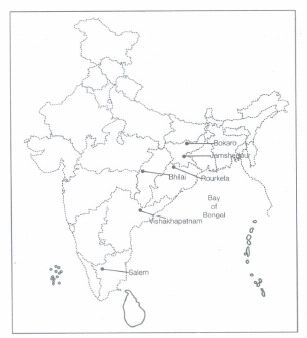
19.
()
Gurgaon, Pune, Thiruvananthapuram, Kochi and Chandigarh
20.
()
Cotton textile industry is mainly situated in Gujarat (Ahmedabad) and in Maharashtra (Mumbai).
21.
()
The industrial system consists of three things:
(i) inputs
(ii) processes
(iii) outputs
22.
()
Making paper-from pulp and then notebook from paper.
23.
()
Manufacturing is an activity which changes raw material into products of more value to people.

8th Standard CBSE Syllabus & Materials
8th Standard CBSE
CBSE 8th Science Particulate Nature of Matter - New Model Questions Papers Study Material - QB365 Set A
NEW8th Standard CBSE
CBSE 8th Science Pressure, Winds, Stroms and Cyclones - New Model Questions Papers Study Material - QB365 Set A
NEW8th Standard CBSE
CBSE 8th Mathematics Quadrilaterals - New Model Questions Papers Study Material - QB365 Set A
NEW8th Standard CBSE
CBSE 8th Mathematics A story of Numbers - New Model Questions Papers Study Material - QB365 Set A



CBSE 8th Standard CBSE Subjects
CBSE Standards




