
 100% FREE ACCESS
8th Standard CBSE Syllabus & Materials
8th Standard CBSE
CBSE 8th Social Science Theme D - Factors of Production - New Model Questions Papers Study Material - QB365 Set A
NEW8th Standard CBSE
CBSE 8th Social Science Theme C - Universal Franchise and India's Electoral System - New Model Questions Papers Study Material - QB365 Set A
NEW8th Standard CBSE
CBSE 8th Social Science Theme B - The Rise of the Marathas - New Model Questions Papers Study Material - QB365 Set A
NEW8th Standard CBSE
CBSE 8th Social Science Theme B - Reshaping India's Political Map - New Model Questions Papers Study Material - QB365 Set A
NEW8th Standard CBSE
CBSE 8th Social Science Theme A - Natural Resources and Their Use - New Model Questions Papers Study Material - QB365 Set A
NEW8th Standard CBSE
CBSE 8th Science Keeping Time with Skies - New Model Questions Papers Study Material - QB365 Set A

Published on: 26/11/2019
From Trade to Territory - Company Establishes Power
Download CBSE Class 8th Standard CBSE Social Science question papers, sample papers, important questions, and previous year solved papers in PDF format. Get free study materials, NCERT solutions, and exam preparation resources for Class 8th Standard CBSE Social Science
Questions + Answers key
Take MCQ Social Science Test
1.
What do you understand by the term ' Nabobs'?
2.
Explain Doctrine of Lapse
3.
The Nawab complains. In 1733 the Nawab of Bengal said this about the English traders: When they first came into the country they petitioned the then government in a humble manner for liberty to purchase a spot of ground to build a factory house upon, which was no sooner granted but they built a strong fort, surrounded it with a ditch which has communication with the river and mounted a great number of guns upon the walls. They have enticed several merchants and others to go and take protection under them and they collect a revenue which amounts to t 100,000. They rob and plunder and carry great number of the king's subjects of both sexes into slavery into their own country.
What was the initial intention of the English traders?
4.
Why were the British furious with Tipu Sultan?
5.
How did the assumption of Diwani benefit the East India Company?
6.
What led to battles between trading companies?
7.
Explain the Battle of Plassey describing its causes, events and consequences.
8.
Why did English develop a strong army?
9.
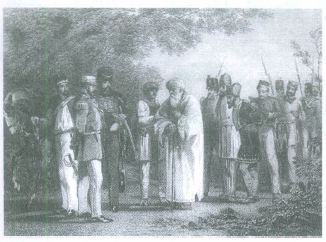
Who were being arrested and by whom?
10.
Where and when was the first English factory established?
On the banks of river Hugli in 1651
On the banks of river Ganga in 1650
On the banks of river Kaveri in 1657
On the banks of river Yamuna in 1600
11.
Two sons of Tipu Sultan were taken as hostages by Cornwallis after the
First Mysore War
Second Mysore War
Third Mysore War
Fourth Mysore War
12.
After Alivardi Khan________ became the Nawab of Bengal.
Murshid Quli Khan
Sirajuddaulah
Haidar Ali
Mir Qasim
13.
Tipu Sultan stopped trade through his kingdom in
1764
1785
1740
1786
14.
The Third Battle of Panipat was fought in the year
1743
1752
1767
1761
15.
Where was Dual system of Government introduced and when?
16.
What do you mean by the term Farman?
17.
Which new power was emerging on the political horizon by the second half of the 18th century?
18.
"Battle of Plassey is an important landmark in the history of India". Comment on this statement.
19.
Write any three causes of the Battle of Plassey.
1.
(i) The people who managed to return back with wealth and led flashy lives and flaunted their richness.
(ii) They were called "Nabobs" - an English version of the Indian word 'Nawab'.
(iii) They were often seen as upstarts and social climbers in British society and were ridiculed or made fun of in plays and cartoons.
2.
(i) The Doctrine of Lapse was introduced by Lord Dalhousie.
(ii) According to this, if the ruler of a protected or dependent state died without a natural heir, his state would automatically lapse.
(iii) The victims of this doctrine were Satara (1848), Jaitpur, Sambalpur (1850), Udaipur (1852), Nagpur (1853)and Jhansi (1854
3.
When the English traders first came to India, they were very polite. They petitioned the then government in a humble manner for permission to purchase land to build a factory house there.
4.
The British got furious with Tipu Sultan.
(i) Mysore controlled the profitable trade of the Malabar coast from where the Company purchased pepper and cardamom. In 1785, Tipu Sultan stopped the export of sandalwood, pepper, cardamom through the ports of his kingdom.
(ii) Tipu Sultan established a close relationship with the French in India and modernized his army with their help.
5.
In 1765, the Mughal emperor appointed the East India Company as the Diwan of Bengal. The Diwani allowed the Company to use the vast revenue resources of Bengal. This solved a major problem of the Company. From the early lSth century its trade with India had expanded. But it had to buy most of the goods in India with gold and silver imported from Britain. This was because at this time Britain had no goods to sell in India.
The outflow of gold from Britain slowed after the battle of Plassey and entirely stopped after the assumption ofDiwani. Now, revenues could be used to purchase cotton and silk textiles in India, maintain Company troops and meet the cost of building the Company fort and offices at Calcutta.
6.
(i) The problem was that all the companies were interested in buying the same things.
(ii) The fine qualities of cotton and silk produced in India had a big market in Europe. Pepper, cloves, cardamom and cinnamon too were in great demand.
(iii) Competition amongst the European companies inevitably pushed up the prices at which these goods could be purchased, and this reduced the profits that could be earned.
(iv) The only way the trading companies could flourish was by eliminating rival competitors.
(v) The urge to secure markets therefore led to fierce battles between the trading companies
7.
(i) Sirajuddaulah refused to grant concessions to the Company, demanded large tributes for the Company's right to trade, denied it any right to mint coins, and stopped it from extending its fortifications.
(ii) Accusing the Company of deceit, he claimed that the Company was depriving the Bengal government of huge amounts of revenue and undermining the authority of the Nawab.
(iii) The Company was refusing to pay taxes, writing disrespectful letters, and trying to humiliate the Nawab and his officials.
Events :
(i) After negotiations failed, the Nawab marched along with 30,000 soldiers to the English factory at Kasim bazar, captured the Company officials, locked the warehouse, disarmed all Englishmen, and blocked English ships.
(ii) Then he marched to Calcutta to establish control over the Company's fort. On hearing the news of the fall of Calcutta, Company officials in Madras sent forces under the command of Robert Clive, reinforced by naval fleets.
(iii) Prolonged negotiations with the Nawab followed. Finally, in 1757, Robert Clive led the Company's army against Sirajuddaulah at Plassey
(iv) One of the main reasons for the defeat of the Nawab was that the forces led by Mir Jafar, one of Sirajuddaulah's commanders, never fought the battle. Clive had managed to secure his support by promising to make him nawab after crushing Sirajuddaulah.
Consequences :
(i) The Battle of Plassey became famous because it was the first major war that the Company had won in India.
(ii) After the defeat at Plassey, Sirajuddaulah was assassinated and Mir Jafar was made the nawab. The Company was still unwilling to take over the responsibility of administration. Its prime objective was the expansion of trade.
8.
The English developed a strong army due to the following reasons :
(i)The army was needed to establish control upon the vast empire.
(ii) It was also required to suppress internal revolts against the British.
(iii) The army consisted of Indian soldiers who were known as sepoys.
(iv) The army was well disciplined, well trained and regularly paid.
9.
Bahadur Shah Zafar and his sons were being arrested by Captain Hodson.
10.
(a)
On the banks of river Hugli in 1651
11.
(c)
Third Mysore War
12.
(b)
Sirajuddaulah
13.
(b)
1785
14.
(d)
1761
15.
()
Dual system of Government was introduced in Bengal in 1770 and it ended in 1772
16.
()
A Farman is a royal edict or a royal order granting some permission. The Mughal emperor Aurangzeb issued a Farman granting the company the right to trade duty free.
17.
()
The British East India Company emerged as a new political power
18.
Battle of Plassey, fought in 1757, is an important landmark in the history of India because:
(i) It marked the beginning of the establishment of British rule in India.
(ii) The British got a foothold from where they were to eventually conquer the whole of India.
19.
Causes responsible for the battle of Plassey are given below:
(i) In 1756A.D., the Nawab seized the English Factory at Kasim Bazar and occupied Fort William, but Clive recaptured it in 1756A.D.
(ii) Mir afar wanted to dethrone the nawab and entered into a conspiracy against the nawab joining hands with the Britishers.
(iii) Clive blamed the nawab that he was conspiring against English with the help of French.

8th Standard CBSE Syllabus & Materials
8th Standard CBSE
CBSE 8th Science Particulate Nature of Matter - New Model Questions Papers Study Material - QB365 Set A
NEW8th Standard CBSE
CBSE 8th Science Pressure, Winds, Stroms and Cyclones - New Model Questions Papers Study Material - QB365 Set A
NEW8th Standard CBSE
CBSE 8th Mathematics Quadrilaterals - New Model Questions Papers Study Material - QB365 Set A
NEW8th Standard CBSE
CBSE 8th Mathematics A story of Numbers - New Model Questions Papers Study Material - QB365 Set A



CBSE 8th Standard CBSE Subjects
CBSE Standards




