
 100% FREE ACCESS
8th Standard CBSE Syllabus & Materials
8th Standard CBSE
CBSE 8th Social Science Theme D - Factors of Production - New Model Questions Papers Study Material - QB365 Set A
NEW8th Standard CBSE
CBSE 8th Social Science Theme C - Universal Franchise and India's Electoral System - New Model Questions Papers Study Material - QB365 Set A
NEW8th Standard CBSE
CBSE 8th Social Science Theme B - The Rise of the Marathas - New Model Questions Papers Study Material - QB365 Set A
NEW8th Standard CBSE
CBSE 8th Social Science Theme B - Reshaping India's Political Map - New Model Questions Papers Study Material - QB365 Set A
NEW8th Standard CBSE
CBSE 8th Social Science Theme A - Natural Resources and Their Use - New Model Questions Papers Study Material - QB365 Set A
NEW8th Standard CBSE
CBSE 8th Science Keeping Time with Skies - New Model Questions Papers Study Material - QB365 Set A

Published on: 10/09/2019
Industries
Download CBSE Class 8th Standard CBSE Social Science question papers, sample papers, important questions, and previous year solved papers in PDF format. Get free study materials, NCERT solutions, and exam preparation resources for Class 8th Standard CBSE Social Science
Questions + Answers key
Take MCQ Social Science Test
1.
List the major industries of the world and where they are located?
2.
Explain the favourable factors for the location of steel plant at Jamshedpur.
3.
What are the similarities between information technology industry in Bangalore and California?
4.
Which industry is often referred to as the backbone of the modern industry and why?
5.
What is meant by the term 'industry'?
6.
The raw material of textile industry is/are
cotton only
silk only
fibres
None of these
7.
Industrial disaster occurred in Bhopal on
3rd December, 1974
3rd December, 1980
3rd December, 1983
3rd December, 1984
8.
Maruti Udyog industry comes under
Private Sector
Public Sector
Joint Sector
Cooperative Sector
9.
The first successful modern textile mill was established in
Mumbai
Kolkata
Chennai
Delhi
10.
Silicon valley is located in
Bangalore
California
Ahmedabad
11.
Basket weaving handicrafts and pottery are examples of _______ industry.
12.
Industries can be classified on the basis of raw materials, size and ________
13.
The river Yodo provides sufficient water _______ textile industry.
14.
Agro-based industries:______ and _____
15.
Tertiary activities:_____ and _______
16.
What are the factors that helped Ahmedabad to become a textile centre?
17.
"The iron and steel industry is the basic as well as heavy industry." Support the statement with suitable examples.
18.
On an outline map of the world, mark the places which provide raw material to cotton textile industry of Osaka
19.
Where and when was the first textile mill established in the country?
20.
Which public sector steel plant of India is located near a port?
21.
Which technique of cotton textile production came into use after the 18th century?
22.
Name the natural fibres?
23.
Apart from Maharashtra and Gujarat, write the other regions of cotton textile centres of India?
1.
The world's major industries are the iron and steel industry, the textile industry and the information technology industry.
1. Locations of iron and steel industry are:
Germany, USA, China
2. Locations of textile industry are
India, Hong Kong, South Korea, Japan
3. Locations of information technology industry are
Silicon Valley of Central California, Bangalore region of India.
2.
Iron and steel industry is located at Jamshedpur due to the following factors:
(i) Manganese is obtained from Keonjhar district of Odisha.
(ii) Well-developed network of transport is available.
(iii) Kolkata provides port facilities.
(iv) Cheap and skilled labour is available from the nearby states.
3.
Similarities between information technology industry in Bangalore and California can be drawn as follows
1.Bangalore is located in Deccan.Plateau while Silicon Valley in California is located next to the Rocky mountains.
2.Both have clean environment.
3.Pleasant climate throughout the year.
4. In the vicinity of educational, scientific and technological centres.
5. Close to major roads and airports.
6.Good access to markets.
7. Both have skilled workforce.
8. Low or affordable cost of living.
4.
1. Iron and steel industry is often referred to as the backbone of the modern industry. This is because almost everything is either made from iron or steel or has been made using tools and machineries of these metals.
2. There are plenty of examples like ships, trains, vehicles; all are made largely of steel. Materials of our day-to-day use starting from safety pin to our building in which we live, are made from steel. Without the use of iron, no industry can run.
5.
Industry means an economic activity that is related to production of goods, extraction of minerals and the provision of services. Examples for the above are - iron and steel industry, coal mining industry and tourism industry, respectively.
6.
(c)
fibres
7.
(d)
3rd December, 1984
8.
(c)
Joint Sector
9.
(a)
Mumbai
10.
(b)
California
11.
()
Small-scale
12.
()
Ownership
13.
()
Osaka
14.
()
Cotton textile,sugar mills
15.
()
Banking, trnsport
16.
Factors that helped the city to become a textile centre are:
i) Ahmedabad is situated in the heart of a cotton growing area, hence the major raw material is easily available.
ii) The humid climate is ideal for spinning and weaving.
iii) The flat terrain and easy availability of land is suitable for the establishment of the mills.
iv) The densely populated states of Gujarat and Maharashtra provide both skilled and semi-skilled labour.
v) The Mumbai port which is situated nearby facilitates import of machinery and export of cotton textiles.
17.
The iron and steel is called basic industry because all other industries depend on it for their machinery.
Steel is needed to manufacture a variety of engineering goods, construction material, defense, medical, telephones, scientific equipment and variety of consumer goods.
Iron and steel is a heavy industry because all the raw materials and finished goods are heavy. They are bulky also. They are entailing heavy transportation costs.
Iron one and limestone are required in high quantity
18.
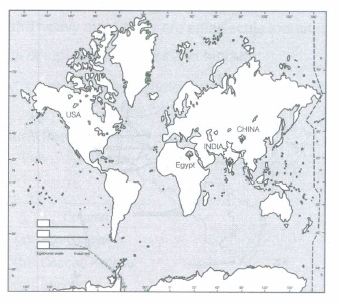
19.
()
The first textile mill in the country was established at Fort Gloster near Kolkata in 1818.
20.
()
Vishakhapatnam steel plant of India is located near a port.
21.
()
Powerlooms technique of cotton textile production came into use after the 18th century.
22.
()
Natural fibres are obtained from wool, silk, cotton and jute.
23.
()
Kanpur, Kolkata, Nagpur, Sholapur, Delhi, Coimbatore etc.

8th Standard CBSE Syllabus & Materials
8th Standard CBSE
CBSE 8th Science Particulate Nature of Matter - New Model Questions Papers Study Material - QB365 Set A
NEW8th Standard CBSE
CBSE 8th Science Pressure, Winds, Stroms and Cyclones - New Model Questions Papers Study Material - QB365 Set A
NEW8th Standard CBSE
CBSE 8th Mathematics Quadrilaterals - New Model Questions Papers Study Material - QB365 Set A
NEW8th Standard CBSE
CBSE 8th Mathematics A story of Numbers - New Model Questions Papers Study Material - QB365 Set A



CBSE 8th Standard CBSE Subjects
CBSE Standards




