
 100% FREE ACCESS
8th Standard CBSE Syllabus & Materials
8th Standard CBSE
CBSE 8th Social Science Theme D - Factors of Production - New Model Questions Papers Study Material - QB365 Set A
NEW8th Standard CBSE
CBSE 8th Social Science Theme C - Universal Franchise and India's Electoral System - New Model Questions Papers Study Material - QB365 Set A
NEW8th Standard CBSE
CBSE 8th Social Science Theme B - The Rise of the Marathas - New Model Questions Papers Study Material - QB365 Set A
NEW8th Standard CBSE
CBSE 8th Social Science Theme B - Reshaping India's Political Map - New Model Questions Papers Study Material - QB365 Set A
NEW8th Standard CBSE
CBSE 8th Social Science Theme A - Natural Resources and Their Use - New Model Questions Papers Study Material - QB365 Set A
NEW8th Standard CBSE
CBSE 8th Science Keeping Time with Skies - New Model Questions Papers Study Material - QB365 Set A

Published on: 12/10/2019
Land, Soil, Water, Natural Vegetation and Wildlife Resource
Download CBSE Class 8th Standard CBSE Social Science question papers, sample papers, important questions, and previous year solved papers in PDF format. Get free study materials, NCERT solutions, and exam preparation resources for Class 8th Standard CBSE Social Science
Questions + Answers key
Take MCQ Social Science Test
1.
How can we stop soil degradation?
2.
What are the main factors responsible for soil degradation ?
3.
What are the main factors that influence the formation of the soil ?
4.
Explain briefly the various factors responsible for soil formation.
5.
In India soils could be alluvial, black, red, laterite desertic and mountain soil. Collect a handful of different types of soil and observe. How these soils are different?
6.
Activity Discuss some more reasons which are responsible for changes of land use pattern. Has your place undergone any change in the land use pattern in recent years?
Find out from your parents and elderly people. You can conduct an interview by asking the following questions.
| Place | When your grand parents were in their 30s |
When your parents were in their 30s |
Why do you think this is happening? |
Are common areas and open spaces disappearing |
| Rural | - | - | - | - |
| Number of cattle and poultry owned | - | - | - | - |
| Number of trees and ponds in the village | - | - | - | - |
| Main occupation of the head of the family | - | - | - | - |
| Urban | ||||
| Number of cars owned | - | - | - | - |
| Number of rooms in the house | - | - | - | - |
| Number of metalled roads | - | - | - | - |
| Number of flyovers in the city | - | - | - | - |
| Number of parks and playgrounds | - | - | - | - |
Based on the table you have just completed, draw a picture of land use patterns that you foresee in your neighbourhood after 20 years. Why do you think that land use patterns change over the years?
7.
Read the given articles carefully.
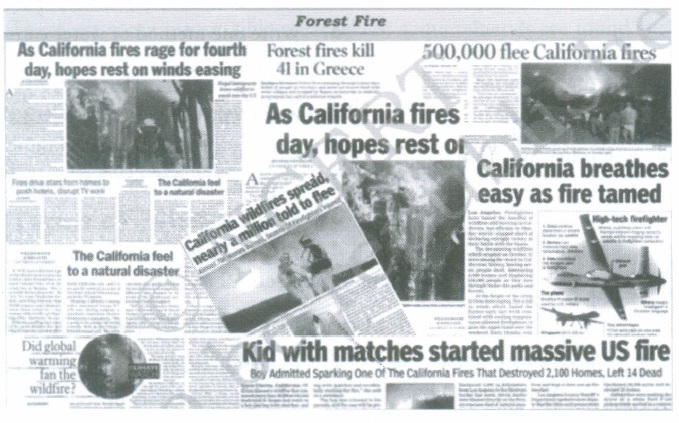
(i) Read the news item and find out how fire started in California? Could it be avoided?
(ii) Write some measures to avoid this kind of hazard.
8.
Differentiate between the CITES and vegetation.
9.
Define the following:
(i) Common property resource
(ii) Biosphere
(iii) Ecosystem
10.
What is rainwater harvesting? Give some advantages of rainwater harvesting.
1.
We can stop soil degradation by following the under-mentioned techniques:
(i) Mulching: It involves the covering of bare ground between the plants with organic matter to retain moisture in the soil.
(ii) Contour Barriers: We can stop soil degradation by building barriers along contours to collect water.
(iii) Rock Dam: It means the piling up of the rocks to prevent gullies and soil loss.
(iv) Terrace Farming: This type of farming must be done on the steep slopes to reduce surface run off and soil erosion.
(v) Intercropping : It means to grow different crops in alternate rows to protect soil from rain-wash.
(vi) Contour Ploughing : It refers to performing ploughing parallel to the contours to form natural barriers to check the soil erosion.
(vii) Shelter Belts: They are mainly done in the coastal and dry regions to check the wind movement in order to prevent soil erosion.
2.
The main factors responsible for soil degradation are:
(i) Landslides: It involves large-scale displacement of soil and rocks from the hilly areas, leading to soil degradation in mountainous regions.
(ii) Rain wash: It includes washing up of the topsoil in the areas of high precipitation.
(iii)Floods : Floods are another most important cause responsible for the soil degradation in terms of quantity as well as quality.
(iv) Deforestation : Large-scale forest destruction by man to fulfill their own needs is one of the major causes responsible for soil destruction.
(v) Overgrazing : It reduces the usefulness of the land and is one of the causes of desertification and erosion.
(vi) Overuse of chemicals : Excessive use of fertilizers and pesticides to increase the agricultural production is one of the major causes for soil pollution.
(vii) Urbanization : Large-scale urbanization is the major cause for the destruction of fertile soil due to encroachment of the fertile areas.
3.
Various factors that are responsible for the formation of soil are as follows:
(i) Parent rock: It determines the colour and texture of the soil. It also provides the base material for soil and determines the chemical and physical properties. It also determines the mineral content and permeability of the soil.
(ii) Climate: It plays a role in disintegrating hard rock into soil particles with the help of weathering. The soil forming processes take place more rapidly during high temperature and heavy rainfall.
(iii) Topography : Altitude and slope of a place determines the accumulation of soil.
(iv)Time: It determines the thickness of the soil profile.
(v) Organic Material: Flora, fauna and microorganisms help in decaying small rock particles into soil and affect the rate of humus formation.
4.
Various factors that are responsible for the formation of soil are as follows:
(i) Parent rock: It determines the colour and texture of the soil. It also provides the base material for soil and determines the chemical and physical properties. It also determines the mineral content and permeability of the soil.
(ii) Climate: It plays a role in disintegrating hard rock into soil particles with the help of weathering. The soil forming processes take place more rapidly during high temperature and heavy rainfall.
(iii) Topography : Altitude and slope of a place determines the accumulation of soil.
(iv)Time: It determines the thickness of the soil profile.
(v) Organic Material: Flora, fauna and microorganisms help in decaying small rock particles into soil and affect the rate of humus formation.
5.
(i) Alluvial soil: It is formed with the silt brought by rivers during the course of their long journey. It contains adequate potash, lime and phosphoric acid. It is generally deficient in organic and nitrogenous content. Main crops : Rice, wheat, cotton, oilseeds and Sugarcane.
(ii) Black soil: It is formed by weathering of volcanic (basalt) rock formed by the Deccan lava. It is rich in lime, Iron, Potash, Magnesium, Alumina, Calcium, but lacks in nitrogen and humus. Main crops : Cotton, tobacco, oilseeds and sugarcane.
(iii) Red soil : It is formed with decomposition of metamorphic rocks. It is rich in iron but lacks in phosphorus, nitrogen, humus and lime. Main crops : Wheat, rice, cotton, pulses and sugarcane.
(iv) Laterite soil: It is formed by intense leaching due to heavy rains and is rich in iron, but is generally deficient in potassium, lime, silica phosphoric acid and nitrogen. Main crops: Coffee, Rubber and Cashew.
(v) Desert soil: It is formed by mechanical weathering of rocks from sands. High proportion of salt is there in the soil, but it is deficient in organic matter. Main corps : Wheat, bajra, melon and grams (through irrigation).
(vi) Mountain soil : It is formed mainly due to the deposition of organic matter, provided by the forests. This soil is rich in humus, but poor in potash, phosphorus and lime. It is heterogeneous in nature. Heavy doses of fertilisers have to be applied for high yields of crops. Main crops: Tea, coffee, spices and tropical fruits in Karnataka.
6.
| Place | When your grand parents were in their 30s |
When your parents were in their 30s |
Why do you think this is happening? |
Are common areas and open spaces disappearing |
| Rural | ||||
| Number of cattle and poultry owned | Cattle:02 per family | -01 | Because of shifting to other jobs from agriculture. |
Yes |
| Number of trees and ponds in the village | Trees: 150 Ponds:12 |
10 01 |
Because of ever increasing population | Yes |
| Main occupation of the head of the family | Agriculture | Small shop | Due to unproductive land and its small size | NIL |
| Urban | ||||
| Number of cars owned | NIL | 01 car per household | Due to increase in income. | NIL |
| Number of rooms in the house | 4 | 2 | Due to division among members. | Yes |
| Number of metalled roads | 1 | 4 | Due to increase in transport facilities | Yes |
| Number of flyovers in the city | NIL | 4 | Due to congestion on the road. | Yes |
| Number of parks and playgrounds | 2 and 4 | 2 and 2 | Due to growth of population. | - |
Land use patterns change over years due to:
(i) Increase in population leading to increase in demand for land for agriculture, transport, housing complexes, industries and so on.
(ii) Change in occupation from primary to tertiary, quaternary activities.
7.
(i) The main cause of California fire was human fault. A child burnt a match stick and threw it carelessly.
(ii) It could have been avoided if the match was kept in safe custody of the family.
8.
Differences between the CITES and vegetation are:
Vegetation The vegetation in the world are grouped as forests, grasslands scrubs and tundra. In areas of heavy rain, huge trees can be found. Forests are abundant in areas of heavy rainfall. With moisture and rainfall the density of forests declines.
CITES (The Convention on International Trade in Endangered Species of Wild Fauna and Flora) It is an international agreement between governments.
It aims to ensure that international trade in specimens of wild animals and plants does not threaten their survival.
Roughly 5,000 species of animals and 28,000 species of plants are protected. Bears, dolphins, cacti, corals, orchids and aloes are some examples.
9.
(i) Common property resource Community land is owned by the community for common uses like collection of fodder, fruits, nuts or medicinal herbs. These community lands are also called common property resources.
(ii) Biosphere Natural vegetation and wildlife exist only in the narrow zone of contact between the lithosphere, hydrosphere and atmosphere that we call biosphere.
(iii) Ecosystem In the biosphere, living beings are interrelated and inter-dependent on each other for survival. This life supporting system is known as the ecosystem.
10.
Rainwater harvesting is the accumulation and storage of rainwater for reuse before it reaches the aquifers under the ground. Uses include water for the garden, water for livestock water for irrigation.
The advantages of rainwater harvesting are as follows:
(i) It reduces the consumption of groundwater.
(ii) It is free from pollutants as well as salts, minerals and other natural and man-made contaminants.
(iii) It is considered as the purest form of natural water.
(iv) The stored water is a reliable source of water when other sources dry up.

8th Standard CBSE Syllabus & Materials
8th Standard CBSE
CBSE 8th Science Particulate Nature of Matter - New Model Questions Papers Study Material - QB365 Set A
NEW8th Standard CBSE
CBSE 8th Science Pressure, Winds, Stroms and Cyclones - New Model Questions Papers Study Material - QB365 Set A
NEW8th Standard CBSE
CBSE 8th Mathematics Quadrilaterals - New Model Questions Papers Study Material - QB365 Set A
NEW8th Standard CBSE
CBSE 8th Mathematics A story of Numbers - New Model Questions Papers Study Material - QB365 Set A



CBSE 8th Standard CBSE Subjects
CBSE Standards




