
 100% FREE ACCESS
8th Standard CBSE Syllabus & Materials
8th Standard CBSE
CBSE 8th Social Science Theme D - Factors of Production - New Model Questions Papers Study Material - QB365 Set A
NEW8th Standard CBSE
CBSE 8th Social Science Theme C - Universal Franchise and India's Electoral System - New Model Questions Papers Study Material - QB365 Set A
NEW8th Standard CBSE
CBSE 8th Social Science Theme B - The Rise of the Marathas - New Model Questions Papers Study Material - QB365 Set A
NEW8th Standard CBSE
CBSE 8th Social Science Theme B - Reshaping India's Political Map - New Model Questions Papers Study Material - QB365 Set A
NEW8th Standard CBSE
CBSE 8th Social Science Theme A - Natural Resources and Their Use - New Model Questions Papers Study Material - QB365 Set A
NEW8th Standard CBSE
CBSE 8th Science Keeping Time with Skies - New Model Questions Papers Study Material - QB365 Set A

Published on: 10/09/2019
The Indian Constitution
Download CBSE Class 8th Standard CBSE Social Science question papers, sample papers, important questions, and previous year solved papers in PDF format. Get free study materials, NCERT solutions, and exam preparation resources for Class 8th Standard CBSE Social Science
Questions + Answers key
Take MCQ Social Science Test
1.
Why are the Fundamental Rights called so?
2.
What role does Constitution play in a democracy?
3.
Why does a democratic country need a Constitution?
4.
Which Fundamental Rights will the following situations violate?
If a politician in one state decides to not allow labourers from other states to work in his state.
5.
Why was Shabnam happy that she had not watched TV? What would you have done in a similar situation?
6.
All minorities, religious or linguistic, can set up their own educational institutions in order to preserve and develop their own culture. Which part of the Constitution says this?
Fundamental Rights
Directive Principles of State Policy
Fundamental Duties
Preamble
7.
Right to Freedom includes
right to make children under 14 years of age work.
right to discriminate between the upper caste and lower caste.
right to freedom of speech and expression.
None of the above
8.
Who among the following was/were members of the Constituent Assembly?
Jawaharlal Nehru
AK Ayyar
Sardar Vallabhbhai Patel
All of the above
9.
According to the Fundamental Rights mentioned in the Indian Constitution, which of the following is prohibited?
Human trafficking
Forced labour
Children under 14 years of age working in hazardous occupations
All of the above
10.
The political system in Nepal till 2006 was
democracy
dictatorship
Panchayati Raj
monarchy
11.
What are the Fundamental Rights given by the Constitution of India? Explain briefly.
12.
Why do we need a Constitution?
13.
Muslims in India are counted as ________________.
14.
Buddhists in India are counted as ______________.
15.
Elections are held every ____________ years.
16.
A secular state has no ______________ of its own.
17.
The Indian Constitution guarantees __________ for all citizens.
18.
When was the Constitution for independent India drafted?
19.
When did the demand for a Constituent Assembly gain momentum?
20.
Who was the first Prime Minister of free India?
21.
What are the three-tiers of government in India?
22.
Who is known as the father of the Indian Constitution?
23.
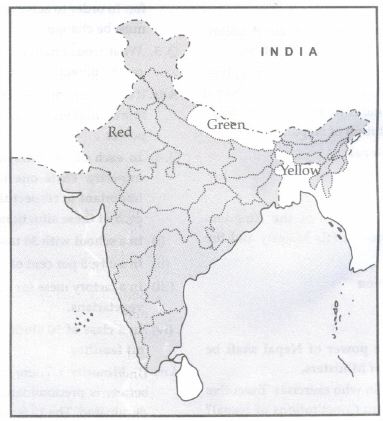
Colour the following countries in this map:
(a) Colour India in red.
(b) Colour Nepal in green.
(c) Colour Bangladesh in yellow.
1.
The rights guaranteed by the Indian Constitution are known as Fundamental Rights because they have been included in the fundamental law of the land. Whenever the rights are violated, the Supreme court and the High Courts have the power to grant remedies. All citizens can claim these rights for securing their welfare and enriching their personality.
2.
In a democracy, ultimate power rests with the people who belong to diverse groups and communities. The Constitution of a democratic country lays down the rules that guard against misuse of power, guarantee right to equality and also make sure that the majority group does not use its power against the minority.
3.
A democratic country needs a Constitution because:
(i) It is a written record of rules that guard against the misuse of power by political representations of the people.
(ii) It guarantees equality to all persons and no citizen can be discriminated on the basis of caste, creed, sex, religion etc.
(iii) It prevents the domination of one majority group over the less powerful minority groups.
(iv) It states the ideals that the people of the country, coming from different communities, have agreed upon and chosen to uphold.
4.
Right to Freedom would be violated. This includes the right to freedom of speech and expression, the right to form associations, the right to move freely and reside in any part of the country and the right to practise any profession, occupation or business.
5.
Shabnam was happy that she had not watched TV because she had used that time to revise her chapters for the test. Because of this, she could do well in the exams. I would also have done what Shabnam did in a similar situation.
6.
(a)
Fundamental Rights
7.
(c)
right to freedom of speech and expression.
8.
(d)
All of the above
9.
(d)
All of the above
10.
(d)
monarchy
11.
The six fundamental rights given by the Indian Constitution are:
(i) Right to Equality All persons are equal before the law and there shall be no discrimination on the basis of religion, caste or sex etc.
(ii) Right to Freedom This includes the right to freedom of speech and expression, the right to form associations, the right to move freely and reside in any part of the country and the right to practise any profession, occupation or business.
(iii) Right against Exploitation Human trafficking, forced labour and children under 14 years of age working in hazardous occupations are prohibited.
(iv) Right to Freedom of Religion All citizens have the right to practise, profess and propagate the religion of their choice.
(v) Cultural and Educational Rights All minorities, religious or linguistic. are free to set up their own educational institutions in order to preserve and develop their culture.
(vi) Right to Constitutional Remedies A citizen can move court if he/she believes that any Fundamental Right has been violated by the state.
12.
The Constitution plays an important role in a state. It is all the more crucial in democratic societies.
Following are some of the reasons why we need a Constitution
(i) First, the Constitution states the ideals that form the basis of the kind of country its people aspire to live in. It gives a set of rules and principles that all persons residing in a country can agree upon and also shape the way in which they want their country to be governed.
(ii) Second, it determines the nature of a country's political system. It gives the guidelines that govern decision-making in the country.
(iii) Third, a Constitution is needed to protect us from ourselves. It guards against taking any decision in haste or whim that might affect the larger interest.
13.
()
minority
14.
()
minority
15.
()
five
16.
()
religion
17.
()
Fundamental Rights
18.
()
The Constitution for independent India was drafted between December 1946 and 1949.
19.
()
The demand for a Constituent Assembly gained momentum during the World War II.
20.
()
The first Prime Minister of free India was Pt Jawaharlal Nehru.
21.
()
The three tiers of government in India are the Central Government, State Government and Panchayati Raj at the village.
22.
()
Dr BR Ambedkar is known as the father of the Indian Constitution.
23.

8th Standard CBSE Syllabus & Materials
8th Standard CBSE
CBSE 8th Science Particulate Nature of Matter - New Model Questions Papers Study Material - QB365 Set A
NEW8th Standard CBSE
CBSE 8th Science Pressure, Winds, Stroms and Cyclones - New Model Questions Papers Study Material - QB365 Set A
NEW8th Standard CBSE
CBSE 8th Mathematics Quadrilaterals - New Model Questions Papers Study Material - QB365 Set A
NEW8th Standard CBSE
CBSE 8th Mathematics A story of Numbers - New Model Questions Papers Study Material - QB365 Set A



CBSE 8th Standard CBSE Subjects
CBSE Standards




