
 100% FREE ACCESS
8th Standard CBSE Syllabus & Materials
8th Standard CBSE
CBSE 8th Social Science Theme D - Factors of Production - New Model Questions Papers Study Material - QB365 Set A
NEW8th Standard CBSE
CBSE 8th Social Science Theme C - Universal Franchise and India's Electoral System - New Model Questions Papers Study Material - QB365 Set A
NEW8th Standard CBSE
CBSE 8th Social Science Theme B - The Rise of the Marathas - New Model Questions Papers Study Material - QB365 Set A
NEW8th Standard CBSE
CBSE 8th Social Science Theme B - Reshaping India's Political Map - New Model Questions Papers Study Material - QB365 Set A
NEW8th Standard CBSE
CBSE 8th Social Science Theme A - Natural Resources and Their Use - New Model Questions Papers Study Material - QB365 Set A
NEW8th Standard CBSE
CBSE 8th Science Keeping Time with Skies - New Model Questions Papers Study Material - QB365 Set A

Published on: 10/09/2019
Understanding Secularism
Download CBSE Class 8th Standard CBSE Social Science question papers, sample papers, important questions, and previous year solved papers in PDF format. Get free study materials, NCERT solutions, and exam preparation resources for Class 8th Standard CBSE Social Science
Questions + Answers key
Take MCQ Social Science Test
1.
Suggest some ways in which you can work to promote Secularism in your country.
2.
How are people of different religions viewed in your society?
3.
In what way does Indian Secularism differ from others?
4.
Will the government intervene if some religious group says that their religion allows them to practise infanticide? Give reasons for your answer.
5.
List the different types of religious practice that you find in your neighbourhood. This could be different forms of prayer, worship of different gods, sacred sites, different kinds of religious music and singing etc. Does this indicate freedom of religious practice?
6.
Untouchability is an ancient practice of
Hinduism
Islam
Christianity
None of the these
7.
The government does not force Sikhs to wear helmet while driving two-wheelers because:
people of Sikh religion enjoy some privileges because they are superior.
Sikhs are powerful, so they 'do not need helmets.
Sikhs do not obey rules
Sikhs wear turban (pagri) which is an important part of their, religion
8.
Which of the following is correct with reference to Saudi Arabia?
It is a secular country.
All religions are treated equally
Non-muslims are free to practise their religion the way they want.
Non-muslims cannot gather in public spaces for prayer.
9.
Secularism means
separation of religion from State power
separation of one community from another
separation of politics from religion
mixing of religion with politics.
10.
What happened in Germany during Hitler's rule?
Bombing of Nagasaki
End of World War II
Assassination of Mahatma Gandhi
Killing of Jews
11.
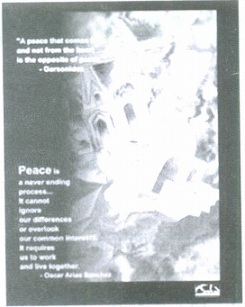
This poster alongside highlights the need for ‘Peace’. It says, “Peace is a never-ending process....It cannot ignore our differences or overlook our common interests.” Write in your own words what you think the above sentences are trying to convey? How does it relate to the need for religious tolerance?
12.
What is the nature of the State in Israel and Saudi Arabia? How is it different from India?
13.
Discuss the nature of Indian Secularism.
14.
Why is it necessary to separate religion from the State?
15.
The Fundamental Rights guaranteed by the Indian Constitution are based on secular principles.
16.
The police stations in India are supposed to display and profess the religion of the police superintendent.
17.
The Indian Constitution does not allow religious communities to set-up their own schools and colleges.
18.
In Indian Secularism, the State is not strictly separate from religion.
19.
Private schools cannot promote anyone religion through their morning prayers or religious celebrations.
20.
Name two festivals in India that are celebrated by both Hindus and Sikhs
21.
When did France pass a law banning students from wearing any conspicuous religious or political signs or symbol?
22.
Give examples of one secular State and one non-secular State.
23.
Name three former French colonies.
24.
What is freedom to interpret?
1.
As a citizen of my country, I also can work towards promoting the ideal of Secularism in the following ways:
(i) Respecting the faith of people following a religion different from mine.
(ii) Not offending the things held sacred by the followers of a certain religion.
(iii) Helping people of a religion different from mine celebrate their festivals by giving them holiday from work/school etc.
2.
In our society, people belonging to different religions live together in harmony. We not only celebrate the festivals of our religion but participate wholeheartedly in the religious festivals of other religions too.
In happy occasions as well as difficult times, the whole society comes together. We have unity in diversity.
3.
There is one significant way in which Indian Secularism differs from others. Unlike the strict separation between religion and the State in other countries like United State of America in the Indian type of Secularism, the State can intervene in religious affairs.
The Indian Constitution permits the State to intervene in religious matters like the practice of untouchability and inheritance laws to establish the Fundamental Right of equality.
4.
The government will intervene if some religious group says that their religion allows them to practise infanticide. It is a crime to practise infanticide and the government will not allow it even if some religion endorses it. The Constitution provides Right to Freedom in addition to the Right to Freedom of Religion. The infant's right to life will be violated if infanticide is practised. Therefore the government will not allow it.
5.
Following is a list of the different types of religious practices followed in my neighbourhood:
Religious Practice Religion
(i) Jagran/SatsanglKirtan/Yajna - Hinduism (singing of religious songs, chanting of hymns)
(ii) Ajan/Namaj (call to the faithful for prayers) - Islam
(iii) Holy Mass/Carols (singing - Christian religious songs in honour of Christ)
It does indicate that different religious communities do enjoy the freedom of religious practice.
6.
(a)
Hinduism
7.
(d)
Sikhs wear turban (pagri) which is an important part of their, religion
8.
(a)
It is a secular country.
9.
(a)
separation of religion from State power
10.
(d)
Killing of Jews
11.
Peace is a long-cherished goal of all citizens. It is a basic human need as it helps maintain harmony, security and lets people live with dignity.
But peace does not come on its own. We have to work towards upholding peace by being tolerant of each other, respecting our differences and focus on achieving the larger common interest. It is a never-ending process. Being tolerant should become a part of our nature. Only then can we truly achieve unity in diversity.
12.
The countries of Israel and Saudi Arabia have a non-secular type of State. The States of Israel and Saudi Arabia profess and promote the Jewish and Islamic religion respectively in their programmes and policies.
Israel and Saudi Arabia are completely different from India in the sense that India is a secular State where all religions are treated equally. Unlike India, the position of religious minorities is very bad in Israel and Saudi Arabia. Minorities are not free to follow their religion freely nor can they assemble in public spaces for prayer, religious gatherings etc. In Saudi Arabia, the followers of other religions cannot set-up their places of worship. The people of minority religions live in constant fear and are even killed and persecuted as is the case in Israel.
13.
The nature of Secularism in India is unique in the sense that the State follows the policy of distancing as well as intervention in matters of religion.
(i) Distancing The Indian State distances itself from all religions. It gives equal respect to all religions yet does not officially promote any one particular religion on its own. This is to maintain neutrality.
(ii) Intervention Though the Indian State follows the policy of keeping away from religious matters, it may intervene in exceptional cases. This happens when the State feels that some citizen's/citizens' Fundamental Rights have been violated by religion.
14.
Fora country to function democratically, it is important to separate religion from the State.Because
(i) Almost all countries of the world have more than one religious group and within these, there is at least one religious group in majority. If a majority religious group has access to State power, it could use this power and financial resources to discriminate against other religious groups.
This could result in tyranny of the majority.
Separation of religion from the State will make invalid any such excess.
(ii) It is important to protect the freedom of individuals to embrace or exit from any religion and interpret its thoughts and beliefs differently.
15.
(a)
16.
(b)
17.
(b)
18.
(a)
19.
(b)
20.
()
Lohri and Deepawali are celebrated by both Hindus and Sikhs.
21.
()
In February 2004, France passed a law banning student from wearing any conspicuous religious or political signs or symbols.
22.
()
India is an example of a secular State and Israel is an example of a non-secular State.
23.
()
The former French colonies are Algeria, Tunisia and Morocco.
24.
()
Freedom to interpret refers to the independence of all citizens to understand their religion in their own way.

8th Standard CBSE Syllabus & Materials
8th Standard CBSE
CBSE 8th Science Particulate Nature of Matter - New Model Questions Papers Study Material - QB365 Set A
NEW8th Standard CBSE
CBSE 8th Science Pressure, Winds, Stroms and Cyclones - New Model Questions Papers Study Material - QB365 Set A
NEW8th Standard CBSE
CBSE 8th Mathematics Quadrilaterals - New Model Questions Papers Study Material - QB365 Set A
NEW8th Standard CBSE
CBSE 8th Mathematics A story of Numbers - New Model Questions Papers Study Material - QB365 Set A



CBSE 8th Standard CBSE Subjects
CBSE Standards




