
 100% FREE ACCESS
8th Standard CBSE Syllabus & Materials
8th Standard CBSE
CBSE 8th Social Science Theme D - Factors of Production - New Model Questions Papers Study Material - QB365 Set A
NEW8th Standard CBSE
CBSE 8th Social Science Theme C - Universal Franchise and India's Electoral System - New Model Questions Papers Study Material - QB365 Set A
NEW8th Standard CBSE
CBSE 8th Social Science Theme B - The Rise of the Marathas - New Model Questions Papers Study Material - QB365 Set A
NEW8th Standard CBSE
CBSE 8th Social Science Theme B - Reshaping India's Political Map - New Model Questions Papers Study Material - QB365 Set A
NEW8th Standard CBSE
CBSE 8th Social Science Theme A - Natural Resources and Their Use - New Model Questions Papers Study Material - QB365 Set A
NEW8th Standard CBSE
CBSE 8th Science Keeping Time with Skies - New Model Questions Papers Study Material - QB365 Set A

Published on: 09/09/2019
Land, Soil, Water, Natural Vegetation and Wildlife Resource
Download CBSE Class 8th Standard CBSE Social Science question papers, sample papers, important questions, and previous year solved papers in PDF format. Get free study materials, NCERT solutions, and exam preparation resources for Class 8th Standard CBSE Social Science
Questions + Answers key
Take MCQ Social Science Test
1.
Which of the following physical features are best suited for living?
Plains and river valleys
Deserts
Lakes and rivers
Mountains
2.
Which of the following factors influences the type and distribution of natural vegetation?
Landforms
Soil
Climate
All of these
3.
What is the percentage of usable water for human consumption?
97
12
1
10
4.
Common property resource is also known as
industrial land
agricultural land
community land
private land
5.
Which one of the following is not a factor of soil formation?
Time
Soil texture
Organic matter
6.
What are the various ways of mitigation of landslides? Write any 3 ways.
7.
What was the reason behind the major landslide at Pangi village?
8.
The given passage is about what type of calamity or disaster?
9.
Why is land use pattern changing?
10.
Why should we conserve biodiversity?
11.
In India soils could be alluvial, black, red, laterite desertic and mountain soil. Collect a handful of different types of soil and observe. How these soils are different?
12.
Read the given articles carefully.
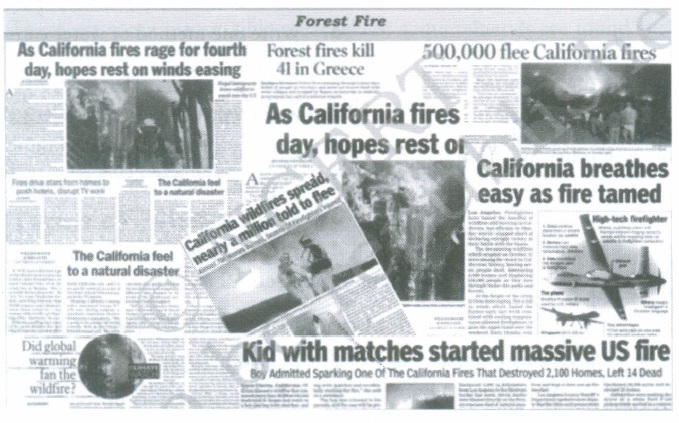
(i) Read the news item and find out how fire started in California? Could it be avoided?
(ii) Write some measures to avoid this kind of hazard.
13.
What is rainwater harvesting? Give some advantages of rainwater harvesting.
14.
70% of fresh water exists as _____
15.
Climatic factors influencing rate of weathering include ____ and ____
16.
The colour, texture etc of soil is determined by _____
17.
The percentage of fresh water on the Earth is _____
18.
The process responsible for soil formation is called ______
19.
It takes hundreds of years to make just one centimetre of soil.
20.
Vegetation and wildlife are valuable resources.
21.
Most of Africa and entire Australia are facing shortages in fresh water supply.
22.
Forest and other vegetation reduce surface run-off.
23.
The growing population is not a cause of soil erosion.
24.
Why are animals poached?
25.
Name the regions of the world which are facing water scarcity?
26.
What is vegetation?
27.
What are the threatened species?
28.
Define water scarcity.
1.
(a)
Plains and river valleys
2.
(d)
All of these
3.
(c)
1
4.
(c)
community land
5.
(b)
Soil texture
6.
There are some broad mitigation techniques of landslide which are as follow:
(i) Hazard mapping to locate areas prone to landslides. Hence, such areas can be avoided for building settlements.
(ii) Construction of retention wall to stop land from slipping.
(iii) Increase in the vegetation cover to arrest landslide.
7.
This landslide was triggered by intense blasting at Pangi village. It was a human factor which was responsible for this major landslide.
8.
The given passage is about natural disaster or calamity, i.e. landslide.
9.
Land use pattern is changing because of the following reasons:
(i) People started encroaching the common lands to build up commercial areas, housing complexes in the urban areas and to expand the agricutural land in rural areas.
(ii) Cultural changes which are taking place in our society.
10.
We should conserve biodiversity because it is very important for all living organisms and for the environment. We should conserve biodiversity to save it from becoming extinct.
11.
(i) Alluvial soil: It is formed with the silt brought by rivers during the course of their long journey. It contains adequate potash, lime and phosphoric acid. It is generally deficient in organic and nitrogenous content. Main crops : Rice, wheat, cotton, oilseeds and Sugarcane.
(ii) Black soil: It is formed by weathering of volcanic (basalt) rock formed by the Deccan lava. It is rich in lime, Iron, Potash, Magnesium, Alumina, Calcium, but lacks in nitrogen and humus. Main crops : Cotton, tobacco, oilseeds and sugarcane.
(iii) Red soil : It is formed with decomposition of metamorphic rocks. It is rich in iron but lacks in phosphorus, nitrogen, humus and lime. Main crops : Wheat, rice, cotton, pulses and sugarcane.
(iv) Laterite soil: It is formed by intense leaching due to heavy rains and is rich in iron, but is generally deficient in potassium, lime, silica phosphoric acid and nitrogen. Main crops: Coffee, Rubber and Cashew.
(v) Desert soil: It is formed by mechanical weathering of rocks from sands. High proportion of salt is there in the soil, but it is deficient in organic matter. Main corps : Wheat, bajra, melon and grams (through irrigation).
(vi) Mountain soil : It is formed mainly due to the deposition of organic matter, provided by the forests. This soil is rich in humus, but poor in potash, phosphorus and lime. It is heterogeneous in nature. Heavy doses of fertilisers have to be applied for high yields of crops. Main crops: Tea, coffee, spices and tropical fruits in Karnataka.
12.
(i) The main cause of California fire was human fault. A child burnt a match stick and threw it carelessly.
(ii) It could have been avoided if the match was kept in safe custody of the family.
13.
Rainwater harvesting is the accumulation and storage of rainwater for reuse before it reaches the aquifers under the ground. Uses include water for the garden, water for livestock water for irrigation.
The advantages of rainwater harvesting are as follows:
(i) It reduces the consumption of groundwater.
(ii) It is free from pollutants as well as salts, minerals and other natural and man-made contaminants.
(iii) It is considered as the purest form of natural water.
(iv) The stored water is a reliable source of water when other sources dry up.
14.
()
ice sheets
15.
()
rainfall, temperature
16.
()
parent rock
17.
()
2.7
18.
()
weathering
19.
(a)
20.
(a)
21.
(a)
22.
(a)
23.
(b)
24.
()
The animals are poached for collection and illegal trade of hides, skins, nails, teeth, horns as well as feathers.
25.
()
Africa, West Asia, South Asia, parts of Western USA, North-West Mexico, parts of South America and entire Australia, are facing shortages in freshwater supply.
26.
()
Assemblages of plants in an environment is known as vegetation.
27.
()
All the species which are listed in endangered, critically endangered and vulnerable group are altogether called threatened species.
28.
()
Shortage of water as compared to its demand is known as water scarcity.

8th Standard CBSE Syllabus & Materials
8th Standard CBSE
CBSE 8th Science Particulate Nature of Matter - New Model Questions Papers Study Material - QB365 Set A
NEW8th Standard CBSE
CBSE 8th Science Pressure, Winds, Stroms and Cyclones - New Model Questions Papers Study Material - QB365 Set A
NEW8th Standard CBSE
CBSE 8th Mathematics Quadrilaterals - New Model Questions Papers Study Material - QB365 Set A
NEW8th Standard CBSE
CBSE 8th Mathematics A story of Numbers - New Model Questions Papers Study Material - QB365 Set A



CBSE 8th Standard CBSE Subjects
CBSE Standards




