
 100% FREE ACCESS
8th Standard CBSE Syllabus & Materials
8th Standard CBSE
CBSE 8th Social Science Theme D - Factors of Production - New Model Questions Papers Study Material - QB365 Set A
NEW8th Standard CBSE
CBSE 8th Social Science Theme C - Universal Franchise and India's Electoral System - New Model Questions Papers Study Material - QB365 Set A
NEW8th Standard CBSE
CBSE 8th Social Science Theme B - The Rise of the Marathas - New Model Questions Papers Study Material - QB365 Set A
NEW8th Standard CBSE
CBSE 8th Social Science Theme B - Reshaping India's Political Map - New Model Questions Papers Study Material - QB365 Set A
NEW8th Standard CBSE
CBSE 8th Social Science Theme A - Natural Resources and Their Use - New Model Questions Papers Study Material - QB365 Set A
NEW8th Standard CBSE
CBSE 8th Science Keeping Time with Skies - New Model Questions Papers Study Material - QB365 Set A

Published on: 11/09/2019
Why Do We Need a Parliament?
Download CBSE Class 8th Standard CBSE Social Science question papers, sample papers, important questions, and previous year solved papers in PDF format. Get free study materials, NCERT solutions, and exam preparation resources for Class 8th Standard CBSE Social Science
Questions + Answers key
Take MCQ Social Science Test
1.
| Lok Sabha | Election Year | Voter Turnout (%) |
|---|---|---|
| 1st | 1951-52 | 44.87 |
| 4st | 1967 | 61.04 |
| 5st | 1971 | 55.27 |
| 6st | 1977 | 60.49 |
| 8st | 1984 | 63.56 |
| 10th | 1991 | 56.73 |
| 14th | 2004 | 58.07 |
Looking at this table. would you say that people's participation during the past 50 years has decreased increased/been stable after initial increase?
2.
If you were a Member of Parliament (MPs), list two questions that you would like to ask.
3.
| Political party | No.of MPs elected |
| National Parties | |
| Bharatiya jana Party(BJP) | 2 |
| Communist Party of india (CPI) | 6 |
| Communist Party of india (Marxist)(CPIM) | 22 |
| Indain Congress Socialist (ICS) | 4 |
| Indain National Congress | 404 |
| Janata Party (JNP) | 10 |
| Lok Dal (LKD) | 3 |
| State Parties | |
| All India Anna DMK (AIADMK) | 12 |
| Dravida Munnetra Kazhagam (DMK) | 2 |
| All India forward block (FBL) | 2 |
| Indian congress (J)(KCJ) | 1 |
| Jammu and Kashmir Conference (JKN) | 3 |
| Kerala Congress(J)(KCJ) | 2 |
| Muslim League (MUL) | 2 |
| Peasants and Workers Party of India (PWP) | 1 |
| Revolutionary Socialist Party (RSP) | 3 |
| Telegu Desam Party (TDP) | 30 |
| Independents | 5 |
| Grand total | 514 |
Is this process similar to what you have read about in class VII?
4.
Identify the work of a State Government and that of a Central Government.
Introduction of a new 1000 rupee note.
5.
Identify the work of a State Government and that of a Central Government.
The decision of the Indian Government to maintain peaceful relations with China.
6.
Members of Lok Sabha are
nominated by President
nominated by Prime Minister
elected by the people
chosen on first-come-first-serve basis
7.
Who presides over the Lok Sabha?
President
Prime Minister
Speaker
People
8.
Who is the head of the Indian state?
The President
Prime Minister
Both 'a' and 'b'
Neither 'a' nor 'b'
9.
When were EVMs first used in India?
1947
1984
1994
2004
10.
When was the Indian National Congress (INC) formed?
1857
1885
1930
1946
11.
Who is the leader of the majority party in Lok Sabha?
12.
What does the Executive do?
13.
What makes the Indian Parliament powerful?
14.
What is the composition of Rajya Sabha?
15.
What is constituency?
16.
Why is Rajya Sabha called the permanent body?
17.
Which political party has won the most seats in all states?
18.
Observe the image of the Parliament given below.
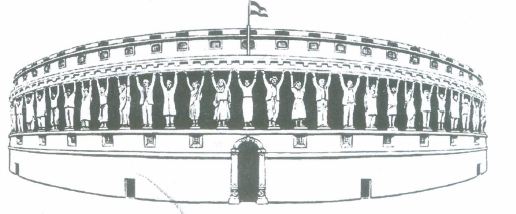
What do you think the artist is trying to convey through this image?
19.
How is government formed in a democracy?
20.
The members of the Rajya Sabha are elected by __________.
21.
The North Block of Central Secretariat has the________ and __________.
22.
The South Block is the house of the Prime Minister's Office (PMO),___________ and ____________.
23.
The _________and__________ are two buildings of the Central Secretariat built during the 1930s.
24.
The Prime Minister is the of the ruling party in the____________ Lok Sabha.
25.
PMO refers to Prime Minister's Office.
26.
Parliament session begins with Zero Hour.
27.
The Lok Sabha is a permanent House.
28.
The Rajya Sabha is also known as the council of states.
1.
People's participation has more or less stabilized with slight fluctuation in the last 50 years after initial increase.
2.
If I were a Member of Parliament (MPs), I would ask the following two questions:
(i) What has the government done to ensure education for all?
(ii) What steps has the government taken for women's upliftment?
3.
Yes.
4.
Central Government
5.
Central Government
6.
(c)
elected by the people
7.
(c)
Speaker
8.
(a)
The President
9.
(d)
2004
10.
(b)
1885
11.
()
The Prime Minister is the leader of the majon party in Lok Sabha
12.
()
The Executive works on implementing the last made by the Parliament.
13.
()
Indian Parliament is powerful because it is the representative of the people.
14.
()
The Rajya Sabha is composed of 233 elected plus 12 nominated members
15.
()
Constituency refers to an electoral district or territorial sub-division for holding elections to a legislative body.
16.
()
Rajya Sabha is never completely dissolved. That is why it is a permanent body.
17.
The Congress Party has won the most seats in all states.
18.
Through this image of the Parliament, the artist is trying to convey that it is the people Parliament is based on the people strength. The Parliament is the supreme law-making body of Indian democracy and it is composed of representatives elected directly by the people. Who come from different religions and backgrounds. So it is ultimately the people who make rules for their country.
19.
In a democracy, government is formed after elections. After the elections, a list is
prepared which indicates the winner of each Lok Sabha seat. These winners become the Members of Parliament (MPs). The political party with the majority of these MPs forms the government.
Since there are 543 seats in Lok Sabha, a party must secure at least half i.e. 272 seats in Parliament to form government. Sometimes, no single political party is able
to win 272 seats on its own and get the majority to form the government. In that
situation, two or more political parties with similar concerns join together to get the
majority and form a Coalition Government.
20.
()
members of Legislative Assemblies
21.
()
Ministry of Finance, Ministry of Home Affairs
22.
()
Ministry of Defence, Ministry of ExternalAffairs
23.
()
South Block, North Block
24.
()
leader
25.
(a)
26.
(b)
27.
(b)
28.
(a)

8th Standard CBSE Syllabus & Materials
8th Standard CBSE
CBSE 8th Science Particulate Nature of Matter - New Model Questions Papers Study Material - QB365 Set A
NEW8th Standard CBSE
CBSE 8th Science Pressure, Winds, Stroms and Cyclones - New Model Questions Papers Study Material - QB365 Set A
NEW8th Standard CBSE
CBSE 8th Mathematics Quadrilaterals - New Model Questions Papers Study Material - QB365 Set A
NEW8th Standard CBSE
CBSE 8th Mathematics A story of Numbers - New Model Questions Papers Study Material - QB365 Set A



CBSE 8th Standard CBSE Subjects
CBSE Standards




