
 100% FREE ACCESS
8th Standard CBSE Syllabus & Materials
8th Standard CBSE
CBSE 8th Social Science Theme D - Factors of Production - New Model Questions Papers Study Material - QB365 Set A
NEW8th Standard CBSE
CBSE 8th Social Science Theme C - Universal Franchise and India's Electoral System - New Model Questions Papers Study Material - QB365 Set A
NEW8th Standard CBSE
CBSE 8th Social Science Theme B - The Rise of the Marathas - New Model Questions Papers Study Material - QB365 Set A
NEW8th Standard CBSE
CBSE 8th Social Science Theme B - Reshaping India's Political Map - New Model Questions Papers Study Material - QB365 Set A
NEW8th Standard CBSE
CBSE 8th Social Science Theme A - Natural Resources and Their Use - New Model Questions Papers Study Material - QB365 Set A
NEW8th Standard CBSE
CBSE 8th Science Keeping Time with Skies - New Model Questions Papers Study Material - QB365 Set A

Published on: 05/03/2019
Cubes and Cube Roots important Questions
Download CBSE Class 8th Standard CBSE Mathematics question papers, sample papers, important questions, and previous year solved papers in PDF format. Get free study materials, NCERT solutions, and exam preparation resources for Class 8th Standard CBSE Mathematics
Questions + Answers key
Take MCQ Mathematics Test
1.
Is 243 a perfect cube?
2.
Which of the following are the cubes of even numbers?
(a) 32768
(b) 2744
(c) 2197
(d) 42875
(e) 132651
(f) 21952
3.
Which of the following are the perfect cubes?
(a) 729
(b) 10,000
(c) 1728
(d) 2817
(e) 6859
(f) 5968
4.
Find the cube root of 1728.
5.
Find the cube root of each of the following numbers by prime factorisation method.
13824
6.
Find the smallest number by which each of the following numbers must be divided to obtain a perfect cube.
81
7.
Check which of the following are perfect cubes.What pattern do you observe in these perfect cubes?
900
8.
Consider the following pattern.
23-13= 1 + 2 x 1 x 3, 33-23=1 + 3 x 2 x 3, 43-33=1 + 4 x 3 x 3
Using the above pattern, find the value of the following:
123 - 113
9.
Find the one's digit of the cube of each of the following numbers.
1024
10.
Hardy-Ramanujan number 1729 is the smallest Hardy-Ramanujan number. There are infinitely many such numbers. Few are 4104 (2,16; 9,15), 13832 (18, 20; 2, 24). Check it with the numbers given in the brackets.
11.
Complete the following crossword puzzle using the given directions for Across [from left to right] and Down [from top to bottom].
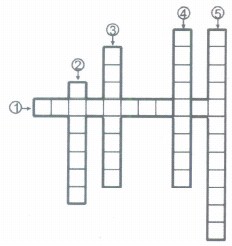
Direction:
Across:
(1) The product of a number by itself three times, is called a _________
Down:
(2) Prime factors of a perfect cube can be grouped into complete__________
(3) The reverse process of finding the cube of a number is finding the ___________of that number.
(4) Numbers that are not exactly divisible by 2, are called__________
(5) The factors of a number, that are prime numbers, are called___________ of the number.
12.
By prime factorisation, find the cube roots of 3375
13.
The volume of a cubical box is 64 cm3, What is its side?
14.
Show that -1728 is a perfect cube. Also, find the number whose cube is -1728.
15.
Using prime factorisation, find the cube root of 5832.
16.
What is the smallest number by which 648 must be multiplied so that the product is a perfect cube?
17.
Show that 46656 is a perfect cube.
18.
Show that 0.001728 is the cube of a rational number. Find that rational number whose cube is 0.0017288.
19.
Find the volume of a cube, whose total surface area is 486 cm2.
20.
Evaluate \(\sqrt [ 3 ]{ 27 } +\sqrt [ 3 ]{ 0.008 } +\sqrt [ 3 ]{ 0.064 } \).
21.
Find the smallest number by which the number 100 must be multiplied to obtain a perfect cube.
5
2
4
10
22.
What is the one's digit in the cube root of the cube number 4913?
7
9
3
6
23.
The one's digit of the cube of the number 50 is
1
0
5
4
24.
Which of the following numbers is not a cube number?
10000
64
3125
729
25.
If a number is doubled, then which of the following is a correct statement?
its cube is two times the cube of the given number
its cube is three times the cube of the given number
its cube is six times the cube of the given number
its cube is eight times the cube of the given number.
26.
If the digit in ones place of a number is 3, then the ending of its cube will be:
3
6
7
9
27.
The smallest number by which 841 be multiplied so that the product becomes a perfect cube is
29
27
25
23
28.
Which of the following number is a perfect cube?
243
512
392
29.
(1.2)3 = ______
30.
Each prime factor of a perfect cube appear _________times in its cube
1.
243 = 3 x 3 x 3 x 3 x 3
In the above factorisation 3 x 3 remains after grouping the 3’s in triplets. Therefore, 243 is not a perfect cube.
2.
(a) 32768
(b) 2744
(f) 21952
3.
(a) 729
(c) 1728
(e) 6859
4.
By prime factorisation, we have
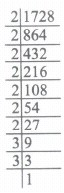
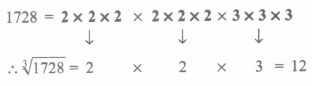
5.
By prime factorisation,
we have
13824 = 2 x 2 x 2 x 2 x 2 x 2 x 2 x 2 x 2 x 3 x 3 x 3
\(\therefore \sqrt[3]{13824}=\)= 2 x 2 x 2 x 3
= 24
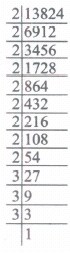
Thus, the cube root of 13824 is 24.
6.
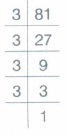
We have, 81
Resolving 81 into prime factors, we get
81 = 3 x 3 x 3 x 3
The prime factor 3 does not appear in a group of three.
So, 81 is not a perfect cube.
Thus, we will divide the number by 3.
∴ 81 ÷ 3 =27 = 3 x 3 x 3
Hence, the smallest number by which 81 should be divided to make it a perfect cube is 3.
7.
We have
900 = 2 x 2 x 3 x 3 x 5 x 5
which are ungrouped in triples.
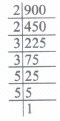
\(\therefore\) 900 is not a perfect cube.
8.
123 - 113 =1 + 12 x 11 x 3 =1 +12 x 33 = 1 + 396 = 397
9.
We have, 1024
One's digit of 1024 = 4
Now, cube of one's digit of 1024 = (4)3= 4 x 4 x 4 = 64
Hence,one's digit in the cube of 1024 is 4.
10.
Verification
4104 = 4096 + 8 = 163 +23
4104 = 3375 + 729 = 153 + 93
13832 = 5832 + 8000 = 183 + 203
and 13832 = 13824 + 8 = 243 + 23
Hence, it is the required verification.
11.
(1)PERFECT-CUBE
(2)TRIPLES
(3)CUBE-ROOT
(4)ODD NUMBER
(5)PRIME-FACTORS
12.
15
13.
Let 'x' be the side of the cube.
\(\therefore x^3=64 or \sqrt[3]{x^3}=\sqrt[3]{64}\)
\(\Rightarrow \ x =\sqrt[3]{2\times2\times2\times2\times2\times2}=\sqrt[3]{2^3\times2^3}\)
=2x2=4
Thus, the required side of the cube is 4 cm.
14.
We have
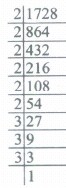
i.e., 1728 = 2 x 2 x 2 x 2 x 2 x 2 x 3 x 3 x 3
\(\Rightarrow\) 1728 = 23 x 23 X 33
\(\Rightarrow\) 1728 = (2 x 2 x 3)3
\(\Rightarrow \sqrt[3]{1728}\) = 2 x 2 x 3 = 12
Since 1728 is a perfect cube.
\(\therefore\) -1728 is also a perfect cube.
Also\(\sqrt[3]{1728} =-12\)
\(\Rightarrow\) -1728 is a perfect cube of -12.
15.
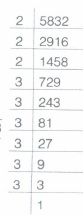
The prime factorisation of 5832
5832 = 2 x 2 x 2 x 3 x 3 x 3 x 3 x 3 x 3
Therefore, \(\sqrt [ 3 ]{ 5832 } \)
= \(\sqrt [ 3 ]{ \underline { 2\times 2\times 2 } \underline { 3\times 3\times 3 } \underline { 3\times 3\times 3 } } \)
= 2 x 3 x 3
=18
16.
64cm3
17.
11
18.
We have 0.001728 =\(1728\over1000000\)
Now,
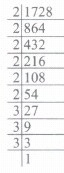
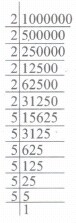
\(\therefore {1728\over 1000000}\)
\(={2\times2\times2\times2\times2\times2\times3\times3\times3\over2\times2\times2\times2\times2\times2\times5\times5\times5\times5\times5\times5 }\)
\(={3\times3\times3\over 5\times5\times5\times5\times5\times5}={3^3\over 5^5\times5^3}=({3\over5\times5})^3\)
\(\therefore \sqrt[3]{1728\over 1000000}=({3\over 5\times5})^3\Rightarrow \sqrt[3]{1728\over 1000000}\)
\(={3\over 5\times5}\Rightarrow \sqrt[3]{0.001728}={3\over25}\)
Thus, 0.001728 is the cube of\({3\over25}\) .
19.
729 cm3
20.
Given, \(\sqrt [ 3 ]{ 27 } +\sqrt [ 3 ]{ 0.008 } +\sqrt [ 3 ]{ 0.064 } \)
Now, \(\sqrt [ 3 ]{ 27 } =\sqrt [ 3 ]{ 3\times 3\times 3 } =3\)
Now \(\sqrt [ 3 ]{ 0.008 } =\sqrt [ 3 ]{ \frac { 8 }{ 1000 } } \)
= \(\sqrt [ 3 ]{ \frac { 2\times 2\times 2 }{ 2\times 2\times 2\times 5\times 5\times 5 } } =\frac { 2 }{ 10 } \)
Now, \(\sqrt [ 3 ]{ 0.064 } =\sqrt [ 3 ]{ \frac { 64 }{ 1000 } } \)
= \(\sqrt [ 3 ]{ \frac { 2\times 2\times 2\times 2\times 2\times 2 }{ 2\times 2\times 2\times 5\times 5\times 5 } } =\frac { 4 }{ 10 } \)
So, \(\sqrt [ 3 ]{ 27 } +\sqrt [ 3 ]{ 0.008 } +\sqrt [ 3 ]{ 0.064 } \)
= \(3+\frac { 2 }{ 10 } +\frac { 4 }{ 10 } \)
LCM of 1 and 10 is 10.
Then, \(\frac { 30+2+4 }{ 10 } =\frac { 36 }{ 10 } \) = 3.6


21.
100=2\(\times\)2\(\times\)5\(\times\)5
22.
7\(\times\)7\(\times\)7=343
23.
0\(\times\)0\(\times\)0=0.
24.
10000 = 2 \(\times\) 2 \(\times\) 2\(\times\) 2 \(\times\) 5 \(\times\) 5\(\times\) 5 \(\times\) 5.
= 24 \(\times\) 54 = 23 \(\times\) 2\(\times\) 53\(\times\) 5.
25.
(d)
its cube is eight times the cube of the given number.
26.
(c)
7
27.
28.
8640
29.
(1.2)3 = (1.2) x (1.2) x (1.2) = 1.728
30.
()
3

8th Standard CBSE Syllabus & Materials
8th Standard CBSE
CBSE 8th Science Particulate Nature of Matter - New Model Questions Papers Study Material - QB365 Set A
NEW8th Standard CBSE
CBSE 8th Science Pressure, Winds, Stroms and Cyclones - New Model Questions Papers Study Material - QB365 Set A
NEW8th Standard CBSE
CBSE 8th Mathematics Quadrilaterals - New Model Questions Papers Study Material - QB365 Set A
NEW8th Standard CBSE
CBSE 8th Mathematics A story of Numbers - New Model Questions Papers Study Material - QB365 Set A



CBSE 8th Standard CBSE Subjects
CBSE Standards




