
 100% FREE ACCESS
8th Standard CBSE Syllabus & Materials
8th Standard CBSE
CBSE 8th Social Science Theme D - Factors of Production - New Model Questions Papers Study Material - QB365 Set A
NEW8th Standard CBSE
CBSE 8th Social Science Theme C - Universal Franchise and India's Electoral System - New Model Questions Papers Study Material - QB365 Set A
NEW8th Standard CBSE
CBSE 8th Social Science Theme B - The Rise of the Marathas - New Model Questions Papers Study Material - QB365 Set A
NEW8th Standard CBSE
CBSE 8th Social Science Theme B - Reshaping India's Political Map - New Model Questions Papers Study Material - QB365 Set A
NEW8th Standard CBSE
CBSE 8th Social Science Theme A - Natural Resources and Their Use - New Model Questions Papers Study Material - QB365 Set A
NEW8th Standard CBSE
CBSE 8th Science Keeping Time with Skies - New Model Questions Papers Study Material - QB365 Set A

Published on: 17/09/2018
Model Question II
Download CBSE Class 8th Standard CBSE Science question papers, sample papers, important questions, and previous year solved papers in PDF format. Get free study materials, NCERT solutions, and exam preparation resources for Class 8th Standard CBSE Science
Questions + Answers key
Take MCQ Science Test
1.
Rayon is different from synthetic fibres because:
It has silk-like appearance.
It is obtained from wood pulp.
Its fibres can also be woven like those of natural fibres.
2.
When a glass rod is rubbed with a piece of silk cloth, the rod
and the cloth both acquire positive charge
becomes positively charged, while the cloth has negative charge
and the cloth both acquire negative charge
becomes negatively charged, while the cloth has a positive charge
3.
When we press the bulb of a dropper with its nozzle kept in water, air in the dropper is seen to escape in the form of bubbles. Once we release the pressure on the bulb, water gets filled in the dropper. The rise of water in the dropper is due to
pressure of water
gravity of the earth
shape of rubber bulb
atmospheric pressure
4.
The presence of a small amount of impurities makes water
a good conductor of electricity
a bad conductor of electricity
pure
None of the above
5.
When electric current is passed through a conducting solution, there is a change of colour of the solution. This indicates
the chemical effect of current
the heating effect of current
the magnetic effect of current
the lightning effect of current
6.
To sharpen the blade of a knife by rubbing it against a surface, which of the following will be most suitable?
Stone
Plastic block
Wooden block
Glass block
7.
Four children were asked to arrange forces due to rolling, static and sliding frictions in a decreasing order. Their arrangements are given below. Choose the correct arrangement.
Rolling, static, sliding
Rolling, sliding, static
Static, sliding, rolling
Sliding, static, rolling
8.
The like charges
repel each other
attract each other
not interaction takes place
All of the above
9.
Purest form of carbon is
coal
charcoal
coke
All of these
10.
Yeast is used in the production of
sugar
alcohol
hydrochloric acid
oxygen
11.
Mention three examples that show that friction produces heat.
12.
The strips of an electroscope diverge when a charged body is brought in contact with the metal clip. Now the clip is touched gently by our hand. What will happen to the strips? Explain.
13.
How plastics are used in health care industry?
14.
What are the advantages of using CNG and LPG as fuels?
15.
What are the major groups of microorganisms?
16.
What is an earthquake? What happens when it occurs?
17.
Write different uses of coal-tar.
18.
Why are vaccines so important for children?
19.
Why is nylon used for making parachutes and ropes for rock climbing?
20.
Sometimes we see that the liquid is conducting but the bulb may not glow. Why?
21.
It is dangerous to touch an electrical appliance with wet hands. Explain why
22.
Mention the name of the natural phenomena which can be predicted to some extent.
23.
Where coal is found in India?
24.
Write the name of raw materials which are used in making nylon.
25.
Give the term used for spherical bacteria.
26.
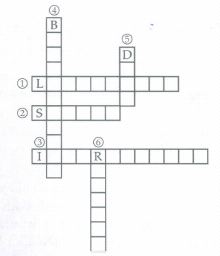
Across:
1. The substances that reduce friction.
2. Friction when we try to move an object at rest
3. Apply a force to overcome.
Down:
4. Axles of bicycles.
5. The frictional force exerted by fluids is called.
6. Body rolls over the surface of another body.
27.
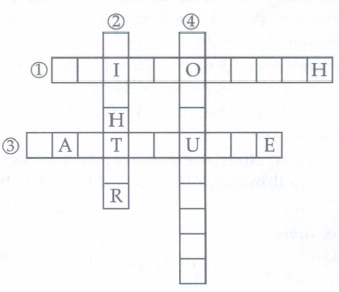
Across:
1. The graph used to record seismic waves.
2. The scale used to measure the magnitude of earthquake.
3. Sudden movement in the Earth plates.
4. A method of charging a neutral material.
28.
Despite being very useful, it is advised to restrict the use of plastic. Why is it so? Can you suggest some methods to limit its consumption?
29.
Observe the circuit given in figure.
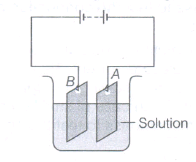
Boojho set up this circuit for purification of copper. What will be the nature of
(a) plate A
(b) plate B
(c) and the solution. Explain the process of purification
30.
It is much easier to burst an inflated balloon with a needle than by a finger. Explain.
31.
Explain why it is safer to use a wireless telephone instead of a land line telephone during lightning.
32.
We say fossil fuels will last only for a few hundred years. Comment.
33.
How can we prevent the following diseases?
(a) Cholera (b) Typhoid (c) Hepatitis-A
34.
Give two examples of good conductors.
35.
Name the force that always opposes the applied force.
36.
What is static electricity?
37.
Name two contact forces.
38.
Keenrose is a fuel used in jet crafts.
39.
What is the versatility about melamine?
40.
Name the articles made from PET.
41.
Why is Terylene popular polyester?
42.
Name the material that is used to make ropes for rock climbing.
43.
Name any two thermoplastic and thermosetting plastics.
44.
How is rayon formed?
45.
What are artificial fibres?
46.
What are natural fibres?
47.
Define cellulose.
48.
Which is biodegradable? Paper bag or polythene bag?
1.
(b)
It is obtained from wood pulp.
2.
(b)
becomes positively charged, while the cloth has negative charge
3.
(d)
atmospheric pressure
4.
(a)
a good conductor of electricity
5.
(a)
the chemical effect of current
6.
(a)
Stone
7.
(c)
Static, sliding, rolling
8.
(a)
repel each other
9.
(c)
coke
10.
(b)
alcohol
11.
Following examples show that the friction produces heat:
(i) Warming of our palms when we rub them.
(ii) Rubbing sticks together to produce fire.
(iii) Warming of the parts of a machine when it is operated.
12.
If we touch the strip and standing on ground (not on any insulating base), the charges will pass through our hand because it will get the path of flow and strips will contract.
13.
Plastics find extensive use in the health care industry. They are used in packaging of tablets, making threads used for stitching wounds, syringes, doctor's gloves and a number of medical instruments.
14.
The advantages of using CNG and LPG as fuels are as follows :
(i) CNG and LPG are clean fuels.
(ii) They do not produce pollution.
(iii) They are easily available.
(iv) They can be used directly for burning.
(v) They are easy to transport.
(vi) Their cost is low.
15.
Microorganisms are divided into four major groups which are as follows:
(i) Bacteria These are single-celled organisms which are harmful, as they cause disease and some of them may be useful as in. vaccines.
(ii) Fungi These are non-green plants which consume their food from the dead organic matter.
(iii) Protozoa These are unicellular animals which causes diseases like malaria and dysentery.
(iv) Algae These are photoautotrophic organisms, that may be unicellular or multicellular. They play important role in medicines, agriculture, industry and as food. Some microbiologists also classify viruses as microorganisms, but other consider these as non-living. They are those microbes which reproduce only inside the cells of host organisms. They cause diseases like cold, polio, AIDS, etc.
16.
An earthquake is a sudden shaking of earth's plates due to collision. When earthquake occurs, then we suffer a huge loss of life and property.
17.
Coal-tar is used as starting material for manufacturing various substances used in everyday life and in industry, like synthetic dyes, drugs, explosives, perfumes, plastics, paints, photographic materials etc.
18.
By introducing vaccine in body, the body fights and kills the bacteria by producing suitable antibodies. The antibodies remain in the body and the child is protected from the disease causing microbes.
19.
Nylon thread is stronger than a steel wire.
20.
The bulb does not glow because the current through it is too weak.
21.
Since, wet hand acts as good conductor. So, we feel electric shock when we touch electrical appliance with wet hands.
22.
Thunderstorm, lightning and cyclones are the natural phenomena that can be predicted.
23.
In India, coal is found mainly in Bihar, West Bengal, Orissa and Madhya Pradesh.
24.
The raw materials used in making nylon are coal, water and air.
25.
Spherical bacteria are called as cocci.
26.
Across:
1. Lubricants
2. Static
3. Interlocking
Down:
4. Ball bearing
5. Drag
6. Rolling
27.
1. Seismograph,
2. Richter,
3. Earthquake,
4. Conduction.
28.
Plastic is non-biodegradable and causes environmental pollution as it takes several years to decompose. It is not environment friendly. When the plastic waste materials are burnt, they burn very slow. They do not get completely burnt. In the burning process, they release lots of poisonous fumes (gases) into the atmosphere causing air pollution. The animals eat up the polythene bags and wrappers of food along with the leftover food thrown on garbage dumps.
The methods to limit its consumption are:
Reducing its use; reusing it for some other purposes and recycling. It may reduce environmental pollution also.
29.
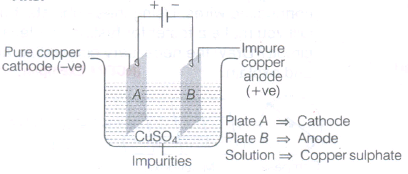
We take CuS04 solution and dip a pure copper plate as cathode (-ve) and impure copper plate as anode (+ve). Due to voltage of battery, the impurities from the impure sample slowly deposit at the bottom and the copper plate becomes purified .
30.
Because needle tip has very less area of cross-section in comparison to that of our finger and we know that pressure exerted by a force is inversely proportional to the area where it has been applied, so pressure exerted will be more by the needle tip than the finger.
31.
It is not safer to use wired telephone during lightning because at that time lightning can enter the wire of telephone, if open somewhere, that is if there is any cut in the wire. On the other hand, there cannot be any possibility of this type in wireless telephone.
32.
Fossil fuels will last only for a few hundred years because they are exhaustible natural resources. If consumed at a rate faster than the rate at which these are formed in nature, they will get exhausted very soon.
Once the present stock of these gets exhausted, no new supplies of these fossil fuels will be available to us in the near future because it required millions of years for the conversion of dead organisms into these fuels.
33.
(a) Cholera By maintaining personal hygiene and good sanitation practices.
(b) Typhoid Eating properly cooked food, drinking boiled water and by getting vaccinated against the disease.
(c) Hepatitis-A Drinking boiled water and getting vaccinated against the disease
34.
()
Silver, copper.
35.
()
Friction.
36.
()
The electricity generated by rubbing is called static electricity.
37.
()
Muscular, frictional force
38.
()
Kerosene
39.
()
It resists fire and can tolerate heat better than plastic.
40.
()
Bottles, utensils, films, wires etc.
41.
()
Because it can be drawn into very fine fibre that can be woven like any other yarn.
42.
()
Nylon.
43.
()
(i) Thermoplastic - Polythene, PVC
(ii) Thermosetting plastics - Melamine, Bakelite.
44.
()
Rayon is obtained by chemical treatment of wood pulp.
45.
()
The fibres made by human beings are called artificial fibres e.g., polyester.
46.
()
The fibres obtained from nature are called natural fibres e.g., cotton.
47.
()
Cellulose is made up of a large number of glucose units.
48.
()
Paper bag.

8th Standard CBSE Syllabus & Materials
8th Standard CBSE
CBSE 8th Science Particulate Nature of Matter - New Model Questions Papers Study Material - QB365 Set A
NEW8th Standard CBSE
CBSE 8th Science Pressure, Winds, Stroms and Cyclones - New Model Questions Papers Study Material - QB365 Set A
NEW8th Standard CBSE
CBSE 8th Mathematics Quadrilaterals - New Model Questions Papers Study Material - QB365 Set A
NEW8th Standard CBSE
CBSE 8th Mathematics A story of Numbers - New Model Questions Papers Study Material - QB365 Set A



CBSE 8th Standard CBSE Subjects
CBSE Standards




