
 100% FREE ACCESS
8th Standard CBSE Syllabus & Materials
8th Standard CBSE
CBSE 8th Social Science Theme D - Factors of Production - New Model Questions Papers Study Material - QB365 Set A
NEW8th Standard CBSE
CBSE 8th Social Science Theme C - Universal Franchise and India's Electoral System - New Model Questions Papers Study Material - QB365 Set A
NEW8th Standard CBSE
CBSE 8th Social Science Theme B - The Rise of the Marathas - New Model Questions Papers Study Material - QB365 Set A
NEW8th Standard CBSE
CBSE 8th Social Science Theme B - Reshaping India's Political Map - New Model Questions Papers Study Material - QB365 Set A
NEW8th Standard CBSE
CBSE 8th Social Science Theme A - Natural Resources and Their Use - New Model Questions Papers Study Material - QB365 Set A
NEW8th Standard CBSE
CBSE 8th Science Keeping Time with Skies - New Model Questions Papers Study Material - QB365 Set A

Published on: 15/02/2019
Revision Test on History
Download CBSE Class 8th Standard CBSE Social Science question papers, sample papers, important questions, and previous year solved papers in PDF format. Get free study materials, NCERT solutions, and exam preparation resources for Class 8th Standard CBSE Social Science
Questions + Answers key
Take MCQ Social Science Test
1.
The Maratha chiefs were held together in a confederacy under the Peshwa, the members were:
(i) Scindia
(ii) Holkar
(iii)Bhonsle
(iv) Gaikwad
A, B,C
B, C, D
A, C, D
A, B, C, D
2.
Cinchona trees provide raw material for making:
Quinine
Mats and ropes
Rubber
Beverages.
3.
Colonisation means:
Conquest of one country by another.
Subjugation of one country by another country.
Subjugation of one country by another, leading to political, social and economic changes.
Economic exploitation of one country by another
4.
The English Education Act was introduced in the year
1825
1835
1845
1855
5.
Who was HJ Khandekar?
A member of the Constituent Assembly
A member of Parliament
A socialist leader
An industrialist
6.
Who established National Congress?
Mahatma Gandhi
Jawaharlal Nehru
Netaji Subhas Chandra Bose
None of the above
7.
Smelting furnaces in villages were built with _______________
carbon crystals and bricks
clay pots and Wootz steel
charcoal and bellows
clay and sun-dried bricks
8.
India was the world's largest producer of cotton textiles around the year ____________
1850
1750
1730
1680
9.
Peasants and artisans were referred to as
Vaishyas
Shudras
Untouchables
Kshatriyas
10.
One of the achievements of the Delhi Improvement Trust was ________
building more than one hundred havelis
building market squares around which shops would be built
building houses grouped around parks with better privacy
building colonial bungalows for the British in New Delhi
11.
What was the objective of the new law passed by the Company in 1850?
Converting all Muslims and Hindus to Christianity.
To divide the Indians on religious lines.
Making religious conversion to Christianity easier.
Not allowing Christians to inherit the land of their ancestors.
12.
Where does the term 'Bewar' mean shifting cultivation?
Jharkhand
Madhya Pradesh
North-East India
Andhra Pradesh
13.
The Third Battle of Panipat was fought in the year
1743
1752
1767
1761
14.
In which state, the weavers created Kalamkari print in cotton clothes?
Orissa
Madhya Pradesh
Andhra Pradesh
Bengal
15.
The National Archives of India came up in the
1920s
1930s
1940s
1950s
16.
Why did James Mill and Thomas Macaulay think that European education was essential in India?
17.
Find out about the Jallianwala Bagh Massacre.
What is Jallianwala Bagh?
18.
How did Jyotirao, the reformer, justify his criticism of caste inequality in society?
19.
Why did handloom weaving in India not die out when cheap British machine-made cloth flooded the Indian market?
20.
How did partition of the country change the lives and occupations of the refugees?
21.
What objections did the sepoys have to the new cartridges that they were asked to use?
22.
Imagine a conversation between a planter and a peasant who is being forced to grow indigo. What reasons would the planter give to persuade the peasant? What problems would the peasant point out? Enact their conversation.
23.
What power did the Residents have?
This is what James Mill, the famous economist and political philosopher from Scotland wrote about the residents appointed by the Company. We place a resident, who really is king of the country, whatever injunctions of non-interference he may act under. As long as the prince acts in perfect subservience, and does what is agreeable to the residents, that is, to the British Government, things go on quietly; they are managed without the resident appearing much in the administration of affairs ... but when anything of a different nature happens,the moment the prince takes a course which the British Government think wrong, then comes clashing and disturbance.
Who was James Mill?
24.
Describe the changes that occurred in the composition of the Company's army.
25.
Why and how do we periodise a time in history?
26.
Read the source below and answer the questions that follow:
A newspaper, The Indian Mirror, wrote in January 1886: The First National Congress at Bombay ... is the nucleus of a future Parliament for our country and will lead to the good of inconceivable magnitude for our countrymen.
(i) What were the aims and objectives of Congress in the first twenty years?
(ii) How did the Moderates in Congress develop public awareness about the unjust nature of the British rule?
27.
What were the problems faced by tribals during British rule?
28.
Why was Permanent Settlement introduced by the East India Company in 1793?
29.
Write a short note on the Charter of 1600
30.
Discuss the work and contribution of Ishwarchandra Vidyasagar for the upliftment of women.
31.
Have you ever noticed that people living in different types of societies do not share the same notion of work and time? The lives of the shifting cultivators and hunters in different regions were regulated by a calendar and division of tasks for men and women. Verrier Elwin, a British anthropologist who lived among the Baigas and Khonds of central India for many years in the 1930s and 1940s, gives us a picture of what this calendar and division of tasks was like. He writes: In Chait, women went to clearings to ... cut stalks that were already reaped; men cut large trees and go for their ritual hunt. The hunt began at full moon from the east. Traps of bamboo were used for hunting. The women gathered fruits like sago, tamarind, and mushroom. Baiga women can only gather roots or Kanda and mahua seeds. Of all the adivasis in Central India, the Baigas were known as the best hunters ... In Baisakh the firing of the forest took place, the women gathered unburnt wood to burn. Men continued to hunt, but nearer their villages. In Jeth sowing took place and hunting still went on. From Asadh to Bhadon the men worked in the fields. In Kuar the first fruits of beans were ripened and in Kartik kutki became ripe. In Aghan every crop was ready and in Pus winnowing took place. Pus was also the time for dances and marriages. In Magh, shifts were made to new bewars and hunting-gathering was the main subsistence activity. The cycle described above took place in the first year. In the second year, there was more time for hunting as only a few crops had to be sown and harvested. But since there was enough food the men lived in the bewars. It was only in the third year that the diet had to be supplemented with the forest products. Adapted from Verrier Elwin, Baiga(1939) and Elwin's unpublished 'Notes on the Khonds' (Verrier Elwin Papers, Nehru Memorial Museum, and Library). look carefully at the tasks that Baiga men and women did. Do you see any pattern? What were the differences in the types of work that they were expected to perform?
32.
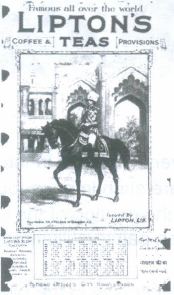
What does the advertisement of Lipton's Tea suggest?
33.
Look at the Map along with a present-day political map, of India. In each of these maps try and identify the different parts of India that were under the British rule.
.JPG)
34.
Why and where did the Portuguese first come into India?
35.
Why were the seats reserved for the members of the lowest castes?
36.
Why was the revolt known as a sepoy mutiny?
37.
What is the meaning of Periodization of History?
1.
(d)
A, B, C, D
2.
(a)
Quinine
3.
(c)
Subjugation of one country by another, leading to political, social and economic changes.
4.
(b)
1835
5.
(a)
A member of the Constituent Assembly
6.
(d)
None of the above
7.
(d)
clay and sun-dried bricks
8.
(b)
1750
9.
(b)
Shudras
10.
(c)
building houses grouped around parks with better privacy
11.
(c)
Making religious conversion to Christianity easier.
12.
(b)
Madhya Pradesh
13.
(d)
1761
14.
(c)
Andhra Pradesh
15.
(a)
1920s
16.
James Mill was a severe critic of Orientalists.
He thought that European education was essential in India because:
(i) The knowledge of the East was full of errors and unscientific thoughts.
(ii) The aim of education ought to be to teach what was useful and practical.
Thomas Macaulay suggested that:
(i) India was an uncivilised country that needed to be civilized.
(ii) No branch of Eastern knowledge could be compared to Western knowledge. Oriental learning was of no practical use.
17.
Jallianwala Bagh is a garden near the Harmandir Sahib in Amritsar
18.
The founder of Saryashodhak Samaj Jyotirao Phule was low-caste leader.
He criticised the caste inequality in our society in the following ways:
(i) He opposed the idea that Brahmans were superior just because they were Aryans. He argued that Aryans were foreigners, who came from outside the subcontinent and defeated and subjugated the true children of our country. These native people had lived here from before the coming of Aryans.
(ii) He claimed that the upper castes had no right to their land and power, in reality the land belonged to the natives of the country.
(iii) He proposed that Shudras (labouring castes) and Ati Shudras (untouchables) should unite to challenge caste discrimination.
(iv) By writing the book Gulamgiri which means slavery in 1873, Jyotirao justified his opinion about the caste inequality in our society.
19.
Handloom weaving in India does not die out when cheap British machine-made cloth flooded the Indian market because:
(i) Saris with intricate borders or cloth with traditional woven patterns, which had a wide demand amongst the rich and middle classes, could not be produced by machines.
(ii) The textile manufacturers in Britain did not produce the very coarse cloths used by the poor people in India. The local handloom weavers filled this gap by supplying the people with their requirements.
20.
The refugees who came from Pakistan were mostly rural landlords, lawyers, teachers, traders and small shopkeepers. Partition changed their lives, as most of them were without homes in Delhi and were forced to live in refugee camps for years.
They had to take up new occupations as hawkers, vendors, carpenters, and ironsmiths. Some of them prospered due to their hard work.
21.
The sepoys raised the objection that the new cartridges they had been asked to use were greased with the fat of cows and pigs. It was a great insult to the religions of Indian sepoys the Hindus as well as the Muslims. It also appeared to the Indian soldiers that the aim of the Britishers was to convert all the sepoys into Christianity.
22.
1. Peasant Sir, why are you forcing me to sign the contract?
2. Planter It is a profitable cultivation. I will give you some money as advance. After delivering indigo, you will get the rest of the money.
3. Peasant But sir, you need the best soil for indigo plantation. In our best land, we usually grow rice, pulses. We can not use this land for indigo cultivation as it exhausts the soil. After an indigo harvest, the land is not usable for rice production.
23.
James Mill was a famous economist and political philosopher from Scotland.
24.
The changes that occurred in the composition of the company's army are as follows:
(i) Before colonisation, the Mughal army was mainly composed of cavalry. i.e. trained soldiers on horsebacks or sawars and the infantry or paidal (foot) soldiers.
(ii) In the early 19th century, the British began to develop a uniform military culture. The soldiers were given European-style training. Drill and discipline were introduced which regulated their life far more than before.
(iii) After the battles with the Marathas and the Mysore rulers. the Company realised the importance of strengthening its cavalry force.
25.
We periodise a time in order to characterize it into different periods on the basis of some significant events that have happened during those days. These demarcations of time into different periods in the past is known as 'periodization', which become important for history as they help to reflect our ideas quickly about the happenings and changes from one period to the next.
26.
(i) The aims and objectives of Congress in first twenty years were:
(a) Extension of irrigation.
(b) Moderate assessment of land revenue.
(c) Stoppage of export of food grains from India.
(d) Protection of interests of Indians abroad.
(e) Protection of farmers against exploitation at the hands of moneylenders.
(f) Development of indigenous industries.
(g) Position of Indians in government and administration should be improved.
(h) They demanded legislative councils in all Provinces.
(ii) The Congress held discussions, published newspaper~, wrote articles and showed how British rule was leading to the economic ruin of the country. They sent petitions, passed resolutions, criticised British rule in their speeches and sent representatives to different parts of the country to mobilise public opinion in India and abroad.
27.
(i) Before British rule, tribal people had tribal chiefs who were important and had certain amount of economic power and had their own police as well as rules at some places, but they lost considerable powers when Britishers arrived.
(ii) Britishers wanted that moving tribal groups should settle down and become peasant cultivators as settled tribes were easier to control.
(iii)The Britishers tried to settle down Jhum cultivators but they were unsuccessful.
(iv) Some forest areas were declared as reserved forests which would provide timber to Britishers.
(v) The traders and money lenders started coming in forests. They wanted to buy forest products at very cheap prices which caused problem.
(vi) Britishers declared the forest as a state property.
28.
The East India Company introduced the Permanent Settlement in 1793 to increase the flow of its revenue.
According to the terms of the Permanent Settlement:
(i) The rajas and taluqdars were recognized as Zamindars.
(ii) Zamindars collected revenue from the peasants.
(iii) The revenue amount to be paid to the Company was fixed.
(iv) The revenue amount was not to be increased in the future.
(v) Zamindars were to invest in improving the land.
29.
(i) In 1600, the East India Company required a charter from the ruler of England, Queen Elizabeth I, granting it the sole right to trade with the East.
(ii) This meant that no other trading group in England could compete with the East India Company. (iii)With this charter, the company could venture across the oceans, looking for new lands from which it could buy goods at a cheaper price, and carry them back to Europe to sell at higher prices.
(iv) The company did not have to fear competition from other English trading companies
30.
Ishwarchandra Vidyasagar was a social reformer, philosopher, academician, philanthropist and a key figure of the Bengal Renaissance. His works and contribution for the upliftment of women are as follows:
(i) He did a lot for the education of women, as he believed that it was our primary duty to educate a woman because she was the real teacher of her child. He opened and ran many schools for girls at his own expense.
(ii) Vidyasagar strongly protested against polygamy and child marriage.
(iii) It was due to his effort, the Hindu Widow Remarriage Act 1856 was passed which allowed the widows to remarriage. He had also opposed the sati system.
Ishwarchandra worked endlessly to provide equal education to all men and women irrespective of their caste, religion and gender. He believed that the status of women and all kinds of injustice and inequalities that they face could be changed only through education.
31.
There is a pattern in the tasks that Baiga men and women did. We notice that the men did the physically harder work and work which required them to go far from home, like working in the fields and going for hunting animals Meanwhile, the Baiga women did the physically less demanding work and which kept them near their homes probably to look after their children and the home, gathering fruits for consumption and unburnt woods for fuel etc.
32.
The advertisement for Lipton Tea suggests that Royal people all over the world prefer this tea.
33.
In the above map, the areas which are under the British rule are-some parts of East UP, Bihar, Bengal, Coastal Andhra Pradesh, Madras city, some parts of Tamil Nadu and Kerala.
34.
The Portuguese first came into India in search of spices. They first landed in Calicut on the Kerala coast in south-west India.
35.
It was recommended that a certain percentage of seats in legislatures as well as jobs in government, should be reserved for members of the lowest castes as they had been deprived of all privileges since ages.
36.
In this revolt, all the sepoys marched to the Britishers' buildings, houses, police stations and burnt them. They killed the British officials. The main role in these activities was that of sepoys. Therefore, the Revolt of 1857 is also called sepoy mutiny (Sepoy means soldiers and mutiny means 'Soldiers March').
37.
Historians divided the history of world into three periods - Ancient, Modern and Medieval. Each period has some distinct features. The modern period of the history is said to have begun with exploration, renaissance and reformation movements. This classification of history into three periods is known as the Periodization of History.

8th Standard CBSE Syllabus & Materials
8th Standard CBSE
CBSE 8th Science Particulate Nature of Matter - New Model Questions Papers Study Material - QB365 Set A
NEW8th Standard CBSE
CBSE 8th Science Pressure, Winds, Stroms and Cyclones - New Model Questions Papers Study Material - QB365 Set A
NEW8th Standard CBSE
CBSE 8th Mathematics Quadrilaterals - New Model Questions Papers Study Material - QB365 Set A
NEW8th Standard CBSE
CBSE 8th Mathematics A story of Numbers - New Model Questions Papers Study Material - QB365 Set A



CBSE 8th Standard CBSE Subjects
CBSE Standards




