
 100% FREE ACCESS
6th Standard CBSE Syllabus & Materials
6th Standard CBSE
CBSE 6th Social Science The Value of Work - New Sample Question Papers Study Material - QB365 Set A
NEW6th Standard CBSE
CBSE 6th Social Science Family and Community - New Sample Question Papers Study Material - QB365 Set A
NEW6th Standard CBSE
CBSE 6th Social Science India's Cultural Roots - New Sample Question Papers Study Material - QB365 Set A
NEW6th Standard CBSE
CBSE 6th Social Science India,That is Bharat - New Sample Question Papers Study Material - QB365 Set A
NEW6th Standard CBSE
CBSE 6th Social Science Timeline and sources of history - New Sample Question Papers Study Material - QB365 Set A
NEW6th Standard CBSE
CBSE 6th Social Science Oceans and Continents - New Sample Question Papers Study Material - QB365 Set A

Published on: 05/03/2019
2 Marks Revision Test
Download CBSE Class 6th Standard CBSE Mathematics question papers, sample papers, important questions, and previous year solved papers in PDF format. Get free study materials, NCERT solutions, and exam preparation resources for Class 6th Standard CBSE Mathematics
Questions + Answers key
Take MCQ Mathematics Test
1.
A tea stall owner consumes in her shop \(2\frac { 1 }{ 2 } \)litres of milk in the morning and \(1\frac { 1 }{ 2 } \) litres of milk in the evening. What is the total amount of milk she uses in the stall?
2.
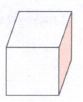
A cube is a cuboid whose edges are all of equal length.
It has_____________faces.
Each face has__________Each face
achface has___________vertices.
3.
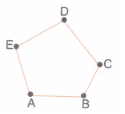
Give justification to call it a polygon.
4.
Give five examples where the number of things counted would be more than 6-digit number.
5.
Write the common factors of 6 and 10.
6.
Find the smallest 4-digit number which is divisible by 18, 24 and 32.
7.
Find the HCF of the following number 12, 45, 75
8.
Add \(\frac { 1 }{ 8 } +\frac { 1 }{ 8 } \)
9.
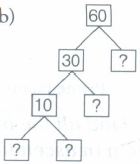
Here is a factor tree for 60. Write the missing number.
10.
What is data?
11.
Find the areas of the following figures by counting square.

12.
Name the properties, where x, y and z are variable and can take any numerical values.
x + y = y + x
13.
Arrange the following in ascending and descending order.\(\frac { 1 }{ 12 } ,\frac { 1 }{ 23 } ,\frac { 1 }{ 5 } ,\frac { 1 }{ 7 } ,\frac { 1 }{ 50 } ,\frac { 1 }{ 9 } ,\frac { 1 }{ 17 } \)
14.
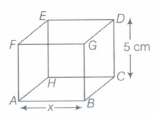
If ABCDEFGH is a square with CD = 5 cm. Then, find the value of x?
15.
Find the number of diagonals of a triangle.
16.
How many Integers are there between - 9 and -2?
17.
Give reason for the following:
A square can be thought of as a special rhombus.
18.
Find first three common multiples of 6 and 8
19.
Name of the following triangles in two different ways. (you may judge the nature of the angle by observation).

20.
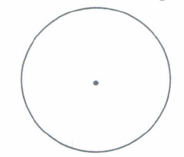
Write all vertex of the given figure.
21.
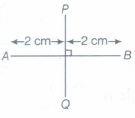
In the given figure, which of the line is perpendicular bisector?
22.
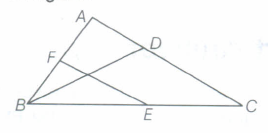
Write down three angles involved in \(\triangle ABC\) of the given figure.
23.
Name all the line segments in given figure.

24.
Write the expanded form of the following 76496
25.
Find additive inverse of the following numbers.
11
26.
Sum of two acute angles, whose measure is greater than 60° is equal to?
27.
Find the solution of the following.
(-7)+ (+8)
28.
Estimate the following using general rule 28,292 - 21,496
29.
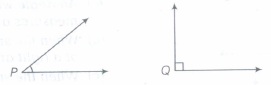
Compare the given angles by their measurement.
30.
Using divisibility tests, determine the following number are divisible by 4 and 8? 12159
31.
Write as fraction in lowest form. 0.06
32.
In each of the following pairs, which number is to the right of the other on the number line?
-3,-8
33.
Write opposites of the following.
30 km North
34.
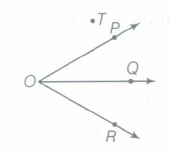
Write the points which lie exterior of the \(\angle POQ\).
35.
Which direction will you face if you start facing West and makes one revolution clockwise?
36.
Represent the following numbers using dots 6.
37.
What is the greatest prime number between 1 and 10?
38.
How many milligrams make one kilogram?
39.
Give a proper fraction, whose denominator is 9 and numerator is 5.
40.
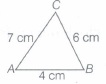
Draw a ΔABC, where AB = 4 cm, BC = 6 cm, CA = 7 cm.
41.
Verify the commutative law under addition for the following whole numbers. Does it hold under subtraction?
(i) 402, 113
(ii) 54, 45.
42.
Whatis 100- 1=?
43.
Find using distributive property 15 x 68.
44.
Color the part according to the given fraction
 \(\frac { 1 }{ 3 } \)
45.
Write first three multiples of 5.
46.
Why is it better to use a divider than a ruler, while measuring the length of a line segment
47.
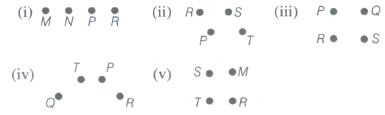
With a sharp tip of the pencil, mark four points on a paper and name them by the letters A, C, P, H. Try to name these points in different ways. One such way could be this

48.
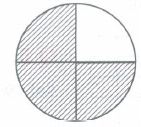
Write the fraction representing the shaded portion
49.
Write the predecessor of
(a) 94
(b) 10000
(c) 208090
(d) 7654321
50.
Compare the following number: 67454 and 78465
1.
Amount of milk consumed in the morning = \(2\frac { 1 }{ 2 } \)litres
Amount of milk consumed in the evening = \(1\frac { 1 }{ 2 } \) litres
\(\therefore\) Total amount of milk consumed
= \(2\frac { 1 }{ 2 } +1\frac { 1 }{ 2 } =\frac { 2\times 2+1 }{ 2 } +\frac { 1\times 2+1 }{ 2 } \)
= \(\frac { 4+1 }{ 2 } +\frac { 2+1 }{ 2 } \)
= \(\frac { 5 }{ 2 } +\frac { 3 }{ 2 } =\frac { 5+3 }{ 2 } =\frac { 8 }{ 2 } \)= 4
Hence she uses 4 litres of milk in a day in the stall.
2.
A cube is a cuboid whose edges are all of equal length.
It has 6 faces.
Each face has 4 Each face
Each face 4 has vertices.
3.
It is a polygon as it is a simple closed figure made up entirely of line segments.
4.
1. Number of people in U.P. state.
2. Number of copies of Ram Charit Manas published each year.
3. Number of grains in a sack full of wheat.
4. Number of railway tickets sold in 2002-2003 in U.P.
5. Number of saving account holders in nationalised banks in U.P.
5.
Factors of 6 = 1,2,3,6
Factors of 10 =1, 2, 5,10
Common factors of 6 and 10 = 1,2
6.
First, we have to find out the LCM of 18, 24, and 32.
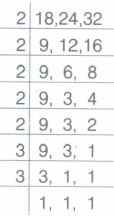
\(\therefore\) LCM = 2 x 2 x 2 x 2 x 2 x 3 x 3
= 288
We know that, the smallest 4-digit number is 1000.
On dividing 1000 by 288, we get 136 as remainder.
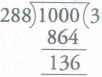
\(\therefore\) Required smallest 4-digit number which is exactly divisible by 18, 24 and 32 = (Smallest 4-digit number + Divisor - Remainder)
= 1000 + 288 - 136 = 1152
7.
HCF of 12, 45 and 75 = 3
8.
Let \(\frac { a }{ b } =\frac { 1 }{ 8 } \) and \(\frac { c }{ b } =\frac { 1 }{ 8 } \) ,then sum = \(\frac { a+c }{ b } =\frac { 1+1 }{ 8 } =\frac { 2 }{ 8 } =\frac { 1 }{ 4 } \) ; Hence the sum of\(\frac { 1 }{ 8 } \) and\(\frac { 1 }{ 8 } \) is \(\frac { 2 }{ 8 } \)
9.
\(\because\) 60 =30 x 2
30 = 10 x 3 and 10 = 5 x 2
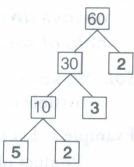
\(\therefore\)Hence, missing numbers are 2, 3, 5 and 2.
10.
Information in raw or unorganised form (such as alphabets. numbers or symbols) that refer to, or represent conditions, ideas or objects.
11.
Given, figure is covered by 4 full squares and 2 half squares
∴ Area = \(\left( 4\times 1+2\times \frac { 1 }{ 2 } \right) sq\quad units\)
= (4 + 1)sq units = 5 sq units
12.
Commutativity of addition
13.
Here, numerators of all fractions are same.
Descending order of denominators
= \(50 > 23 > 17 > 12 > 9 > 7 > 5\)
∴ Ascending order of fractions =\(\frac { 1 }{ 50 } ,\frac { 1 }{ 23 } ,\frac { 1 }{ 17 } ,\frac { 1 }{ 12 } ,\frac { 1 }{ 9 } ,\frac { 1 }{ 7 } ,\frac { 1 }{ 5 } \)\(\begin{bmatrix} \because {1\over 50}\ has\ larger\ denominator, \\ so\ it\ is\ smaller\ fraction \end{bmatrix}\)
and descending order of fractions = \({1\over 5},{1\over 7},\frac { 1 }{ 9 } ,\frac { 1 }{ 12 } ,\frac { 1 }{ 17 } ,\frac { 1 }{ 23 } ,\frac { 1 }{ 50 } \)
14.
x=5 cm
15.
Zero
16.
6
17.
We know that, in a rhombus, all four sides are equal and opposite sides are parallel. If its all angles are right angles, then it becomes a square. So, a square can be thought of as a special rhombus.
18.
Multiples of 6 = 6, 12,18, 24, 30, 36, 42, 48, 54, 60, 66,72, ...
Multiples of 8 = 8, 16, 24, 32, 40, 48, 56, 64, 72, 80,88,96, ...
Hence, first three common multiples are 24, 48 and 72.
19.
By observing the given triangles in two different ways, name of each triangle is given below:
In the given triangle, all the sides are different, so it is a scalene triangle and one angle is right angle. So, it is a right angled triangle also.
20.
Vertex of a circle cannot be possible i.e. circle has no vertex.
21.
PQ is perpendicular bisector of AB.
22.
The three angles in the above figure are \(\angle BAC,\angle ABC,\ and\ \angle ACB\).
23.
All the line segments are \(\bar {PQ},\bar {PR},\bar {PS},\bar {QR},\bar {QS}\ and \bar {RS}.\)
24.
Expanded form of given numbers as
76496 = 7 \(\times\) 10000 + 6 \(\times\) 1000 + 4 \(\times\) 100 + 9 \(\times\) 10 + 6
25.
-11
26.
Obtuse angle
27.
(-7)+(+8)=(-7)+(+7)+(+1) [∵ 7+1=8]
=0+(+1)=+1 [∵ (-7)+(+7)=0]
28.
∵ 28,292 ⟶ 28,000[rounding off to nearest thousands]
21,496 ⟶ 21,000 [rounding off to nearest thousands]
∴ Estimated difference = 28000 - 21000 = 7000
29.
The measurement of L\(\angle P\) = 30°
The measurement of \(\angle Q\) = 90°,
Hence, \(\angle Q > \angle P.\)
30.
12159 is not divisible by 4.
12159 is not divisible by 8.
31.
We have, 0.06=0 tenths + 6 hundreds = \(0+\frac { 6 }{ 100 } =\frac { 6 }{ 100 } =\frac { 3 }{ 50 } \)
32.

Here, -3 and -8 both are on the left of zero, but -3 is near to the zero in comparison of -8. So, -3 is to the right of -8.
33.
Opposite of 30 km North is 30 Km South.
34.
T and R
35.
West
36.
.png)
37.
Prime numbers between 1 and 10 are 2,3,5 and 7.
Therefore, the greatest prime number between 1 and 10 is 7.
38.
We know that, 1 kg = 1000 g = (1000 X 1000) mg [∵ 1 g = 1000 mg]
= 1000000 mg
∴ 1000000 milligrams make one kilogram
39.
Numerator =5 and denominator =9
∴ Required fraction = \(\frac { 5 }{ 9 } \)
40.
41.
No, the commutative property does not hold under subtraction of whole numbers.
42.
100 - 1= 99
43.
We have, 15 x 68 = 15 x (60 + 8) = 15 x 60 + 15 x 8 [by distributive property of multiplication over addition]
= 900 + 120 = 1020.
44.
Here, fraction \(\frac { 1 }{ 3 } \) shows that out of 3 equal parts, 1 part is shaded. So, the required figure is shown alongside.

45.
To get the multiples of any number, we multiply that number with natural numbers.
So, first three multiples of 5 are 5 x 1,5 x 2,5 x 3 = 5, 10, 15.
46.
When we measure the length of a line segment by ruler, there may be some errors due to its thickness and angular viewing. These errors can be removed by measuring a line segment with the help of a divider. Hence, the use of a divider is better than a ruler.
47.
We can give the name to these given points in different ways as follows:
48.
Here, the given figure is divided into 4 equal parts and 3 parts out of 4 parts are shaded.
∴ The required fraction = \(\frac { 3 }{ 4 } \)
49.
The predecessor of given numbers are as follows:
| Given number | Successor | |
| (a) | 94 | 94 - 1 = 93 |
| (b) | 10000 | 10000 - 1 = 9999 |
| (c) | 208090 | 208090 - 1 = 208089 |
| (d) | 7654321 | 7654321 - 1 = 7654320 |
50.
Both 67454 and 78465 are five-digit numbers. So, we compare them by comparing the digits at ten thousand places. Since, 7> 6. So, 78465> 67454.

6th Standard CBSE Syllabus & Materials
6th Standard CBSE
CBSE 6th Social Science Locating Places on the Earth - New Sample Question Papers Study Material - QB365 Set A
NEW6th Standard CBSE
CBSE 6th Science A Journey Through States of Water - New Sample Question Papers Study Material - QB365 Set A
NEW6th Standard CBSE
CBSE 6th Science Temperature and its Measurement - New Sample Question Papers Study Material - QB365 Set A
NEW6th Standard CBSE
CBSE 6th Science Materials Around Us - New Sample Question Papers Study Material - QB365 Set A



CBSE 6th Standard CBSE Subjects
CBSE Standards




