
 100% FREE ACCESS
8th Standard CBSE Syllabus & Materials
8th Standard CBSE
CBSE 8th Social Science Theme D - Factors of Production - New Model Questions Papers Study Material - QB365 Set A
NEW8th Standard CBSE
CBSE 8th Social Science Theme C - Universal Franchise and India's Electoral System - New Model Questions Papers Study Material - QB365 Set A
NEW8th Standard CBSE
CBSE 8th Social Science Theme B - The Rise of the Marathas - New Model Questions Papers Study Material - QB365 Set A
NEW8th Standard CBSE
CBSE 8th Social Science Theme B - Reshaping India's Political Map - New Model Questions Papers Study Material - QB365 Set A
NEW8th Standard CBSE
CBSE 8th Social Science Theme A - Natural Resources and Their Use - New Model Questions Papers Study Material - QB365 Set A
NEW8th Standard CBSE
CBSE 8th Science Keeping Time with Skies - New Model Questions Papers Study Material - QB365 Set A

Published on: 01/01/2019
Grade 8 Slip Test
Download CBSE Class 8th Standard CBSE Mathematics question papers, sample papers, important questions, and previous year solved papers in PDF format. Get free study materials, NCERT solutions, and exam preparation resources for Class 8th Standard CBSE Mathematics
Questions + Answers key
Take MCQ Mathematics Test
1.
Every rectangle is a rhombus
2.
In the point (4,3),3 denotes the x-coordinate and 4 denotes the y-coordinate.
3.
A 2-digit number ab is always divisible by 2, if b is an even number.
4.
Cube of any odd number is even.
5.
\({2\over3}-{5\over4}={5\over4}-{2\over3}\)
6.
Take a sheet of paper. Fold it as shown in the figure. Count the number of parts and the area of a part in each case.

Tabulate your observations and discuss with your friends. Is it a case inverse proportion? Why?
| Number of parts | 1 | 2 | 4 | 8 | 16 |
| Area of each part | area of the paper | \(\frac { 1 }{ 2 } \)the area of the paper | ... | ... | ... |
7.
Complete the following crossword puzzle using the given directions for Across [from left to right} and Down [from top to bottom).
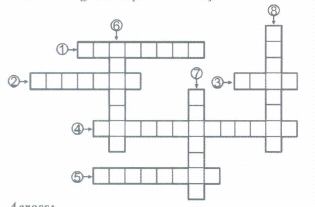
Across:
(1) The points where, the sides of a polygon meet are called _________
(2) A polygon made by six sides is called a __________
(3) The side joining two vertices is called a ____________
(4) 'A four sided polygon is called a ____________
(5) A five sided polygon is called a _________
Down:
(6) A parallelogram having all of its four sides equal is called a ____________
(7) A simple closed figure made of only line segments is called a __________
(8) The line segment joining the opposite sides of a polygon (except triangle) is called a ___________ of the polygon.
8.
If 53a is divisible by 9, then find the value of a.
9.
The curved surface area of a cylinder is 2\(\pi \) (y2 + 7y + 12) and its radius is (y + 3). Find the height of the cylinder. (CSA of cylinder = 2\(\pi \)rh)
10.
Segal bought 5 \(2\over3\)kg of sweets for Diwali celebration. On the way to her home, she distributed\(2\over7\) of sweets to street children and \(5\over11\) of sweets to some children suffering from cancer in a hospital.
(a) How much sweets she is left with?
(b) What kind of values are depicted by Segal?
11.
Evaluate using suitable identities
(i) (48)2
(ii) 1812-192
(iii) 497x 505
(iv) 2.07x1.93
12.
A company increased its production of two wheelers from 50000 in 2013 to 65000 in 2014. Find the annual rate of growth of production of two wheelers?
13.
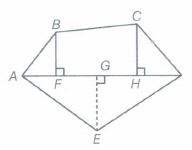
Polygon ABCDE is divided into parts as shown Find its area, if AD = 8 cm, AH=6cm, AG = 4cm, AF= 3cm and perpendiculars BF = 2 cm, CH= 3 cm, EG = 2. 5cm Areaof polygon ABCD = Area of ΔAFB+...
Area of ΔAFB =\(\frac { 1 }{ 2 } \times \) AF\(\times\) BF=\(\frac { 1 }{ 2 } \times \) 3\(\times\) 2 = ..
Area of trapezium FBCH = FH \(\times\)\(\frac { (BF+CH) }{ 2 } \)
= \(3\times \frac { (2+3) }{ 2 } \) +.... [∵ FH=AH-AF]
Area of ΔCHD =\(\frac { 1 }{ 2 } \times \) HD \(\times\) CH
Area of ΔADE =\(\frac { 1 }{ 2 } \times \) AD\(\times\) GE = ...
So,the area of polygon ABCDE =...
14.
I have a total of Rs. 300 in coins of denomination Rs. 1, Rs.2 and Rs. 5. The number of Rs. 2 coins is 3 times the number of Rs.5 coins. The total number of coins is 160.How many coins of each denomination are with me?
15.
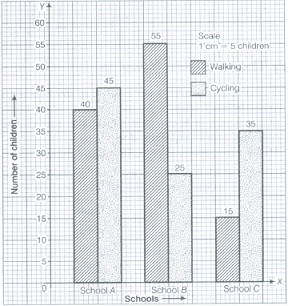
Draw an appropriate graph to represent the given information.
| Children who prefer | School A | School B | School C |
|---|---|---|---|
| Walking | 40 | 55 | 15 |
| Cycling | 45 | 25 | 35 |
16.
Which of 172, 342, 252 and 492 would have 6 at unit place?
17.
12 = 1, then square root of 1 =_______.
18.
The standard form of \(\frac{1}{10000000000}\) is ____________
19.
Volume of a cylinder with radius r and height h is_____
20.
_______ is a regular quadrilateral.
21.
| Numbers | Associative for | |||
| Addition | Subtraction | Multiplication | Division | |
| Rational numbers | ___________ | ____________ | ___________ | No |
22.
Present ages of Shaloo and Preeti are in the ratio 5: 4. 5 years from now the ratio of their ages will be 6: 5. Find their ages.
23.
The area of a quadrilateral shaped field is 252 m2. The perpendiculars droped on it from the opposite comers on a diagonal are 8 m and 13 m. Find the length of the diagonal.
24.
Factorise the following expressions.4p2 - 9q2
25.
A shop gives 10%discount. What would be the sale price of each of these a pair of shoesmarked at Rs 650?
26.
______ + \((-\frac{11}{7})=(-\frac{11}{7})+\) ________ =0.
27.
Find and correct the errors in the following mathematical statements.
(2a + 3b)(a - b) = 2a2 - 3b2
28.
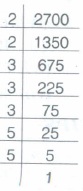
Check which of the following are perfect cubes.What pattern do you observe in these perfect cubes?
2700
29.
Which of the following numbers would have digit 6 at unit's place? 262
30.
Simplify:(1.5x- 4y) (1.5x+ 4y+ 3) - 4.5x + 12y
31.
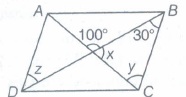
In the following figure, ABCD is a parallelogram. Find the values of x, y and z.
32.
If the height of a cuboid becomes zero, it will take the shape of a
cube
parallelogram
circle
rectangle.
33.
The common factor of 2x, 3x3, 4 is
1
2
3
4
34.
Observe the histogram and answer the question given below:
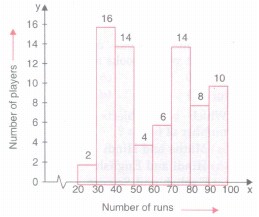
How many players make runs less than 40?
8
2
18
10
35.
Find the smallest number by which the number 1296 must be divided to obtain a perfect cube.
6
2
4
3
36.
If 'x' and 'y' are in a direct propostion then which of the following is correct?
x-y = constant
x +y = constant
x \(\times\) y = constant
\(\frac { x }{ y } \) = constant
37.
Which of the following is the value of\(\left( x+\frac { 1 }{ x } \right) ^{ 2 }\) ?
\(x^{ 2 }+\frac { 1 }{ x^{ 2 } } \)
\(x^{ 2 }-\frac { 1 }{ x^{ 2 } } \)
\(x^{ 2 }+\frac { 1 }{ x^{ 2 } } +2\)
\(x^{ 2 }+\frac { 1 }{ x^{ 2 } } +2x\)
38.
Which of the following is the product of \(\left( \frac { -7 }{ 8 } \right) \) and \(\frac { 2 }{ 21 }\)?
\(-\frac { 1 }{ 12 } \)
12
\(\frac { -63 }{ 16 } \)
\(\frac { -16 }{ 147 } \)
39.
Which of the following is a regular quadrilateral?
rectangle
square
rhombus
trapezium
40.
Which of the following can be four interior angles of a quadrilateral?
70°, 90°, 45°, 130°
35°, 49°, 9r, 17°
140°, 60°, 60°, 90°
25°, 145°, 85°, 105°
41.
Divide: 70x2y2z2 \(\div \) 140 xyz
42.
Find the value of \({ x }^{ 2 }+\frac { 1 }{ { x }^{ 2 } } +2x\) at x =1
43.
Using the long division method find the square root of the following numbers.
14400
44.
A group of students was asked for their favourite subject. The results were listed as under: Art, Mathematics, Science, English, Mathematics, Art, English, Mathematics, English, Art, Science, Art, Science, Science, Mathematics, Art, English, Art, Science, Mathematics, Science, Art. Answer the following questions:
(i) Which is the most liked subject?
(ii) Which is the least liked subject?
45.
Is a rational number the quotient of two integers such that the denominator is a nonzero integer?
1.
(b)
2.
(b)
3.
(a)
4.
(b)
5.
(b)
6.
| Number of parts\(\rightarrow\) | 1 | 2 | 4 | 8 | 16 |
| Area of each part\(\rightarrow\) | Area of the full paper | \(\frac { 1 }{ 2 } \)the area of the paper | \(\frac { 1 }{ 4 } \) the area of the paper | \(\frac { 1 }{ 8 } \) the area of the paper | \(\frac { 1 }{ 16 } \) the area of the paper |
Here, more the number of parts, lesser is the area of each part.
\(\therefore\) It is a case of "inverse proportion".
7.
(l)\(\rightarrow\)VERTICES
(2)\(\rightarrow\)HEXAGON
(3)\(\rightarrow\)EDGE
(4)\(\rightarrow\)QUADRILATERAL
(5)\(\rightarrow\)PENTAGON
(6)\(\rightarrow\)RHOMBUS
(7)\(\rightarrow\)POLYGON
(8)\(\rightarrow\)DIAGONAL
8.
a = 1
9.
It is given that, the curved surface area of the cylinder = 2\(\pi \)(y2+ 7y + 12).....(i)
We know that, the formula of curved surface area of the cylinder = 2\(\pi \)rh.....(ii)
where, r = Radius of the cylinder
h = Height of the cylinder
On comparing Eqs. (l) and (ii), we get
2\(\pi \)rh = 2\(\pi \)(y2+ 7y + 12)
r\(\times\)h=(y2+7y+12).....(iii)
But radius of the cylinder = R = (y + 3)
Putting this value in Eq.(iii), we get
(y+ 3)\(\times\)h =(y2 + 7y +12)
\(h=\frac { \left( { y }^{ 2 }+7y+12 \right) }{ \left( y+3 \right) } \)
We have to factorise (y2+ 7y + 12)
Since, 4 \(\times\) 3 = 12 and 4 + 3 = 7
Putting this value in (y2 + 7y + 12), we get
y2 + (4 + 3)y+ 4 \(\times\) 3
= y2+4y+3y+4x3
= y(y + 4)+ 3(y + 4)=(y + 4)(y + 3)
\(h=\frac { \left( { y }^{ 2 }+7y+12 \right) }{ \left( y+3 \right) } =\frac { \left( y+4 \right) \left( y+3 \right) }{ \left( y+3 \right) } \)
= (y + 4) units
Hence, height of the cylinder = (y + 4) units.
10.
(a) Sweets bought by Segal = 5\({2\over3}={17\over3}kg\)
Sweets distributed by Segal =\({2\over7}+{5\over11}={57\over77}kg\)
\(\therefore\)Sweets left with Segal = \({17\over3}-{57\over77}\)
\(={1309-171\over231}={1138\over231}=4.9kg\)
(b) She is very kind girl and have helping nature.
11.
(i)(48)2=(50-2)2
Since, (a - b)2 = a2 - 2ab + b2
(50-2)2=(50)2-2x50x2+(2)2
= 2500 - 200 + 4 (a-b)2=a2-2ab+b2
= 2504 - 200 = 2304
(ii) 1812 -192 =(181-19)(181+ 19)
where, a = 50 and b = 2
= 162 x 200 = 32400
(iii) 497 x 505 =(500 - 3)(500 + 5)
= 5002 + (-3 + 5) x 500 + (-3)(5)
[.: (x + a)(x + b) = x2 + (a +. b) x + ab]
= 250000 + 1000 -15 = 250985
(iv) 2.07 x1.93 = (2 + 0.07)(2 - 0.07)
= 22 -(0.07)2
[.: where, a = 50 and b = 2]
= 3.9951
12.
30%
13.
Given, polygon ABCDE is divided into four parts, so it is clear from given figure that
Area of polygon ABCDE =Area of ΔAFB + Area of trapezium FBCH + Area of ΔCHD+ Area of ΔADE ....(i)
Also, AD =8 cm, AH=6cm, AG = 4cm, AF=3 cm,BF = 2 cm, CH = 3 cm and EG = 2.5 cm
Now, area of ΔAFB = AF \(\times\)BD =\(\frac { 1 }{ 2 } \times \) 3\(\times\) 2 = 3 cm2
Area of trapezium FBCH = \(\frac { 1 }{ 2 } \times \)FH \(\times\)(BF+CH)
= \(\frac { 1 }{ 2 } \times \)3 \(\times\)(2+3)
[∵ FH= AH - AF=6 -3 =3 cm ]
=\(\frac { 1 }{ 2 } \times \) 3 \(\times\)5 = =7.5 cm2
Area of ΔCHD =\(\frac { 1 }{ 2 } \times \) HD \(\times\)CH
=\(\frac { 1 }{ 2 } \times \) (AD-AH)\(\times\) CH [∵ HD=AD-AH]
=\(\frac { 1 }{ 2 } \times \) (8-6)\(\times\)3 =\(\frac { 1 }{ 2 } \times \) 2\(\times\)3 = 3 cm2
Now, area of ΔADE =\(\frac { 1 }{ 2 } \times \) AD\(\times\) GE =\(\frac { 1 }{ 2 } \times \) 8\(\times\) 2.5
= 4\(\times\) 2.5 = 10 cm2
On putting all these values in Eq. (i), we get
Area of polygon ABCDE = (3 + 7.5 + 3 + 10) = 23.5 cm2
14.
Let the number of Rs. 5 coins be x.
Then, the number of Rs. 2 coins = 3x
The total number of coins is 160 .
The number of coins of Rs. 1= 160 - (x + 3x)
= (160 - 4x)
The amount that I have from Rs. 5 coins = 5 x x = 5x
The amount that I have from Rs. 2 coins = 2 x 3x = 6x
The amount that I have from Rs. 1 coins
= 1 x (160 - 4x) = 160 - 4x
According to the question,
Total amount = 300
\(\Rightarrow\) 5x + 6x + (160 - 4x) = 300
\(\Rightarrow\) 5x +6x +160 - 4x = 300
\(\Rightarrow\) 7x + 160 = 300 [transposing 160 to RHS]
\(\Rightarrow\) 7x = 300 -160 [transposing 160 to RHS]
\(\Rightarrow\) 7x = 140
\(\Rightarrow\) x = \(\frac { 140 }{ 7 } \) = 20 [dividing both sides by 7]
Number of Rs. 5 coins = x = 20
Number of Rs. 2 coins = 3x = 3 x 20 = 60
and number of Rs.1 coins = 160 - 4x = 160 - 4 x 20
= 160 - 80 = SO
Hence, I have SO,60 and 20 coins of denomination Rs.1, Rs. 2 and Rs 5, respectively.
15.
Here, comparison of two activities is given, so to represent the given information, we draw the double bar graph. So, draw two perpendicular axes OX and OY. Take schools on OX and number of children on OY. Choose a suitable scale for OX and OY to draw double bar graph.
Thus, we get the following double bar graph:
16.
If a number has 4 or 6 in the unit's place, then its square ends in 6
17.
()
1
18.
()
10-10
19.
Volume of a cylinder with radius r and height h is \(\pi\)r2h
20.
Square; since, in a square all the sides and angles are equal.
21.
()
| Numbers | Associative for | |||
| Addition | Subtraction | Multiplication | Division | |
| Rational numbers | Yes \(e.g {-1\over2} + [{3\over7}+{-4\over3}]\\ =[{-1\over2}+{3\over7}]+({-4\over3})
\\ \Rightarrow {-1\over2}+({9-28\over21}) \\ = ({-7+6\over14}) -{4\over3} \\ \Rightarrow -
{1\over2}-{19\over21}={-1\over14}-{4\over3} \\ \Rightarrow{-59\over42}={-59\over42},\) which is true |
No \(e.g {-2\over3} -({-4\over5}-{1\over2}) \\ \neq [{-2\over3}-({-4\over5})]-{1\over2}\\ \Rightarrow{-2\over3} - ({-8-5\over10})\neq [{-10+12\over15}]-{1\over2} \\ \Rightarrow -{2\over3}+{13\over10}\neq {2\over15}-{1\over2}\\ \Rightarrow {-20+39\over30}\neq {4-15\over30}\Rightarrow {19\over30}\neq {-11\over30}\) which is not true. |
Yes e.g \({2\over3} \times({-6\over7}\times{4\over5})\\ =({2\over3}\times {-6\over7})\times {4\over5}\\ \Rightarrow {2\over3} \times ({-24\over35}) \\ {-12\over21} \times{4\over5} \\ \Rightarrow {-16\over35}={-16\over35},\) which is true. |
No which is not true |
22.
Let the present age of Shaloo = 5x years
Let the present age of Preeti = 4x years
After 5 years, age of Shaloo = (5x + 5) years
Age of Preeti = (4x + 5) years
According to the condition, we have
\({(5x+5)\over (4x+5)}={6\over 5}\) By cross-multiplication, we have
5(5x + 5) = 6(4x + 5) or 25x + 25 = 24x + 30
Transposing 25 to RHS and 24x to LHS, we have
25x - 24x = 30 - 25 or x = 5
\(\therefore\) 5x = 5 x 5 = 25 and 4x = 4 x 5 = 20
Therefore, present age of Shaloo = 25 years
Present age of Preeti = 20 years.
23.
24 m
24.
4p2 -9q2 = (2p)2 -(3q)2
This expression is of the form a2 - b2.
On comparing, we get a = 2P and b =3q
\(\therefore\) 4p2 - 9q2 = (2p +3q) (2p - 3q)
[\(\therefore\)a2 - b2 = (a +b)(a-b)]
25.
We know that,
Discount = Marked price - Sale price
Sale price = Marked price - Discount
∵ Marked price = Rs 650 [given]
Discount = 10% of Rs 650 =\(\frac{10}{100}\times 650\)=65
∴ Sale price = Marked price - Discount = Rs (650 - 65) = Rs 585
26.
\(\frac{11}{7}+(-\frac{11}{7})=(-\frac{11}{7})+\frac{11}{7}=0\)
27.
Given mathematical statement is incorrect because here we use the wrong formula. Before applying any formula, we have to make sure whether the formula is really applicable.
Hence, correct statement is given below:
(2a + 3b)(a - b) = [(2a)(a) - (b)(2a) + (3b)(a) - (b)(3b)]
= 2a2 - 2ab + 3ab - 3b2
= 2a2 + ab -3b2
It is the multiplication of two algebraic terms.
28.
We have, 2700
Resolving 2700 into prime factors,
we get
2700 = 2 x 2 x 3 x 3 x 3 x 5 x 5
Clearly, the prime factors of 2 and 5 do not appear in groups of three (triples).
So, 2700 is not a perfect cube.
29.
Since, number 26 ends with digit 6, so the number getting from the square of 26, will be the end of the digit 6.
30.
(1.5x - 4y)(1.5x + 4y + 3) - 4.5x + 12y
= 1.5x(1.5x + 4y +3) - 4y(1.5x + 4y + 3) -4.5x + 12y
= (1.5x\(\times\)1.5x) + (1.5x\(\times\)4y) + (1.5x\(\times\)3) - (4y\(\times\)1.5x) - (4y\(\times\)4y) - (4y\(\times\)3)-4.5x + 12y
= 2.25x2 + 6xy + 4.5x - 6xy -16y2- 12y - 4.5x + 12y
= 2.25x2+ (6 - 6)xy + (4.5 - 4.5)x - 161 + (12 - 12)y
= 2.25x2 + (0)xy + (0)x-16y2+ (o)y
= 2.25x2+ 0 + 0 - 16y2+ 0
= 2.25x2- 16y2
31.
x= 80°, y = 70°, z = 30°
32.
(d)
rectangle.
33.
2x = 2 \(\times\)x
3x3 = 3 \(\times\) x \(\times\) x \(\times\) x
4 = 2 \(\times\)2.
34.
Required number = 2 + 16 = 18.
35.
1296 = 2\(\times\) 2\(\times\) 2 \(\times\) 2 \(\times\) 3 \(\times\) 3 \(\times\) 3 \(\times\) 3
= 23 \(\times\) 2\(\times\) 33 \(\times\) 3.
36.
(d)
\(\frac { x }{ y } \) = constant
37.
(c)
\(x^{ 2 }+\frac { 1 }{ x^{ 2 } } +2\)
38.
(a)
\(-\frac { 1 }{ 12 } \)
39.
(b)
square
40.
(d)
25°, 145°, 85°, 105°
41.
()
\(\frac { 1 }{ 2 } xyz\)
42.
()
4
43.
()
120
44.
()
(i) Art
(ii) English
45.
()
yes

8th Standard CBSE Syllabus & Materials
8th Standard CBSE
CBSE 8th Science Particulate Nature of Matter - New Model Questions Papers Study Material - QB365 Set A
NEW8th Standard CBSE
CBSE 8th Science Pressure, Winds, Stroms and Cyclones - New Model Questions Papers Study Material - QB365 Set A
NEW8th Standard CBSE
CBSE 8th Mathematics Quadrilaterals - New Model Questions Papers Study Material - QB365 Set A
NEW8th Standard CBSE
CBSE 8th Mathematics A story of Numbers - New Model Questions Papers Study Material - QB365 Set A



CBSE 8th Standard CBSE Subjects
CBSE Standards




