
 100% FREE ACCESS
12th Standard Syllabus & Materials
12th Standard
TN 12th Computer Applications மின்னணு தரவு பரிமாற்றம் Sample Question Papers Study Material - QB365 Set A
NEW12th Standard
TN 12th Computer Applications மின் - வணிக பாதுகாப்பு அமைப்புகள் Sample Question Papers Study Material - QB365 Set A
NEW12th Standard
TN 12th Computer Applications மின்னணு செலுத்தல் முறைகள் Sample Question Papers Study Material - QB365 Set A
NEW12th Standard
TN 12th Computer Applications மின் - வணிகம் Sample Question Papers Study Material - QB365 Set A
NEW12th Standard
TN 12th Computer Applications திறந்த மூல கருத்துருக்கள் Sample Question Papers Study Material - QB365 Set A
NEW12th Standard
TN 12th Computer Applications வலையமைப்பு வடமிடல் Sample Question Papers Study Material - QB365 Set A

Published on: 28/06/2019
chapter one creative five mark questions
Download Tamil Nadu 12th Standard Chemistry question papers, model tests, one-mark questions, important questions, and public exam papers in PDF format. Free study materials and answer keys for TN State Board students.
Questions + Answers key
Take MCQ Chemistry Test
1.
Explain refining of titanium by Van-Arkel method.
2.
Explain refining of nickel by mond's process
3.
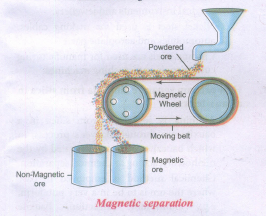
Explain concentration by magnetic separation with diagram.
4.
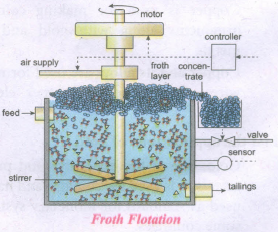
Explain froth flotation, with diagram.
1.
(i) Van-Arkel method is based on the thermal decomposition of metal compounds which lead to the formation of pure metals.
(ii) Titanium and zirconium can be purified, using this method.
(iii) For example, the impure titanium metal is heated in an evacuated vessel with iodine at a temperature of 550 K to form the volatile titanium tetra-iodide(Til4)
(iv) The impurities are left behind, as they do not react with iodine
\({ Ti }_{ (s) }+{ 2I }_{ 2(s) }\longrightarrow { Til }_{ 4 }(vapour)\)
(v) The volatile titanium tetraiodide vapour is passed over a tungsten filament at a temperature around 1800 K.
(vi) The titanium tetraiodide is decomposed and pure titanium is deposited on the filament
(vii) The iodine is reused.
\({ Til }_{ 4 }(vapour)\longrightarrow { { Ti }_{ (s) } }+{ 2I }_{ 2(s) }\)
2.
(i) The impure nickel is heated in a stream of carbon monoxide at around 350 K.
(ii) The nickel reacts with the CO to form a highly volatile nickel tetracarbonyl.
(iii) The solid impurities are left behind
\({ Ni }_{ (s) }+4{ CO }_{ (g) }\longrightarrow { Ni(CO) }_{ 4(g) }\)
(iv) On heating the nickel tetracarbonyl around 460 K, the complex decomposes to give pure metal.
\({ Ni(CO) }_{ 4(g) }\longrightarrow { Ni }_{ (s) }+{ 4CO }_{ (g) }\)
3.
(i) Magnetic separation is applicable to ferromagnetic ores and it is based on the difference in the magnetic properties of the ore and the impurities.
(ii) For example tin stone can be separated from the wolframite impurities which is magnetic.
(iii) Similarly, ores such as chromite, pyrolusite having magnetic property can be removed from the non magnetic siliceous impurities.
(iv) The crushed ore is poured on to an electromagnetic separator consisting of a belt moving over two rollers of which one is magnetic.
(v) The magnetic part of the ore is attracted towards the magnet and falls as a heap close to the magnetic region while the nonmagnetic part falls away from it as shown in the figure.
4.
(i) Froth flotation method is commonly used to concentrate sulphide ores such as galena (PbS), zinc blende (ZnS) etc.
(ii) In this method, the metallic ore particles which are preferentially wetted by oil can be separated from gangue.
(iii) In this method, the crushed ore is suspended in water and mixed with frothing agent such as pine oil, eucalyptus oil etc.
(iv) A small quantity of sodium ethyl xanthate which acts as a collector is also added.
(v) A froth is generated by blowing air through this mixture.
(vi) The collector molecules attach to the ore particle and make them water repellent.
(vii) As a result, ore particles, wetted by the oil, rise to the surface along with the froth.
(viii) The froth is skimmed off and dried to recover the concentrated ore.
(ix) The gangue particles that are preferentially wetted by water settle at the bottom.

12th Standard Syllabus & Materials
12th Standard
TN 12th Computer Applications களப்பெயர் முறைமை (DNS) Sample Question Papers Study Material - QB365 Set A
NEW12th Standard
TN 12th Computer Applications வலையமைப்பு எடுத்துக்காட்டுகள் மற்றும் நெறிமுறைகள் Sample Question Papers Study Material - QB365 Set A
NEW12th Standard
TN 12th Computer Applications கணினி வலையமைப்பு ஓர் அறிமுகம் Sample Question Papers Study Material - QB365 Set A
NEW12th Standard
TN 12th Computer Applications PHP-உடன் MySQL-ஐ இணைத்தல் Sample Question Papers Study Material - QB365 Set A



Tamilnadu Stateboard 12th Standard Subjects

Maths
Chemistry

Physics

Biology

Computer Science

Business Maths and Statistics

Economics

Commerce

Accountancy

History

Computer Applications
Biology
Computer Technology
Computer Applications
Computer Science
Business Maths and Statistics
Commerce
Economics
Maths
Chemistry
Physics
Computer Technology
History
Accountancy

Tamil

English

French
Tamilnadu Stateboard Standards
