
 100% FREE ACCESS
8th Standard CBSE Syllabus & Materials
8th Standard CBSE
CBSE 8th Social Science Theme D - Factors of Production - New Model Questions Papers Study Material - QB365 Set A
NEW8th Standard CBSE
CBSE 8th Social Science Theme C - Universal Franchise and India's Electoral System - New Model Questions Papers Study Material - QB365 Set A
NEW8th Standard CBSE
CBSE 8th Social Science Theme B - The Rise of the Marathas - New Model Questions Papers Study Material - QB365 Set A
NEW8th Standard CBSE
CBSE 8th Social Science Theme B - Reshaping India's Political Map - New Model Questions Papers Study Material - QB365 Set A
NEW8th Standard CBSE
CBSE 8th Social Science Theme A - Natural Resources and Their Use - New Model Questions Papers Study Material - QB365 Set A
NEW8th Standard CBSE
CBSE 8th Science Keeping Time with Skies - New Model Questions Papers Study Material - QB365 Set A

Published on: 20/08/2019
Chemical Effects of Electric Current
Download CBSE Class 8th Standard CBSE Science question papers, sample papers, important questions, and previous year solved papers in PDF format. Get free study materials, NCERT solutions, and exam preparation resources for Class 8th Standard CBSE Science
Questions + Answers key
Take MCQ Science Test
1.
Why should we not experiment with the electric supply from mains?
2.
Experimentally prove that the solutions of acids, bases and salts conduct electricity.
3.
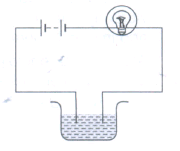
The bulb does not glow in the setup shown in figure below. List the possible reasons.Explain your answer.
4.
The ordinary water can conduct electricity while distilled water cannot. Explain why?
5.
Why does the bulb glows when electric current passes through it?
6.
What happens when common salt is added to distilled water?
7.
State, which one is better conductor of electricity sea water or drinking water.
8.
Explain the magnetic effects of electric current
9.
What is electroplating? What are its advantages?
10.
Observe the circuit given in figure.
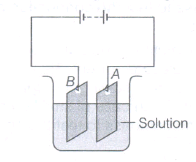
Boojho set up this circuit for purification of copper. What will be the nature of
(a) plate A
(b) plate B
(c) and the solution. Explain the process of purification
11.
Which of the following metals is used in electroplating to make objects appear shining?
Iron
Copper
Chromium
Aluminium
12.
Boojho's uncle has set up an electroplating factory near his village. He should dispose off the waste of the factory
in the nearby river
in the nearby pond
in the nearby corn field
according to the disposal guidelines of the local authority
13.
The presence of a small amount of impurities makes water
a good conductor of electricity
a bad conductor of electricity
pure
None of the above
14.
Electrolytes conduct electricity due to the movement of
electrodes
atoms
electrons
ions
15.
On passing electric current through solution of an electrolyte, the solution experiences
magnetic effect
heating effect
chemical effect
None of these
16.
________ does not corrode easily.
17.
Electroplating is used to give more...............to the cheap objects.
18.
Most of the conducting liquids are the solutions of.................,.............,and..........
19.
Distilled water is..............of the electricity
20.
The object to be electroplated is taken as.........electrode
21.
Distilled water conducts the electric current
22.
Some liquids are good conductors of electricity and some are poor conductors
23.
Electrolysis is a chemical change
24.
During the electrolysis of water, hydrogen gas is liberated at the anode
25.
Adding of sugar makes pure water conducting
26.
What is a tester?
27.
How can we check magnetic effects of current?
28.
What is distilled water?
29.
What is electric current?
30.
What are good conductors of electricity?
1.
We should not experiment with electric supply from mains as supply is very strong and of a high voltage. It may be very dangerous. We should experiment with electric cells only.
2.
The solutions of acids, bases and salts conduct electricity. This can be experimentally proved by following methods:
(i) Take three clean plastic or rubber caps of bottles.
(ii) Pour about two teaspoonfulls of distilled water in each of them.
(iii) Add few drops of lemon juice in one cap.
(iv) Add few drops of base as caustic soda in second cap.
(v) Add little salt to third cap to form salt solution.
(vi) Now conduct electricity through each. An electric current flows through all the conducting solutions thus indicating that acids, bases and salts conduct electricity.
3.
The possible reasons are as follows:
(i) The current is not produced by the given liquid and hence, bulb does not glow.
(ii) Connections are loose.
(iii) Bulb is fused.
(iv) Cells are used up.
4.
The ordinary water we get from the tap, river, lakes and ponds is not as pure as distilled water. It contains so many impurities in the form of the salts. These impurities make it good conductor of electricity. As distilled water is free from salt, it is unable to conduct electricity.
5.
Due to the heating effect of current, the filament of the bulb gets heated to a high temperature and it starts glowing. However, if the current passing through a circuit is too weak, the filament does not get heated sufficiently and it does not glow.
6.
Distilled water is not a good conductor of electricity but adding common salt make it conducting.
7.
As sea water contains more salt which increases conductivity. So, sea water is a good conductor of electricity.
8.
The electric current produces the magnetic field under which a current carrying wire behaves like a magnet.
9.
Electroplating is the process of depositing a layer of any desired metal on another metal by means of electricity.
Advantages of electroplating:
(i) It is used to coat a desired metal on another metal.
(ii) It protects the metals from corrosion.
(iii)It also prevents the metallic surface from rusting.
(iv) Some cheap and dull metals are coated with costly and shinning metals for ornamental use.
(v) It can make more reactive metals like iron less reactive.
(vi) Coating of chromium on metals gives luster to object
10.
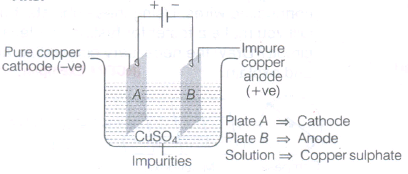
We take CuS04 solution and dip a pure copper plate as cathode (-ve) and impure copper plate as anode (+ve). Due to voltage of battery, the impurities from the impure sample slowly deposit at the bottom and the copper plate becomes purified .
11.
(c)
Chromium
12.
(d)
according to the disposal guidelines of the local authority
13.
(a)
a good conductor of electricity
14.
(d)
ions
15.
(c)
chemical effect
16.
()
plastic
17.
()
attraction/shining
18.
()
acids, bases and salts
19.
()
poor conductor
20.
()
negative
21.
(b)
22.
(a)
23.
(a)
24.
(b)
25.
(b)
26.
()
The device which is used to check current is called tester
27.
()
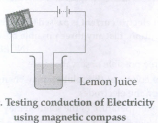
By using magnetic compass.
28.
()
The water that does not contain salts is called distilled water
29.
()
The flow of electric charge is called electric current.
30.
()
The materials that allow electric current to pass through them are called good conductors of electricity.

8th Standard CBSE Syllabus & Materials
8th Standard CBSE
CBSE 8th Science Particulate Nature of Matter - New Model Questions Papers Study Material - QB365 Set A
NEW8th Standard CBSE
CBSE 8th Science Pressure, Winds, Stroms and Cyclones - New Model Questions Papers Study Material - QB365 Set A
NEW8th Standard CBSE
CBSE 8th Mathematics Quadrilaterals - New Model Questions Papers Study Material - QB365 Set A
NEW8th Standard CBSE
CBSE 8th Mathematics A story of Numbers - New Model Questions Papers Study Material - QB365 Set A



CBSE 8th Standard CBSE Subjects
CBSE Standards




