
 100% FREE ACCESS
6th Standard CBSE Syllabus & Materials
6th Standard CBSE
CBSE 6th Social Science The Value of Work - New Sample Question Papers Study Material - QB365 Set A
NEW6th Standard CBSE
CBSE 6th Social Science Family and Community - New Sample Question Papers Study Material - QB365 Set A
NEW6th Standard CBSE
CBSE 6th Social Science India's Cultural Roots - New Sample Question Papers Study Material - QB365 Set A
NEW6th Standard CBSE
CBSE 6th Social Science India,That is Bharat - New Sample Question Papers Study Material - QB365 Set A
NEW6th Standard CBSE
CBSE 6th Social Science Timeline and sources of history - New Sample Question Papers Study Material - QB365 Set A
NEW6th Standard CBSE
CBSE 6th Social Science Oceans and Continents - New Sample Question Papers Study Material - QB365 Set A

Published on: 31/12/2018
Class Important HOTS Question
Download CBSE Class 6th Standard CBSE Mathematics question papers, sample papers, important questions, and previous year solved papers in PDF format. Get free study materials, NCERT solutions, and exam preparation resources for Class 6th Standard CBSE Mathematics
Questions + Answers key
Take MCQ Mathematics Test
1.
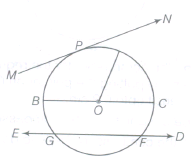
In the given figure, the diameter of the circle is GF.
2.
It is possible to find the greatest prime number.
3.
8 : 9: :24:27
4.
A horizontal line and a vertical line always intersect at right angle.
5.
1 is the smallest whole number.
6.
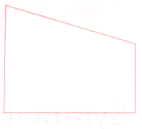
The adjacent figure is not symmetrical. Can you tell 'why not'?
7.
Give five examples of situations where you need to know the perimeter.
8.
Solve \(\frac { 2 }{ 5 } +\frac { 1 }{ 6 } \)
9.
Give expressions in the following cases.
5 times y to which 3 is added
10.
Find first three common multiples of 6 and 8
11.
Which is greater? 0.07 or 0.02
12.
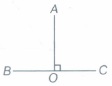
Find the angle indicated below and write name of lines, which are perpendicular to each other.
13.
Draw a number line and answer the following:
Which number will we reach, if we move 5 numbers to the left of 1?
14.
Find the sum of place and face values of 8 in 43836.
15.
Write the successor and predecessor of 2192.
16.
Consider this situation. Raju went to the market to purchase tomatoes. One shopkeeper tells him that the cost of tomatoes is Rs. 40 for 5 kg. Another shopkeeper gives the cost as 6 kg for Rs. 42. Now, what should Raju do? Should he purchase tomatoes from the first shopkeeper or from the second? Will the comparison by taking the difference help him decide? No, why not? Think of some way to help him. Discuss with your friends.
17.
If twice of a number is 6, find the number.
18.
Insert commas suitably and write the name according to International system of numeration.
(a) 78921992
(b) 7452283
(c) 99985102
(d) 48049831.
19.
The weight of 15 boxes is 60 kg. The weight of 12 boxes is ____________
20.
A diameter of a circle is the _________ chord of the circle.
21.
\(\frac{5}{17}+\frac{11}{17}\)is equal to ______ .
22.
An isosceles triangle has ______ line of symmetry.
23.
15 is a multiple of _________ and __________
24.
A _____________ represents data through pictures of objects.
25.
A pair of opposite sides of a rectangle are ____ and _____
26.
A triangle has_______vertices.
27.
25+ (... ) = 20
28.
Multiplication is distributive over ___________ for whole numbers.
29.
Cuboid
30.
Cylinder
31.
Cone
32.
All sides are of different length
33.
2 sides of equal length
34.
116 is divisible by
2
3
6
8
35.
Solve: p + 1 = 2
1
2
-1
-2
36.
The area of a rectangle of length 2 cm and breadth 1 cm is
1 cm2
2 cm2
4 cm2
8 cm2
37.
(-4)+(+3)=?
-1
1
0
+2
38.
Arrange the following numbers in ascending order: 132, 2000, 7500, 525.
7500, 2000, 525,132
132, 525, 2000, 7500
132, 525, 7500,2000
7500, 2000, 132, 525
39.
I purchased 10 litres of milk in the morning and 5 litres of milk in the evening. If the milk costs ~ 30 per litre, how much money will I have to pay to the milkman?
Rs 450
Rs 300
Rs 150
None of these
40.
The decimal 0.238 is equal to the fraction
\(\frac { 119 }{ 500 } \)
\(\frac { 238}{ 25 } \)
\(\frac { 119}{ 25 } \)
\(\frac { 119}{ 50} \)
41.
If \(\frac{5}{8} = \frac{20}{p}\) then value of p is
23
2
32
16
42.
The marks obtained by 10 students in Science test are given below:
53, 36, 95, 73, 62, 42, 25, 78, 75, 62
Answer the following questions that are related to the given data.
How many students got marks below 62?
3
4
5
2
43.
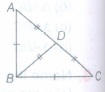
In figure, AB = BC and AD = BD = DC. Then, the number of isosceles triangles in the figure is
1
2
3
4
44.
The number of cars sold over a period of six months is represented in a pictograph given below
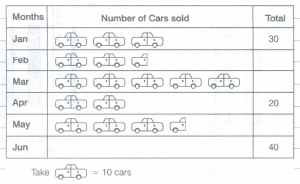
(b) Which month has the highest number of cars being sold?
(c) Find the ratio of the number of cars sold in April to the number of cars being sold in June.
45.
Monica, Heronica and Rajat begin to jog around a circular stadium. They complete their revolution in 42 s, 56 s and 63 s, respectively. How many seconds after will they be together at the starting point?
46.
Look at all these representations of fraction.
.png)
These fractions are \(\frac { 1 }{ 2 } ,\frac { 2 }{ 4 } ,\frac { 3 }{ 6 } \)representing the parts takenjrom the total numberofparts./fwe place the pictorial representation of one over the other they are found to be equal. Do you agree?
47.
State which of the following are equations (with a variable). Give reason for your answer. Identify the variable from the equations with a variable.
\(\frac { 3q }{ 2 } <5\)
48.
Get 100 using four 9's and some of the symbols like +, ÷ x, etc.
49.
Is there any other alphabet which illustrates perpendicularity?
50.
Do you know what is India's population today? Try to find this too.
1.
(b)
2.
(b)
3.
(a)
4.
(a)
5.
(b)
6.
The reason that in the given figure, there is no such line in the plane of the figure such that if we fold the figure along it. then one part of the figure fits exactly over the other half.
7.
Ex. 1. Perimeter of the top of study table
Ex. 2. Perimeter of a park
Ex. 3. Perimeter of a page of our notebook
Ex. 4. Perimeter of a field
Ex. 5. Perimeter of a wall of a room
8.
\(\frac { 2 }{ 5 } +\frac { 1 }{ 6 } =\frac { 17 }{ 30 } \)
9.
5 times of y is 5y, when 3 added to 5y, then expression is 5y +3.
10.
Multiples of 6 = 6, 12,18, 24, 30, 36, 42, 48, 54, 60, 66,72, ...
Multiples of 8 = 8, 16, 24, 32, 40, 48, 56, 64, 72, 80,88,96, ...
Hence, first three common multiples are 24, 48 and 72.
11.
We have, 0.07 or 0.02
\(\therefore \quad 0.07=0.0\times \frac { 1 }{ 10 } +7\times \frac { 1 }{ 100 } \)
\(and\quad 0.02=0+0\times \frac { 1 }{ 10 } +2\times \frac { 1 }{ 100 } \)
Here, whole parts as wells tenths parts of both numbers are same i.e. 0.
Now, hundredths part of 0.07=\(\frac { 7 }{ 100 } \)
and hundredths part of 0.02=\(\frac { 2 }{ 100 } \)
Here, 7 is greater than 2 i.e. \(\frac { 7 }{ 100 } >\frac { 2 }{ 100 } \)
Hence, 0.07 is greater than 0.02.
12.
\(\angle AOC=90°\), AO 丄 BC
13.

On the number line, starting from 1 and moving 5 points towards left (each step being equal to 1 unit), we will reach at - 4.
14.
808
15.
2193, 2191.
16.
\(\frac { 40 }{ 5 } =\frac { 8 }{ 1 } \)
\(\frac { 42 }{ 6 } =\frac { 7 }{ 1 } \)
\(\because\) 8 > 7
\(\therefore\) First shopkeeper is costlier
\(\therefore\) Tomatoes must be purchased from the second shopkeeper.
The comparison by taking difference will not help him decide as the weights of tomatoes purchased from the two shopkeepers are different.
17.
3
18.
We can draw a table to show these operations:
| Number | Number, using commas in International system of numeration | Number name |
| (a) 78921092 | 78,921,092 | Seventy eight millions nine hundreds twenty one thousands ninety two |
| (b) 7452283 | 7,452,283 | Seven millions four hundreds fifty two thousands two hundreds eighty three |
| (c) 99985102 | 99,985,102 | Ninety nine millions nine hundreds eighty five thousands one hundred two |
| (d) 48049831 | 48,049,831 | Forty eight millions forty nine thousands eight hundreds thirty one. |
19.
()
48 Kg
20.
()
longest
21.
()
We have, \(\frac{5}{17}+\frac{11}{17}=\frac{5+11}{17}=\frac{16}{17}\)
22.
()
one
23.
()
3 and 5
24.
()
Pictograph
25.
()
equal , parallel
26.
()
three
27.
()
-5
28.
We know that, multiplication is distributive over addition for whole numbers.
e.g. 2, 3, 5 are whole numbers, then 2 x (3 + 5) = 2 x 3 + 2 x 5.
29.
()

30.
()

31.
()

32.
()
Scalene
33.
()
Isosceles
34.
(a)
2
35.
(a)
1
36.
Area = 2 x 1 = 2 cm2
37.
(a)
-1
38.
(b)
132, 525, 2000, 7500
39.
(a)
Rs 450
40.
(a)
\(\frac { 119 }{ 500 } \)
41.
(c)
32
42.
(b)
4
43.
(c)
3
44.
(b) March (c) 1:2
45.
Required second of time = LCM of 42, 56 and 63
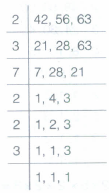
LCM = 2 x 3 x 7 x 2 x 2 x 3 = 504 s
Hence, after 504 s, they will be together at starting point.
46.
()
Yes.
47.
()
Is not an equation LHS ≠ RHS : Related variable = q
48.
()
99+\(\frac{9}{9}\) =100
49.
()
Yes.L.
50.
()
Today India's population is 1200 million.

6th Standard CBSE Syllabus & Materials
6th Standard CBSE
CBSE 6th Social Science Locating Places on the Earth - New Sample Question Papers Study Material - QB365 Set A
NEW6th Standard CBSE
CBSE 6th Science A Journey Through States of Water - New Sample Question Papers Study Material - QB365 Set A
NEW6th Standard CBSE
CBSE 6th Science Temperature and its Measurement - New Sample Question Papers Study Material - QB365 Set A
NEW6th Standard CBSE
CBSE 6th Science Materials Around Us - New Sample Question Papers Study Material - QB365 Set A



CBSE 6th Standard CBSE Subjects
CBSE Standards




