
 100% FREE ACCESS
6th Standard CBSE Syllabus & Materials
6th Standard CBSE
CBSE 6th Social Science The Value of Work - New Sample Question Papers Study Material - QB365 Set A
NEW6th Standard CBSE
CBSE 6th Social Science Family and Community - New Sample Question Papers Study Material - QB365 Set A
NEW6th Standard CBSE
CBSE 6th Social Science India's Cultural Roots - New Sample Question Papers Study Material - QB365 Set A
NEW6th Standard CBSE
CBSE 6th Social Science India,That is Bharat - New Sample Question Papers Study Material - QB365 Set A
NEW6th Standard CBSE
CBSE 6th Social Science Timeline and sources of history - New Sample Question Papers Study Material - QB365 Set A
NEW6th Standard CBSE
CBSE 6th Social Science Oceans and Continents - New Sample Question Papers Study Material - QB365 Set A

Published on: 22/09/2018
Centum Questions
Download CBSE Class 6th Standard CBSE Social Science question papers, sample papers, important questions, and previous year solved papers in PDF format. Get free study materials, NCERT solutions, and exam preparation resources for Class 6th Standard CBSE Social Science
Questions + Answers key
Take MCQ Social Science Test
1.
Tools found from Hunasagi were made of :
Wood
Limestone
Iron
Nickel
2.
One of the techniques employed to make stone tools was:
Stone to stone
Break the stone
Stone on stone
Pressure on stone
3.
Which metals were used to make ornaments?
Gold
Silver
Both (a) and (b)
None of these
4.
The Great Bath has been found in :
Harappa
Mehrgarh
Mohanjodaro
Surat
5.
Hastinapur and Atranjikhera are situated in
Bihar
Maharashtra
Rajasthan
Uttar Pradesh
6.
Ashvamedh was
Cow sacrifice
Horse sacrifice
Rat sacrifice
Elephant sacrifice
7.
Archaeologists discovered houses built by the people in Burzahom were generally made of :
marble
glass
in the ground in pits
hay
8.
Chirand is located in :
Jammu & Kashmir
Bihar
Rajasthan
TamilNadu
9.
Which crop was first grown to the North of the Vindhyas?
Wheat
Rubber
Sugarcane
Rice
10.
Which kingdom was located in the area along Ganga's tributary in the South of Ganga ?
Magadha
Taxila
Burma
Calicut
11.
This is a rock and cave shelter of Bhimbetka in the Deccan Plateau. Answer the following questions related to the cave shelter:
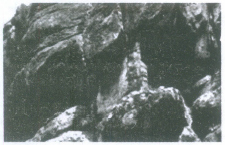
(i) What are habitation sites?
(ii) Why did people use these cave shelters as habitation sites?
(iii) In which mountain range are these rock and cave shelters found ?
(iv) Which valley is close to these rock shelters ?
12.
What type of life was there in the city of Harappa?
13.
Write two lines on Harappan seals.
14.
What are Microliths? How did the Mesolithic man use Microliths ?
15.
What was the advantage of writing on a hard surface?
16.
What are tributaries? Give example.
17.
What is the importance of wheels?
18.
Who was Charaka? Which book did he wrote ?
19.
Who could join the Sanghas?
20.
What is a Sangha?
21.
Distinguish between parallels of latitudes and meridians of longitudes.
22.
Draw the diagram of a grid.
23.
Which longitude is taken as the International Date Line and why?
24.
What were the sources of raw materials for the Harappans?
25.
What was special about the cities of Harappa?
26.
Explain the ways through which the Chiefs use to rule South India.
27.
Name the Chinese visitors who came to India. What was their aim of visit?
28.
Write about the administration of Ashoka
29.
What are the activities of the members of a tribe?
30.
This is a cave in Karle. Answer the following questions related to the picture:
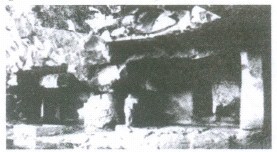
(i) Who lived in these shelters?
(ii) In which season were these caves used the most and why?
(iii)Where is this cave situated in the present day?
1.
(b)
Limestone
2.
(c)
Stone on stone
3.
(c)
Both (a) and (b)
4.
(c)
Mohanjodaro
5.
(d)
Uttar Pradesh
6.
(b)
Horse sacrifice
7.
(c)
in the ground in pits
8.
(b)
Bihar
9.
(d)
Rice
10.
(a)
Magadha
11.
(i) Habitation sites were the places where people lived. For example, rock and cave shelters.
(ii) People choose these natural caves for habitation because they provided protection from rain, sun and wind.
(iii) These rock and cave shelters are found in the Vindhyas.
(iv) These rock shelters are close to the Narmada valley.
12.
The Harappan city was a very busy place. There were people who planned the construction of special buildings in the city, People may have kept the most valuable objects, such. as ornaments of gold and silver. People also travelled to distant lands.
13.
(i) Harappan seals were rectangular in shape.
(ii) These seals were made of stone.
14.
Stone tools found during the Mesolithic period are called Microliths. They were generally tiny in size. The Mesolithic man probably stuck these stones on to the handles of bones or wood to make tools such as saws and sickles. These tools were used for digging the ground and stitching clothes.
15.
In the earlier times, writings were done on relatively hard surfaces such as blacked clay, stone or metal. Since, these objects were imperishable, these writings usually survived for a long time.
16.
Tributaries are smaller rivers that flow into a larger river, e.g., the river Son is a tributary of the river Ganga.
17.
Importance of Wheels:
(i) Pottery-making can be done.
(ii) It makes to draw water from wells.
(iii) Heavy objects can be easily transported.
(iv) Spinning of threads has become easier.
18.
Charaka was a famous ancient Indian physician. He wrote a book on medicine science known as, 'Charaka Samhita'.
19.
Sangha could be joined by brahmins, kshatriyas, merchants, labourers, barbers, courtesans and slaves.
20.
Sangha was an association of those who left their homes. As both Mahavira and Buddha felt that only those who left their homes could gain true knowledge, they arranged for them to stay together in the Sangha.
21.
The difference between parallels of latitudes and meridians of longitudes are given below:
| S.No | Parallel of Latitudes | Meridians of Longitudes |
|---|---|---|
|
(i) |
All parallel circles from the Equator up to the poles are called parallels of latitude. | All semi-circles running from North Pole to South Pole are called meridians of longitude |
| (ii) | In total, there are 180° latitudes that is 90° North and 90° South | In total, there are 360° longitudes, that is, 180° East |
| (iii) | 0° latitude is known as the Equator. | 0° longitude is known as the Prime Meridian |
| (iv) | They help to judge the climate of the places | They help to find out the time of places |
22.
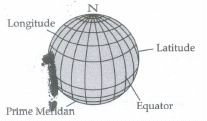
23.
The International Date Line (IDL) is an imaginary line on the surface of the Earth opposite the Prime Meridian, where the date changes as one travel across the East or West. Roughly along 180° longitude, it almost corresponds to the time zone boundary separating -12 and +12 hours, Greenwich Mean Time (GMT). Crossing the IDL, travelling east results in a day or 24 hours being added and crossing west results in a day being subtracted. The exact number of hours depends on the time zones.
24.
(i) Some of the raw materials that the Harappans used were available locally and many items such as copper, tin, gold, silver and precious stones had to be brought from distant places.
(ii) The Harappans probably got copper from present-day Rajasthan and even from Oman in West Asia.
(iii) Tin, which was mixed with copper to produce bronze, may have been brought from present day Afghanistan and Iran.
(iv) Gold could have come all the way from present day Karnataka and precious stones from present day Gujarat, Iran and Afghanistan.
25.
(i) The Harappan cities developed about 4700 years ago. Many of these cities were divided into two or more parts. Usually, the part to the West was smaller but higher. Archaeologists describe it as the citadel. Generally, the part to the East was larger but lower and it is called the lower town,
(ii) In some cities, special buildings were constructed on the citadel. For example, in Mohenjodoro, a very special tank, which archeologists call the Great Bath, was built It was lined with bricks and coated with plaster, Perhaps, important people took a dip in this tank on special occasions,
(iii) Other cities, such as Kaibangan and Lothal had fire altars where sacrifices may have been performed. And some cities like Mohenjadaro, Harappa and Lothal had elaborate storehouses. These cities were found in Punjab and Sindh in Pakistan and in Gujarat, Haryana, Rajasthan and Punjab in India.
(iv) There were people who planned the construction of special buildings in the city. They were probably the rulers.
(v) It is likely that the rulers sent people to distant lands to get metals, precious stones and other things that they wanted. They may have kept the most valuable objects, such as ornaments of gold and silver or beautiful beads for themselves.
26.
(i) The Cholas, Cheras and Pandyas were the three ruling families who became powerful in South India around 2300 years ago.
(ii) Each of the three Chiefs had two centres of power: one on land, and one on the coast.
(iii) The Chiefs did not collect regular taxes. Instead, they demanded and received gifts from the people.
(iv) They also went on military expeditions and collected tributes from neighbouring areas.
(v) They kept some of the wealth and distributed the rest amongst their supporters including members of their family, soldiers and poets.
(vi) Many poets whose compositions are found in the Sangam collection are poems in praise of the chiefs who often rewarded them with precious stones, gold, horses, elephants, chariots and fine cloth.
27.
The Chinese Buddhist pilgrims who visited India were:
(i) Fa Xian, who Came to the sub-continent about 1600years ago,
(ii) Xuan Zang who came around 1400 years ago, and
(iii) I-Qing, who came about 50 years after Xuan Zang.
Their aim was to visit places associated with the life of Buddha as well as the famous monasteries.
28.
(i) Administration: During Ashoka's time, the king was the head of the state and was assisted by 'rnantriparishad' -the council of ministers. His empire was divided into provinces and the provinces were divided into districts. Villages were the smallest units. City was the basic trade centre.
(ii) Pataliputra: The capital city was administrated by the Chief-Nagarika with the City Council of 30 members, who, in turn, had 6 boards, each board incharge of various functions. All the cities were administered like Pataliputra.
(iii) Education: It was fairly widespread and teaching was mainly the job of the Brahmins. Buddhist monasteries were the educational institutions. Famous educational centers were established in Taxila, Ujjain, and Varanasi.
(iv) Revenue: The income for the empire came through taxes which were both in cash and kind, levied on land holding and trade. Tax collection was hardly very strict.
(v) Army: The army was very huge and functioned under Senapati who directly reported to the king. The Soldiers were well equipped with swords, bows and arrows and spears and were looked after very well. Army was divided into six branches. They were: Cavalry, Infantry, Chariots, Elephants, Transport and Navy.
(vi) Economy: The administrators helped villagers by clearing forest area and starting new settlements. They also helped people start agriculture and animal husbandry.
29.
(i) The members of a tribe follow occupations such as hunting, gathering, farming, herding and fishing.
(ii) Women do most of the agricultural work like preparing the ground, sowing seeds, looking after the growing plants and harvesting grain.
(iii) Children often look after plants, driving away animals and birds that might eat them. The cleaning of animals and milking, is done by both men and women.
(iv) Both women and men make pots, baskets, tools and huts. They also take part in singing, dancing and decorating their huts.
30.
(i) Buddhist monks and nuns lived and meditated in these shelters.
(ii) These raves were used by the monks and nuns in tile rainy season because during this season it was very difficult to travel.
(iii) This cave is in Karle, which is in present day Maharashtra.

6th Standard CBSE Syllabus & Materials
6th Standard CBSE
CBSE 6th Social Science Locating Places on the Earth - New Sample Question Papers Study Material - QB365 Set A
NEW6th Standard CBSE
CBSE 6th Science A Journey Through States of Water - New Sample Question Papers Study Material - QB365 Set A
NEW6th Standard CBSE
CBSE 6th Science Temperature and its Measurement - New Sample Question Papers Study Material - QB365 Set A
NEW6th Standard CBSE
CBSE 6th Science Materials Around Us - New Sample Question Papers Study Material - QB365 Set A



CBSE 6th Standard CBSE Subjects
CBSE Standards




