
 100% FREE ACCESS
6th Standard CBSE Syllabus & Materials
6th Standard CBSE
CBSE 6th Social Science The Value of Work - New Sample Question Papers Study Material - QB365 Set A
NEW6th Standard CBSE
CBSE 6th Social Science Family and Community - New Sample Question Papers Study Material - QB365 Set A
NEW6th Standard CBSE
CBSE 6th Social Science India's Cultural Roots - New Sample Question Papers Study Material - QB365 Set A
NEW6th Standard CBSE
CBSE 6th Social Science India,That is Bharat - New Sample Question Papers Study Material - QB365 Set A
NEW6th Standard CBSE
CBSE 6th Social Science Timeline and sources of history - New Sample Question Papers Study Material - QB365 Set A
NEW6th Standard CBSE
CBSE 6th Social Science Oceans and Continents - New Sample Question Papers Study Material - QB365 Set A

Published on: 31/12/2018
Class 6 Model Question
Download CBSE Class 6th Standard CBSE Science question papers, sample papers, important questions, and previous year solved papers in PDF format. Get free study materials, NCERT solutions, and exam preparation resources for Class 6th Standard CBSE Science
Questions + Answers key
Take MCQ Science Test
1.
Why is water called universal solvent?
2.
Why do wet clothes placed on a clothesline get dry after some time? Explain.
3.
Some animals cannot cope in low temperature habitat. What happens to them?
4.
Identify the kind of stem in the following plants.
(a) Money plant (b) Bean stalk (c) Gourd plants (d) Grapevines
5.
An essential food is provided by bees. What is it?
6.
The device used to break an electric circuit is called________.
7.
What is the name of water habitat in which plants and animals live?
8.
Dried leaves ______________ on the surface of water.
9.
In rectilinear motion, object moves _________________a______________ line.
10.
An average person should drink __________ glasses of water daily.
11.
Which of the following is an amphibian?
Man
Dove
Fish
Frog
12.
The image formed in water is :
Erect
Diminished
Inverted
Enlarged
13.
Among the following items from waste, which item can be recycled?
Waste paper
Leather shoes
Animal waste
Kitchen waste
14.
Transpiration is a process in which plants
receive water from soil
absorb water vapour from air
prepare food from water
release water in the form of water vapour
15.
Which one of the steps while burning a candle is not reversible?
Melting of solid wax
Wax vapour burn into flame
Liquid wax changes into vapours
All of the above
16.
Fibres are made up of yams.
17.
Fruit is a matured ovary.
18.
Artificial magnets were discovered in Greece.
19.
Mirror does not change the direction of light falls
20.
When ice melts to form water, then a change occurs in its state.
21.
Identify the wrong statements and correct them.
(a) Anther is a part of the pistil.
(b) The visible parts of a bud are the petals.
(c) Lateral roots are present in a tap root.
(d) Leaves perform the function of transpiration only.
22.
What is a shadow? Explain a simple process for shadow formation.
23.
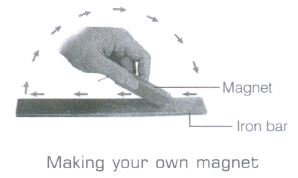
Describe the steps involved in the magnetising of an iron strip with the help of a magnet.
24.
Explain the following observations briefly.
(a) A firki does not rotate in a closed area.
(b) The arrow of weather cock points towards a particular direction at a particular moment.
(c) An empty glass in fact is not empty.
(d) Breathing through mouth may harm you.
25.
Rohan and his friends planned to play cricket match on sunday morning. But, by chance on saturday, Rohan got high fever. Due to high fever, his parents did not allow him to play cricket. So, Rohan was very upset. But his father suggested to him that he can see the cricket match that his friends were playing in the park through a glass window, although the window will be closed
Read the above passage and answer the following questions.
(a) How Rohan was abie to see the cricket match, although the window was closed?
(b) Write different types of materials based on their transparency.
(c) What values are shown by Rohan's father?.
26.
Femur
27.
Fixed joint
28.
Joint
29.
Snails
30.
Human being
31.
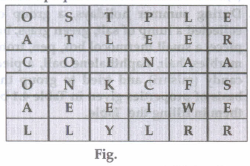
Pick five objects from the word box given in Fig. which are opaque and would sink in water.
32.
Shikha has placed rose under shrubs. Is she correct? Justify
33.
List some differentiating features between composting and vermicomposting.
34.
Briefly explain about the components present inside the cell.
35.
Two animals X and Y are present in the same habitat called grassland. The animal X is a herbivore. It has eyes on the sides of its head and big ears. It is very agile animals. The animal Yis a carnivore. It has eyes in the front of the head. This animal has long, strong sharp claws in its front legs which can tear flesh easily and withdraw inside the toes. It also runs very fast.
(a) Can you recognise animal X and Y?
(b) List the benefit of animal X or having eyes on the sides of the head?
(c) Mention the advantage of animal Yfor having eyes in front of its head?
36.
State whether the following statements are true or false. If false, correct them.
(a) Silk is a plant fibre.
(b) Jute is obtained from the leaves of a plant.
(c) Weaving is a process of arranging two sets of yarn together.
(d) Cotton yarn on burning gives an odour similar to that of a burning paper.
37.
Name the joint where our neck joins the head.
38.
A cement bag left open gets hard after some time, what type of change it is ?
39.
When does lunar eclipse occur ?
40.
Which cereal-fields have rows of plants?
1.
Water is called universal solvent as it can dissolve maximum materials.
2.
Wet clothes placed on a clothesline get dry after some time due to evaporation. In this process, water present in wet clothes is converted into water vapour which is released into atmosphere .
3.
Animals unable to cope in harshen conditions go to sleep to prevent extreme cold and food shortage, this is known as hibernation.
4.
Bean stalk, gourd plants money and grapevines plants all have weak stem but readily climbs up a neighbouring support or a tree. These plants are called climbers.
5.
We get honey from bees as a food product. It is highly nutritious, rich in sugars, minerals and enzymes.
6.
()
switch
7.
()
Aquatic habitat.
8.
()
float
9.
()
in, straight
10.
()
8 -12
11.
(d)
Frog
12.
(a)
Erect
13.
(a)
Waste paper
14.
(d)
release water in the form of water vapour
15.
(b)
Wax vapour burn into flame
16.
(b)
17.
(a)
18.
(a)
19.
(b)
20.
(a)
21.
Wrong statements :
(a) Anther is a part of the pistil.
Correct statement: Anther is a part of the stamen.
(b) The visibleparts of a bud are the petals.
Correct statement: The visible parts of a bud are the sepals.
(d) Leaves perform the function of transpiration only.
Correct statement: Leaves perform the functions of both photosynthesis and transpiration.
22.
Opaque objects do not allow light to pass through them. When an opaque object is placed in the path of light, then the light is obstructed by the object leading to the formation of a dark patch known as the shadow of that object, which can be taken on a screen placed behind it.
Shadow formation: To form a shadow, there must be (i) a light source (ii) a screen (iii) an opaque object placed between the light source and the screen. For shadow formation, we can follow the given steps
Step 1: Take an opaque object.
Step 2: Throw light on it from a light source.
Step 3: Put a screen behind the object. In this way, a shadow of an object can be obtained on the screen.
In this way, a shadow of an object can be obtained on the screen.
23.
Steps involved in the magnetising of an iron strip are
(i) Take an iron strip which is to be magnetised.
(ii) Keep it in a wooden table.
(iii) Hold one end of bar magnet in your hand and keep the other end of bar magnet at one end of iron bar.
(iv) Without lifting, move the lower end of bar magnet to the end of iron bar.
(v) After reaching end of iron bar, lift the bar magnet and bring it to the same position and repeat the process again and again.
24.
(a) Motion of firki is based on the pressure/force applied by air on the blades of the firki. A firki does not rotate in a closed area because of lack of air movement.
(b) The arrow of weather cock points towards a particular direction as it shows the direction in which the air is moving at that place at a particular moment.
(c) An empty glass in fact is not empty. It is filled with air. Air is present everywhere.
(d) Breathing through mouth may harm us because we may inhale dust if present in air which is harmful.
25.
(a) Rohan was able to see the cricket match through glass window panes which were transparent.
(b) On the basis of transparency different types of materials are
(i) Transparent materials like glass, water air.
(ii) Opaque materials like wood, cardboard metal container.
(iii) Translucent materials like oil paper, butter paper.
(c) Rohan's father is caring and helpful.
26.
()
Thigh bone
27.
()
Skull joints
28.
()
A place where two bones meet together.
29.
()
Move by the muscular foot.
30.
()
Legs
31.
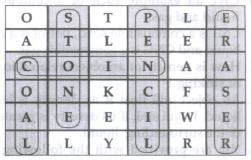
(i) Coal
(ii) Stone
(iii) Coin
(iv) Pencil
(v) Eraser
32.
Yes, she is correct. Rose is categorised as a shrub because it displays the following characteristics:
(i) These are medium-sized plants with least thickness and height.
(ii) It has woody stem.
(iii)These are generally bushy.
(iv)Branches are slightly above the ground.
(v) Roses are generally used for ornamental purposes.
33.
Composting It is a natural process by which biodegradable waste like leaves can be turned into manures by the use of microbes only.
Vermicomposting In this process, manure is formed from the waste by use of redworms along with the microbes.
34.
The cell consists of a carbon rod present of the centre of the zinc container. By the side, metal cup present is positive terminal and opposite to that is a metal disc which is of negative terminal.
35.
(a) Yes, X is dear and Y is lion
(b) The eyes on the sides of the head enables the deer to see in all directions at the same time.
(c) The eyes in front of its head enables the lion to have correct idea of the location of its prey like deer.
36.
()
(a) False, as silk is an animal fibre.
(b) False, as jute is obtained from the stem of a plant.
(c) True
(d) True
37.
()
The joint where our neck joins the head is a pivotal joint.
38.
()
Chemical change.
39.
()
When earth comes between sun and moon
40.
()
Paddy and Wheat.

6th Standard CBSE Syllabus & Materials
6th Standard CBSE
CBSE 6th Social Science Locating Places on the Earth - New Sample Question Papers Study Material - QB365 Set A
NEW6th Standard CBSE
CBSE 6th Science A Journey Through States of Water - New Sample Question Papers Study Material - QB365 Set A
NEW6th Standard CBSE
CBSE 6th Science Temperature and its Measurement - New Sample Question Papers Study Material - QB365 Set A
NEW6th Standard CBSE
CBSE 6th Science Materials Around Us - New Sample Question Papers Study Material - QB365 Set A



CBSE 6th Standard CBSE Subjects
CBSE Standards




