
 100% FREE ACCESS
6th Standard CBSE Syllabus & Materials
6th Standard CBSE
CBSE 6th Social Science The Value of Work - New Sample Question Papers Study Material - QB365 Set A
NEW6th Standard CBSE
CBSE 6th Social Science Family and Community - New Sample Question Papers Study Material - QB365 Set A
NEW6th Standard CBSE
CBSE 6th Social Science India's Cultural Roots - New Sample Question Papers Study Material - QB365 Set A
NEW6th Standard CBSE
CBSE 6th Social Science India,That is Bharat - New Sample Question Papers Study Material - QB365 Set A
NEW6th Standard CBSE
CBSE 6th Social Science Timeline and sources of history - New Sample Question Papers Study Material - QB365 Set A
NEW6th Standard CBSE
CBSE 6th Social Science Oceans and Continents - New Sample Question Papers Study Material - QB365 Set A

Published on: 31/12/2018
Class 6 Unit Test
Download CBSE Class 6th Standard CBSE Social Science question papers, sample papers, important questions, and previous year solved papers in PDF format. Get free study materials, NCERT solutions, and exam preparation resources for Class 6th Standard CBSE Social Science
Questions + Answers key
Take MCQ Social Science Test
1.
There are almost one crore street vendors working
Rural areas
Urban areas
both (a) and (b)
None of these
2.
Which of the following stations in India has an equable climate
Delhi
Nagpur
Bikaner
Kanyakumari
3.
Pole Star tells the
Western direction
Eastern direction
Southern direction
Northern direction
4.
When did South Africa become a democratic country?
In 1914
In 1920
In 1994
In 1979
5.
Kanishka was a:
Gupta ruler
Kushana ruler
Maurya ruler
Pala ruler
6.
The arrangement made by the people for the dead was:
funeral pyre
coffins
mummies
burials
7.
Which of the following crops is grown in
Rice
Wheat
Soyabean
Sunflower
8.
Which of the following is the largest ocean?
Pacific ocean
Atlantic ocean
Indian ocean
Antarctic ocean
9.
When do both boys and girls cry?
When they are weak
When they are strong
When they are angry
When they are happy
10.
From which Vedic group, Buddha belonged to?
Brahman
Kshatriya
Shudra
Vaishya
11.
How do burials help in understanding social differences?
12.
Why did people travel from one part of the subcontinent to another?
13.
How does the caste system bar equality?
14.
Name the strait between India and Sri Lanka.
15.
In Maya's story did the government support the idea that people are equal ?
16.
Why is the Earth called a unique planet?
17.
Mark the following Janapadas and Mahajanapadas on the outline map of India:
(i) Taxila (ii) Ujjain (iii) Vaishali (iv) Magadha (v) Gandhara (vi) Avanti
18.
Pune, being a big city, has a Municipal Corporation.
19.
As we go higher, the climate becomes hotter.
20.
Years are counted with reference to the birth of Christ.
21.
Rajas who let the ashvamedha horse pass through their lands were invited to the sacrifice.
22.
The ruler of Northern India was called Dakshinapatha.
23.
The capital of Kosala
24.
Priests performed religious rituals at
25.
Jatakas
26.
Pradakshina patha
27.
Shikhara
28.
He was born into the________caste, which was considered untouchable.
29.
When do we observe a leap year?
30.
South African people were divided into _____________ Indian and races.
31.
The ____________contain stories about God and Goddesses.
32.
Siberian Cranes arrive in ______________ and stay till early ________________
33.
Write a few lines on the wildlife of India
34.
Explain the features of seals.
35.
Who all were involved in rituals and what functions did they perform?
36.
Look at the pictures given below carefully and answer the following questions:
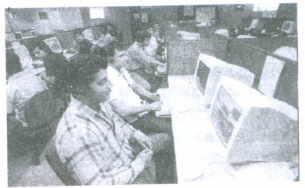
(i) Describe the work condition at all centres. Why are many call centres set up in India?
(ii) Where do we find a labour?
37.
Write a short note on the Cauvery water dispute between Karnataka and Tamil
Nadu.
38.
Write short notes on the following:
(i) Indian ocean (ii) Pacific ocean
(iii) Arctic ocean (iv) Antarctic ocean
39.
Name one Dalit person who was the member of the Constituent Assembly of India?
40.
What is the distance between the Sun and the Earth?
41.
What is the language of the Rigveda?
42.
How much does Bachchu Manjhi earn per day?
43.
Why the lava plateaus are good for cultivation?
1.
(b)
Urban areas
2.
(d)
Kanyakumari
3.
(d)
Northern direction
4.
(c)
In 1994
5.
(b)
Kushana ruler
6.
(d)
burials
7.
(c)
Soyabean
8.
(a)
Pacific ocean
9.
(c)
When they are angry
10.
(b)
Kshatriya
11.
Archaeologists think that objects found with a skeleton probably belonged to the dead person.
(i) Sometimes, more objects are found in one grave than in another. For example, in Brahmagiri, one skeleton was buried with 33 gold beads, 2 stone beads, 4 copper bangles and one conch shell. Other skeletons had only a few pots.
(ii) These findings suggest that there was some difference in status amongst the people who were buried. Some were rich, others poor, some chiefs, while others were followers.
12.
(i) They moved in search of livelihood.
(ii) Men marched in armies to conquer the other lands.
(iii) Merchants travelled with caravans or ships to sell goods.
(iv) Some people travelled to discover new places.
13.
The society was divided into different groups depending upon the work that people did and they were supposed to remain in those groups.
If one's parents were potters, then that person could only become a potter and one's profession denoted his/her caste. So this created a situate of inequality.
14.
The strait that lies between India and Sri Lanka is Palk strait.
15.
In Maya's story, the government did not support the idea that people are equal. Sharp differences were seen between the whites and non-whites. The whites availed all privileges while the non-whites had to face hardships. They had no voting rights like the whites.
16.
The life supporting conditions are available only on the Earth and the life on Earth makes it a unique planet.
17.
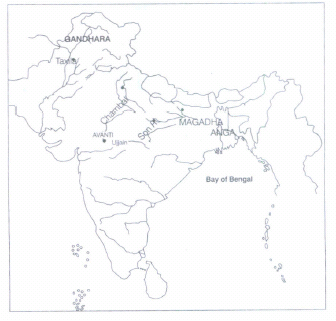
18.
(a)
19.
(b)
20.
(a)
21.
(a)
22.
(b)
23.
()
Ayodhya
24.
()
Garbhagriha
25.
()
Stories told by ordinary people
26.
()
Circular path around the stupa
27.
()
Tower
28.
()
Mahar
29.
()
We observe a leap year after every four years.
30.
()
White, Black Coloured
31.
()
Puranas
32.
()
December, March
33.
There are thousands of species of animals and a large variety of reptiles, amphibians, mammals, birds, insects and worms which dwell in the forest of India.
(i) The tiger is our national animal. It is found in various parts of the country. Gir forest in Gujarat is the home of Asiatic lions.
(ii) Elephants and one-horned rhinoceroses roam in the forests of Assam. Elephants are also found in Kerala and Karnataka.
(iii) Camels and wild asses are found in the Great Indian desert and the Rann of Kuchchh.
(iv) Wild goats, snow leopards, bears, etc. are found in the Himalayan region.
(v) Besides these, many other animals are found in our country such as monkey, wolf, jackal, nilgai, cheetah, etc.
(vi) There are several hundreds of species of snakes found in India. Cobras and kraits are important among them. India is equally rich in bird life.
(vii) The peacock is our national bird. Other common birds are parrots, pigeons, mynah, geese, bulbul and ducks.
(viii) There are several bird sanctuaries which have been formed to give birds their natural habitat. These provide the birds with protection from hunters.
34.
(i) Seals are clay tablets have been found from various Harappan sites. They have figures of animals, trees and various letters carved on them.
(ii) Seals may have been used to stamp bags or packets containing goods that were sent from one place to another.
(iii) After a bag was closed or tied, a layer of wet clay was applied on the knot and seal was pressed on it
(iv) The impression of the seal is known as sealing. If the sealing was intact, one could be sure that the goods cased arrived safely.
35.
(i) Priests: Rituals were performed by specially trained priests, who were rewarded with gifts by the Rajas.
(ii) Charioteer: He was the Raja's companion in the battlefield and witnessed his campaigns and chanted tales of his glory.
(iii) Rajas wives and sons: They had to perform a variety of minor rituals.
(iv) Other Rajas: They were simply spectators who had to sit and watch the performance of the sacrifice.
(v) The ordinary people, the Vish or Vaishya brought gifts for Raja.
36.
(i) Call centres are generally set-up as large rooms with work stations that include a computer, a telephone set and supervisor's stations. India has become a major centre not only for Indian companies but also foreign companies. They set-up call centres here as they can get people who can speak English and will work for lower wages.
(ii) We find labour at labour chowk where many people were sitting on railings or in groups at the crossing These labourers are daily wage labourers.
37.
Cauvery Water Dispute
• River Cauvery flows through Karnataka and Tamil Nadu.
Two dams have been constructed on this river:
(i) Krishnasagar dam has been constructed on Cauvery in Karnataka.
(a) It stores water which is used in irrigation in several districts of Karnataka.
(b) It also meets the water needs of Bangalore city.
(ii) Mettur dam has been constructed in Tamil Nadu.
(a) Its water is used in crop irrigation in the delta regions of Tamil Nadu.
(iii) Downstream dam of Mettur can be filled up only if water from upstream dam Krishnasagar is released.
(iv) Neither of the two states gets as much water as per their requirement.
(v) Due to these two dams being on the same river, a conflict has arisen.
38.
(i) Indian ocean The Indian ocean is the only ocean named after a country, India. The shape of this ocean is almost triangular. It is bound by Asia in the North, in the West by Africa and in the East by Australia. (ii) Pacific ocean The Pacific ocean is the largest ocean. It is spread over one-third of the earth. The Pacific ocean is almost circular in shape. Asia, Australia, North America and South America surround it.
(iii) Arctic ocean It is connected with the Pacific ocean by a narrow stretch of shallow water called Berring strait.
The Arctic ocean is located within the Arctic Circle and surrounds the North Pole. It is bound by Northern coasts of North America and Eurasia.
(iv) Antarctic ocean The Southern ocean encircles the continent of Antarctica and extends northward to 60 degrees South latitude. Most of the time, it is covered with thick ice.
39.
()
Dr. Bhim Rao Ambedkar, a Dalit, was the member of the Constituent Assembly of India. He belonged to Mahar caste.
40.
()
The distance between the Sun and the Earth is 150 million km approximately.
41.
()
The Rigveda is in old or Vedic Sanskrit
42.
()
Bachchu Manjhi earns Rs 80-1 00 every day
43.
()
Lava plateaus are rich in black soil that is fertile and good for cultivation.

6th Standard CBSE Syllabus & Materials
6th Standard CBSE
CBSE 6th Social Science Locating Places on the Earth - New Sample Question Papers Study Material - QB365 Set A
NEW6th Standard CBSE
CBSE 6th Science A Journey Through States of Water - New Sample Question Papers Study Material - QB365 Set A
NEW6th Standard CBSE
CBSE 6th Science Temperature and its Measurement - New Sample Question Papers Study Material - QB365 Set A
NEW6th Standard CBSE
CBSE 6th Science Materials Around Us - New Sample Question Papers Study Material - QB365 Set A



CBSE 6th Standard CBSE Subjects
CBSE Standards




