
 100% FREE ACCESS
8th Standard CBSE Syllabus & Materials
8th Standard CBSE
CBSE 8th Social Science Theme D - Factors of Production - New Model Questions Papers Study Material - QB365 Set A
NEW8th Standard CBSE
CBSE 8th Social Science Theme C - Universal Franchise and India's Electoral System - New Model Questions Papers Study Material - QB365 Set A
NEW8th Standard CBSE
CBSE 8th Social Science Theme B - The Rise of the Marathas - New Model Questions Papers Study Material - QB365 Set A
NEW8th Standard CBSE
CBSE 8th Social Science Theme B - Reshaping India's Political Map - New Model Questions Papers Study Material - QB365 Set A
NEW8th Standard CBSE
CBSE 8th Social Science Theme A - Natural Resources and Their Use - New Model Questions Papers Study Material - QB365 Set A
NEW8th Standard CBSE
CBSE 8th Science Keeping Time with Skies - New Model Questions Papers Study Material - QB365 Set A

Published on: 15/09/2018
Model Question
Download CBSE Class 8th Standard CBSE Mathematics question papers, sample papers, important questions, and previous year solved papers in PDF format. Get free study materials, NCERT solutions, and exam preparation resources for Class 8th Standard CBSE Mathematics
Questions + Answers key
Take MCQ Mathematics Test
1.
Write the terms and co-efficients of 1 + x + x2
2.
Carry out the following divisions.
34x3y3z3 ÷ 51xy2z3
3.
Write the coordinates of the vertices of each of these adjoining figures.
4.
If the cost of 10 pencils is Rs 90. Find the cost of 19 pencils?
5.
Check the divisibility of the following number by 10: 400
6.
If 400 students voted in all, then how many did vote 'others' colour as their favourite?
7.
How many non square numbers lie between the following pairs of numbers ? 10002 and 10012
8.
Write five rational numbers greater than -2.
9.
Can you construct the quadrilateral PLAN, if PL = 6 cm, LA = 9.5 cm, \(\angle \)P = 75°, \(\angle \)L = 150° and \(\angle \)A = 140°?
10.
Solve the following equations 1.6 = \(\frac { y }{ 1.5 } \)
11.
Solve the following linear equations:
m-\(\frac{m-1}{2}\)=1-\(\frac{m-2}{2}\)
12.
The following graph shows the number of people present at a certain shop at different times. Observe the graph and answer the following questions.
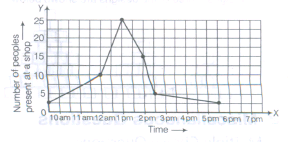
(a) What type of graph is this?
(b) What information does the graph give?
(c) What is the busiest time of day at the shop?
(d) How many people enter the shop, when it opens?
(e) About how many people are there in the shop at 1: 30 pm?
13.
During a mass drill exercise, 6250 students of different schools are arranged in rows such that the number of students in each row is equal to the number of rows. In doing so, the instructor finds out that 9 children are left out. Find the number of children in each row of the square. What is the value depicted from the exercise?
14.
The table shows the portion of some common materials that are recycled.
| Material | Recycled |
| Paper | \({5\over11}\) |
| Aluminium cans | \({5\over8}\) |
| Glass | \({2\over5}\) |
| Scrap | \({3\over4}\) |
(a) Is the rational number expressing the amount of paper recycled more than \({1\over2}\)or less than \({1\over2}\) ?
(b) Which items have a recycled amount less than \({1\over2}\) ?
(c) Is the quantity of aluminium cans recycled more (or less) than half of the quantity of aluminium cans?
(d) Arrange the rate of recycling the materials from the greatest to the smallest.
(e) What do you understand from recycling and how it is useful?
15.
You are told that 1331 is a perfect cube. Can you guess without factorisation what is its cube root? Similarly, guess the cube roots of 4913, 12167, 32768.
16.
Construct the following quadrilaterals. Rhombus BEST BE = 4.5 cm, ET = 6 cm
17.
x4 + x2y2+y4
18.
a2 + 2ab + b2
19.
If the interest compounded half yearly the rate of interest becomes ___________
20.
The parallelogram that is inscribed in a circle is a
21.
The coordinates of C are (3,0). It lies on:
22.
Volume of cuboid ABCDEFG
23.
0.81
24.
Cube root of 21952
25.
In a kite, diagonals are
26.
Rational numbers are not associative for
27.
The smallest 3-digit perfect square is
999
100
961
125
28.
The simple interest of Rs. 500 at the rate I of 5% is Rs.100. This interest is of the time.
1 year
4 years
10 years
20 years
29.
The factorisation of x2 - 9 is
(x - 3)2
(x + 3)2
(x + 3)(x - 3)
none of these.
30.
In a regular polygon of n sides, the measure of each internal angle is
\({360^\circ\over n }\)
\(({2n-4\over n})90^\circ\)
n 90°
2n right angles
31.
Observe the following bar graph carefully and answer the following question.
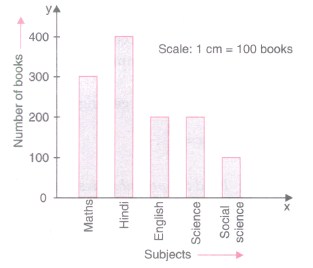
The total of the number of books of English and Science is
200
100
400
0
32.
Which of the following is true for a ratio?
the quantities are always in the same unit.
the quantities may be in different unit.
the quantities are always in different units.
none of the above.
33.
What should be subtracted from \(\frac { -3 }{ 4 } \) to get - 1?
\(\frac { 1 }{ 4 } \)
\(-\frac { 1 }{ 4 } \)
1
\(-\frac { 3 }{ 4 } \)
34.
What will be the side of a rhombus whose diagonals are 10 em and 24 em long?
15 em
17 em
18 em
13 em
35.
The value of \(\frac{1}{9^{-2}}\) is
27
81
-81
18
36.
Which of the following is the top view of the given shape?
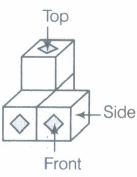
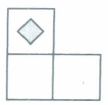
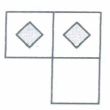
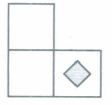
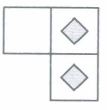
37.
Factorise: 3x2 - 9xy + 5x - 15y
38.
If 52 men can do a piece of work in 35 days, in how many days 28 men will do it?
39.
How many small cubes with edge of 30 cm each can be just accommodated in a cubical box of 3 m edge?
40.
Draw the net of a regular tetrahedron with side 5 cm.
41.
Add the following:
21a2bc,-45abc2,18a2bc,21abc2
42.
Is there a number which is equal to its cube but not equal to its squares? If yes find it.
43.
Leela invited some friends for tea on her birthday. Her mother placed some plates and some puris on a table to be served. If Leela places 4 puris in each plate 1 plate would be left empty. But if she places 3 puris in each plate 1puri would be left. Find the number of plates and number of puris on the table.
44.
Take a clock and fix its minute hand at 12.
Record the angle turned through by the minute hand from its original position and the time that has passed, in the following table:
| Time Passed (T) (in minutes) |
(T1) 15 | (T2) 15 | (T3) 45 | (T4) 60 |
|---|---|---|---|---|
| Angle turned (A) (in degree) | (A1) 90 | (A2) __ | (A3) __ | (A4) __ |
| \(T\over A\) | - | - | - | - |
What do you observe about T and A? Do they increase together? Is \(T\over A\) same every time?
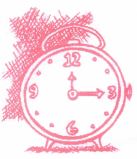
Is the angle turned through by the minute hand directly proportional to the time that has passed? Yes; From the above table, you can also see
T1 : T2 = A1 A2, because
T1 : T2 = 15 30= 1 :2
A1 : A2 = 90 180 = 1 :2
Check if T2: T3 = A2 A3 and T3 : T4 = A3 : A4
You can repeat this activity by choosing your own time interval.
45.
Present the following data in the form of a grouped frequency distribution table having 6 classes of equal size (one of the class being 40-48):
| 30 | 39 | 58 | 17 | 34 | 50 | 23 | 37 |
| 42 | 49 | 55 | 59 | 19 | 28 | 47 | 49 |
| 18 | 60 | 56 | 36 | 58 | 35 | 55 | 37 |
| 25 | 34 | 39 | 61 | 53 | 33 | 36 | 53 |
| 61 | 62 | 39 | 53 | 21 | 18 | 28 | 23 |
1.
Terms: 1,+x,+x2 Co-efficients: 1,1,1
2.
34x3y3z3 ÷ 51xy2z3=\(\frac{2}{3}x^{2}y\)
3.
(i) In the rectangle OABC, the coordinates of O is (0, 0), A is (2, 0), B is (2, 3) and C is (0, 3)
(ii) In the parallelogram PQRS, the coordinates of Pis (4, 3), Qis (6, 1), R is (6, 5) and S is (4, 7)
.png)
(iii) In the ΔKLM, the coordinates of K is (10, 5), Lis (7, 7) and Mis (10, 8).
4.
It is the case of direct proportion.
Let number of pencils be x and cost of pencil be Rs.y
\(x\propto y\)
x1 =10, y1 = Rs.90, x2 =19,y2 =?
Using formula,
\(\frac { { x }_{ 1 } }{ { y }_{ 1 } } =\frac { { x }_{ 2 } }{ { y }_{ 2 } } \Rightarrow \frac { 10 }{ 90 } =\frac { 19 }{ { y }_{ 2 } } \)
y2 x 10 = 90 \(\times\)19
\(\ { \therefore y }_{ 2 }=\frac { 90\times 19 }{ 10 } =171\)
So, cost of 19 pencils is Rs.171.
5.
Yes
6.
48
7.
Given, pair of numbers 10002 and 10012.
Non-square numbers between 10002 and 10012 = 2n
= 2 \(\times\) 1000 = 2000 [\(\because\) n = 1000]
8.
There are infinitely many rational numbers greater than -2.
Five of them are \({-3\over2},{-1},{-1\over2},0,{1\over2}\)
9.
No, since, using angle sum property of a quadrilateral PLAN, we see that
\(\angle\) P+ \(\angle\)L + \(\angle\)A + \(\angle\)N=75° + 150°+ 140° + \(\angle\)N
= 365°+ \(\angle\)N, which is greater than 360°.
But sum of all the interior angles of a quadrilateral must be equal to 360°. So, construction of quadrilateral PLAN is not possible.
10.
We have 1.6 =\(\frac { y }{ 1.5 } \) \(\Rightarrow\) 1.6 x 1. 5 = \(\frac { y }{ 1.5 } \) x 1.5 [multiplying both sides by 1.5]
1.6 x 1.5 = y \(\Rightarrow\) 2.40 = y
y = 2.4, Which is the required solution
11.
m-\(\frac{m-1}{2}\)=1-\(\frac{m-2}{2}\)
We have m-\(\frac{m-1}{2}\)=1-\(\frac{m-2}{2}\)
It is a linear equation since it involves linear expressions only.
\(\Rightarrow\) m-\(\frac{m}{2}+\frac{1}{2}\)=1-\(\frac{m}{3}+\frac{1}{3}\)
\(\Rightarrow\) m-\(\frac{m}{2}+\frac{m}{3}\)=1+\(\frac{2}{3}+\frac{1}{2}\)
Transposing -\(\frac{m}{3}\)to LHS and \(\frac{1}{2}\)to RHS
\(\Rightarrow\) \(\frac { 6m-3m+2m }{ 6 } =\frac { 6+4-3 }{ 6 } \)
Taking LCM
\(\Rightarrow\) \(\frac { 5m }{ 6 } =\frac { 7 }{ 6 } \)
\(\Rightarrow\) m = \(\frac { 7 }{ 6 } \times \frac { 6 }{ 5 } =\frac { 7 }{ 5 } \)
Multiplying both sides by \(\frac{6}{5}\)
This is the required solution.
12.
(a) This a line graph.
(b) It represents the number of people, who visited the store at a particular time.
(c) The busiest time of day is 1 pm at a shop.
(d) When, it opens less than 5 people enter the shop.
(e) There are 20 people in the shop at 1 : 30 prn.
13.
Total number of students = 6250
Number of students forming a square = 6250 - 9
= 6241
Thus, 6241 students form a big square which has number of rows equal to the number of students in each row.
Let the number of students in each row be x, then the number of rows will be x.
Therefore, x x x = 6241 \(\Rightarrow\) x = \(\sqrt { 6241 } \) = 79
Hence, there are 79 students in each row of the square formed.
The value depicted here is that exercise is essential for good health. It makes our body fit and strong.
14.
\((a) \because {1\over2}={1\over2}\times{11\over11}={11\over22} and {5\over11}={5\over11}\times{2\over2}={10\over22}\)
So, paper recycled is less than \({1\over2}\)
\((b) Similarly ,{5\over8}is \ greater \ than {1\over2}(={4\over8})\)
\(\\ Also, {2\over5}={2\times2\over5\times2}={4\over10}<{1\over2}(={5\over10})\)
\(\\ and {3\over4}>{1\over2}(={2\over4}) \)
So, the quantity of paper and glass recycled is less than \({1\over2}\)
(c) Quantity of cans = \({5\over8}(={10\over16})\) is more than half of the quantity of aluminium cans
\(={5\over8}\times {1\over2}={5\over16}\)
(d) Scrap> Aluminium cans> Paper> Glass
(e) Recycling is the process, which reduce our wastage and create the same matter from the used part of the matter and hence, it is very useful
15.
Yes,we can guess without prime factorisation. Firstly, we separate1331 into two groups (i.e. one's, tens and hundred's place digit and remaining digit).
So, we separate the given number 1331 into two groups as 331 and 1.
Take first group number 331, whose one's digit is 1.
∴ Unit's digit of cube root of 1 = 1
and take second group number 1, whose one's digit is 1.
∴ Unit's digit of cube root of 1= 1
Thus, the cube root of 1331 is 11.
(i) We have, 4913
Here, unit's digit of 4913 = 3
∴ Unit's digit of its cube root = 7
After striking three digits from the right most side of 4913, we get the number 4.
As 13 = 1 and 23 = 8
So, 13 < 4 < 23
Therefore, the ten's digit of cube root of 4913 is 1.
\(\sqrt [ 3 ]{ 4913 } \)= 17
(ii) We have, 12167
Here, unit's digit of 12167 = 7
:. Unit's digit of its cube = 3
After striking three digits from the rightmost side of
12167, we get the number 12.
As 23 = 8 and 33 = 27
So, 23 < 12< 33
Therefore, the ten's digit of the cube root of 12167 is 2.
∴ \(\sqrt [ 3 ]{ 12167 } \)=23
(iii) We have, 32768
Unit's digit of 32768 = 8
Unit's digit of its cube root = 2
After striking three digits from the rightmost side of
32768, we get the number 32.
As 33 = 27 and 43 = 64
So, 33 < 32 < 43
Therefore, the ten's digit of the cube root of 32768 is 3.
∴ \(\sqrt [ 3 ]{ 32768 } \) = 32
16.
We know that, in a rhombus, all sides are of equal length.
Here, BE=4.5 cm
Firstly, draw a rough sketch of rhombus BEST, which helps us in deciding steps of construction.
So, BE = ES = ST = BT = 4.5 cm
Steps of construction
Step IDraw BE = 4.5 cm.
Step II With B as centre and radius 4.5 cm, draw an arc.
Step III With E as centre at E and radius 6 cm, draw another arc which intersects the arc in Step II at T
Step IV With E as centre and radius 4.5 cm, draw an arc on the side opposite to B with reference to ET
Step V With T as centre and radius 4.5 cm, draw another arc which intersects the arc drawn in step IV at S.
Step VI Join ES, ST, TB and TE.
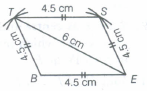
Thus, BEST is the required rhombus.
17.
()
(x2 + xy + y2) (x2- xy + y2)
18.
()
(a+b)2
19.
()
Half
20.
()
Rectangle
21.
()
x-axis
22.
()
abh
23.
()
0.9
24.
()
28
25.
()
at perpendicular
26.
()
Division
27.
100 = 102
28.
\(\frac { 500\times 5\times T }{ 100 } =100\)
\(\Rightarrow T=\frac { 100\times 100 }{ 500\times 5 } =4\).
29.
x2 - 9 = (x)2 - (3)2 = (x - 3) (x + 3).
30.
(b)
\(({2n-4\over n})90^\circ\)
31.
200 + 200 = 400
32.
(a)
the quantities are always in the same unit.
33.
(a)
\(\frac { 1 }{ 4 } \)
34.
(d)
13 em
35.
(b)
81
36.
(a)
37.
(x - 3y)(3x + 5)
38.
Suppose, 28 men will do the piece of work in x days. The given information can be exhibited in the following tabular form:
| Number of men | 52 | 28 |
| Number of days | 35 | x |
Clearly, less is the number of men, more will be the number of days to finish the work, therefore it is the case of inverse proportion.
Ratio of number of men = Inverse ratio of number of days
52: 28 = x : 35
\(\Rightarrow \frac { 52 }{ 28 } =\frac { x }{ 35 } \Rightarrow 52\times 35=28\times x\Rightarrow x=\frac { 52\times 35 }{ 28 } =65\)
Hence, 28 men will do the work in 65 days.
39.
Edge of a small cube = 30 cm
Surface area of each small cube = 6\(\times\)(Edge)2
= 6\(\times\)30\(\times\)30 = 5400 cm2
Edge of the cubical box = 3 m = 300 cm
Surface area of cubical box = 6\(\times\)(Edge)2
= 6\(\times\)(300)2 = 6\(\times\)300\(\times\)300 = 540000 cm2
∴ Number of small cubes accomodated in the cubical box of edge 3 m or 300 cm
= \(\frac { Surface\quad area\quad of\quad the\quad cubical\quad box }{ Surface\quad area\quad of\quad each\quad small\quad cubes } \)
= \(\frac { 54000 }{ 5400 } =100\)
Hence, 100 small cubes can be accomodated ina cubical box of 3 m edge.
40.
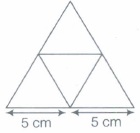
41.
(21a2bc) + (-45abc2) + (18a2bc) + (21abc2)
= 21a2bc - 45abc2 + 18a2bc + 21abc2
= 21a2bc + 18a2bc - 45abc2 + 21abc2
= 39a2bc - 24abc2
42.
Let the required number be x.
Then, according to the question
x3 = x ...(1) and x2≠x ...(2)
From (1), x3 -x = 0
⇒ x(x2 - 1) = 0
⇒ x = 0, ± 1
⇒ x = 0,1,-1
If x = 0, then x2 = x.
∴ x = is inadmissible
If x = 1 then x2 = x.
∴ x = 1 is inadmissible
If x = - 1, then x2 = (- 1)2 = 1 ≠ x(= - 1)
Hence, the required number is - 1.
43.
Let the number of plates on the table be y and the number of puris be x.
Then, according to the first condition of the problem
4(y - 1) = x ...(1)
and, according to the second condition of the
problem
3y + 1= x ... (2)
From (1) and (2), we have
4(y - 1) = 3y + 1
⇒ 4y - 4 = 3y + 1
⇒ 4y - 3y = 1 + 4
⇒ y=5
Put y = 5 in (1), we get
x = 4(5) - 4 = 20 - 4 = 16
Hence, the number of plates and number of puris on the table are 5 and 16 respectively.
44.
| Time Passed (T) (in minutes) |
(T1) 15 | (T2) 15 | (T3) 45 | (T4) 60 |
|---|---|---|---|---|
| Angle turned (A) (in degree) | (A1) 90 | (A2) __ | (A3) __ | (A4) __ |
| \(T\over A\) | \({15\over 90}={1\over6}\) | \({30\over 180}={1\over6}\) | \({45\over 270}={1\over6}\) | \({60\over 360}={1\over6}\) |
We observe about T and A that they increase together and is \(T\over A\) same every time.
Yes; The angle turned by the minute hand is directly proportional to the time that has passed.
On checking, we find that
T2 : T3 = A1 : A3 = 2: 3
and T3 : T4 = A3 : A4 = 3 : 4
45.
The highest observation = 62
The lowest observation = 17
One of the class intervals = 40-48
∴ Class size = Upper class limit - Lower class limit
= 48 - 40 = 8
∴ The appropriate classes can be:
16-24, 24-32, 32-40, 40-48, 48-56, 56-64
Thus, the frequency distribution table for the above data can be shown using the Tally marks
| Groups [Class intervals] | Tally marks | Frequency |
|---|---|---|
| 16-24 | .jpg) || || |
7 |
| 24-32 | |||| | 4 |
| 32-40 | | |
11 |
| 40-48 | || | 2 |
| 48-56 | |||| |
9 |
| 56-64 | || |
7 |
| Total | 40 |

8th Standard CBSE Syllabus & Materials
8th Standard CBSE
CBSE 8th Science Particulate Nature of Matter - New Model Questions Papers Study Material - QB365 Set A
NEW8th Standard CBSE
CBSE 8th Science Pressure, Winds, Stroms and Cyclones - New Model Questions Papers Study Material - QB365 Set A
NEW8th Standard CBSE
CBSE 8th Mathematics Quadrilaterals - New Model Questions Papers Study Material - QB365 Set A
NEW8th Standard CBSE
CBSE 8th Mathematics A story of Numbers - New Model Questions Papers Study Material - QB365 Set A



CBSE 8th Standard CBSE Subjects
CBSE Standards




