
 100% FREE ACCESS
8th Standard CBSE Syllabus & Materials
8th Standard CBSE
CBSE 8th Social Science Theme D - Factors of Production - New Model Questions Papers Study Material - QB365 Set A
NEW8th Standard CBSE
CBSE 8th Social Science Theme C - Universal Franchise and India's Electoral System - New Model Questions Papers Study Material - QB365 Set A
NEW8th Standard CBSE
CBSE 8th Social Science Theme B - The Rise of the Marathas - New Model Questions Papers Study Material - QB365 Set A
NEW8th Standard CBSE
CBSE 8th Social Science Theme B - Reshaping India's Political Map - New Model Questions Papers Study Material - QB365 Set A
NEW8th Standard CBSE
CBSE 8th Social Science Theme A - Natural Resources and Their Use - New Model Questions Papers Study Material - QB365 Set A
NEW8th Standard CBSE
CBSE 8th Science Keeping Time with Skies - New Model Questions Papers Study Material - QB365 Set A

Published on: 01/01/2019
8th Class Unit Test
Download CBSE Class 8th Standard CBSE Mathematics question papers, sample papers, important questions, and previous year solved papers in PDF format. Get free study materials, NCERT solutions, and exam preparation resources for Class 8th Standard CBSE Mathematics
Questions + Answers key
Take MCQ Mathematics Test
1.
Observe the following tables and find if x and y are directly proportional.
| x | 5 | 8 | 12 | 15 | 18 | 20 |
| y | 15 | 24 | 36 | 60 | 72 | 100 |
2.
If 2A 7\(\div\) A= 33, then find the value of A.
3.
(a) A swimming pool is 200 m by 50 m and has an average depth of 2 m. By the end of a summer day, the water level drops by 2 cm. How many cubic meters of water is lost on that day?
(b) What is the value depicted from swimming?
4.
Find the value of the following :
\(\frac { 181\times 181-119\times 119 }{ 300 } \)
5.
Find the product of the following binomials.
\(\left( \frac { x-y }{ 2 } \right) \left( \frac { x+y }{ 2 } \right) \)
6.
Five years ago, a man was seven times as old as his son. Five years after, the father will be three times as old as his son. Find their present ages.
7.
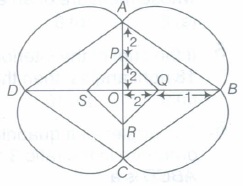
A rangoli has been drawn on the floor of a school's main gate. Participatent of Class VllI th girls for making rangoli, all bring different types of color from market to colour the rangoli (as shown below), where, ABCD and PORS both are in the shape of a rhombus. Find the radius of semi circle drawn on each side of rhombus ABCD. What type of value depict here?
8.
The population of a city 1 yr ago was 55500. Due to an epidemic, it decreases every year at the rate of 5% per annum. Find its present population.
9.
Rearrange suitably and find the sum in each of the following:
\({-5\over7}+{5\over6}+{1\over7}+3+{-13\over6}\)
10.
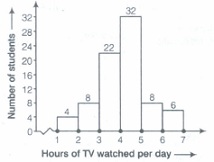
The number of hours for which students of a particular class watched television during holidays is shown through the given graph.
Answer the following:
(i) For how many hours did the maximum number of students watch TV?
(ii) How many students watched TV for less than 4 h?
(iii) How many students spent more than 5 h in watching TV?
11.
Factorise: 54x2 - 96y2
12.
What is the least number to be added to 8200 to make it a perfect square (using division method)?
13.
Find the one's digit of the cube of each of the following numbers.
149
14.
Simplify : \({32\over5}+{23\over11}\times{22\over15}\)
15.
Find the product of (4p2 + 5p+ 7) x 3p.
16.
Two regular polygons are such that the ratio between their number of sides is 1 : 3 and the ratio of measure of their interior angles is 4:7. Find the number of sides of each polygon.
17.

Find Shape, Area?
18.
The square root of 24025 will have _____________ digits.
19.
a13 x a-10 = _________
20.
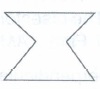 is a closed curve entirely made up of line segments. The another name for this shape is _____
21.
The additive inverse of a positive rational number is always a ________________rational number.
22.
The coordinates of the origin are (0, 0).
23.
A 3-digit number abc is divisible by 5 if c is an even number
24.
There is no perfect cube which ends with 8.
25.
A diagonal of a rhombus bisects both the angles.
26.
If x and y are negative rational numbers, then so is (x + y).
27.
8 g of sandal wood cost Rs40. What will 10g cost?
Rs.30
Rs.36
Rs.48
Rs.50
28.
The coefficient in the term - 20 is
-1
-2
-10
-20
29.
The quotient of 12a8b8 + (- 4a6b6) is
3a2b2
3a2b
3ab2
-3a2b2
30.
Observe the histogram and answer the question given below:
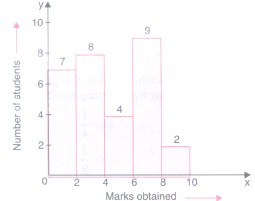
The number of students getting marks less than 4 is
10
15
7
8
31.
Find the smallest number by which the number 256 must be divided to obtain a perfect cube.
2
4
3
8
32.
Radius of a circle is 7cm. Its perimeter
44 cm
36 cm
58 cm
154 cm
33.
Which one of the following is a Pythagorian triplet?
(n2-1), 2n and (n2+ 1)
(n + 1)(n2-1) and (n2+ 1)
n, (n2-1) and (n2+ 1)
(n - 1), (n2- 1) and (n2 + 1)
34.
If one member of a Pythagorean triplet is 2m, then other two members are
m, m2 + 1
m2 + 1, m2 - 1
m2, m2 - 1
m2 , m+1
35.
For which of the following quadrilaterals, diagonals are perpendicular to each other?
Parallelogram
Trapezium
Rectangle
Kite
36.
Divide 24(x2yz + xy2z + xyz2) by 8xyz.
37.
The population of a city was 20,000 in 1997. It increased at the rate of 5% per annum. Find the population at the end of the year 2000.
38.
Find the value of x, 10000x = (9982)2 - (18)2
39.
The denominator of a rational number is greater than its numerator by 8. If the numerator is increased by 17 and the denominator is decreased by 1, the number obtained is 3/2. Find the rational number.
40.
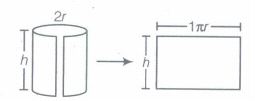
The lateral surface area of a hollow cylinder is 4224 cm2 . It is cut along its height and formed a rectangular sheet of width 33 cm. Find the perimeter of rectangular sheet.
41.
Two monomials are multiplied. Is the product a monomial or binomial?
42.
Write all the square numbers between 100 and 300.
43.
The following pie-chart represents the marks scored by a student. If he obtained 540 as total marks, answer the following questions:
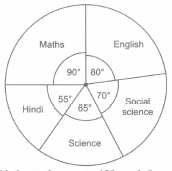
(i) In which subject did the student score 120 marks?
(ii) What is the difference in the marks obtained in Maths and English?
(iii) In which subject did he get minimum marks?
44.
Which rational numbers are their own reciprocals?
1.
\(\frac { 5 }{ 15 } =\frac { 1 }{ 3 } ,\frac { 8 }{ 24 } =\frac { 1 }{ 3 } ,\frac { 12 }{ 36 } =\frac { 1 }{ 3 } \)
\(\frac { 15 }{ 60 } =\frac { 1 }{ 4 } ,\frac { 18 }{ 72 } =\frac { 1 }{ 4 } ,\frac { 20 }{ 100 } =\frac { 1 }{ 5 } \)
i.e., All the ratios are not the same.
\(\therefore\) x and y are not directly proportional.
2.
Given, \(\frac { 2A7 }{ A }\)=33
Now, put the value of A = 1,2,3,4,5,6,7,8,9 and check the answer.
When A = 1, then \(\frac { 217 }{ 1 }\)=217 [not satisfied]
When A = 2, then \(\frac { 227 }{ 2 }\)= 113.5 [not satisfied]
When A = 3, then \(\frac { 237 }{ 3 }\)= 79 [not satisfied]
When A = 4, then\(\frac { 247 }{ 4 }\)= 61.75 [not satisfied]
When A = 5, then \(\frac { 257 }{ 5 }\)= 51.4 [not satisfied]
When A = 6, then \(\frac { 267 }{ 6 }\)= 44.5 [not satisfied]
When A = 7, then \(\frac { 247 }{ 7 }\)= 39.57 [not satisfied]
When A = 8, then \(\frac { 287 }{ 8 }\)= 35.87 [not satisfied]
When A = 9, then \(\frac { 297 }{ 9 }\)= 33 [satisfied]
So, the value of A = 9.
3.
(a)Capacity of the swimming pool = l\(\times\)b\(\times\) h
= 200\(\times\)50\(\times\)2 = 20000 m3
Since, water level drop by 2 cm
i.e h' =\(\left( 2-\frac { 2 }{ 100 } \right) \) m = (2-0.02)m = 1.98m
∴ After dropping water level, capacity of the swimming pool= l \(\times\) b \(\times\) h'
= 200\(\times\) 50\(\times\)1.98 = 19800 m3
∴ Cubic metre of water lost on that day
= 20000 m3 - 19800 m3
= 200 m3
(b)Swimming is good for our body. So, we should take swimming as a regular exercise.
4.
62
5.
\(\frac { { x }^{ 2 }-{ y }^{ 2 } }{ 4 } \)
6.
10 yr and 40 yr
7.
In rhombus ABCD,
AO = OP + PA = 2 + 2 ⇒ AO = 4
and OB = OQ + QB = 2 + 1 ⇒ OB = 3
In ΔOAB,
(AB)2 =(OA)2 + (OB)2
[by Pythagoras theorem]
⇒ (AB)2 =(4)2 + (3)2 = 25
⇒ AB=5
Since, AB is diameter of semi-circle.
∴ Radius = \(\frac { 5 }{ 2 } \)=2.5
Hence, radius of the semi-circle is 2.5. The value depict here is participation unity and creativity.
8.
52725
9.
\(23\over21\)
10.
(i) Here, maximum height of the bar is 32 for the interval 4 - 5, so the maximum number of students watching TV is 32 and they watch TV for 4 to 5 h.
(ii) It is clear from the given graph that, students watch TV for 1 - 2, 2 - 3, 3 - 4, 4 - 5, 5 - 6 and 6 - 7 h. So, students who watch TV for less than 4 h lie in the intervals 1 - 2, 2 - 3 and 3 - 4. Also, their corresponding frequencies are 4,8 and 22.
\(\therefore\) Number of students watching TV for less than 4 h
= 4 +8 + 22 =34
(iii) Students who watch TV for more than 5 h lie in the intervals 5 - 6 and 6 - 7. Also, their corresponding frequencies are 8 and 6.
\(\therefore\) Number of students watching TV for more than 5 h
= 8 + 6 = 14.
11.
we have 54x2 - 96y2 =6[9x2 - 16y2]
=6[(3x)2 - (4y)2]
= 6[(3x + 4y)(3x - 4y)]
[Using a2 - b2 = (a + b)(a - b)]
Thus, 54x2- 96y2 = 6 (3x + 4y)(3x - 4y)
12.
81
13.
We have, 149
One's digit of 149 = 9
Now, cube of the one's digit of 149 = (9)3
=9 x 9 x 9 = 729
Hence, one's digit in the cube of 149 is 9.
14.
\({142\over15} \ or {\ 9{7\over15}}\)
15.
We have, (4p2 + 5p + 7)x3p = 3px (4p2 + 5p + 7)
[by commutative law
= (3P x 4P2 ) + (3p x 5p) + (3p x 7)
[by distributive law]
=12p3 + 15p2 + 21p
16.
Number of sides of first polygon = 4
Number of sides of second polyqon = 12
17.
()
Triangle;\(\frac{1}{2}\times b\times h\)
18.
()
3
19.
()
a3
20.
Concave polygon; given, figure is a closed curve with two angles more than 180°. So, another name of this shape is concave polygon.
21.
()
Negative
22.
(a)
23.
(b)
24.
(b)
25.
(a)
26.
(a)
27.
(d)
Rs.50
28.
Coefficient = - 20.
29.
-\(\frac { { 12a }^{ 8 }b^{ 8 } }{ { 4a }^{ 6 }b6 } \)
\(=\frac { 2\times 2\times 3\times a\times a\times a\times a\times a\times a\times a\times a\times b\times b\times b\times b\times b\times b\times b\times b }{ 2\times 2\times a\times a\times a\times a\times a\times a\times b\times b\times b\times b\times b\times b } \)
=-3a2b2
30.
Required number = 7 + 8 = 15.
31.
256 = 2 \(\times\) 2 \(\times\) 2 \(\times\) 2 \(\times\) 2 \(\times\) 2 \(\times\) 2 \(\times\) 2
= 23 \(\times\) 23 \(\times\) 2 \(\times\) 2.
32.
(b)
36 cm
33.
(a)
(n2-1), 2n and (n2+ 1)
34.
(b)
m2 + 1, m2 - 1
35.
(d)
Kite
36.
24 (x2yz + xy2z + xyz2)
\(=2 \times 2 \times 2 \times 3 \times[(x \times x \times y \times z)+(x \times y \times y \times z)+(x \times y \times z \times z)] \)
\(=2 \times 2 \times 2 \times 3 \times x \times y \times z \times(x+y+z)=8 \times 3 \times x y z \times(x+y+z)\)
Therefore, 24 (x2yz + xy2z + xyz2) ÷ 8xyz
\(=\frac{8 \times 3 \times x y z \times(x+y+z)}{8 \times x y z}=3 \times(x+y+z)=3(x+y+z)\)
Alternately,24(x2yz + xy2z + xyz2) ÷ 8xyz
= \(\frac{24 x^{2} y z}{8 x y z}+\frac{24 x y^{2} z}{8 x y z}+\frac{24 x y z^{2}}{8 x y z}\)
= 3x + 3y + 3z = 3(x + y + z)
37.
There is 5% increase in population every year, so every new year has new population. Thus, we can say it is increasing in compounded form.
Population in the beginning of 1998 = 20000 (we treat this as the principal for the 1st year)
Increase at 5% = \(=\frac{5}{100} \times 20000=1000\)
Population in 1999 = 20000 + 1000 = 21000
Increase at 5% \(=\frac{5}{100} \times 21000=1050\)
Population in 2000 = 21000 + 1050
= 22050
Increase at 5% = \(\frac{5}{100} \times 22050\)
= 1102.5
At the end of 2000 the population = 22050 + 1102.5 = 23152.5
or, Population at the end of 2000 = 20000 \(\left(1+\frac{5}{100}\right)^{3}\)
\(=20000 \times \frac{21}{20} \times \frac{21}{20} \times \frac{21}{20}\)
= 23152.5
So, the estimated population = 23153.
38.
RHS = (9982)2 - (18)2
= (9982 + 18)(9982 -18)
[using identity a2 - b2 = (a + p)(a -b)]
= 10000 x 9964
LHS = 10000 x x
Since, it is given that
LHS = RHS
10000 x x =10000 x 9964
\(\Rightarrow\) \(x={10000 \times 9964 \over 10000}=9964\)
39.
Let the numerator be x. Then, denominator = x + 8
So, rationl number = \(\frac { x }{ x+8 } \)
According to the question, \(\frac { x+17 }{ (x+8)-1 } =\frac { 3 }{ 2 } \Rightarrow \frac { x+17 }{ (x+8)-1 } =\frac { 3 }{ 2 } \Rightarrow \frac { x+17 }{ x+7 } =\frac { 3 }{ 2 } \)
\(\Rightarrow\) 3 (x + 7) = 2 (x +17 [by cross-multiplication]
\(\Rightarrow\) 3x + 21 = 2x + 34
\(\Rightarrow\) 3x - 2x = 34 - 21 [transposing 2x to LHS and 21 to RHS]
\(\Rightarrow\) x = 13
Rational number = \(\frac { x }{ x+8 } =\frac { 13 }{ 13+8 } \frac { 13 }{ 21 } \)
Hence, the rational number is \(\frac { 13 }{ 21 } \)
40.
According to the question, on cutting the cylinder along its height, we get a rectangular sheet of width 33 cm which is height of cylinder. So, the height of cylinder, h = 33 cm. Let radius of cylinder be r cm.
Given, lateral surface area of cylinder = 4224 cm2
∴ 2\(\pi\)r = 4224 ⇒ \(2\times \frac { 22 }{ 7 } \times r\times 33\)=4224
⇒ \(r=\frac { 7\times 4224 }{ 2\times 22\times 33 } =\frac { 7\times 96 }{ 33 } =\frac { 7\times 32 }{ 11 } cm\)
Also, on cutting the hollow cylinder, the perimeter of base becomes the length of the rectangular sheet
∴ Length of rectangular sheet = Perimeter of circular base
= 2\(\pi\)r
\(2\times \frac { 22 }{ 7 } \times \frac { 7\times 32 }{ 11 } \) = 128 cm
and breadth of rectangular sheet = 33 cm
∴ Perimeter of rectangular sheet = 2(1 + b) = 2(128 +33) = 2\(\times\)161 =322 cm
41.
()
monomial
42.
()
121, 144, 169, 196, 225, 256 and 289
43.
()
(i) English
(ii) 15
(iii) Hindi
44.
()
1 and - 1

8th Standard CBSE Syllabus & Materials
8th Standard CBSE
CBSE 8th Science Particulate Nature of Matter - New Model Questions Papers Study Material - QB365 Set A
NEW8th Standard CBSE
CBSE 8th Science Pressure, Winds, Stroms and Cyclones - New Model Questions Papers Study Material - QB365 Set A
NEW8th Standard CBSE
CBSE 8th Mathematics Quadrilaterals - New Model Questions Papers Study Material - QB365 Set A
NEW8th Standard CBSE
CBSE 8th Mathematics A story of Numbers - New Model Questions Papers Study Material - QB365 Set A



CBSE 8th Standard CBSE Subjects
CBSE Standards




