
 100% FREE ACCESS
8th Standard CBSE Syllabus & Materials
8th Standard CBSE
CBSE 8th Social Science Theme D - Factors of Production - New Model Questions Papers Study Material - QB365 Set A
NEW8th Standard CBSE
CBSE 8th Social Science Theme C - Universal Franchise and India's Electoral System - New Model Questions Papers Study Material - QB365 Set A
NEW8th Standard CBSE
CBSE 8th Social Science Theme B - The Rise of the Marathas - New Model Questions Papers Study Material - QB365 Set A
NEW8th Standard CBSE
CBSE 8th Social Science Theme B - Reshaping India's Political Map - New Model Questions Papers Study Material - QB365 Set A
NEW8th Standard CBSE
CBSE 8th Social Science Theme A - Natural Resources and Their Use - New Model Questions Papers Study Material - QB365 Set A
NEW8th Standard CBSE
CBSE 8th Science Keeping Time with Skies - New Model Questions Papers Study Material - QB365 Set A

Published on: 02/08/2018
Based on the current academic syllabus, some of the important questions are prepared from the chapter Comparing Quantities.
Students, subscribe and get plenty of question paper with answer key. For subscription please click here.
Download CBSE Class 8th Standard CBSE Mathematics question papers, sample papers, important questions, and previous year solved papers in PDF format. Get free study materials, NCERT solutions, and exam preparation resources for Class 8th Standard CBSE Mathematics
Questions + Answers key
Take MCQ Mathematics Test
1.
Find the ratio of the following.
(a) Speed of a cycle 15 km/h to the speed of scooter 30km/h
(b) 5m to 10 km
(c) 50 paise to Rs.5
2.
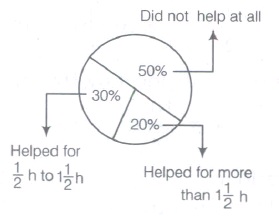
In a primary school, the parents were asked about the number of hours, they spend per day in helping their children to do homework. There were 90 parents, who helped for \(\frac{1}{2}\)h to \(\frac{1}{2}\)h.The distribution of parents according to the time for which, they said they helped is given in the adjoining figure, 20%helped for more than1\(\frac{1}{2}\)h per day, 30%helped for \(\frac{1}{2}\)h to 1\(\frac{1}{2}\)h, 50%did not help at all.
Using this, answer the following:
(i) How many parents were surveyed?
(ii) How many said that they did not help?
(iii) How many said that they helped for more than 1\(\frac{1}{2}\)h?
3.
Find the time period and rate tor each a sum taken for 1\(\frac{1}{2}\)yr at 8% per annum is compounded half-yearly.
4.
The marked price of an article is Rs 500. The shopkeeper gives a discount of 5% and still makes a profit of 25%. Find the cost price of article.
5.
Find the discount in per cent, when MP = Rs 900and SP = Rs 873
6.
72% of 25 students are good in Mathematics. How many students are not good in Mathematics?
7.
Convert the following ratios to percentages. 2:3
8.
Convert the following ratios to percentages. 3:4
9.
A shop gives 10%discount. What would be the sale price of each of these a pair of shoesmarked at Rs 650?
10.
A shop gives 10%discount. What would be the sale price of each of these a jeans marked at Rs I50?
11.
The price of a fan is Rs 1200. If the price of fan is decreased by 15%, then find the new price.
12.
The price of an article was Rs 68000. If its price is increased by 20%, then find the new price of that article.
13.
If 25% of x is 150, then find the value of x.
14.
If the price of an article, which is Rs 1000, is reduced by 7%, then find the new price.
15.
Radhika bought a car for Rs 250000. Next year, its price decreased by 10% and further next year it decreased by 12%. In the two years, overall decrease per cent in the price of the car is
3.2%
22%
20.8%
8%
16.
Avinash bought an electric iron for Rs 900 and sold it at a gain of 10%. He sold another electric iron at 5% loss which was bought for Rs 1200. On the transaction, he has a
profit of Rs 75
loss of Rs 75
profit of Rs 30
Loss of Rs 30
17.
Suppose a certain sum doubles in 2 yr at r % rateof simple interest per annum or at R% rate of interest per annum compounded annually,we have
r
R < r
R=r
Cannot be termined
18.
To gain 25% after allowing a discount of 10%, the shopkeeper must mark the price of the article which costs him Rs 360 as
Rs 500
Rs 450
Rs 460
Rs 486
19.
Sachin purchases a bat for Rs 660 including sales tax. If the rate of sales tax is 10%, then the selling price of the bat is
Rs 580
Rs 590
Rs 600
Rs 610
20.
The loss per cent on selling 140 geometry boxes at the loss .of SP of 10 geometry boxes is equal to ___________
21.
3500 is greater than 500 by __________ %
22.
The marked price of an article when it is sold for Rs 880 after a discount of 12% is __________
23.
______ = Discount % of marked price
24.
___________ is a reduction on the marked price of the article.
1.
(a) Given, speed of a cycle = 15 km/h
and speed of scooter = 30 km/h
∴ Ratio of the speed of a cycle to the speed of the
scooter = \(\frac{15 km/h}{30 km/h}=\frac{15}{30}=\frac{1}{2}\)or 1:2
(b) We know that, 1 km = 1000 m
∴ Ratto of 5m to 10 km = \(\frac{5m}{10 km}=\frac{5 m}{10\times 1000m}\)|
\(=\frac{5}{10\times1000}=\frac{1}{2000}\)
or 1 : 2000
(c) We know that, Rs 1 = 100 paise
∴ Ratio of 50 paise to Rs 5 = \(\frac{50 paise}{Rs 5}\)
\(\frac{50 paise}{5\times 100 paise}=\frac{50}{5\times100}\)
\(=\frac{5}{5\times10}=\frac{1}{10}\) or 1:10
2.
(i) Here, 90 parents helped their children for \(\frac{1}{2}\)h to 1\(\frac{1}{2}\) h.
Given, percentage = 30%
Let x parents be surveyed.
Then, 30% of x helped for \(\frac{1}{2}\)h to 1\(\frac{1}{2}\)h = 90
∴ 30% of x = 90
⇒ \(\frac{30}{100} \times x=90\)
⇒ \(x=\frac{90\times100}{30}=300\)
Hence, the number of parents were 300.
(ii) Here, 50% parents did not help at all.
So, number of parents did not help = 50% of 300
= \(\frac{50}{100}\times100=50\times3=150\)
Hence, 150 parents did not help.
(iii)Here, 20% parents helped for more than 1\(\frac{1}{2}\)h.
So, number of parents who helped for more than 1\(\frac{1}{2}\)h
= 20% of 300=\(\frac{20}{100} \times300=20\times3\)
= 60
Hence, 60 parents helped for more than 1\(\frac{1}{2}\)h.
3.
Here, time period (T) = 1\(\frac{1}{2}\)yr = \(\frac{3}{2}\)yr and rate = 8%
For half-yearly, time period, T =\(\frac{3}{2}\)x2 = 3
and rate = \(\frac{8}{2}\)% = 4 %
4.
Rs 380
5.
3%
6.
Total number of students = 25
Students good in Mathematics = 72%
Students, who are not good in Mathematics = (100 - 72)%
= 28%
Now, number of students who are not good in Mathematics
= 28% of 25 = \(\frac{28}{100}\times25=7\)
Hence, 7 students are not good in Mathematics.
7.
Given ratio = 2 :3
∴ Percentage =\((\frac{2}{3}\times100)=(\frac{200}{3})=66\frac{2}{3}\)%
8.
Given ratio = 3 : 4
∴ Percentage =\((\frac{3}{4}\times100)=(3\times25)=75%\)%
9.
We know that,
Discount = Marked price - Sale price
Sale price = Marked price - Discount
∵ Marked price = Rs 650 [given]
Discount = 10% of Rs 650 =\(\frac{10}{100}\times 650\)=65
∴ Sale price = Marked price - Discount = Rs (650 - 65) = Rs 585
10.
We know that,
Discount = Marked price - Sale price
Sale price = Marked price - Discount
Discount = 10% of 150 =\(\frac{10}{100}\times150\)=Rs 15
∴ Sale price of a jeans marked at Rs 150 = 150 - 15 = Rs (150 -15) = Rs 135
11.
We have, old price of the fan = Rs 1200
Since, the price is decreased by 15%.
∴ New price of the fan = Old price - Decreased price = 1200 -1200x\(\frac{15}{100}\) = 1200-180 = Rs 1020
Alternate Method
We have, old price of the fan = Rs 1200
∴ New Price of the fan = \(\frac{Old price\times (100-x)}{100}\) [where, x = rate of decrease in price]
=\(\frac{1200\times(100-15)}{100}=\frac{1200\times85}{100}\) = Rs 1020
12.
We have, price of the article = Rs 68000
∴ New price of the article = Old price + Increased price = 68000 +68000 x \(\frac{20}{100}=68000+13600=Rs 81600\)
Alternate Method
New pnce of the article = \(\frac{Old price \times (100+x)}{100}\) [where, x = percentage of increase in price of the anicle]
\(=\frac{68000\times(100+20)}{100}=\frac{68000\times20}{100}\) = Rs 81600
13.
600
14.
Rs 930
15.
(c)
20.8%
16.
(c)
profit of Rs 30
17.
(b)
R < r
18.
(a)
Rs 500
19.
(c)
Rs 600
20.
()
6\(\frac{2}{3}\)%
21.
()
600
22.
()
Rs 1000
23.
()
Discount
24.
()
Discount

8th Standard CBSE Syllabus & Materials
8th Standard CBSE
CBSE 8th Science Particulate Nature of Matter - New Model Questions Papers Study Material - QB365 Set A
NEW8th Standard CBSE
CBSE 8th Science Pressure, Winds, Stroms and Cyclones - New Model Questions Papers Study Material - QB365 Set A
NEW8th Standard CBSE
CBSE 8th Mathematics Quadrilaterals - New Model Questions Papers Study Material - QB365 Set A
NEW8th Standard CBSE
CBSE 8th Mathematics A story of Numbers - New Model Questions Papers Study Material - QB365 Set A



CBSE 8th Standard CBSE Subjects
CBSE Standards




