
 100% FREE ACCESS
8th Standard CBSE Syllabus & Materials
8th Standard CBSE
CBSE 8th Social Science Theme D - Factors of Production - New Model Questions Papers Study Material - QB365 Set A
NEW8th Standard CBSE
CBSE 8th Social Science Theme C - Universal Franchise and India's Electoral System - New Model Questions Papers Study Material - QB365 Set A
NEW8th Standard CBSE
CBSE 8th Social Science Theme B - The Rise of the Marathas - New Model Questions Papers Study Material - QB365 Set A
NEW8th Standard CBSE
CBSE 8th Social Science Theme B - Reshaping India's Political Map - New Model Questions Papers Study Material - QB365 Set A
NEW8th Standard CBSE
CBSE 8th Social Science Theme A - Natural Resources and Their Use - New Model Questions Papers Study Material - QB365 Set A
NEW8th Standard CBSE
CBSE 8th Science Keeping Time with Skies - New Model Questions Papers Study Material - QB365 Set A

Published on: 30/07/2018
Some of the important questions are prepared from this chapter Cubes and Cube Roots The important questions are covers from the Higher Order Thinking Questions and Value Based Questions.
Download CBSE Class 8th Standard CBSE Mathematics question papers, sample papers, important questions, and previous year solved papers in PDF format. Get free study materials, NCERT solutions, and exam preparation resources for Class 8th Standard CBSE Mathematics
Questions + Answers key
Take MCQ Mathematics Test
1.
Check which of the following are perfect cubes.What pattern do you observe in these perfect cubes?
64000
2.
Which of the following are perfect cubes?
3375
3.
Find the one's digit of the cube of each of the following numbers.
53
4.
Find the one's digit of the cube of each of the following numbers.
1005
5.
Find the one's digit of the cube of each of the following numbers.
3331
6.
If a2 ends in 9, then a3 ends in 7.
7.
The cube of a two digits number may be a three digits number.
8.
There is no perfect cube which ends with 8.
9.
A perfect cube does not end with two zeroes.
10.
Cube of any odd number is even.
11.
Evaluate the following :
\(\left( 1\frac { 2 }{ 5 } \right) ^{ 3 }\).
12.
Find the cube of \(\left( 2+\frac { 3 }{ 5 } \right) \).
13.
Using prime factorisation, find the cube root of 5832.
14.
Find the cube root of 614125 through estimation.
15.
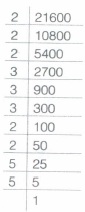
Check whether 21600 is a perfect cube or not.
16.
Three numbers are in ratio to one another 2: 3: 4. The sum of their cubes is 33957. Find the numbers.
17.
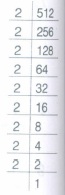
Find the length of each side of a cube, if its volume is 512 cm3 .
18.
The value of \(\sqrt [ 3 ]{ 512 } \times \sqrt [ 3 ]{ -27 } \) is
24
-24
48
-48
19.
Which of the following is the cube of an even natural number?
1331
4913
3375
1728
20.
The cube of 0.08 is
0.000512
0.0512
0.512
5.12
21.
\(\sqrt [ 3 ]{ 1000 } \) is equal to
10
100
1
None of these
22.
Which of the following number is a perfect cube?
243
512
392
23.
The least number by which 72 is divided to make it a perfect cube is _____
24.
The least number by which 250 is multiplied to make it a perfect cube is _____
25.
(1.2)3 = ______
26.
1m3 = _______ cm3.
27.
There are _____ perfect cubes between 1 and 1000.
1.
We have
64000 = 2 x 2 x 2 x 2 x 2 x 2 x 2 x 2 x 2 x 5 x 5 x 5
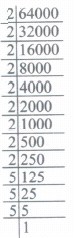
Since, we get groups of triples.
\(\therefore\)64000 is a perfect cube.
2.
We have, 3375
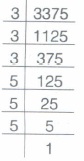
Resolving 3375 into prime factors, we get
3375 = 3 x 3 x 3 x 5 x 5 x 5
Clearly, the prime factors of 3375 are grouped into triples of equal factors and no factor is left over.
So, 3375 is a perfect cube.
3.
We have, 53
One's digit of 53 = 3
Now, cube of one's digit of 53 = (3)3 = 3 x 3 x 3 = 27
Hence, the one's digit in the cube of 53 is 7.
4.
We have, 1005
One's digit of 1005 = 5
Now, cube of one's digit of 1005 = (5)3 = 5 x 5 x 5 = 125
Hence,one's digit in the cube of 1005 is 5.
5.
We have, 3331 = 1
One's digit of 3331 = 1
Now, cube of the one's digit of 3331 = (1)3= 1 x 1 x 1=1
Hence, one's digit in the cube of 3331 is 1.
6.
(b)
7.
(b)
8.
(b)
9.
(a)
10.
(b)
11.
\(\frac { 343 }{ 125 } \).
12.
\(\frac { 2197 }{ 125 } \)
13.
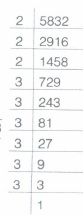
The prime factorisation of 5832
5832 = 2 x 2 x 2 x 3 x 3 x 3 x 3 x 3 x 3
Therefore, \(\sqrt [ 3 ]{ 5832 } \)
= \(\sqrt [ 3 ]{ \underline { 2\times 2\times 2 } \underline { 3\times 3\times 3 } \underline { 3\times 3\times 3 } } \)
= 2 x 3 x 3
=18
14.
Given, number is 614125.
So, groups of 614125 are
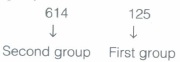
In the first group, the number 125 ends with 5. We know that, 5 comes at the unit's place of a number only when its cube ends in 5.
So, 5 will come at unit's place.
Now, in the second group, the number is 614
∵ (8)3 = 512 and (9)3=729
and 512 < 614 < 729
So, ten's place of required cube root is 8.
Hence, \(\sqrt [ 3 ]{ 614125 } \) = 85
15.
Given, number is 21600.
Now, prime factorisation of 21600
21600 = 2 x 2 x 2 x 3 x 3 x 3 x 2 x 2 x 5 x 5
Prime factors 2 and 5 do not have triples.
So, 21600 is not a perfect cube.
16.
14, 21, 28
17.
Given, the volume of cube = 512 cm3
We know that, the volume of a cube = (Side)3
=(Side)3
Let the length of each side be a.
So, (a)3 = 512
a = \(\sqrt [ 3 ]{ 512 } \)
a = \(\sqrt [ 3 ]{ \underline { 2\times 2\times 2 } \times \underline { 2\times 2\times 2 } \times \underline { 2\times 2\times 2 } } \)
= 2 x 2 x 2
=8 cm
Hence, length of the each side of a cube is 8 cm.
18.
(b)
-24
19.
(d)
1728
20.
21.
22.
8640
23.
∵ 72 = 2 x 2 x 2 x 3 x 3
So, dividing by 3 x 3 = 9, we get a perfect cube.
24.
∵ 250 = 5 x 5 x 5 x 2 ∴ Least number = 2 x 2 =4
25.
(1.2)3 = (1.2) x (1.2) x (1.2) = 1.728
26.
1 m =100 cm
So, 1m3 = 100x100 x 100 cm3 = 106 cm3
27.
8, [8, 27, 64, 125, 216, 343, 512, 729 are 8 perfect cubes between 1 and 1000]

8th Standard CBSE Syllabus & Materials
8th Standard CBSE
CBSE 8th Science Particulate Nature of Matter - New Model Questions Papers Study Material - QB365 Set A
NEW8th Standard CBSE
CBSE 8th Science Pressure, Winds, Stroms and Cyclones - New Model Questions Papers Study Material - QB365 Set A
NEW8th Standard CBSE
CBSE 8th Mathematics Quadrilaterals - New Model Questions Papers Study Material - QB365 Set A
NEW8th Standard CBSE
CBSE 8th Mathematics A story of Numbers - New Model Questions Papers Study Material - QB365 Set A



CBSE 8th Standard CBSE Subjects
CBSE Standards




