
 100% FREE ACCESS
11th Standard Syllabus & Materials
11th Standard
TN 11th Tamil இயற்கை வேளாண்மை,சுற்றுச்சூழல் -செய்யுள் - மனோன்மணீயம் Important Questions And Answers Study Material - QB365 Set A
NEW11th Standard
TN 11th Tamil என்னுயிர் என்பேன் -துணைப்பாடம் - இசைத்தமிழர் இருவர் Important Questions And Answers Study Material - QB365 Set A
NEW11th Standard
TN 11th Tamil மொழி கலை -செய்யுள் - ஒவ்வொரு புல்லையும் Important Questions And Answers Study Material - QB365 Set A
NEW11th Standard
TN 11th Tamil பீடு பெற நில் - இலக்கணம் - பகுபத உறுப்புகள் Important Questions And Answers Study Material - QB365 Set A
NEW11th Standard
TN 11th Tamil பீடு பெற நில் - துணைப்பாடம் - வாடிவாசல் Important Questions And Answers Study Material - QB365 Set A
NEW11th Standard
TN 11th Tamil பீடு பெற நில் - செய்யுள் - குறுந்தொகை Important Questions And Answers Study Material - QB365 Set A

Published on: 27/04/2019
Quantum Mechanical Model of Atom frequently asked three mark questions - III
Download Tamil Nadu 11th Standard Chemistry question papers, model tests, one-mark questions, important questions, and public exam papers in PDF format. Free study materials and answer keys for TN State Board students.
Questions + Answers key
Take MCQ Chemistry Test
1.
Which ion has the stable electronic configuration? Ni2+ or Fe3+.
2.
Explain how effective nuclear charge us related with stability of the orbital.
3.
The electron energy in hydrogen atom is given by En = (- 2.18 x 10⁻¹⁸)/n2 J. Calculate the energy required to remove an electron completely from the n = 2 orbit. What is the longest wavelength of light in cm that can be used to cause this transition?
4.
An element with mass number 81 contains 31. 7% more neutrons as compared to protons. Assign the symbol to the element.
5.
Dual behaviour of matter proposed by de Broglie led to the discovery of electron microscope often used for the highly magnified images of biological molecules and other type of material. If the velocity of the electron in this microscope is 1.6 x 10⁶ ms-1, calculate de Broglie wavelength associated with this electron.
6.
From the following sets of quantum numbers, state which are possible. Explain why the others are not possible.
\(n=3,l=1,m_l=0,m_s=+\frac{1}{2}\)
7.
From the following sets of quantum numbers, state which are possible. Explain why the others are not possible.
\(n=3,l=3,m_l=-3,m_s=+\frac{1}{2}\)
8.
From the following sets of quantum numbers, state which are possible. Explain why the others are not possible.
\(n=1,l=0,m_l=+1,m_s=+\frac{1}{2}\)
9.
From the following sets of quantum numbers, state which are possible. Explain why the others are not possible.
\(n=1,l=1,m_l=0,m_s=+\frac{1}{2}\)
10.
From the following sets of quantum numbers, state which are possible. Explain why the others are not possible.
n = 1,l = 1,ml = 0,\(m_s=+\frac{1}{2}\)
11.
From the following sets of quantum numbers, state which are possible. Explain why the others are not possible.
n = 0, l = 0, ml = 0, \(m_s=+\frac{1}{2}\)
12.
In a hydrogen atom, the energy of an electron in first Bohr's orbit is 13.12 x 10⁵ J mol-1 . What is the energy required for its excitation to Bohr's second orbit?
13.
What is the wavelength for the electron accelerated by 1.0 x 10⁴ volts?
14.
Calculate the de Broglie wavelength of an electron moving with 1% of the speed of light?
15.
Using Aufbau principle, write the ground state electronic configuration of following atoms.
(i) Boron (Z = 5)
(ii) Neon (Z = 10)
(iii) Aluminium (Z = 13)
(iv) Chlorine (Z = 17)
(v) Calcium (Z = 20)
(vi) Rubidium (Z = 37)
16.
With what velocity must an electron travel so that its momentum is equal to that of a photon of wavelength = 5200\(\mathring{A}\) ?
17.
The uncertainty in the position and velocity of a particle are 10-10 m and 5.27 x 10⁻²⁴ms-1respectively. Calculate the mass of the particle.
18.
The mass of an electron is 9.1\(\times\)10-31 kg.If its kinetic energy is 3.0 \(\times\) 10-25J, calculate its wavelength.
19.
Calculate the wavelength of an electron moving with a velocity of 2.05 x 10⁷ ms-1.
20.
Draw the shapes of 1s, 2s and 3s orbitals.
21.
Explain about azimuthal quantum number.
22.
Write a note about principal quantum number.
23.
Calculate the uncertainty in velocity of an electron in hydrogen atom assuming the position of the electron in first orbit (0.529\(\mathring A\)) is determined with the accuracy of 0.5% of the radius.
24.
Explain Davisson and Germer experiment.
25.
Illustrate the significance of de Broglie equation with an iron ball and an electron.
(i) 6.626 kg iron ball moving with 10 ms-1.
(ii) An electron moving at 72.73 ms-1.
26.
What are the limitations of Bohr's atom model?
27.
What are the conclusions of Rutherford's α-rays scattering experiment?
28.
The uncertainty in the position of a moving bullet of mass 10 g is 10-5 m. Calculate the uncertainty in its velocity?
29.
An ion with mass number 56 contains 3 units of positive charge and 30.4% more neutrons than electrons. Assign symbol to the ion.
30.
Show that the circumference of the Bohr orbit for the hydrogen atom is an integral multiple of the de Broglie wavelength associated with the electron revolving around the orbit.
31.
How many electrons in an atom may have the following quantum numbers?
(a) n = 4; ms = -1/2 (b) n = 3, l = 0.
1.
Electronic configuration of Fe3+ : 1s2 2s2 2p6 3s2 3p6 4s0 3d5
Electronic configuration of Ni2+ : 1s2 2s2 2p6 3s2 3p6 4s0 3d8
Fe3+ has stable 3d5 half filled configuration.
2.
(i) In a multi-electron atom, in addition to the electrostatic attractive forces between the electron and nucleus, there exists a repulsive force among the electrons.
(ii) These two forces are operating in the opposite direction. This results in the decrease in the nuclear force of attraction on electron.
(iii) The net charge experienced by the electron is called effective nuclear charge.
(iv) The effective nuclear charge depends on the shape of the orbitals and it decreases with increases in azimuthal quantum number l.
(v) The order of the effective nuclear charge felt by a electron in an orbital within the given shell is s > p > d > f.
(vi) Greater the effective nuclear charge, greater is the stability of the orbital. Hence, within a given energy level, the energy of the orbitals are in the following order s < p < d < f.
3.
Step 1. Calculation of energy required
The energy required is the difference in the energy when the electron jumps from orbit with n = \(\infty\) to orbit with n = 2.
The energy required (\(\triangle\)E) = E\(\infty\)-E2
\(=0-(-{2.18\times 10^{-18}\over 4}J)=5.45\times 10^{-19}J\)
Step II. Calculation of the longest wavelength of light in cm used to cause the transition
\(\triangle E=hv=hc/ \lambda\)
\(\lambda={hc\over \triangle E}={(6.626\times 10^{-34}J s)\times (3\times 10^{8}ms^{-1})\over (5.45\times 10^{-19}J)}\)
= 3.644 x 10⁻⁷ m = 3.644 x 10-7 x 102 = 3.645 x 10⁻⁵ cm.
4.
An element can be identified by its atomic number only. Let us find the atomic number.
Let the number of protons = x
\(\therefore\) Number of neutrons = \(x+{x\times 31.7\over 100}=(x+0.317x)\)
Now, Mass no. of element = 35, No. of protons + No. of neutrons
81 = x + x + 0.317x = 2.317x = 2.317x or x = \({81\over 2.317}=35\)
\(\therefore\) No. of protons = 35, No. of neutrons = 81 - 35 = 46
Atomic number of element (Z) = Number of protons = 35
The element with atomic number (Z) 35 is bromine \(^{81}_{35}Br.\)
5.
\(\lambda ={h\over mv}; \lambda ={(6.626\times 10^{-34}Js)\over (9.1\times 10^{-31}kg)\times (1.6\times 10^{6}ms^{-1})}\)
= 0.455 x 10⁻³⁴+ 25m = 0.455 nm = 455 pm.
6.
The set of quantum number is possible.
7.
The set of quantum number is not possible because, for n = 3,\(l\ne3.\)
8.
The set of quantum numbers is not possible because for l = 0,ml cannot be +1. It must be zero.
9.
The set of quantum numbers is not possible because, for n = 1,1 cannot be equal to 1. It can have 0 value.
10.
The set of quantum numbers is possible.
11.
The set of quantum numbers is not possible because the minimum value of n can be 1 and not zero.
12.
\(E_n=-{2\pi^{2}m_e^4\over n^2h^2}\)
When n = 1,E1\(=-{2\pi^{2}m_e^4\over (1)^2h^2}=-13.12\times 10^5 J\ mol^{-1}\)
When n = 2,E2 \(=-{2\pi^{2}m_e^4\over (2)^2h^2}={-13.12\times 10^5 \over 4}J\ mol^{-1}\)
= 3.28 x 10⁵ J mol-1.
The energy required for the excitation is:
\(\triangle\)E = E2 - E1 =(-3.28 x 10⁵) - (- 13.12 x 10⁵) = 9.84 x 10⁵ J mol-1.
13.
Step I. Calculation of the velocity of electron
Energy (kinetic energy) of electron = 1.0 x 10⁴ volts.
= 1.0 x 104 x 1.6 x 10-19 J = 1.6 x 10⁻¹⁵J
= 1.6 x 10⁻¹⁵kg m2 s-2
or 1\2 mv2 = 1.6 x 10⁻¹⁵kg m2 S-2
or v= \(({2\times 1.6\times 10^{-15}kg m^2s^{-2}\over 9.1\times 10^{-31}kg})^{1\over2}=5.93\times10^{7}ms^{-1}.\)
Step II. Calculation of wavelength of the electron
According to de Broglie equation,
\(\lambda ={h\over mv};\lambda={(6.626\times 10^{-34}kg m^{2}s^{-1})\over (9.1\times 10^{-31}kg)\times(5.93\times10^{7}ms^{-1})}=1.22\times 10^{-11}m\)
14.
According to de Broglie equation, \(\lambda ={h\over mv}\)
Mass of electron = 9.1 x 10⁻³¹kg; Planck's constant = 6.626 x 10⁻³⁴kg m2 s-1
Velocity of electron = 1% of speed of light = 3.0 x 108 x 0.01 = 3 x 10⁶ ms-1
Wavelength of electron(\(\lambda\)) =\(h\over mv\) = \({(6.626\times 10^{-34}kg m^2s^{-1})\over (9.1\times 10^{-31}kg)\times(3\times 10^6ms^{-1})}\)
= 2.43 x 10⁻¹⁰m.
15.
(i) Boron (Z = 5) ; 1s2 2s2 2p1
(ii) Neon (Z = 10) ; 1s2 2S22p6
(iii) Aluminium (Z = 13) ;1s2 2S22p6 3s2 3p1
(iv) Chlorine(Z = 17) ; 1s2 2s2 2p6 3s2 3p5
(v) Calcium (Z = 20) ;1s2 2S22p6 3s2 3p6 4s2
(vi) Rubidium (Z = 37) ; 1s2 2s2 2p6 3s2 3p6 3d10 4s2 4p6 5s1
16.
According to de Broglie equation, \(\lambda ={h\over mv}\)
Momentum of electron, mv =\({h\over \lambda}={({6.626\times 10^{-34}}kg m^2s^{-1})\over (5200\times 10^{-10}m)}\)
=1.274 x 10⁻²⁷kg ms-1.... (i)
The momentum of electron can also be calculated as = mv = (9.1 x 10⁻³¹kg) x v ....(ii)
Comparing (i) and (ii)
(9.1 x 10⁻³¹kg) x v = (1.274 x 10⁻²⁷kg ms-1)
\(v={(1.274\times 10^{-27}kg \ ms^{-1})\over (9.1 \times 10^{-31}kg) }=1.4\times 10^{3}ms^{-1}\)
17.
According to uncertainty principle,
\(\triangle x.m\triangle v={ h4\pi }\) or \(\triangle m={ h4\pi \triangle x\triangle v };h=6.626\times 10^{ -34 }kg\ m^{ 2 }s^{ -1 }\)
\(\triangle x=10^{-10}m;\triangle x=5.27\times 10^{-24}ms^{-1}\)
\(m={(6.626\times 10^{-34}kgm^2s^{-1} )\over 4\times 3.143\times (10^{-10}m)\times (5.27\times 10^{-24})ms^{-1}}=0.1\ kg\)
18.
Step I. Calculate of the velocity of electron
Kinetic energy \(=\frac{1}{2}\ mv^2=3.0\times10^{-25}J=3.0\times10^{-25}\ Kg\ m^2s^{-2}\)
\(v^2=\frac{2\times K.E.}{m}=\frac{2\times(3.0\times10^{-25}\ Kg\ m^2s^{-2})}{(9.1\times10^{-31}\ Kg)}=65.9\times 10^4\ m^2s^{-2}\)
\(v=(65.9\times10^4ms^{-2})^{\frac{1}{2}}=8.12\times10^2 \ ms^{-1}\)
Step II. Calculation of wavelength of the electron According to de Broglie's equation,
\(\lambda=\frac{h}{mv}=\frac{(6.626\times 10^{-34}\ Kg\ m^2s^{-1})}{(9.1\times10^{-31\ Kg})\times(8.12\times10^2\ ms^{-1})}\)
= 0.08967\(\times\)10-5m = 8967\(\times\)10-10m = 8967\(\mathring A\)\((\therefore 1\mathring A=10^{-10}m)\)
19.
According to de Broglie's equation,\(\lambda=\frac{h}{mv}\)
Mass of electron (m) = 9.1 x 10⁻³¹ kg
Velocity of electron (v) = 2.05 x 10⁷ ms-1
Planck's constant (h) = 6.626 x 10⁻³⁴ kg m2s-1
\(\lambda=\frac{(6.626\times10^{-34}\ Kg\ m^2s^{-1})}{(9.1\times10^{-31}\ Kg)\times(2.05\times10^7\ ms^{-1})}=3.55\times10^{-4}\ m.\)
20.
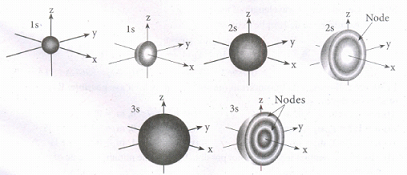
21.
(i) It is represented by the letter 'l' and can take integral values from zero to n - 1, where n is the principal quantum number.
(ii) Each l value represents a subshell (orbital). l = 0, 1, 2, 3 and 4 represents the s, p, d, f and g orbitals respectively.
(iii) The maximum number of electrons that can be accommodated in a given subshell (orbital) is 2(2l + 1).
(iv) It is used to calculate the orbital angular momentum using the expression Angular momentum \(=\sqrt {l(l+1)}\frac{h}{2\pi}\)
22.
(i) The principal quantum number represents the energy level in which electron revolves around the nucleus and is denoted by the symbol 'n'.
(ii) The 'n' can have the values 1,2,3, ... n = 1 represents K shell; n = 2 represents L shell and n = 3, 4, 5 represent the M, N, O shells, respectively.
(iii) The maximum number of electrons that can be accommodated in a given shell is 2n2.
(iv) 'n' gives the energy of the electron,
\(E_n=\frac{(-1312.8)Z^2}{n^2}\ kJ\ mol^{-1}\) and the distance of the electron from the nucleus is given by \(r_n=\frac{(0.529)n^2}{Z}A\)
23.
Uncertainty in position \(=\triangle x\)
\(=\frac{0.5\%}{100\%}\times0.529\mathring A\)
\(=\frac{0.5}{100}\times10^{-10}\times0.529\ m\)
\(\triangle x=2.645\times10^{-13}\ m\)
From Heisenberg's uncertainty principle
\(\triangle x.\triangle p\ge\frac{h}{4\pi}\)
\(\triangle x.m.\triangle v \ge\frac{h}{4\pi}\)
\(\triangle v\ge\frac{h}{\triangle x.m.4\pi}\)
\(
\geq \frac{6.626 \times 10^{-34}}{4 \times 3.14} \times
\frac{1}{2.645 \times 10^{-13} \times 9.11 \times 10^{-31}}
\)
\(\triangle v=2.189\times10^8\ ms^{-1}\)
24.
(i) The wave nature of electron-was experimentally confirmed by Davisson and Germer.
(ii) They allowed the accelerated beam of electrons to fall on a nickel crystal and recorded the diffraction pattern.
(iii) The resultant diffraction pattern is similar to the X-ray diffraction pattern.
(iv) The finding of wave nature of electron leads to the development of various experimental techniques such as electron microscope, low energy electron diffraction etc.
25.
(i) \(\lambda_{iron\ ball}=\frac{h}{mv}\)
\(=\frac{6.626\times10^{-34}\ Kg\ m^2s^{-1}}{6.626\ Kg\times10ms^{-1}}\)
\(=1\times10^{-35}\ m\)
(ii) \(\lambda_{electron}=\frac{h}{mv}\)
\(=\frac{6.626\times10^{-34}\ Kgm^2s^{-1}}{9.11\times10^{-31}\ Kg\times72.73\ ms^{-1}}\)
\(=\frac{6.626}{6.626}\times10^{-3}\ m=1\times10^5\ m\)
For an electron, the de Broglie wavelength is significant and measurable while for iron ball it is too small to measure, hence it becomes insignificant.
26.
(i) The Bohr's atom model is applicable only to species having one electron such as hydrogen, Li2+ etc and not applicable to multi-electron atoms.
(ii) It was unable to explain the splitting of spectral lines in the presence of magnetic field (Zeeman effect) or an electric-field (Stark effect).
(iii) Bohr's theory was unable to explain why the electron is restricted to revolve around the nucleus in a fixed orbit in which the angular momentum of the electron is equal to \(\frac{nh}{2\pi}\)
27.
(i) Rutherford bombarded a thin gold foil with a stream of fast moving a-particles.
(ii) It was observed that most of the \(\alpha\)-particles passed through the foil.
(iii) Some of them were deflected through a small angle.
(iv) Very few α-particles were reflected back by 180°.
(v) Based on these observations, he proposed that in an atom, there is a tiny positively charged nucleus and the electrons are moving around the nucleus with high speed.
28.
According to uncertainty principle,
\(\triangle x.m\triangle v={h\over 4\pi}\) or \(\triangle v={h\over 4\pi m \triangle x};\) h = 6.626 x 10⁻³⁴ kg m2 s-1;m = 10g = 10-2 kg
\(\triangle x =10^{-5}m;\triangle v ={(6.626\times 10^{-.34}kgm^2s^{-1})\over4\times 3.143\times (10^{-2}kg)\times (10^{-5}m)}=5.27\times 10^{-28}\)mv
29.
Let the no. of electrons in the ion = x
\(\therefore\) the no. of the protons = x + 3 (as the ion has three units positive charge) and the no. of neutrons = \(x+{30.4x\over 100}=x+0.304x\)
Now, mass number of ion = Number of protons + Number of neutrons
= (x + 3) + (x + 0.304 x)
\(\therefore\) 56 = (x + 3) + (x + 0.304 x) or 2.304 x = 56 - 3 = 53
\(x={53\over 2.304}=23\)
Atomic number of the ion (or element) = 23 + 3 = 26
The element with atomic number 26 is iron (Fe) and the corresponding ion is Fe3+.
30.
According to Bohr's theory,
\(mvr={nh\over 2\pi}\) (n = 1, 2, 3, ... so on)
or \(2\pi r={nh\over mv}\)or \( mv={nh\over 2\pi r}\) ......(i)
According to de Broglie equation,
\(\lambda ={h\over mv}\)or \(mv ={h\over \lambda}\).......(ii)
Comparing (i) and (ii),
\({nh\over 2\pi r}={h\over \lambda}\) or \( 2\pi r=n\lambda\)
Thus, the circumference (\(2\pi\)r) of the Bohr orbit for hydrogen atom is an into the de Broglie wavelength.
31.
(a) For n = 4
Total number of electrons= 2n2 = 2 x 16 = 32
Half out of these will have ms = - 1/2
\(\therefore\) Total electrons with ms (- 1/2) = 16
(b) For n=3
1= 0 ; ml = 0, m = +1/2 - 1/2 (two e-)

11th Standard Syllabus & Materials
11th Standard
TN 11th Tamil பீடு பெற நில் - செய்யுள் - காவடிச்சிந்து Important Questions And Answers Study Material - QB365 Set A
NEW11th Standard
TN 11th Tamil பீடு பெற நில் - உரைநடை - மலை இடப்பெயர்கள் : ஓர் ஆய்வு Important Questions And Answers Study Material - QB365 Set A
NEW11th Standard
TN 11th Tamil மாமழை போற்றுதும் - துணைப்பாடம் - யானை டாக்டர் Important Questions And Answers Study Material - QB365 Set A
NEW11th Standard
TN 11th Tamil மாமழை போற்றுதும் - செய்யுள் - ஐங்குறுநூறு Important Questions And Answers Study Material - QB365 Set A



Tamilnadu Stateboard 11th Standard Subjects

Maths

Commerce

Economics

Biology

Business Maths and Statistics

Accountancy

Computer Science

Physics
Chemistry
Maths
Biology
Economics
Physics
Chemistry

History
Business Maths and Statistics

Computer Science
Accountancy

Computer Applications
History
Computer Technology
Commerce
Computer Applications
Computer Technology

Tamil

English

French
Tamilnadu Stateboard Standards
