
 100% FREE ACCESS
8th Standard CBSE Syllabus & Materials
8th Standard CBSE
CBSE 8th Social Science Theme D - Factors of Production - New Model Questions Papers Study Material - QB365 Set A
NEW8th Standard CBSE
CBSE 8th Social Science Theme C - Universal Franchise and India's Electoral System - New Model Questions Papers Study Material - QB365 Set A
NEW8th Standard CBSE
CBSE 8th Social Science Theme B - The Rise of the Marathas - New Model Questions Papers Study Material - QB365 Set A
NEW8th Standard CBSE
CBSE 8th Social Science Theme B - Reshaping India's Political Map - New Model Questions Papers Study Material - QB365 Set A
NEW8th Standard CBSE
CBSE 8th Social Science Theme A - Natural Resources and Their Use - New Model Questions Papers Study Material - QB365 Set A
NEW8th Standard CBSE
CBSE 8th Science Keeping Time with Skies - New Model Questions Papers Study Material - QB365 Set A

Published on: 02/03/2019
Exponents and Powers Important Questions
Download CBSE Class 8th Standard CBSE Mathematics question papers, sample papers, important questions, and previous year solved papers in PDF format. Get free study materials, NCERT solutions, and exam preparation resources for Class 8th Standard CBSE Mathematics
Questions + Answers key
Take MCQ Mathematics Test
1.
If the thickness of a paper sheet is 0.0016 cm. Find the thickness of 100 sheets. Express your answer in the standard form.
2.
Simplify: \(\left\{ { \left( \frac { 1 }{ 3 } \right) }^{ -2 }-\left( \frac { 1 }{ 2 } \right) \frac { -3 }{ 4 } \right\} \div { \left( \frac { 1 }{ 4 } \right) }^{ -2 }\)
3.
Simplify: 25 \(\div \) 2-6
4.
Express the following numbers in standard form: 0.00035
5.
Write each of the following in standard form: 0.000007
6.
A sugar factory has annual sales of 3 billion 720 million kilograms of sugar. Express this number in the standard form.
7.
Write the following numbers in standard form.
0.000568
8.
Express the following numbers in standard form.
0.00000000000942
9.
Evaluate {\((\frac{1}{3})^{-1}-(\frac{1}{4})^{-1}\)}-1
10.
Find the multiplicative inverse of the following:
10-100
11.
Write the following in standard form: 34500000.
12.
Find the value of: \({ \left( \frac { 1 }{ 4 } \right) }^{ -2 }+{ \left( \frac { 1 }{ 3 } \right) }^{ -3 }+{ \left( \frac { 1 }{ 2 } \right) }^{ -4 }\)
13.
Compare the size of a red blood cell which is 0.000007 m to that of a plant cell which is 0.0000129 m.
14.
The cells of a bacteria double itself every hour. How many cells will there be after 12 h, if initially we start with 1 cell? Express the answer in powers.
15.
Find the usual form of the number \(\frac{3\times 10^{4}}{2\times 10^{8}}\)
16.
Find the value of x, if 2x÷ 23 = 2-1
17.
By what number should (-5)-1 be multiplied, so that the product becomes 9?
18.
While studying her family's history. Shikha discovers records of ancestors 12 generations back. She wonders how many ancestors she has had in the past 12 generations. She starts to make a diagram to help her figure this out. The diagram soon becomes very complex.
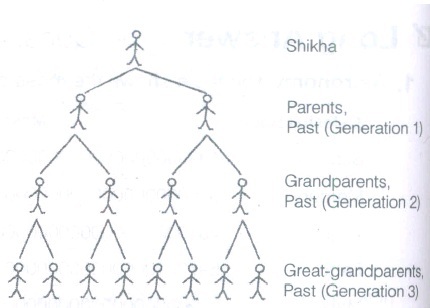
(a) Make a table showing the number of ancestors in each of the 12 generations.
(b) Write an equation for the number of ancestors in a given generation n.
19.
Consider a quantity of a radioactive substance. The fraction of this quantity that remains after t half-lives can be found by using the expression 3-t.
(a) What fraction of substance remains after 7 half-lives?
(b) After how many half-lives, will the fraction be \(\frac{1}{243}\) of the original?
20.
Astronomy The table shows the mass of the planets, the Sun and the Moon in our solar system.
| Celestial Body | Mass (kg) | Mass (kg) in Standard Notation |
|---|---|---|
| Sun | 1990000000000000000000000000000 | |
| Mercury | 330000000000000000000000 | |
| Venus | 4870000000000000000000000 | |
| Earth | 5970000000000000000000000 | |
| Mars | 642000000000000000000000000000 | |
| Jupiter | 1900000000000000000000000000 | |
| Saturn | 568000000000000000000000000 | |
| Uranus | 86800000000000000000000000 | |
| Neptune | 102800000000000000000000000 | |
| Pluto | 12700000000000000000000 | |
| Moon | 73500000000000000000000 |
(a) Write the mass of each celestial body in standard notation.
(b) Arrange the planets and the Moon according to their mass from least to greatest.
(c) Which planet has same mass as the Earth?
21.
2.1 x 10⁻⁶ is equal to
0.0000021
0.000021
0.00021
0.0021.
22.
(-1)51 is equal to
-1
1
51
-51
23.
(- 2)-2 is equal to
\({1\over 4}\)
\({1\over 2}\)
\(-{1\over 2}\)
\(-{1\over 4}\)
24.
10-1 is equal to
10
-1
\({1\over 10}\)
\(-{1\over 10}\)
25.
am x an is equal to
am + n
am - n
amn
an - m
26.
Which of the following is the reciprocal of \({ \left( \frac { -3 }{ 4 } \right) }^{ 0 }\)?
-1
1
\(\frac { -4 }{ 3 } \)
\(\frac { 4 }{ 3 } \)
27.
Which of the following is the standard form of 0.00001275?
1.275 \(\times\) 10-5
1.275 \(\times\) 10-5
127.5 \(\times\) 10-7
127.5\(\times\) 107
28.
The usual form of 2.08 x 10⁻⁵ is
0.0000208
0.000028
0.000208
0.0002080
29.
For a non-zero integer x, x7÷x12 is equal to
x5
x3
x4
x-5
30.
The reciprocal of \((\frac{3}{7})^{-1}\)is
\(\frac{7}{3}\)
\(-\frac{3}{7}\)
\(-\frac{7}{3}\)
\(\frac{3}{7}\)
31.
The value of [2-1 +3-1 +4-1 +5-1]0 is _____________
32.
The value of \((\frac{1}{2^{3}})^{2}\) is equal to __________
33.
3829.26= 3 x 1000 + 8 x 100 + 2 x 10 + 9 + 2 x 10⁻¹ + 6 x 10-2
= 3 x 10³ + 8 x 10² + 2 x 101 + 9 x 10° + 2x 10⁻¹ +6 X 10⁻²
34.
The value of: \({ \left[ { \left( \frac { 1 }{ 2 } \right) }^{ -3 }-{ \left( \frac { 1 }{ 3 } \right) }^{ -1 } \right] }^{ 2 }\)
35.
(25÷28) X 2-7
1.
1.6 \(\times\) 10-1
2.
\(\left\{\left(\frac{1}{3}\right)^{-2}-\left(\frac{1}{2}\right)^{-3}\right\} \div\left(\frac{1}{4}\right)^{-2} =\left\{\frac{1^{-2}}{3^{-2}}-\frac{1^{-3}}{2^{-3}}\right\} \div \frac{1^{-2}}{4^{-2}} \)
\(\\ =\left\{\frac{3^{2}}{1^{2}}-\frac{2^{3}}{1^{3}}\right\} \div \frac{4^{2}}{1^{2}}=\{9-8\} \div 16=\frac{1}{16} \)
3.
25 ÷ 2– 6 = 25 – (– 6) = 211
4.
3.5 \(\times\) 10-4
5.
7 \(\times\) 10-6
6.
3.72 x 10⁹ kg
7.
5.68 x 10⁻⁴
8.
We have, 0.00000000000942
=\(\frac{942}{10^{14}}=\frac{9.42\times 100}{10^{14}}=9.42\times 10^{2}\times 10^{-14} \quad [\because \frac{1}{a^{m}}=a^{-m}]\)
= \(9.42\times 10^{2-14}=9.42\times10^{-12}\quad [\because a^{m}\times a^{n}=a^{m+n}]\)
which is the required standard form.
9.
We have , {\((\frac{1}{3})^{-1}-(\frac{1}{4})^{-1}\)}-1
\(\left\{ \frac { { \left( 1 \right) }^{ -1 } }{ { \left( 3 \right) }^{ -1 } } -\frac { { \left( 1 \right) }^{ -1 } }{ { \left( 4 \right) }^{ -1 } } \right\} ^{ -1 }\quad \quad \quad \left[ \because \quad \left( \frac { a }{ b } \right) ^{ m }=\frac { { a }^{ m } }{ { b }^{ m } } \quad \right] \)
\(=\left\{ \frac { 3 }{ 1 } -\frac { 4 }{ 1 } \right\} ^{ -1 }\quad \quad \quad \left[ \because \quad { a }^{ -m }=\frac { 1 }{ { a }^{ m } } \right] \)
= (3-4)-1 = (-1)-1=\(\frac{1}{(-1)^{1}}\) \( \left[ \because \quad { a }^{ -m }=\frac { 1 }{ { a }^{ m } } \right] \)
=\(\frac{1}{-1}=-1\)
10.
Multiplicative inverse of 10-100 is 10100.
11.
34500000 - 345 \(\times\) 100000
= 3.45 \(\times\) 100 \(\times\) 100000
= 3.45 \(\times\) 102 \(\times\) 105
= 3.45 \(\times\) 102+5
= 3.45 \(\times\) 107
Thus, 34500000 = 3.45 \(\times\) 107
12.
Since \({ \left( \frac { 1 }{ 4 } \right) }^{ -2 }={ \left( \frac { 4 }{ 1 } \right) }^{ 2 }={ (4) }^{ 2 }=16\)
\({ \left( \frac { 1 }{ 3 } \right) }^{ -3 }={ (3) }^{ 3 }=3\times 3\times 3=27\)
\({ \left( \frac { 1 }{ 2 } \right) }^{ -4 }={ (2) }^{ 4 }=2\times 2\times 2\times 2=16\)
\(\therefore \quad { \left( \frac { 1 }{ 4 } \right) }^{ -2 }+{ \left( \frac { 1 }{ 3 } \right) }^{ -3 }+{ \left( \frac { 1 }{ 2 } \right) }^{ -4 }=16+27+16=59\)
13.
Size of red blood cell = 0.000007 m
\(=\frac { 7 }{ 1000000 } =7\times { 10 }^{ -6 }m\)
Size of the plant cell = 0.0000129 m
\(=\frac { 129 }{ 10000000 } m=\frac { 1.29\times { 10 }^{ 2 } }{ 10000000 } m=1.29\times { 10 }^{ -5 }m\)
Now \(\frac { 7\times { 10 }^{ -6 } }{ 1.29\times { 10 }^{ -5 } } =\frac { 7\times { 10 }^{ -1 } }{ 1.29 } \)
\(=\frac { 7\times { 10 }^{ -1 } }{ 1.3 } =\frac { 0.7 }{ 1.3 } =\frac { 1 }{ 2 } \) (approx.)
Thus, the size of a red blood cell is half of the plant cell size.
14.
The cells of a bacteria double itself every hour, i.e.
the cells of a bacteria after 1 h = 2
∴ The cells of a bacteria after 2 h = 2 x 2 = 22
The cells of a bacteria after 3 h = 2 x 22 = 23
The cells of a bacteria after 12 h = 212
15.
0.00015
16.
2
17.
-45
18.
(a) Generation table (according to the diagram) showing the number of ancestors are given below:
| Generation | Ancestor |
|---|---|
| 1 | 2 |
| 2 | 22 |
| 3 | 23 |
| 4 | 24 |
| 5 | 25 |
| 6 | 26 |
| 7 | 27 |
| 8 | 28 |
| 9 | 29 |
| 10 | 210 |
| 11 | 211 |
| 12 | 212 |
(b) Equation for the number of ancestors in generation n is 2n [according to the part (a)].
19.
The fraction of substance remains after 7 half- lives =3-7=\(\frac{1}{3^{7}}\)
ஃ \(3^{-x}=\frac{1}{243}=\frac{1}{3\times3\times3\times3\times3}=\frac{1}{3^{5}}\)
⇒ \(3^{-x}=3^{-5}\)
⇒ \((3)^{-x}=(3)^{-5}\)
⇒ -x=-5 [∵ bases are same]]
Hence, after 5 half-lives, the fraction will be \(\frac{1}{243}\) of the original.
20.
(a) Mass of each celestial body in standard in notation is given below.
Mass of Sun = 1.99 x 1030 kg
Mass of Mercury = 3.3 x 10²³ kg
Mass of Venus = 4.870 x 1024 kg
Mass of Earth = 5.970 x 1024 kg
Mass of Mars = 6.42 x 1029 kg
Mass of Jupiter = 1.9 x 1027 kg
Mass of Saturn = 5.68 x1026 kg
Mass of Uranus = 8.68 x 1025 kg
Mass of Neptune = 1.02 x 1026 kg
Mass of Pluto = 1.27 x 10²² kg
Mass of Moon = 7.35 x 10²² kg
(b) On observing the masses of the all given planets and the Moon in the exponent form, we see that the order of planets and the Moon by mass from least to greatest is Pluto < Moon < Mercury < Venus < Earth < Uranus < Neptune < Saturn < Jupiter < Mars
(c) ஃ Mass of Earth = 5.970 X1024 kg and mass of Venus = 4.870 x 1024 kg ,
Thus, we can say that planet Venus has about same mass as the Earth.
21.
2.1 x 10-6= 0.0000021
22.
(-1)odd natural number = -1
23.
\((-2)^{-2}={1\over (-2)^2}={1\over 4}\)
24.
\(10^{-1}={1\over 10^1}={1\over 10}\)
25.
(a)
am + n
26.
(b)
1
27.
(a)
1.275 \(\times\) 10-5
28.
(a)
0.0000208
29.
(d)
x-5
30.
(d)
\(\frac{3}{7}\)
31.
()
1
32.
()
\(\frac{1}{64}\)
33.
(a)
34.
()
25
35.
()
2-10

8th Standard CBSE Syllabus & Materials
8th Standard CBSE
CBSE 8th Science Particulate Nature of Matter - New Model Questions Papers Study Material - QB365 Set A
NEW8th Standard CBSE
CBSE 8th Science Pressure, Winds, Stroms and Cyclones - New Model Questions Papers Study Material - QB365 Set A
NEW8th Standard CBSE
CBSE 8th Mathematics Quadrilaterals - New Model Questions Papers Study Material - QB365 Set A
NEW8th Standard CBSE
CBSE 8th Mathematics A story of Numbers - New Model Questions Papers Study Material - QB365 Set A



CBSE 8th Standard CBSE Subjects
CBSE Standards




