
 100% FREE ACCESS
6th Standard CBSE Syllabus & Materials
6th Standard CBSE
CBSE 6th Social Science The Value of Work - New Sample Question Papers Study Material - QB365 Set A
NEW6th Standard CBSE
CBSE 6th Social Science Family and Community - New Sample Question Papers Study Material - QB365 Set A
NEW6th Standard CBSE
CBSE 6th Social Science India's Cultural Roots - New Sample Question Papers Study Material - QB365 Set A
NEW6th Standard CBSE
CBSE 6th Social Science India,That is Bharat - New Sample Question Papers Study Material - QB365 Set A
NEW6th Standard CBSE
CBSE 6th Social Science Timeline and sources of history - New Sample Question Papers Study Material - QB365 Set A
NEW6th Standard CBSE
CBSE 6th Social Science Oceans and Continents - New Sample Question Papers Study Material - QB365 Set A

Published on: 31/07/2018
Based on the current academic syllabus, some of the important questions are prepared from the chapter Fractions.
Students, subscribe and get plenty of question paper with answer key. For subscription please click here.
Download CBSE Class 6th Standard CBSE Mathematics question papers, sample papers, important questions, and previous year solved papers in PDF format. Get free study materials, NCERT solutions, and exam preparation resources for Class 6th Standard CBSE Mathematics
Questions + Answers key
Take MCQ Mathematics Test
1.
A triangle is divided into 4 equal parts and 3 out of it are painted red, whereas a square is divided into 8 equal parts and 7 out of them are painted red. Which of the shaded part represents a bigger fraction?
2.
Write four fractions equivalent to \(\frac { 5 }{ 11 } \)
3.
How is 8 out of 11 parts written as?
4.
Determine \(\frac { 5 }{ 7 } \)of 42 books
5.
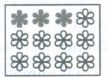
Write the fraction representing the shaded portion.
6.
\(\frac{7}{9} \)and\( \frac{11}{17}\) are two fractions, Which one is greater and by how much?
7.
Simplify. \(\frac{11}{10}+5\frac{1}{15}+3\)
8.
Find an equivalent fraction of \(\frac{2}{3}\) having denominator equal to 18.
9.
Compare \(\frac { 5 }{ 6 } \) and \(\frac { 13 }{ 15 } \)
10.
Write the simplest form of \(\frac { 15 }{ 75 } \)
11.
What should be subtracted from the sum of \(2\frac{1}{4} \) and \(3\frac{1}{7}\) to get \(2\frac{3}{28}\)?
12.
My elder sister divided the watermelon into 16 parts. I ate 7 out of them. My friend ate 4. How much did we eat between us? How much more of the watermelon did I eat than my friend? What portion of the watermelon remained?
13.
If \(\frac{7}{9}=\frac{28}{p}\) then value of p is
23
2
36
16
14.
________ can be expressed in form
\(2\frac{3}{19}\)
\(2\frac{1}{19}\)
\(1\frac{2}{19}\)
\(3\frac{1}{19}\)
15.
If \(\frac{3}{4}\) is equivalent to , then \(\frac{x}{24}\)the value of x is
15
20
16
18
16.
On subtracting \(\frac{6}{13}\) from \(\frac{11}{13}\) the result is
5/13
2/13
3/13
8/13
17.
The fraction which is not equal to \(\frac{4}{5}\) is
\(\frac{40}{50}\)
\(\frac{12}{15}\)
\(\frac{16}{20}\)
\(\frac{9}{15}\)
18.
1 whole = ____ tenths
19.
The fraction \(\frac{25}{40}\) in simplest form is _________.
20.
\(13\frac{5}{18}\) is an _______ fraction.
21.
Fractions with the same denominators are called _____ fractions
22.
A number representing a part of a __________ is called a fraction.
23.
The simplest form of \(\frac{24}{50}\) is \(\frac{12}{25}\)
24.
Sum of \(\frac{5}{12}\) and \(\frac{7}{12} \) is \(1\frac{7}{12}\)
25.
The fraction represented by the shaded portion in the following figure is \(\frac{3}{8}\)

26.
The result obtained by subtracting a fraction from another fraction is necessarily a fraction.
27.
Fractions \(\frac{7}{9}\) and \(\frac{42}{54}\) are equr.va Ient fractions.
1.
Painted part of square
2.
\(\frac { 10 }{ 22 } ,\frac { 15 }{ 33 } ,\frac { 20 }{ 44 } ,\frac { 25 }{ 55 } \)
3.
\(\frac { 8 }{ 11 } \)
4.
30
5.
Total number of equal parts = 12; Shaded parts = 3
∴ Fraction representing the shaded portion = \(\frac { 3 }{ 12 } \)
6.
\(\frac{7}{9}\)is greater by \(\frac{20}{153}\)
7.
\(9\frac{1}{6}\)
8.
Let \(\frac { 2 }{ 3 } =\frac { \Box }{ 18 } \)
Now, \(\frac{2}{3}\)=\(\frac { 2\times 6 }{ 3\times 6 } =\frac { \boxed { 12 } }{ 18 } \)
So, equivalent fraction is \(\frac { \boxed { 12 } }{ 18 } .\)
9.
The given fractions are unlike, we should first get their equivalent fractions with a denominator, which is common multiple of 6 and 15 i.e 30.
now \(\frac { 5\times 5 }{ 6\times 5 } =\frac { 25 }{ 30 } ,\frac { 13\times 2 }{ 15\times 2 } =\frac { 26 }{ 30 } \)
Since\(\frac { 26 }{ 30 } >\frac { 25 }{ 30 } \)so \(\frac { 13 }{ 15 } >\frac { 5 }{ 6 } \)
10.
Given fraction is \(\frac { 15 }{ 75 } \)

now first of all we find the HCF of 15 and 75.
So, the HCF of 15 and 75 is 15.
Now, to change into simplest form, divide numerator and denominator by HCF.
\(\frac { 15 }{ 75 } =\frac { 15\div 15 }{ 75\div 15 } =\frac { 1 }{ 5 } \)
11.
\(3\frac{8}{28}\)
12.
Here, a watermelon is divided into 16 parts.
∴ Each part =\(\frac { 1 }{ 16 } \)
I ate 7 parts out of 16 parts i.e. \(\frac { 7 }{ 16 } \) part
My friend ate 4 parts out of 16 parts i.e\(\frac { 4 }{ 16 } \) part
Now, the part which we eat together
=\(\frac { 7 }{ 16 } +\frac { 4 }{ 16 } =\frac { 7+4 }{ 16 } =\frac { 11 }{ 16 } \) part
Now, difference between our parts = \(\frac { 7 }{ 16 } -\frac { 4 }{ 16 } =\frac { 7-4 }{ 16 } =\frac { 3 }{ 16 } \)
So, I ate\(\frac { 3 }{ 16 } \) part of watermelon more than my friend. Now, remaining part of the watermelon = 1- \(\frac { 11 }{ 16 } -\frac { 16 }{ 16 } -\frac { 11 }{ 16 } \)
[∵ \(\frac { 16 }{ 16 } \)and 1 are equivalent fractions]
= \(\frac { 16-11 }{ 16 } =\frac { 5 }{ 16 } \)
13.
(c)
36
14.
(c)
\(1\frac{2}{19}\)
15.
(d)
18
16.
(a)
5/13
17.
(d)
\(\frac{9}{15}\)
18.
()
1 whole = 10 tenths
19.
()
we have, \(\frac{25}{20}=\frac{25+5}{40+5}=\frac{5}{8}\)[∵ HCF of 25 and 40 is 5]
20.
()
\(13\frac{5}{18}\)is a mixed fraction.
21.
()
Fractions having same denominators are called like fractions.
22.
()
We know that, a fraction represents a part of a whole.
23.
(a)
24.
(b)
25.
(a)
26.
(b)
27.
(a)

6th Standard CBSE Syllabus & Materials
6th Standard CBSE
CBSE 6th Social Science Locating Places on the Earth - New Sample Question Papers Study Material - QB365 Set A
NEW6th Standard CBSE
CBSE 6th Science A Journey Through States of Water - New Sample Question Papers Study Material - QB365 Set A
NEW6th Standard CBSE
CBSE 6th Science Temperature and its Measurement - New Sample Question Papers Study Material - QB365 Set A
NEW6th Standard CBSE
CBSE 6th Science Materials Around Us - New Sample Question Papers Study Material - QB365 Set A



CBSE 6th Standard CBSE Subjects
CBSE Standards




