
 100% FREE ACCESS
12th Standard Syllabus & Materials
12th Standard
TN 12th Computer Applications மின்னணு தரவு பரிமாற்றம் Sample Question Papers Study Material - QB365 Set A
NEW12th Standard
TN 12th Computer Applications மின் - வணிக பாதுகாப்பு அமைப்புகள் Sample Question Papers Study Material - QB365 Set A
NEW12th Standard
TN 12th Computer Applications மின்னணு செலுத்தல் முறைகள் Sample Question Papers Study Material - QB365 Set A
NEW12th Standard
TN 12th Computer Applications மின் - வணிகம் Sample Question Papers Study Material - QB365 Set A
NEW12th Standard
TN 12th Computer Applications திறந்த மூல கருத்துருக்கள் Sample Question Papers Study Material - QB365 Set A
NEW12th Standard
TN 12th Computer Applications வலையமைப்பு வடமிடல் Sample Question Papers Study Material - QB365 Set A

Published on: 29/06/2019
frequently asked questions in +2 state board english medium business maths first chapter
Download Tamil Nadu 12th Standard Business Maths and Statistics question papers, model tests, one-mark questions, important questions, and public exam papers in PDF format. Free study materials and answer keys for TN State Board students.
Questions + Answers key
Take MCQ Business Maths and Statistics Test
1.
If \(\left( \begin{matrix} 1 & 0 & 0 \\ 0 & 1 & 0 \\ 0 & 0 & 1 \end{matrix} \right) \left( \begin{matrix} x \\ y \\ z \end{matrix} \right) =\left( \begin{matrix} 1 \\ -1 \\ 0 \end{matrix} \right) \) find x, y and z
2.
For what value of x, the matrix
\(A=\left| \begin{matrix} 1 & -2 & 3 \\ 1 & 2 & 1 \\ x & 2 & -3 \end{matrix} \right| \) is singular?
3.
Show that the equations x + y + z = 6, x + 2y + 3z = 14 and x + 4y + 7z = 30 are consistent
4.
Find the rank of the matrix \(\begin{pmatrix} -5 & -7 \\ 5 & 7 \end{pmatrix}\)
5.
Solve: 2x + 3y = 5, 6x + 5y = 11
6.
Show that the equations x- 3y + 4z = 3, 2x - 5y + 7z = 6, 3x - 8y + 11z = 1 are inconsistent
7.
Find the rank of the matrix \(A=\left( \begin{matrix} 1 & 2 & -4 \\ 2 & -1 & 3 \\ 8 & 1 & 9 \end{matrix}\begin{matrix} 5 \\ 6 \\ 7 \end{matrix} \right) \)
8.
The total cost of 11 pencils and 3 erasers is Rs. 64 and the total cost of 8 pencils and 3 erasers is Rs. 49. Find the cost of each pencil and each eraser by Cramer’s rule.
9.
The following table represents the number of shares of two companies A and B during the month of January and February and it also gives the amount in rupees invested by Ravi during these two months for the purchase of shares of two companies. Find the the price per share of A and B purchased during both the months
| Months | Number of Shares of the company |
Amount invested by Ravi (in Rs) |
|
| A | B | ||
| January | 10 | 5 | 125 |
| February | 9 | 12 | 150 |
10.
Find the rank of the matrix \(\left( \begin{matrix} 5 & 3 & 0 \\ 1 & 2 & -4 \\ -2 & -4 & 8 \end{matrix} \right) \)
11.
A mixture is to be made of three foods A, B, C. The three foods A, B, C contain nutrients P, Q, R as shown below
| Ounces per pound of Nutrient | |||
| Food | P | Q | R |
| A | 1 | 2 | 5 |
| B | 3 | 1 | 1 |
| C | 4 | 2 | 1 |
How to form a mixture which will have 8 ounces of P, 5 ounces of Q and 7 ounces of R? (Cramer's rule).
12.
The price of 3 Business Mathematics books, 2 Accountancy books and one Commerce book is Rs. 840. The price of 2 Business Mathematics books, one Accountancy book and one Commerce book is Rs. 570. The price of one Business Mathematics book, one Accountancy book and 2 Commerce books is Rs. 630. Find the cost of each book by using Cramer’s rule.
13.
For what values of the parameter λ, will the following equations fail to have unique solution: 3x − y+λz = 1, 2x + y + z = 2, x + 2y − λz = −1 by rank method.
14.
Show that the equations 5x + 3y + 7z = 4, 3x + 26y + 2z = 9, 7x + 2y + 10z = 5 are consistent and solve them by rank method.
15.
If A, B are two n x n non-singular matrices, then ___________
AB is non-singular
AB is singular
(AB)-1 = A-1 B-1
(AB)-1 does not exit
16.
If A is a singular matrix, then Adj A is ___________
non-singular
singular
symmetric
not defined
17.
If \(\left| \begin{matrix} 2x & 5 \\ 8 & x \end{matrix} \right| =\left| \begin{matrix} 6 & -2 \\ 7 & 3 \end{matrix} \right| \) then x =
3
± 3
± 6
6
18.
The value of \(\left| \begin{matrix} { 5 }^{ 2 } & { 5 }^{ 3 } & { 5 }^{ 4 } \\ { 5 }^{ 3 } & { 5 }^{ 4 } & { 5^{ 5 } } \\ { 5 }^{ 4 } & { 5 }^{ 5 } & { 5 }^{ 6 } \end{matrix} \right| \)
52
0
513
59
19.
The rank of an n x n matrix each of whose elements is 2 is __________
1
2
n
n2
20.
For what value of k, the matrix \(A=\left( \begin{matrix} 2 & k \\ 3 & 5 \end{matrix} \right) \) has no inverse?
\(\frac { 3 }{ 10 } \)
\(\frac { 10 }{ 3 } \)
3
10
21.
Rank of a null matrix is _______.
0
-1
\(\infty \)
1
22.
The rank of the unit matrix of order n is ________.
n −1
n
n +1
n2
23.
The rank of m x n matrix whose elements are unity is ________.
0
1
m
n
24.
If A = (1 2 3), then the rank of AAT is ________.
0
2
3
1
25.
If IAI = 0, then
(a) A is a singular matrix
(b) System has either no solution or infinitely many solutions
(c) No solution
(d) non-singular matrix
26.
Which one is incorrect?
(a) \({ R }_{ 1 }\rightarrow { R }_{ 1 }+{ R }_{ 2 }\)
(b) \({ C }_{ 1 }\rightarrow { C }_{ 1 }-{ 2C }_{ 2 }\)
(c) \({ R }_{ 3 }\leftrightarrow { R }_{ 1 }\)
(d) \({ R }_{ 1 }\leftrightarrow { C }_{ 1 }\)
27.
The transition probabilities Pjk satisfy
(a) \({ P }_{ \mu }>0\)
(b) \(\sum _{ k }^{ 1 }{ { P }_{ jk } } =1\)
(c) \({ P }_{ jk }\le 0\)
(d) \({ P }_{ jk }>1\)
28.
Rank of a 2 x 2 matrix may be
(a) 0
(b)1
(c) 2
(d)3
29.
The system of non-homogeneous equations will have.
(a) unique solution
(b) Infinitely many solutions
(c) No solution
(d) Trivial solution
30.
If \(\rho (A,B)\neq \rho (A)\) then the system is
31.
If \(\rho (A,B)=\rho (A)=n\) then the system has
32.
If \(\rho (A,B)=\rho\) (A)
33.
For the system of equations AX = B, the solution is X = A-1 B provided
34.
A row having at least one non-zero element is
35.
The value on for which the system of equations x + y + z = 5, x + 2y + 3z = 9, \(x+3y+\lambda z=\mu \) is __________
36.
The system of linear equations x + y + Z = 2, 2x + Y - z = 3, 3x + 2y + kz = 4 has a unique solution if k is_______
37.
The system of equation x + y + z = 2, 3x - y + 2z = 6 and 3x + y - z = -18 has________solution
38.
If A is a square matrix of order n, then |Adj A|=______
39.
If \(A=\left[ \begin{matrix} a & 0 & 0 \\ 0 & a & 0 \\ 0 & 0 & a \end{matrix} \right] \) then the value of |adj A| is ___________
1.
Given \(\left( \begin{matrix} 1 & 0 & 0 \\ 0 & 1 & 0 \\ 0 & 0 & 1 \end{matrix} \right) \left( \begin{matrix} x \\ y \\ z \end{matrix} \right) =\left( \begin{matrix} 1 \\ -1 \\ 0 \end{matrix} \right) \)
\(\Rightarrow \left( \begin{matrix} x+0+x \\ 0+y+0 \\ 0+0+z \end{matrix} \right) =\left( \begin{matrix} 1 \\ -1 \\ 0 \end{matrix} \right) \)
\(\Rightarrow \left( \begin{matrix} x \\ y \\ z \end{matrix} \right) =\left( \begin{matrix} 1 \\ -1 \\ 0 \end{matrix} \right) \)
\(\Rightarrow x=1,y=-1,z=0\)
2.
The matrix A is singular, if
\(\left| \begin{matrix} 1 & -2 & 3 \\ 1 & 2 & 1 \\ x & 2 & -3 \end{matrix} \right| =0\)
\(1\left| \begin{matrix} 2 & 1 \\ 2 & -3 \end{matrix} \right| +2\left| \begin{matrix} 1 & 1 \\ x & -3 \end{matrix} \right| +3\left| \begin{matrix} 1 & 2 \\ x & 2 \end{matrix} \right| =0\)
\(\Rightarrow\) (-8) -6 - 2x + 6 - 6x = 0
\(\Rightarrow\) -8-2x-6x = 0
\(\Rightarrow\) -8-8x = 0
\(\Rightarrow\) -8 = 8x
\(\Rightarrow\) \(x=\cfrac { -8 }{ 8 } =-1\)
3.
Given non-homogeneous equations are x + y + z = 6, x + 2y + 3z = 14, x + 4y + 7z = 30
| Augmented matrix | Elementary Transformation |
|---|---|
| \(\left( \begin{matrix} 1 & 2 & \begin{matrix} 1 & 6 \end{matrix} \\ 1 & 2 & \begin{matrix} 3 & 14 \end{matrix} \\ 1 & 4 & \begin{matrix} 7 & 30 \end{matrix} \end{matrix} \right) \) | |
| \(\left( \begin{matrix} 1 & 1 & 1 \\ 0 & 1 & 2 \\ 0 & 3 & 6 \end{matrix}\begin{matrix} 6 \\ 8 \\ 24 \end{matrix} \right) \) | \({ R }_{ 2 }\rightarrow { R }_{ 2 }-{ R }_{ 1 }\) \({ R }_{ 3 }\rightarrow { R }_{ 3 }-{ R }_{ 1 }\) |
| \(-\left( \begin{matrix} 1 & 1 & 1 \\ 0 & 1 & 2 \\ 0 & 0 & 0 \end{matrix}\begin{matrix} 6 \\ 8 \\ 0 \end{matrix} \right) \) | \({ R }_{ 3 }\rightarrow { R }_{ 3 }-{ R }_{ 1 }\) |
Here \(\rho (A)=\rho (A,B) = 2\)
\(\therefore\) The given system is consistent
4.
Let A =\(\begin{pmatrix} -5 & -7 \\ 5 & 7 \end{pmatrix}\)
Order of A is 2 \(\times\) 2
∴\(\rho \)(A)\(\le \)2
Consider the second order minor \(\begin{vmatrix} -5 & -7 \\ 5 & 7 \end{vmatrix}\)=0
Since the second order minor vanishes,\(\rho (A)\neq 2\)
Consider a first order minor \(\left| -5 \right| \neq 0\)
There is a minor of order 1, which is not zero
\(\therefore \rho (A)=1\)
5.
Given non-homogeneous equations are
2x + 3y = 5 6X + 5y = 11
\(\Delta =\left| \begin{matrix} 2 & 3 \\ 6 & 5 \end{matrix} \right| =10-18=-8\)
Since \(\Delta \neq 0\) Cramer's rule can be applied and the system is consistent with unique solution
\(\Delta x=\left| \begin{matrix} 5 & 3 \\ 11 & 5 \end{matrix} \right| =25-33=-8\)
\(\Delta y=\left| \begin{matrix} 2 & 5 \\ 6 & 11 \end{matrix} \right| =22-30=-8\)
\(\therefore x=\cfrac { \Delta x }{ \Delta } =\cfrac { -8 }{ -8 } =1\)
\(y=\cfrac { \Delta y }{ \Delta } =\cfrac { -8 }{ -8 } =1\)
\(\therefore \) Solution set is {1, 1}
6.
Given non-homogeneous equations are
x- 3y + 4z = 3, 2x - 5y + 7z = 6, 3x - 8y + 11z = 1
| Augmented matrix [A, B] |
Elementary Transformation |
|---|---|
| \(\left( \begin{matrix} 1 & -3 & 4 \\ 2 & -5 & 7 \\ 3 & -8 & 11 \end{matrix}\begin{matrix} 3 \\ 6 \\ 1 \end{matrix} \right) \) | |
| \(\sim \left( \begin{matrix} 1 & -3 & 4 \\ 0 & 1 & -1 \\ 0 & 1 & -1 \end{matrix}\begin{matrix} 3 \\ 0 \\ -8 \end{matrix} \right) \) | \({ R }_{ 2 }\rightarrow { R }_{ 2 }-2{ R }_{ 1 }\) \({ R }_{ 3 }\rightarrow { R }_{ 3 }-{ 3R }_{ 1 }\) |
| \(\sim \left( \begin{matrix} 1 & -3 & 4 \\ 0 & 1 & -1 \\ 0 & 0 & -0 \end{matrix}\begin{matrix} 3 \\ 0 \\ -8 \end{matrix} \right) \) | \({ R }_{ 3 }\rightarrow { R }_{ 3 }-R_{ 2 }\) |
Clearly \(\rho (A)=2\) and \(\rho (A,B)=3\)
\(\rho (A,B)\neq \rho (A)\)
Hence, the given system is inconsistent and has no solution.
7.
The order of A is 3 x 4
\(\therefore \rho (A)\le min\left( 3,4 \right) \)
\(\rho (A)\le 3\)
Consider the third order minor
\(\left| \begin{matrix} 1 & 2 & -4 \\ 2 & -1 & 3 \\ 8 & 1 & 9 \end{matrix} \right| =1\left| \begin{matrix} -1 & 3 \\ 1 & 9 \end{matrix} \right| -2\left| \begin{matrix} 2 & 3 \\ 8 & 9 \end{matrix} \right| -4\left| \begin{matrix} 2 & -1 \\ 8 & 1 \end{matrix} \right| \)
= 1(- 9 - 3) - 2(18 - 24) - 4(2 + 8)
= 1 (-12) - 2 (- 6) - 4 (10)
= - 12 + 12 - 40
= - 40::\(\neq \) 0.
There is a minor of order 3, which is not zero
\(\therefore \rho (A)=3\)
8.
Let ‘x’ be the cost of a pencil
Let ‘y’ be the cost of an eraser
\(\therefore \) By given data, we get the following equations
11x + 3y = 64
8x + 3y = 49
\(\triangle =\left| \begin{matrix} 11 & 3 \\ 8 & 3 \end{matrix} \right| =9\neq 0,\) It has unique solution.
\({ \triangle }_{ x }\left| \begin{matrix} 64 & 3 \\ 49 & 3 \end{matrix} \right| =45\)
\({ \triangle }_{ y }\left| \begin{matrix} 11 & 64 \\ 8 & 49 \end{matrix} \right| =27\)
\(\therefore \) By Cramer’s rule
\(x={ \frac { \triangle x }{ \triangle } =\frac { 45 }{ 9 } =5 }\)
\(y={ \frac { \triangle y }{ \triangle } =\frac { 27 }{ 9 } =3 }\)
\(\therefore \) The cost of a pencil is Rs. 5 and the cost of an eraser is Rs. 3.
9.
Let the price of one share of A be x
Let the price of one share of B be y
\(\therefore \) By given data, we get the following equations
10x + 5y = 125
9x + 12y = 150
\(\triangle =\left| \begin{matrix} 10 & 5 \\ 9 & 12 \end{matrix} \right| =75\neq 0\)
\({ \triangle }_{ x }=\left| \begin{matrix} 125 & 5 \\ 150 & 12 \end{matrix} \right| =750\)
\({ \triangle }_{ y }=\left| \begin{matrix} 10 & 125 \\ 9 & 150 \end{matrix} \right| =375\)
\(\therefore \) Cramer’s rule
\(x=\frac { \triangle x }{ \triangle } =\frac { 750 }{ 75 } =10\)
\( y=\frac { \triangle y }{ \triangle } =\frac { 375 }{ 75 } =5\)
The price of the share A is Rs10 and the price of the share B is Rs. 5.
10.
Let A= \(\left( \begin{matrix} 5 & 3 & 0 \\ 1 & 2 & -4 \\ -2 & -4 & 8 \end{matrix} \right) \)
Order of A is 3 \(\times\) 3.
∴\(\rho \)(A)\(\le \)3
Consider the third order minor \(\left| \begin{matrix} 5 & 3 & 0 \\ 1 & 2 & -4 \\ -2 & -4 & 8 \end{matrix} \right| =0\)
Since the third order minor vanishes, therefore \(\rho (A)\neq 3\)
Consider a second order minor \(\left| \begin{matrix} 5 & 3 \\ 1 & 2 \end{matrix} \right| =7\neq 0\)
There is a minor of order 2, which is not zero.
\(\therefore \rho (A)=2\)
11.
Let x pounds of food A, y pounds of food B and z pounds of food C be needed to form the mixture.
Given x + 3y + 4z = 8
2x + y + 2z = 5
5x + y + z = 7
\(\Delta =\left| \begin{matrix} 1 & 3 & 4 \\ 2 & 1 & 2 \\ 5 & 1 & 1 \end{matrix} \right| \)
= \(1\left| \begin{matrix} 1 & 2 \\ 1 & 1 \end{matrix} \right| -3\left| \begin{matrix} 2 & 2 \\ 5 & 1 \end{matrix} \right| +4\left| \begin{matrix} 2 & 1 \\ 5 & 1 \end{matrix} \right| \)
= 1(1 - 2) - 3(2 - 10) + 4(2 - 5)
= 1(-1)-3(-8)+4(-3)
= - 1 + 24 - 12 = 11
Since \(\Delta \neq 0\) Cramer's rule can be applied and the system has unique solution.
\(\Delta x=\left| \begin{matrix} 8 & 3 & 4 \\ 5 & 1 & 2 \\ 7 & 1 & 1 \end{matrix} \right| \)
= \(8\left| \begin{matrix} 1 & 2 \\ 1 & 1 \end{matrix} \right| -3\left| \begin{matrix} 5 & 2 \\ 7 & 1 \end{matrix} \right| +4\left| \begin{matrix} 5 & 1 \\ 7 & 1 \end{matrix} \right| \)
= 8(1 - 2) - 3(5 - 14) + 4(5 - 7)
= 8 (- 1) - 3 (- 9) + 4 (- 2)
= 8 + 27 - 8 = 11
\(\Delta y=\left| \begin{matrix} 1 & 8 & 4 \\ 2 & 5 & 2 \\ 5 & 7 & 1 \end{matrix} \right| =1\left| \begin{matrix} 5 & 2 \\ 7 & 1 \end{matrix} \right| -8\left| \begin{matrix} 2 & 2 \\ 5 & 1 \end{matrix} \right| +4\left| \begin{matrix} 2 & 5 \\ 5 & 7 \end{matrix} \right| \)
= 1(5 - 14) - 8(2 - 10) + 4(14 - 25)
= 1 (- 9) - 8 (- 8) + 4 (- 11)
= 9 + 64 - 44 = 11
\(\Delta z=\left| \begin{matrix} 1 & 3 & 8 \\ 2 & 1 & 5 \\ 5 & 1 & 7 \end{matrix} \right| =1\left| \begin{matrix} 1 & 5 \\ 1 & 7 \end{matrix} \right| -3\left| \begin{matrix} 2 & 5 \\ 5 & 7 \end{matrix} \right| +8\left| \begin{matrix} 2 & 1 \\ 5 & 1 \end{matrix} \right| \)
= 1(7 - 5) - 3(14 - 25) + 8(2 - 5)
= 1 (2) - 3 (- 11) + 8 (- 3)
= 2 + 33 - 24
= 11
\(\therefore\ x=\cfrac { \Delta x }{ \Delta } =\cfrac { 11 }{ 11 } =1\)
\(y=\cfrac { \Delta y }{ \Delta } =\cfrac { 11 }{ 11 } =1\)
\(z=\cfrac { \Delta z }{ \Delta } =\cfrac { 11 }{ 11 } =1\)
Hence, the mixture is formed by mixing one pound of each of the foods A, B and C.
12.
Let ‘x’ be the cost of a Business Mathematics book
Let ‘y’ be the cost of a Accountancy book.
Let ‘z’ be the cost of a Commerce book.
\(\therefore \) 3x + 2y + z = 840
2x + y + z = 570
x + y + 2z = 630
Here \({ \triangle }=\left| \begin{matrix} 3 & 2 & 1 \\ 2 & 1 & 1 \\ 1 & 1 & 2 \end{matrix} \right| =-2\neq 0\)
\({ \triangle }_{ x }=\left| \begin{matrix} 840 & 2 & 1 \\ 570 & 1 & 1 \\ 630 & 1 & 2 \end{matrix}\begin{matrix} 1 \\ 1 \\ 2 \end{matrix} \right| =-240 \)
\({ \triangle }_{ y }=\left| \begin{matrix} 3 & 840 & 1 \\ 2 & 570 & 1 \\ 1 & 630 & 2 \end{matrix} \right| =-300 \)
\({ \triangle }_{ z }=\left| \begin{matrix} 3 & 2 & 840 \\ 2 & 1 & 570 \\ 1 & 1 & 630 \end{matrix} \right| =-360\)
\(\therefore \) By Cramer’s rule
\(x=\frac { { \triangle }x }{ { \triangle } } =\frac { -240 }{ -2 } =120 \)
\(y=\frac { { \triangle }y }{ { \triangle } } =\frac { 300 }{ -2 } =150 \)
\(z=\frac { { \triangle }z }{ { \triangle } } =\frac { 360 }{ -2 } =180\)
\(\therefore \) The cost of a Business Mathematics book is Rs. 120,
the cost of a Accountancy book is Rs. 150 and
the cost of a Commerce book is Rs. 180.
13.
Given non-homogeneous equations are
\(3x-y+\lambda z=1\)
\(2x+y+z=2\)
\(x+2y-\lambda z=-1\)
The matrix equation corresponding to the given system is
| Augmented matrix [A,B] | Elementary Transformation |
|---|---|
| \(\left( \begin{matrix} 3 & -1 & \lambda \\ 2 & 1 & 1 \\ 1 & 2 & - \end{matrix}\begin{matrix} 1 \\ 2 \\ -1 \end{matrix} \right) \) | |
| \(\sim \left( \begin{matrix} 1 & 2 & -\lambda \\ 2 & 1 & 1 \\ 3 & -1 & \lambda \end{matrix}\begin{matrix} -1 \\ 2 \\ 1 \end{matrix} \right) \) | \({ R }_{ 1 }\leftrightarrow { R }_{ 3 }\) |
| \(\sim \left( \begin{matrix} 1 & 2 & -\lambda \\ 0 & -3 & 1+2\lambda \\ 3 & -1 & \lambda \end{matrix}\begin{matrix} -1 \\ 4 \\ 1 \end{matrix} \right) \) | \({ R }_{ 2 }\rightarrow { R }_{ 2 }-2{ R }_{ 1 }\) |
| \(\left( \begin{matrix} 1 & 2 & -\lambda \\ 0 & -3 & 1+2\lambda \\ 0 & -7 & 4\lambda \end{matrix}\begin{matrix} -1 \\ 4 \\ 4 \end{matrix} \right) \) | \({ R }_{ 3 }\rightarrow { R }_{ 3 }-3{ R }_{ 1 }\) |
| \(\sim \left( \begin{matrix} 1 & 2 & -\lambda \\ 0 & -1 & \frac { 1+2\lambda }{ 3 } \\ 0 & - & \frac { 4\lambda }{ 7 } \end{matrix}\begin{matrix} -1 \\ \frac { 4 }{ 3 } \\ \frac { 4 }{ 7 } \end{matrix} \right) \) | \({ R }_{ 2 }\rightarrow { R }_{ 2 }\div 3\) \({ R }_{ 3 }\rightarrow { R }_{ 3 }\div 7\) |
| \(\left( \begin{matrix} 1 & 2 & -\lambda \\ 0 & -1 & \frac { 1+2 }{ 3 } \\ 0 & 0 & \frac { -7-2\lambda }{ 21 } \end{matrix}\begin{matrix} -1 \\ \frac { 4 }{ 3 } \\ \frac { -16 }{ 21 } \end{matrix} \right) \) | \({ R }_{ 3 }\rightarrow { R }_{ 3 }-{ R }_{ 2 }\) |
Since
\(\cfrac { 4\lambda }{ 7 } -\cfrac { 1+2\lambda }{ 3 } \)
= \(\cfrac { 12\lambda -7-14\lambda }{ 21 } =\cfrac { -7-2\lambda }{ 21 } \)
and \(\cfrac { 4 }{ 7 } -\cfrac { 4 }{ 3 } =\cfrac { 12-28 }{ 21 } \)
= \(\cfrac { -16 }{ 21 } \)
\(\therefore\) Since the system is fail to have unique solution either it can have infinitely many solution or it may be inconsistent.
This can happen only when \(\cfrac { -7-2\lambda }{ 21 } =0\)
\(\Rightarrow -7-2\lambda =0\)
\(\Rightarrow -7=2\lambda \)
\(\Rightarrow \lambda =\cfrac { -7 }{ 2 } \)
14.
Given non-homogeneous equations are
5x+ 3y + 7z = 4
3x + 26y + 2z = 9
7x + 2y + 10z = 5
The matrix equation corresponding to the given system is
\(\left( \begin{matrix} 5 & 3 & 7 \\ 3 & 26 & 2 \\ 7 & 2 & 10 \end{matrix} \right) \left( \begin{matrix} x \\ y \\ z \end{matrix} \right) =\left( \begin{matrix} 4 \\ 9 \\ 5 \end{matrix} \right) \)
| Augmented matrix [A, B] | Elementary Transformation |
|---|---|
| \(\left( \begin{matrix} 5 & 3 & 7 \\ 3 & 26 & 2 \\ 7 & 2 & 10 \end{matrix}\begin{matrix} 4 \\ 9 \\ 5 \end{matrix} \right) \) | |
| \(\sim \left( \begin{matrix} 3 & 26 & 2 \\ 5 & 3 & 7 \\ 7 & 2 & 10 \end{matrix}\begin{matrix} 9 \\ 4 \\ 5 \end{matrix} \right) \) | \({ R }_{ 1 }\leftrightarrow { R }_{ 2 }\) |
| \(\left( \begin{matrix} 1 & \frac { 26 }{ 3 } & \frac { 2 }{ 3 } \\ 5 & 3 & 7 \\ 7 & 2 & 10 \end{matrix}\begin{matrix} 3 \\ 4 \\ 5 \end{matrix} \right) \) | \({ R }_{ 1 }\rightarrow { R }_{ 1 }\div 3\) |
| \(\left( \begin{matrix} 1 & \frac { 26 }{ 3 } & \frac { 2 }{ 3 } \\ 0 & \frac { -121 }{ 3 } & \frac { 11 }{ 3 } \\ 7 & 2 & 5 \end{matrix}\begin{matrix} 3 \\ -11 \\ 5 \end{matrix} \right) \) | \({ R }_{ 2 }\rightarrow { R }_{ 2 }-5{ R }_{ 1 }\) |
| \(\left( \begin{matrix} 1 & \frac { 26 }{ 3 } & \frac { 2 }{ 3 } \\ 0 & \frac { -121 }{ 3 } & \frac { 11 }{ 3 } \\ 0 & \frac { -176 }{ 3 } & \frac { 16 }{ 3 } \end{matrix}\begin{matrix} 3 \\ -11 \\ -16 \end{matrix} \right) \) | \({ R }_{ 3 }\rightarrow { R }_{ 3 }-7{ R }_{ 1 }\) |
| \(\sim \left( \begin{matrix} 1 & \frac { 26 }{ 3 } & \frac { 2 }{ 3 } \\ 0 & \frac { -11 }{ 3 } & \frac { 1 }{ 3 } \\ 0 & \frac { -11 }{ 3 } & \frac { 1 }{ 3 } \end{matrix}\begin{matrix} 3 \\ -1 \\ -1 \end{matrix} \right) \) | \({ R }_{ 2 }\rightarrow { R }_{ 2 }\div 11\) \({ R }_{ 3 }\rightarrow { R }_{ 3 }\div 16\) |
| \(\left( \begin{matrix} 1 & \frac { 26 }{ 3 } & \frac { 2 }{ 3 } \\ 0 & \frac { -11 }{ 3 } & \frac { 1 }{ 3 } \\ 0 & 0 & 0 \end{matrix}\begin{matrix} 3 \\ -1 \\ 0 \end{matrix} \right) \) | \({ R }_{ 3 }\rightarrow { R }_{ 3 }-{ R }_{ 2 }\) |
\(\therefore\) The system is consistent with infinitely many solutions let us rewrite the above echelon form into matrix form
\(\left( \begin{matrix} 1 & \frac { 26 }{ 3 } & \frac { 2 }{ 3 } \\ 0 & \frac { -11 }{ 3 } & \frac { 1 }{ 3 } \\ 0 & 0 & 0 \end{matrix} \right) \left( \begin{matrix} x \\ y \\ z \end{matrix} \right) =\left( \begin{matrix} 3 \\ -1 \\ 0 \end{matrix} \right) \)
\(x+\cfrac { 26 }{ 3 } y+\cfrac { 2 }{ 3 } z=3\)
\(x+\cfrac { 26 }{ 3 } y+\cfrac { 2 }{ 3 } z=3\)
let z = k where k\(\in\) R
\((2)\Rightarrow \cfrac { -11 }{ 3 } y+\cfrac { k }{ 3 } =-1\)
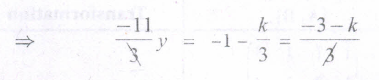
\(\Rightarrow \ -11y=-3-k\)
11y = 3 + k
\(\Rightarrow \quad y=\cfrac { 1 }{ 11 } \left( 3+k \right) \)
Substituting \(y=\cfrac { 1 }{ 11 } \left( 3+k \right) \) and z = k in (1) we get,
\(x+\cfrac { 26 }{ 3 } \left( \cfrac { 3+k }{ 11 } \right) +\cfrac { 2 }{ 3 } k=3\)
\(=\cfrac { 26 }{ 3 } \left( \cfrac { 3+k }{ 11 } \right) -\cfrac { 2k }{ 3 } +3\)
\(\cfrac { 78-26k }{ 33 } -\cfrac { 2k }{ 3 } +3\)
\(\cfrac { 78-26k-22k+99 }{ 33 } \)
\(\cfrac { 78-26k-22k+99 }{ 33 } \)
\(\cfrac { 21-48k }{ 33 } =\cfrac { 3(7-16k) }{ 33 } \)
= \(\cfrac { 1 }{ 11 } (7-6k)\)
\(\therefore\) Solution set is \(\left\{ \cfrac { 1 }{ 11 } \left( 7-16k \right), \cfrac { 1 }{ 11 } (3+k),k \right\} \)K \(\in\) R
Hence, for different values of k, we get infinitely many solutions.
15.
The non-homogeneous equation are
2x - y + z = 7, 3x + y - 5z = 13, x + y + z = 5
| Augmented matrix [A,B] |
Elementary Transformation |
|---|---|
| \(\left( \begin{matrix} 2 & -1 & 1 \\ 3 & 1 & -5 \\ 1 & 1 & 1 \end{matrix}\begin{matrix} 7 \\ 13 \\ 5 \end{matrix} \right) \) | |
| \(-\left( \begin{matrix} 1 & 1 & 1 \\ 3 & 1 & -5 \\ 2 & -1 & 1 \end{matrix}\begin{matrix} 5 \\ 13 \\ 7 \end{matrix} \right) \) | \({ R }_{ 1 }\leftrightarrow { R }_{ 3 }\) |
| \(\sim \left( \begin{matrix} 1 & 1 & 1 \\ 0 & -2 & -8 \\ 0 & -3 & -1 \end{matrix}\begin{matrix} 5 \\ -2 \\ -3 \end{matrix} \right) \) | \({ R }_{ 2 }\rightarrow { R }_{ 2 }-3{ R }_{ 1 }\) \({ R }_{ 3 }\rightarrow { R }_{ 3 }-2{ R }_{ 1 }\) |
| \(\sim \left( \begin{matrix} 1 & 1 & 1 \\ 0 & -2 & -8 \\ 0 & 0 & 11 \end{matrix}\begin{matrix} 5 \\ -2 \\ 0 \end{matrix} \right) \) | \({ R }_{ 3 }\rightarrow { R }_{ 3 }-\cfrac { 3 }{ 2 } { R }_{ 2 }\) |
Clearly \(\rho (A)=3\) and \(\rho (A,B)\) = 3 = Number of unknowns
\(\therefore\) The given system is consistent and has unique solution.
16.
(b)
singular
17.
(c)
± 6
18.
(b)
0
19.
(a)
1
20.
(b)
\(\frac { 10 }{ 3 } \)
21.
(a)
0
22.
(b)
n
23.
(b)
1
24.
(d)
1
25.
non-singular matrix
26.
\({ R }_{ 1 }\leftrightarrow { C }_{ 1 }\)
27.
\({ P }_{ jk }\le 0\)
28.
3
29.
Trivial solution
30.
inconsistent
31.
unique solution
32.
infinitely many solutions
33.
\(|A|\neq 0\)
34.
non-zero row
35.
()
\(\lambda \neq 5\)
36.
()
Not equal to 0
37.
()
unique
38.
()
|A|n-1
39.
()
a6

12th Standard Syllabus & Materials
12th Standard
TN 12th Computer Applications களப்பெயர் முறைமை (DNS) Sample Question Papers Study Material - QB365 Set A
NEW12th Standard
TN 12th Computer Applications வலையமைப்பு எடுத்துக்காட்டுகள் மற்றும் நெறிமுறைகள் Sample Question Papers Study Material - QB365 Set A
NEW12th Standard
TN 12th Computer Applications கணினி வலையமைப்பு ஓர் அறிமுகம் Sample Question Papers Study Material - QB365 Set A
NEW12th Standard
TN 12th Computer Applications PHP-உடன் MySQL-ஐ இணைத்தல் Sample Question Papers Study Material - QB365 Set A



Tamilnadu Stateboard 12th Standard Subjects

Maths

Chemistry

Physics

Biology

Computer Science
Business Maths and Statistics

Economics

Commerce

Accountancy

History

Computer Applications
Biology
Computer Technology
Computer Applications
Computer Science
Business Maths and Statistics
Commerce
Economics
Maths
Chemistry
Physics
Computer Technology
History
Accountancy

Tamil

English

French
Tamilnadu Stateboard Standards
