
 100% FREE ACCESS
12th Standard Syllabus & Materials
12th Standard
TN 12th Computer Applications மின்னணு தரவு பரிமாற்றம் Sample Question Papers Study Material - QB365 Set A
NEW12th Standard
TN 12th Computer Applications மின் - வணிக பாதுகாப்பு அமைப்புகள் Sample Question Papers Study Material - QB365 Set A
NEW12th Standard
TN 12th Computer Applications மின்னணு செலுத்தல் முறைகள் Sample Question Papers Study Material - QB365 Set A
NEW12th Standard
TN 12th Computer Applications மின் - வணிகம் Sample Question Papers Study Material - QB365 Set A
NEW12th Standard
TN 12th Computer Applications திறந்த மூல கருத்துருக்கள் Sample Question Papers Study Material - QB365 Set A
NEW12th Standard
TN 12th Computer Applications வலையமைப்பு வடமிடல் Sample Question Papers Study Material - QB365 Set A

Published on: 14/02/2020
Download Tamil Nadu 12th Standard Maths question papers, model tests, one-mark questions, important questions, and public exam papers in PDF format. Free study materials and answer keys for TN State Board students.
Questions + Answers key
Take MCQ Maths Test1.
Find the approximate value of \(\left( \frac { 17 }{ 81 } \right) ^{ \frac { 1 }{ 4 } }\) using linear approximation.
2.
Suppose that f (x) given below represents a probability mass function
| x | 1 | 2 | 3 | 4 | 5 | 6 |
| f(x) | c2 | 2c2 | 3c2 | 4c2 | c | 2c |
Find
(i) the value of c
(ii) Mean and variance.
3.
If U(x, y, z) = log (x3 + y3 + z3), find \(\frac { \partial U }{ \partial x } +\frac { \partial U }{ \partial y } +\frac { \partial U }{ \partial z } \)
4.
Evaluate: \(\int _{ 0 }^{ 2\pi }{ { x }^{ 2 }sin\ nx\ dx } \) where n is a positive integer.
5.
Suppose f(x) is a differentiable function for all x with f'(x) ≤ 29 and f(2) = 17. What is the maximum value of f(7)?
6.
Show that \(\left| \frac { z-3 }{ z+3 } \right| \) = 2 represent a circle.
7.
Find the vector and Cartesian form of the equations of a plane which is at a distance of 12 units from the origin and perpendicular to \(6\hat { i } +2\hat { j } -3\hat { k } \)
8.
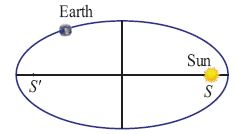
The maximum and minimum distances of the Earth from the Sun respectively are 152 × 106 km and 94.5 × 10⁶ km. The Sun is at one focus of the elliptical orbit. Find the distance from the Sun to the other focus.
9.
Find the rank of the matrix \(\left[ \begin{matrix} 2 \\ \begin{matrix} -3 \\ 6 \end{matrix} \end{matrix}\begin{matrix} -2 \\ \begin{matrix} 4 \\ 2 \end{matrix} \end{matrix}\begin{matrix} 4 \\ \begin{matrix} -2 \\ -1 \end{matrix} \end{matrix}\begin{matrix} 3 \\ \begin{matrix} -1 \\ 7 \end{matrix} \end{matrix} \right] \) by reducing it to an echelon form.
10.
Find all values of x such that -6\(\pi\le x \le 6\pi\) and cos x = 0
11.
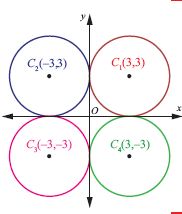
A circle of radius 3 units touches both the axes. Find the equations of all possible circles formed in the general form.
12.
Form the differential equation satisfied by are the straight lines in my-plane.
13.
Find df for f(x) = x2 + 3x and evaluate it for
x = 2 and dx = 0.1
14.
Explain why Rolle’s theorem is not applicable to the following functions in the respective intervals.
\(f(x)=tan x,x \in [0, \pi]\)
15.
Evaluate the following if z = 5−2i and w = −1+3i
z − iw
16.
Find the rank of the following matrices by minor method:
\(\left[\begin{array}{l} 1 -2 -10 \\ 3 -6 -31 \end{array}\right]\)
17.
Identify the type of the conic for the following equations:
3x2+2y2 = 14
18.
Find the principal value of cosec−1(−1)
19.
Using truth table check whether the statements ¬(p V q) V (¬p ∧ q) and ¬p are logically equivalent.
20.
Verify the
(i) closure property,
(ii) commutative property,
(iii) associative property
(iv) existence of identity and
(v) existence of inverse for the arithmetic operation + on Zo = the set of all odd integers
21.
Find the mean and variance of a random variable X , whose probability density function is \(f(x)=\begin{cases} \begin{matrix} { \lambda e }^{ -2x } & for\ge 0 \end{matrix} \\ \begin{matrix} 0 & otherwise \end{matrix} \end{cases}\)
22.
Evaluate \(\int ^{\pi}_{-\pi} \frac{cos ^2 x}{1+ a^x}\) dx
23.
A random variable X has the following probability mass function.
| x | 1 | 2 | 3 | 4 | 5 |
| f(x) | k2 | 2k2 | 3k2 | 2k | 3k |
Find
(i) the value of k
(ii) P(2 \(\le\) X < 5)
(iii) P(3 < X )
24.
The engine of a motor boat moving at 10 m/s is shut off. Given that the retardation at any subsequent time (after shutting off the engine) equal to the velocity at that time. Find the velocity after 2 seconds of switching off the engine.
25.
Find the dimensions of the largest rectangle that can be inscribed in a semi circle of radius r cm.
26.
Solve the following differential equations:
ydx + (1 +x2) tan-1 xdy = 0
27.
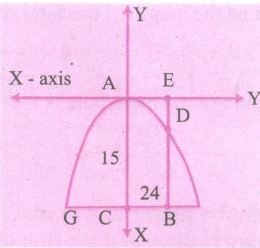
The girder of a railway bridge is a parabola with its vertex at the highest point 15 m above the ends. If the span is 120 m, find the height of the bridge at 24 m from the middle point.
28.
ABCD is a quadrilateral with \(\overset { \rightarrow }{ AB } =\overset { \rightarrow }{ \alpha } \) and \(\overset { \rightarrow }{ AD } =\overset { \rightarrow }{ \beta } \) and \(\overset { \rightarrow }{ AC } =2\overset { \rightarrow }{ \alpha } +3\overset { \rightarrow }{ \beta } \). If the area of the quadrilateral is λ times the area of the parallelogram with \(\overset { \rightarrow }{ AB } \) and \(\overset { \rightarrow }{ AD } \) as adjacent sides, then prove that \(\lambda =\frac { 5 }{ 2 } \)
29.
Show that the lines \(\vec { r } =(6\hat { i } +\hat { j } +2\hat { k } )+s(\hat { i } +2\hat { j } -3\hat { k } )\) and \(\vec { r } =(3\hat { i } +2\hat { j } -2\hat { k } )+t(2\hat { i } +4\hat { j } -5\hat { k } )\) are skew lines and hence find the shortest distance between them.
30.
Test for consistency of the following system of linear equations and if possible solve:
x + 2y - z = 3, 3x - y + 2z = 1, x - 2y + 3z = 3, x - y + z + 1 = 0
31.
Solve the equation z3+ 27 = 0
32.
Prove by vector method that sin(α + β ) = sin α cos β + cos α sin β
33.
34.
Determine k and solve the equation 2x3-6x2+3x+k = 0 if one of its roots is twice the sum of the other two roots.
35.
The function -3x+12 is ________ function on R.
decreasing
strictly decreasing
increasing
strictly increasing
36.
The operation * defined by \(a * b =\frac{ab}{7}\) is not a binary operation on
Q+
Z
R
C
37.
The value of \(\int _{ 0 }^{ a }{ { (\sqrt { { a }^{ 2 }-{ x }^{ 2 } } ) }^{ 3 } } dx\) is
\(\frac { { \pi a }^{3 } }{ 16 } \)
\(\frac { 3\pi { a }^{ 4 } }{ 16 } \)
\(\frac { 3\pi { a }^{2 } }{ 8} \)
\(\frac { 3\pi { a }^{ 4 } }{ 8} \)
38.
39.
The value of \(\int _{ 0 }^{ 1 }{ x{ (1-x) }^{ 99 }dx } \) is
\(\frac{1}{11000}\)
\(\frac{1}{10100}\)
\(\frac{1}{10010}\)
\(\frac{1}{10001}\)
40.
The percentage error of fifth root of 31 is approximately how many times the percentage error in 31?
\(\frac{1}{31}\)
\(\frac15\)
5
31
41.
A rod of length 2l is broken into two pieces at random. The probability density function of the shorter of the two pieces is
\(f(x)=\left\{\begin{array}{ll} \frac{1}{l} & 0< x < l \\ 0 & l <x<2l \end{array}\right.\)
The mean and variance of the shorter of the two pieces are respectively.
\(\frac { l }{ 2 } ,\frac { { l }^{ 2 } }{ 3 } \)
\( \frac { l }{ 2 } ,\frac { { l }^{ 2 } }{ 6 } \)
\(l,\frac { { l }^{ 2 } }{ 12 } \)
\(\frac { l }{ 2 } ,\frac { { l }^{ 2 } }{ 12 } \)
42.
The number of arbitrary constants in the particular solution of a differential equation of third order is
3
2
1
0
43.
The minimum value of the function |3 - x| + 9 is
0
3
6
9
44.
\(\frac { 1+e^{ -i\theta } }{ 1+{ e }^{ i\theta } } \) =__________
cosθ + i sinθ
cosθ - i sinθ
sinθ - i cosθ
sinθ + icosθ
45.
The value of \({ sin }^{ -1 }\left( cos\frac { 33\pi }{ 5 } \right) \) is________
\(\frac { 3\pi }{ 5 } \)
\(\frac { -\pi }{ 10 } \)
\(\frac { \pi }{ 10 } \)
\(\frac { 7\pi }{ 5 } \)
46.
If A = \(\left[ \begin{matrix} 1 & \tan { \frac { \theta }{ 2 } } \\ -\tan { \frac { \theta }{ 2 } } & 1 \end{matrix} \right] \) and AB = I2, then B =
\(\left( \cos ^{ 2 }{ \frac { \theta }{ 2 } } \right) A\)
\(\left( \cos ^{ 2 }{ \frac { \theta }{ 2 } } \right) { A }^{ T }\)
\(\left( \cos ^{ 2 }{ \theta } \right) I\)
(Sin2\(\frac { \theta }{ 2 } \))A
47.
If (AB)-1 = \(\left[ \begin{matrix} 12 & -17 \\ -19 & 27 \end{matrix} \right] \) and A-1 = \(\left[ \begin{matrix} 1 & -1 \\ -2 & 3 \end{matrix} \right] \), then B-1 =
\(\left[ \begin{matrix} 2 & -5 \\ -3 & 8 \end{matrix} \right] \)
\(\left[ \begin{matrix} 8 & 5 \\ 3 & 2 \end{matrix} \right] \)
\(\left[ \begin{matrix} 3 & 1 \\ 2 & 1 \end{matrix} \right] \)
\(\left[ \begin{matrix} 8 & -5 \\ -3 & 2 \end{matrix} \right] \)
48.
49.
50.
The ellipse \(E_{1}: \frac{x^{2}}{9}+\frac{y^{2}}{4}=1\) is inscribed in a rectangle R whose sides are parallel to the coordinate axes. Another ellipse E2 passing through the point (0, 4) circumscribes the rectangle R. The eccentricity of the ellipse is
\(\frac { \sqrt { 2 } }{ 2 } \)
\(\frac { \sqrt { 3 } }{ 2 } \)
\(\frac { 1 }{ 2 } \)
\(\frac { 3 }{ 4 } \)
51.
If the normals of the parabola y2 = 4x drawn at the end points of its latus rectum are tangents to the circle (x − 3)2 + (y + 2)2 = r2 , then the value of r2 is
2
3
1
4
52.
If \(\cot ^{-1}(\sqrt{\sin \alpha})+\tan ^{-1}(\sqrt{\sin \alpha})=u\), then cos2u is equal to
tan2\(\alpha\)
0
-1
tan2\(\alpha\)
53.
54.
A polynomial equation in x of degree n always has
n distinct roots
n real roots
n complex roots
at most one root
1.
0.677
2.
(i) Since f (x) is a probability mass function, f (x) ≥ 0 for all x , and d \(\sum_{x} f(x)=1\)
Thus, \(\sum_{x} f(x)=1\)
\(c^{2}+2 c^{2}+3 c^{2}+4 c^{2}+c+2 c=0\)
\(c=\frac{1}{5} \text { or }-\frac{1}{2}\)
Since f x( ) ≥ 0 for all x , the possible value of c is \(\frac{1}{5}\)
Hence, the probability mass function is
| x | 1 | 2 | 3 | 4 | 5 | 6 |
| f(x) | \( \frac{1}{25} \) | \( \frac{2}{25} \) | \( \frac{3}{25} \) | \(\frac{4}{25} \) | \(\frac{1}{5}\) | \( \frac{2}{5}\) |
(ii) To find mean and variance, let us use the following table
| x | f(x) | xf(x) | x2f(x) |
| 1 | \(\cfrac { 1 }{ 25 } \) | \(\cfrac { 2 }{ 25 } \) | \(\cfrac { 1 }{ 25 } \) |
| 2 | \(\cfrac { 2 }{ 25 } \) | \(\cfrac { 4 }{ 25 } \) | \(\cfrac { 8 }{ 25 } \) |
| 3. | \(\cfrac { 3 }{ 25 } \) | \(\cfrac { 9 }{ 25 } \) | \(\cfrac { 27 }{ 25 } \) |
| 4. | \(\cfrac { 4 }{ 25 } \) | \(\cfrac { 16 }{ 25 } \) | \(\cfrac { 64 }{ 25 } \) |
| 5. | \(\cfrac { 1 }{ 5 } \) | \(\cfrac { 5 }{ 5 } \) | \(\cfrac { 25 }{ 5 } \) |
| 6. | \(\cfrac { 2 }{ 25 } \) | \(\cfrac { 12 }{ 5 } \) | \(\cfrac { 72 }{ 5 } \) |
| \(\Sigma f(x)=1\) | \(\Sigma xf(x)=\cfrac { 115 }{ 25 } \) | \({ \Sigma x }^{ 2 }f(x)=\cfrac { 585 }{ 25 } \) |
Mean : \(E(X)=\Sigma xf(x)=\frac { 115 }{ 25 } =4.6\)
Variance : \(V(x)=E\left( x \right) ^{ 2 }=\Sigma { x }^{ 2 }f(x)-\left( \Sigma xf(x) \right) ^{ 2 }\)
= \(\frac { 585 }{ 25 } -\left( \frac { 115 }{ 25 } \right) ^{ 2 }=23.40-21.16=2.24\)
Therefore the mean and variance are 4.6 and 2.24 respectively.
3.
Given (x, y, z) = log (x3 + y3 + z3)
\(\frac { \partial U }{ \partial x } =\frac { 1 }{ { x }^{ 3 }+{ y }^{ 3 }+{ z }^{ 3 } } { (3x }^{ 2 });\)
\(\frac { \partial U }{ \partial y } =\frac { { 3y }^{ 2 } }{ { x }^{ 3 }+{ y }^{ 3 }+{ z }^{ 3 } } \) and
\(\frac { \partial U }{ \partial z } =\frac { { 3z }^{ 2 } }{ { x }^{ 3 }+{ y }^{ 3 }+{ z }^{ 3 } } \)
\(\therefore \frac { \partial U }{ \partial x } +\frac { \partial U }{ \partial y } +\frac { \partial U }{ \partial z } =\frac { { 3x }^{ 2 } }{ { x }^{ 3 }+{ y }^{ 3 }+{ z }^{ 3 } } +\frac { { 3y }^{ 2 } }{ { x }^{ 3 }+{ y }^{ 3 }+{ z }^{ 3 } } +\frac { { 3z }^{ 2 } }{ { x }^{ 3 }+{ y }^{ 3 }+{ z }^{ 3 } } \)
\(=\frac { { 3({ x }^{ 2 }+y }^{ 2 }+{ z }^{ 2 }) }{ { x }^{ 3 }+{ y }^{ 3 }+{ z }^{ 3 } } \)
4.
Taking u = x2 and v = sin nx, and applying the Bernoulli’s formula, we get
\(I=\int _{ 0 }^{ 2\pi }{ { x }^{ 2 } } sin\quad nx\quad dx={ \left[ \left( { x }^{ 2 } \right) \left( -\frac { cos\quad nx }{ n } \right) -(2x)\left( -\frac { sin\quad nx }{ { n }^{ 2 } } \right) +(2)\left( \frac { cos\quad nx }{ { n }^{ 3 } } \right) \right] }_{ 0 }^{ 2x }\)
\(=\left[ (4{ \pi }^{ 2 })\left( -\frac { 1 }{ n } \right) -0+(2)\left( \frac { 1 }{ { n }^{ 3 } } \right) \right] -\left[ 0-0+(2)\left( \frac { 1 }{ { n }^{ 3 } } \right) \right] \) since cos 2n\(\pi\) = 1 and sin 2n \(\pi\) = 0
\(=-\frac { 4{ \pi }^{ 2 } }{ n } +\frac { 2 }{ { n }^{ 3 } } -\frac { 2 }{ { n }^{ 3 } } =\frac { { 4\pi }^{ 2 } }{ n } \)
5.
By the mean value theorem we have, there exists 'c'∈(2, 7) such that,
\(\frac { f(7)-f(2) }{ 7-2 } \) = f'(c) ≤ 29
Hence, f(7) ≤ 5× 29 +17 = 162
Therefore, the maximum value of f (7) is 162.
6.
Let z = x + iy be a complex number
∴ \(\left| \frac { x+iy-3 }{ x+iy+3 } \right| \) = 2
⇒ \(\left| \frac { x+iy-3 }{ x+iy+3 } \right| \) = 2
⇒ |(x-3) + iy| = 2|(x+3)+iy|
⇒ \(\sqrt { (x-3)^{ 2 }+{ y }^{ 2 } } =2\sqrt { (x+3)^{ 2 }+{ y }^{ 2 } } \)
Squaring both sides we get,
(x - 3)2 + y2 = 4[(x + 3)2 + y2]
⇒ x2 + 9 - 6x + y2 = 4 [x2+ 9 + 6x + y2]
x2 + 9 - 6x + 1 = 4x2 + 36 + 24x + 4y2
⇒ 3x2 + 3y2 + 30x + 27 = which represent a circle.
7.
Let \(\hat { d } =6\hat { i } +2\hat { j } -3\hat { k } \) and p = 12
If \(\hat { d } \) is the unit normal vector in the direction of the vector \(6\hat { i } +2\hat { j } -3\hat { k } \)
then \(\hat { d } =\frac { \hat { d } }{ \left| \hat { d } \right| } =\frac { 1 }{ 7 } (6\hat { i } +2\hat { j } -3\hat { k } )\)
If \(\hat { r } \) is the position vector of an arbitrary point (x, y, z) on the plane, then using \(\vec { r } .\hat { d } =p\), the vector equation of the plane in normal form is \(\vec { r } .\frac { 1 }{ 7 } (6\hat { i } +2\hat { j } -3\hat { k } )=12\)
Substituting \(\vec { r } =x\hat { i } +y\hat { j } +z\hat { k } \) in the above equation, we get \((x\hat { i } +y\hat { j } +z\hat { k } ).\frac { 1 }{ 7 } (6\hat { i } +2\hat { j } -3\hat { k } )=12\)
Applying dot product in the above equation and simplifying, we get 6x + 2y - 3z = 84, which is the Cartesian equation of the required plane.
8.
AS = 94.5 × 10⁶ km,
SA' = 152 × 106 km
a+c = 152 × 106
a-c = 94.5 × 10⁶
Subtracting 2c = 57.5 × 106 = 575 × 105 km
Distance of the Sun from the other focus is SS' = 575 × 105 km.
9.
Let A be the matrix. Performing elementary row operations, we get
A = \(\left[ \begin{matrix} 2 \\ \begin{matrix} -3 \\ 6 \end{matrix} \end{matrix}\begin{matrix} -2 \\ \begin{matrix} 4 \\ 2 \end{matrix} \end{matrix}\begin{matrix} 4 \\ \begin{matrix} -2 \\ -1 \end{matrix} \end{matrix}\begin{matrix} 3 \\ \begin{matrix} -1 \\ 7 \end{matrix} \end{matrix} \right] \)\(\overset { { R }_{ 2 }\longrightarrow 2{ R }_{ 2 } }{ \longrightarrow } \left[ \begin{matrix} 2 \\ \begin{matrix} -6 \\ 6 \end{matrix} \end{matrix}\begin{matrix} -2 \\ \begin{matrix} 8 \\ 2 \end{matrix} \end{matrix}\begin{matrix} 4 \\ \begin{matrix} -4 \\ -1 \end{matrix} \end{matrix}\begin{matrix} 3 \\ \begin{matrix} -2 \\ 7 \end{matrix} \end{matrix} \right] \overset { \begin{matrix} { R }_{ 2 }\longrightarrow { R }_{ 2 }+3{ R }_{ 1 } \\ { R }_{ 3 }\longrightarrow { R }_{ 3 }-3{ R }_{ 1 } \end{matrix} }{ \longrightarrow } \left[ \begin{matrix} 2 \\ \begin{matrix} 0 \\ 0 \end{matrix} \end{matrix}\begin{matrix} -2 \\ \begin{matrix} 2 \\ 8 \end{matrix} \end{matrix}\begin{matrix} 4 \\ \begin{matrix} 8 \\ -13 \end{matrix} \end{matrix}\begin{matrix} 3 \\ \begin{matrix} 7 \\ -2 \end{matrix} \end{matrix} \right] \).
\(\overset { { R }_{ 3 }\longrightarrow { R }_{ 3 }-4{ R }_{ 2 } }{ \longrightarrow } \left[ \begin{matrix} 2 \\ \begin{matrix} 0 \\ 0 \end{matrix} \end{matrix}\begin{matrix} -2 \\ \begin{matrix} 2 \\ 0 \end{matrix} \end{matrix}\begin{matrix} 4 \\ \begin{matrix} 8 \\ -45 \end{matrix} \end{matrix}\begin{matrix} 3 \\ \begin{matrix} 7 \\ -30 \end{matrix} \end{matrix} \right] \overset { { R }_{ 3 }\longrightarrow { R }_{ 3 }\div \left( -15 \right) }{ \longrightarrow } \left[ \begin{matrix} 2 \\ \begin{matrix} 0 \\ 0 \end{matrix} \end{matrix}\begin{matrix} -2 \\ \begin{matrix} 2 \\ 0 \end{matrix} \end{matrix}\begin{matrix} 4 \\ \begin{matrix} 8 \\ 3 \end{matrix} \end{matrix}\begin{matrix} 3 \\ \begin{matrix} 7 \\ 2 \end{matrix} \end{matrix} \right] \).
The last equivalent matrix is in row-echelon form. It has three non-zero rows. So, ρ(A) = 3.
10.
cos x = 0
\(\Rightarrow x=\left( 2n+1 \right) \frac { \pi }{ 2 } ,n\varepsilon Z\)
But \(-6\pi \le x\le 6\pi \)
\(\therefore \) n can take values from
\(x=(2n+1)\frac { \pi }{ 2 } ,n=0\pm 1,\pm 2,...\pm 5\), -6
11.
As the circle touches both the axes, the distance of the centre from both the axes is 3 units, centre can be (±3, ±3) and hence there are four circles with radius 3, and the required equations of the four circles are
x2 + y2 ± 6x ± 6y + 9 = 0.
12.
Equation of family of straight lines in my plane is y = mx - c where m and c are arbitrary constraints.
Differentiating, y' = m
Differentiating again, y" = 0, is the required differential equation.
13.
x = 2 and dx = 0.1
Taking differentials,
df = (2x + 3) dx
Whenx = 2, dx = 0.1
df = (2(2) + 3)(0.1) = 7(0.1) = 0.7
14.
Given f(x) = tan x, x ∈ [0, π]
Rolle's theorem is not applicable since tan x is not continuous at x = \(\frac{\pi}{2}\) [∵ tan \(\frac{\pi}{2}\) = ∞]
15.
z-iw
= (5-2i) - i(-1+3i)
= (5-2i) + (+1-3i2)
5 - 2i + i - 3(-1) = 5 - i + 3 = 8 - i
16.
\(\left[ \begin{matrix} 1 \\ 3 \end{matrix}\begin{matrix} -2 \\ -6 \end{matrix}\begin{matrix} -1 \\ -3 \end{matrix}\begin{matrix} 0 \\ 1 \end{matrix} \right] \)
Let A =\(\left[ \begin{matrix} 1 \\ 3 \end{matrix}\begin{matrix} -2 \\ -6 \end{matrix}\begin{matrix} -1 \\ -3 \end{matrix}\begin{matrix} 0 \\ 1 \end{matrix} \right] \)
A is a matrix of order (2 \(\times\) 4)
∴ \(\rho \)(A) ≤ min(2, 4) = 2
The highest order of minor of A is 2
It is \(\left| \begin{matrix} 1 & -2 \\ 3 & -6 \end{matrix} \right| \) = -6 + 6 = 0
Also, \(\left| \begin{matrix} -1 & 0 \\ -3 & 1 \end{matrix} \right| \) = -1 + 0 = -1 ≠ 0
∴ \(\rho \)(A) = 2
17.
Here A = 3, C = 2 and F = -14
A ≠ C and A and C are of the same sign.
Hence, the given equation represents an ellipse.
18.
Let cosec−1(−1) = y. Then, cosec y = −1
Since the range of principal value branch of y = cosec-1x is\(\left[ -\frac { \pi }{ 2 } ,\frac { \pi }{ 2 } \right] \)\{0} and
cosec \((-\frac{\pi}{2})=-1,\)
We have y = \(-\frac{\pi}{2}\).
Note that \(-\frac{\pi}{2}\in\left[ -\frac { \pi }{ 2 } ,\frac { \pi }{ 2 } \right] \)\{0}.
Thus, the principal value of cosec−1(−1) is −\(\frac{\pi}{2}\)
19.
~(p V q) V (~p ∧ q) and ~p
| p | q | p V q | ~(p ∧ q) | ~p | ~p ∧ q | ~(p V q) V (~p ∧ q) |
| T | T | T | F | F | F | F |
| T | F | T | F | F | F | F |
| F | T | T | F | T | T | T |
| F | F | F | T | T | F | T |
The entries in column (5) and column (7) are identical.
∴ ~(p V q) V (~p ∧ q) and ~p are logically equivalent.
20.
Consider the set Zo of all odd integers Zo = {2k+1 : k∈Z} = {.., -5,-3,-1,1,3,5,...}. + is not a binary operation on Zo because when x = 2m+1, y = 2n +1, x + y = 2(m+ n) + 2 is even for all m and n. For instance, consider the two odd numbers 3, 7 ∈Zo. Their sum 3 + 7 = 10 is an even number. In general, if x, y∈Z0, then (x+y)∉Zo. Other properties need not be checked as it is not a binary operation.
21.
Observe that the given distribution is continuous
By definition \(\mu =E(X)=\int _{ -\infty }^{ \infty }{ xf(x) } dx\) (We can also use integration by parts or Bernoulli’s formula)
= \(\int _{ -\infty }^{ 0 }{ 0\left( \lambda { e }^{ -2x } \right) dx } +\int _{ 0 }^{ \infty }{ x\left( { \lambda e }^{ -\lambda x } \right) } dx\)
= \(0+\lambda \int _{ 0 }^{ \infty }{ x\left( { e }^{ -\lambda x } \right) dx } \)
= \(0+\lambda \left( \frac { 1 }{ { \lambda }^{ 2 } } \right) \) (using Gamma integral for positive integer n,\(\int _{ 0 }^{ \infty }{ { x }^{ n } } { e }^{ -ax }dx=\cfrac { n }{ { a }^{ n+1 } } \))
= \(\frac { 1 }{ \lambda } \)
Variance :
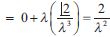
By definition,\(E\left( { X }^{ 2 } \right) =\int _{ -\infty }^{ \infty }{ { x }^{ 2 }f(x) } dx\) (We can also use integration by parts or Bernoulli’s formula)
= \(\int _{ -\infty }^{ 0 }{ 0\left( \lambda { e }^{ -\lambda x } \right) } dx+\int _{ 0 }^{ \infty }{ { x }^{ 2 }\left( \lambda { e }^{ -2x } \right) } dx\)
= \(0+\lambda \int _{ 0 }^{ \infty }{ { x }^{ 2 }\left( { e }^{ -2x } \right) dx } \)
 (using Gamma integral for positive integer)
Therefore Var(X ) = E(X2 )- E(X )2
= \(\frac { 2 }{ { \lambda }^{ 2 } } -\left( \frac { 1 }{ \lambda } \right) ^{ 2 }=\frac { 1 }{ { \lambda }^{ 2 } } \)
Hence the mean and variance are respectively \(\frac { 1 }{ \lambda } \) and \(\frac { 1 }{ { \lambda }^{ 2 } } \)
22.
Let I = \(\int ^{\pi}_{-\pi} \frac{cos ^2 x}{1+ a^x} dx\)-- (1)
Using \(\int ^{b}_{a}\) f(x) dx =\(\int ^{b}_{a}\) f(a+b -x)dx we get,
I = \(\int ^{\pi}_{-\pi} \frac{cos ^2 (\pi -\pi - x)}{1+ a^{\pi -\pi - x}} dx\)
= \(\int ^{\pi}_{-\pi} \frac{cos ^2 (-x)}{1+ a^{-x}} dx\)
= \(\int ^{\pi}_{-\pi} a^x (\frac{cos ^2 x }{a^x+ 1} )dx\) --- (2)
Adding (1) and (2) we get
2I = \(\int ^{\pi}_{-\pi} \frac{cos ^2 x }{a^x+ 1}(a^x+ 1) dx\) = \(\int ^{\pi}_{-\pi} cos ^2 x dx\)
= 2 \(x =\int ^{\pi}_{-\pi} cos ^2 x dx\) (since cos2 x is an even function)
Hence, I = \(\int ^{\pi}_{0} (\frac{1 + cos2x }{2} )dx\)
= \(\frac {1}{2} [ x + \frac {sin 2x}{2}]^{x}_{0}\)
= \(\frac {1}{2} [\pi]\)
= \(\frac {\pi}{2}\)
23.
Given probability mass function is
| x | 0 | 1 | 2 | 3 | 4 |
| f(x) | \(\frac{1}{36}\) | \(\frac{2}{36}\) | \(\frac{3}{36}\) | \(\frac{2}{36}\) | \(\frac{3}{36}\) |
(i) Since f(x) is a probability mass function.
\(\sum _{ i=1 }^{ 5 }{ f({ x }_{ i }) } =1\)
⇒ k2 + 2k2 + 3k2 + 2k + 3k = 1
⇒ 6k2 + 5k = 1
⇒ 6k2 + 5k - 1 = 0
⇒ (k + 1) (6k - 1) = 0
⇒ k = -1 or ⇒ \(k=\frac { 1 }{ 6 } \)
⇒ \(k=\frac { 1 }{ 6 } \)
(ii) p(2 ≤ x < 5)
= p(x = 2) + p(x = 3) + p(x = 4)
= 2k2 + 3k2 + 2k = 5k2 + 2k
= \(5\left( \frac { 1 }{ 36 } \right) +2\left( \frac { 1 }{ 6 } \right) \)
= \(\frac { 5 }{ 36 } +\frac { 1 }{ 3 } =\frac { 5+12 }{ 36 } \)
= \(\frac { 17 }{ 36 } \)
(iii) p(3 < x) = p(x > 3)
= p(x = 4) + p(x = 5)
= 2k + 3k = 5k
= \(5\left( \frac { 1 }{ 6 } \right) \)
= \(\frac { 5 }{ 6 } \)
24.
Let V be the velocity and the retardation (negative acceleration) be -\(\frac{dv}{dt}\)
Given \(\frac{dv}{dt}\) = -V
Separating the variables,
\(\frac{dv}{v}=-dt\)
\(\Rightarrow \int { \frac { dv }{ v } } =-\int { dt } \)
\(\Rightarrow log\quad v=-t+logC\)
\(\Rightarrow logv-logC=-t\)
\(\Rightarrow log\left( \frac { v }{ { C }_{ v } } \right) =-t\)
\(\Rightarrow ={ e }^{ -t }\)
\(\Rightarrow \frac { v }{ { C }_{ v } } ={ Ce }^{ -t }...(1)\)
Given when t = 0, v = m/sec
\(\therefore\) (1) become 10 = Ce0 \(\Rightarrow\) C = 10
\(\therefore\) (1) v = 10e-t
When t = 2, v = 10e-2
\(\Rightarrow v=\frac { 10 }{ { e }^{ 2 } } \)
25.
Let us take the semi circle with center (0, 0) an radius r
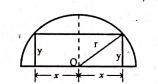
x = r cos θ,
y = r sin θ
ஃ Length of the rectangle = 2x = 2r cos θ
Breadth of the rectangle = y = r sin θ
ஃ Area = 2xy = 2r2 cos θ sin θ
= r2 sin 2θ
Letf'(θ) = r2 2 cos 2θ
f(θ) = r2cosθ sinθ
⇒ 2r2 cos 2θ = 0
\(\Rightarrow cos2\theta =0=cos\frac { \pi }{ 2 } \)
\(\Rightarrow 2\theta =\frac { \pi }{ 2 } \)
\(\Rightarrow \theta =\frac { \pi }{ 4 } \)
\(f''={ 2r }^{ 2 }(2)-(-sin2\theta )\)
= \(-4{ r }^{ 2 }sin2\theta \)
\(\therefore f''\left( \frac { 4\pi }{ 4 } \right) =-4{ r }^{ 2 }sin2\left( \frac { \pi }{ 4 } \right) \)
= \(-4{ r }^{ 2 }sin\frac { \pi }{ 2 } ={ 4r }^{ 2 }<0\)
ஃ f(θ) is maximum when \(\theta =\frac { \pi }{ 4 } \)
ஃ Length of the rectangle \((x)=2ros\frac { \pi }{ 4 } \)
= \(2r\times \frac { 1 }{ \sqrt { 2 } } =\sqrt { 2 } r\)
ஃ Breadth of the rectangle = y = r sin θ
= \(rsin\frac { \pi }{ 4 } =\frac { r }{ \sqrt { 2 } } \)
26.
ydx + (1 + x2) tan-1 xdy = 0
\(\mathrm{yd} x=-\left(1+x^2\right) \tan ^{-1} x \mathrm{dy}
\)
\(\frac{d x}{\left(1+x^2\right) \tan ^{-1} x}=-\frac{d y}{y}
\)
Take \(\mathrm{t}=\tan ^{-1} x
\)
\(\mathrm{dt}=\frac{1}{1+x^2} d x\)
The equation can be written as
\(\frac{d t}{t}=-\frac{d y}{y}\)
Taking Integration on both sides, we get
\(\int \frac{d t}{t}=-\int \frac{d y}{y}\)
log t = - log y + log C
log (tan-1 x) = -log y+ log C
log (tan-1 x) + log y = log C
log y(tan-1 x) = log c
y tan-1 x = c
27.
Let us take the axis AX as the and the tangent AY at A as y-axis.
Equation of the parabola is y2 = 4ax
CA 15, FG = 120
CF = CG= 60
F is (15, 60)
Since F lies on (1), 602 = Aa(15) ∴ ⇒ a = 60
y2 = 240x
When y = 24, 242 = 240(x)
⇒ x = \(\frac { 24\times 24 }{ 240 } \)
x = \(\frac{24}{10}\) = \(\frac{12}{5}\) = 2.4
From the diagram
BD = BE - ED = 15-2.4 = 12.6m.
Hence the required height is 12.6 m.
28.
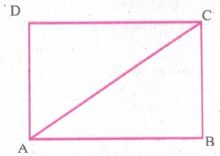
Given \(\overset { \rightarrow }{ AB } =\overset { \rightarrow }{ \alpha } \), \(\overset { \rightarrow }{ AD } =\overset { \rightarrow }{ \beta } \) and \(\overset { \rightarrow }{ AC } =2\overset { \rightarrow }{ \alpha } +3\overset { \rightarrow }{ \beta } \)
Area of the quadrilateral ABCD
∴ = are of ∆ ABC + area of ∆ ACD
\(=\frac { 1 }{ 2 } \left| \overset { \rightarrow }{ AB } \times \overset { \rightarrow }{ AC } \right| +\frac { 1 }{ 2 } \left| \overset { \rightarrow }{ AC } \times \overset { \rightarrow }{ AD } \right| \)
\(=\frac { 1 }{ 2 } \left| \overset { \rightarrow }{ \alpha } \times \left( 2\overset { \rightarrow }{ \alpha } +3\overset { \rightarrow }{ \beta } \right) \right| +\frac { 1 }{ 2 } \left| \left( 2\overset { \rightarrow }{ \alpha } +3\overset { \rightarrow }{ \beta } \right) \times \overset { \rightarrow }{ \beta } \right| \)
\(=\frac { 1 }{ 2 } \left| 2\left( \overset { \rightarrow }{ \alpha } \times \overset { \rightarrow }{ \alpha } \right) +3\left( \overset { \rightarrow }{ \alpha } \times \overset { \rightarrow }{ \beta } \right) \right| +\frac { 1 }{ 2 } \left| 2\left( \overset { \rightarrow }{ \alpha } \times \overset { \rightarrow }{ \beta } \right) +3\left( \overset { \rightarrow }{ \beta } \times \overset { \rightarrow }{ \beta } \right) \right| \)
\(=\frac { 1 }{ 2 } \left| 3\left( \overset { \rightarrow }{ \alpha } \times \overset { \rightarrow }{ \beta } \right) \right| +\frac { 1 }{ 2 } \left| 2\left( \overset { \rightarrow }{ \alpha } \times \overset { \rightarrow }{ \beta } \right) \right| \quad \quad \quad \left[ \because \overset { \rightarrow }{ \alpha } \times \overset { \rightarrow }{ \alpha } =\overset { \rightarrow }{ \beta } \times \overset { \rightarrow }{ \beta } =0 \right] \)
\(=\left( \frac { 3 }{ 2 } +\frac { 2 }{ 2 } \right) \left( \overset { \rightarrow }{ \alpha } \times \overset { \rightarrow }{ \beta } \right) =\left( \frac { 5 }{ 2 } \right) \left| \overset { \rightarrow }{ \alpha } \times \overset { \rightarrow }{ \beta } \right| \quad \quad (1)\)
Now, Area of the parallelogram with \(\overset { \rightarrow }{ AB } \) and \(\overset { \rightarrow }{ AD } \) as
adjacent sides = \(\left| \overset { \rightarrow }{ AB } \times \overset { \rightarrow }{ AD } \right| =\left| \overset { \rightarrow }{ \alpha } \times \overset { \rightarrow }{ \beta } \right| .... (2)\)
From (1) & (2), \(\frac { 5 }{ 2 } \left| \overset { \rightarrow }{ \alpha } \times \overset { \rightarrow }{ \beta } \right| =\lambda \left| \overset { \rightarrow }{ \alpha } \times \overset { \rightarrow }{ \beta } \right| \) [Given]
\(\lambda =\frac { 5 }{ 2 } \)
29.
Given lines are
\(\vec { r } =(6\hat { i } +\hat { j } +2\hat { k } )+s(\hat { i } +2\hat { j } -3\hat { k } )\)
\(\vec { a } =6\hat { i } +\hat { j } +2\hat { k } ,\vec { b } =\hat { i } +2\hat { j } -3\hat { k } \)
and \(\vec { r } =(3\hat { i } +2\hat { j } -2\hat { k } )+t(2\hat { i } +4\hat { j } -5\hat { k } )\)
\(\vec { c } =3\hat { i } +2\hat { j } -2\hat { k } \quad and\quad \vec d = 2\hat { i } +4\hat { j } -5\hat { k } \)
Since \(\vec { b } \neq \vec { d } \), they are not parallel and they do not intersect.
Hence the given lines are skew lines.
Shortest distance between the two skew lines
\(\delta =\frac { |(\vec { c } -\vec { a } ).(\vec { b } \times \vec { d } )| }{ |(\vec { b } \times \vec { d } )| } \)
\(\vec { b } \times \vec { d } =\left| \begin{matrix} \hat { i } & \hat { j } & \hat { k } \\ 1 & 2 & -3 \\ 2 & 4 & -5 \end{matrix} \right| \)
\(=\hat { i } (-10+12)-\hat { j } (-5+6)+\hat { k } (4-4)\)
\(=2\hat { i } -\hat { j } \Rightarrow |\vec { b } \times \vec { d } |\quad \sqrt { { 2 }^{ 2 }++(-1)^{ 2 } } =\sqrt { 5 } \)
\(\vec { c } =\vec { a } =(3\hat { i } +2\hat { j } -2\hat { k } )-(6\hat { i } +\hat { j } +2\hat { k } )\)
\(=-3\hat { i } +\hat { j } -4\hat { k } \)
\(\therefore (\vec { c } -\vec { a } ).(\vec { b } \times \vec { d } )=(-3\hat { i } +\hat { j } -4\hat { k } ).(2\hat { i } -\hat { j } )\)
= -6-1 = -7
\(\therefore \delta =\frac { |-7| }{ \sqrt { 5 } } =\frac { 7 }{ \sqrt { 5 } } units\)
30.
Here the number of unknowns is 3.
The matrix form of the system is AX = B, where
A = \(\left[ \begin{matrix} 1 \\ \begin{matrix} 3 \\ \begin{matrix} 1 \\ 1 \end{matrix} \end{matrix} \end{matrix}\begin{matrix} 2 \\ \begin{matrix} -1 \\ \begin{matrix} -2 \\ -1 \end{matrix} \end{matrix} \end{matrix}\begin{matrix} -1 \\ \begin{matrix} 2 \\ \begin{matrix} 3 \\ 1 \end{matrix} \end{matrix} \end{matrix} \right] \), X = \(\left[ \begin{matrix} x \\ y \\ z \end{matrix} \right] \), B = \(\left[ \begin{matrix} 3 \\ \begin{matrix} 1 \\ \begin{matrix} 3 \\ -1 \end{matrix} \end{matrix} \end{matrix} \right] \).
The augmented matrix is [A | B] = \(\left[\begin{array}{ccc|c} 1 & 2 & -1 & 3 \\ 3 & -1 & 2 & 1 \\ 1 & -2 & 3 & 3 \\ 1 & -1 & 1 & -1 \end{array}\right]\).
Applying Gaussian elimination method on [A | B], we get
[A | B] \(\overset { \begin{matrix} { R }_{ 2 }\longrightarrow { R }_{ 2 }-3{ R }_{ 1 } \\ { R }_{ 3 }\longrightarrow { R }_{ 3 }-{ R }_{ 1 }, \\ { R }_{ 4 }\longrightarrow { R }_{ 4 }-{ R }_{ 1 } \end{matrix} }{ \longrightarrow } \left[ \begin{matrix} 1 \\ \begin{matrix} 0 \\ \begin{matrix} 0 \\ 0 \end{matrix} \end{matrix} \end{matrix}\begin{matrix} 2 \\ \begin{matrix} -7 \\ \begin{matrix} -4 \\ -3 \end{matrix} \end{matrix} \end{matrix}\begin{matrix} -1 \\ \begin{matrix} 5 \\ \begin{matrix} 4 \\ 2 \end{matrix} \end{matrix} \end{matrix}|\begin{matrix} 3 \\ \begin{matrix} -8 \\ \begin{matrix} 0 \\ 4 \end{matrix} \end{matrix} \end{matrix} \right] \overset { \begin{matrix} { R }_{ 2 }\longrightarrow \left( -1 \right) { R }_{ 2 }, \\ { R }_{ 3 }\longrightarrow \left( -1 \right) { R }_{ 3 } \\ { R }_{ 4 }\longrightarrow \left( -1 \right) { R }_{ 4 } \end{matrix} }{ \longrightarrow } \left[ \begin{matrix} 1 \\ \begin{matrix} 0 \\ \begin{matrix} 0 \\ 0 \end{matrix} \end{matrix} \end{matrix}\begin{matrix} 2 \\ \begin{matrix} 7 \\ \begin{matrix} 4 \\ 3 \end{matrix} \end{matrix} \end{matrix}\begin{matrix} -1 \\ \begin{matrix} -5 \\ \begin{matrix} -4 \\ -2 \end{matrix} \end{matrix} \end{matrix}|\begin{matrix} 3 \\ \begin{matrix} 8 \\ \begin{matrix} 0 \\ 4 \end{matrix} \end{matrix} \end{matrix} \right] \)\(\overset { \begin{matrix} { R }_{ 3 }\longrightarrow 7{ R }_{ 3 }-4{ R }_{ 2 } \\ { R }_{ 4 }\longrightarrow 7{ R }_{ 4 }-3{ R }_{ 2 } \end{matrix} }{ \longrightarrow } \left[ \begin{matrix} 1 \\ \begin{matrix} 0 \\ \begin{matrix} 0 \\ 0 \end{matrix} \end{matrix} \end{matrix}\begin{matrix} 2 \\ \begin{matrix} 7 \\ \begin{matrix} 0 \\ 0 \end{matrix} \end{matrix} \end{matrix}\begin{matrix} -1 \\ \begin{matrix} -5 \\ \begin{matrix} -8 \\ 1 \end{matrix} \end{matrix} \end{matrix}|\begin{matrix} 3 \\ \begin{matrix} 8 \\ \begin{matrix} -32 \\ 4 \end{matrix} \end{matrix} \end{matrix} \right] \overset { { R }_{ 3 }\longrightarrow { R }_{ 3 }\div \left( -8 \right) }{ \longrightarrow } \left[ \begin{matrix} 1 \\ \begin{matrix} 0 \\ \begin{matrix} 0 \\ 0 \end{matrix} \end{matrix} \end{matrix}\begin{matrix} 2 \\ \begin{matrix} 7 \\ \begin{matrix} 0 \\ 0 \end{matrix} \end{matrix} \end{matrix}\begin{matrix} -1 \\ \begin{matrix} -5 \\ \begin{matrix} 1 \\ 1 \end{matrix} \end{matrix} \end{matrix}|\begin{matrix} 3 \\ \begin{matrix} 8 \\ \begin{matrix} 4 \\ 4 \end{matrix} \end{matrix} \end{matrix} \right] \overset { { R }_{ 4 }\longrightarrow { R }_{ 4 }-{ R }_{ 3 } }{ \longrightarrow } \left[ \begin{matrix} 1 \\ \begin{matrix} 0 \\ \begin{matrix} 0 \\ 0 \end{matrix} \end{matrix} \end{matrix}\begin{matrix} 2 \\ \begin{matrix} 7 \\ \begin{matrix} 0 \\ 0 \end{matrix} \end{matrix} \end{matrix}\begin{matrix} -1 \\ \begin{matrix} -5 \\ \begin{matrix} 1 \\ 0 \end{matrix} \end{matrix} \end{matrix}|\begin{matrix} 3 \\ \begin{matrix} 8 \\ \begin{matrix} 4 \\ 0 \end{matrix} \end{matrix} \end{matrix} \right] \)
There are three non-zero rows in the row-echelon form of [A | B]. So, ρ([A | B]) = 3.
So, the row-echelon form of A is \(\left[ \begin{matrix} 1 \\ \begin{matrix} 0 \\ \begin{matrix} 0 \\ 0 \end{matrix} \end{matrix} \end{matrix}\begin{matrix} 2 \\ \begin{matrix} 7 \\ \begin{matrix} 0 \\ 0 \end{matrix} \end{matrix} \end{matrix}\begin{matrix} -1 \\ \begin{matrix} -5 \\ \begin{matrix} 1 \\ 0 \end{matrix} \end{matrix} \end{matrix} \right] \). There are three non-zero rows in it. So ρ(A) = 3.
Hence, ρ(A) = ρ([A | B]) = 3.
From the echelon form, we write the equivalent system of equations
x + 2y − z = 3,7y − 5z = 8, z = 4, 0 = 0.
The last equation 0=0 is meaningful. By the method of back substitution, we get
z = 4
7y − 20 = 8 ⇒ y = 4 ,
x = 3 − 8 + 4 ⇒ x = −1.
So, the solution is (x = −1, y = 4, z = 4).(Note that A is not a square matrix.)
Here the given system is consistent and the solution is unique.
31.
z3 = -27 = (-1 \(\times\) 3)3 = -1 \(\times\) 33
z = \((-1)^{ \frac { 1 }{ 3 } }\times 3^{ 3\times \frac { 1 }{ 3 } }=(-1)^{ \frac { 1 }{ 3 } }\)\(\times\) 3
∴ z = 3\(\left[ cos\pi +isin\pi \right] ^{ \frac { 1 }{ 3 } }\)
[∵ cos π = -1 and sin π = 0]
= 3\(\left[ cos\frac { 1 }{ 3 } (2k\pi +\pi )isin\frac { 1 }{ 3 } (2k\pi +\pi ) \right] \)
k = 0, 1, 2
When k = 0,
z = 3\(\left[ cos\frac { 1 }{ 3 } (\pi )isin\frac { 1 }{ 3 } (\pi ) \right] =3cos\frac { \pi }{ 3 } \)
When k = 1
z = 3\(\left[ cos\frac { 1 }{ 3 } (3\pi )isin\frac { 1 }{ 3 } (3\pi ) \right] \)
= 3[cos π + i sin π] = 3(-1+0)
When k = 2
z = 3\(\left[ cos\frac { 1 }{ 3 } (5\pi )isin\frac { 1 }{ 3 } (5\pi ) \right] =3\left[ cos5\frac { \pi }{ 3 } \right] \)
Hence, the roots are 3 cis\(\frac { \pi }{ 3 } \), -3, 3 c is 5\(\frac { \pi }{ 3 } \)
32.
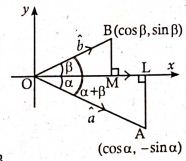
Let \(\hat { a } =\vec { OA } \) and \(\hat { b } =\vec { OB } \) be the unit vectors and which make angles α,β respectively with positive x-axis
Draw AL and BM 丄 to x-axis
Then \(|\vec { OL } |=|\vec { OA } |cos\alpha \Rightarrow \vec { OL } =\vec { |OL| } \hat { i } =cos\alpha \hat { i } \)
\(|\vec { LA } |=|\vec { OB } |\) sin α
⇒ \(\vec { LA } =|\vec { OB } |\hat { j } =sin\alpha (-\hat { j } )=-sin\alpha \hat { j } \)
[\(\vec { LA } \) is in the opp direction of y axis]
\(\hat { a } =\vec { OA } =\vec { OL } +\vec { LA } =cos\alpha \hat { i } -sin\alpha \check { j } \) ..(1)
Similarly \(\hat { b } =\vec { OB } =\vec { OM } +\vec { MB } =cos\beta \hat { i } +sin\beta \hat { j } \) ...(2)
Now \(\hat { a } \times \hat { b } =|\hat { a } ||\hat { b } |sin(\alpha +\beta )\hat { k } =sin(\alpha +\beta )\hat { k } \) ....(3)
[\(|\hat { a } |=|\hat { b } |\) = 1]
Also \(\hat { a } \times \hat { b } =\left| \begin{matrix} \hat { i } & \hat { j } & \hat { k } \\ cos\alpha & -sin\alpha & 0 \\ cos\beta & cos\beta & 0 \end{matrix} \right| \)
= \(\hat { i } (0)-\hat { j } (0)+\hat { k } \)(cosα sinβ + sinα cosβ)
= (sin α cos β + cos α sin β)\(\hat { k } \) .(4)
using (3) and (4), sin(α+β) = sin α cos β + cos α sin β
33.
34.
Given cubic equation is 2x3-6x2+3x+k = 0
Here, a = 2, b = -6, c = 3, d = k
Let ∝, β, ૪ be the roots
Given ∝ = 2(β+૪) ⇒ \(\frac{\alpha}{2}\) = β+૪ ...(1)
Now, \(\alpha +\beta +\gamma =\frac { -b }{ a } =-\frac { (-6) }{ 2 } =3\)
\(\frac { \alpha }{ 2 } +\alpha =3\Rightarrow \frac { \alpha +2\alpha }{ 2 } =3\Rightarrow \frac { 3\alpha }{ 2 } =3\)
\(\Rightarrow \alpha =2\)
\(\alpha \beta \gamma =\frac { -d }{ a } =\frac { -k }{ 2 } \Rightarrow 2.\beta \gamma =\frac { -k }{ 2 } \)
\(\beta \gamma =\frac { -k }{ 4 } ...(2)\)
Also, \(\alpha \beta +\beta \gamma +\gamma \alpha =\frac { c }{ a } \)
\(2\beta +\beta \gamma +2\gamma =\frac { 3 }{ 2 } \)
\(2(\beta +\gamma )+\beta \gamma =\frac { 3 }{ 2 } \)
\(\alpha \frac { -k }{ 4 } =\frac { 3 }{ 2 } \quad [from(1)\& (2)]\)
Also, \(2-\frac { k }{ 4 } =\frac { 3 }{ 2 } [\because \alpha =2]\)
\(2-\frac { 3 }{ 2 } =\frac { k }{ 4 } \Rightarrow \frac { 1 }{ 2 } =\frac { k }{ 4 } \)
\(\\ k=\frac { 4 }{ 2 } \Rightarrow k=2\)
From(2), \(\beta \gamma =\frac { -k }{ 4 } =\frac { -2 }{ 4 } =\frac { -1 }{ 2 } \)\(\Rightarrow \gamma =\frac { -1 }{ 2\beta } \)
From \((1),\beta +\gamma =\frac { \alpha }{ 2 } =\frac { 2 }{ 2 } =1\)
Substituting \(\gamma =\frac { -1 }{ 2\beta } \) We get
\(\beta -\frac { 1 }{ 2\beta } =1\Rightarrow 2{ \beta }^{ 2 }-1=2\beta \Rightarrow 2\beta -2\beta -1=0\)
\(\beta =\frac { 2\pm \sqrt { 4-4(2)(-1) } }{ 4 } =\frac { 2\pm \sqrt { 4+8 } }{ 4 } \)
\(=\frac { 2\pm \sqrt { 12 } }{ 4 } =\frac { 2\pm 2\sqrt { 3 } }{ 4 } \)
\(\beta =\frac { 1\pm \sqrt { 3 } }{ 2 } \)
Hence the roots are \(2,\frac { 1+\sqrt { 3 } }{ 2 } ,\frac { 1-\sqrt { 3 } }{ 2 } \) and k = 2
35.
(b)
strictly decreasing
36.
(b)
Z
37.
(b)
\(\frac { 3\pi { a }^{ 4 } }{ 16 } \)
38.
(b)
39.
(b)
\(\frac{1}{10100}\)
40.
(b)
\(\frac15\)
41.
(d)
\(\frac { l }{ 2 } ,\frac { { l }^{ 2 } }{ 12 } \)
42.
(d)
0
43.
(d)
9
44.
(b)
cosθ - i sinθ
45.
(b)
\(\frac { -\pi }{ 10 } \)
46.
(b)
\(\left( \cos ^{ 2 }{ \frac { \theta }{ 2 } } \right) { A }^{ T }\)
47.
(a)
\(\left[ \begin{matrix} 2 & -5 \\ -3 & 8 \end{matrix} \right] \)
48.
(d)
49.
(d)
50.
(c)
\(\frac { 1 }{ 2 } \)
51.
(a)
2
52.
(c)
-1
53.
(b)
54.
(c)
n complex roots

12th Standard Syllabus & Materials
12th Standard
TN 12th Computer Applications களப்பெயர் முறைமை (DNS) Sample Question Papers Study Material - QB365 Set A
NEW12th Standard
TN 12th Computer Applications வலையமைப்பு எடுத்துக்காட்டுகள் மற்றும் நெறிமுறைகள் Sample Question Papers Study Material - QB365 Set A
NEW12th Standard
TN 12th Computer Applications கணினி வலையமைப்பு ஓர் அறிமுகம் Sample Question Papers Study Material - QB365 Set A
NEW12th Standard
TN 12th Computer Applications PHP-உடன் MySQL-ஐ இணைத்தல் Sample Question Papers Study Material - QB365 Set A



Tamilnadu Stateboard 12th Standard Subjects
Maths

Chemistry

Physics

Biology

Computer Science

Business Maths and Statistics

Economics

Commerce

Accountancy

History

Computer Applications
Biology
Computer Technology
Computer Applications
Computer Science
Business Maths and Statistics
Commerce
Economics
Maths
Chemistry
Physics
Computer Technology
History
Accountancy

Tamil

English

French
Tamilnadu Stateboard Standards

