
 100% FREE ACCESS
12th Standard Syllabus & Materials
12th Standard
TN 12th Computer Applications மின்னணு தரவு பரிமாற்றம் Sample Question Papers Study Material - QB365 Set A
NEW12th Standard
TN 12th Computer Applications மின் - வணிக பாதுகாப்பு அமைப்புகள் Sample Question Papers Study Material - QB365 Set A
NEW12th Standard
TN 12th Computer Applications மின்னணு செலுத்தல் முறைகள் Sample Question Papers Study Material - QB365 Set A
NEW12th Standard
TN 12th Computer Applications மின் - வணிகம் Sample Question Papers Study Material - QB365 Set A
NEW12th Standard
TN 12th Computer Applications திறந்த மூல கருத்துருக்கள் Sample Question Papers Study Material - QB365 Set A
NEW12th Standard
TN 12th Computer Applications வலையமைப்பு வடமிடல் Sample Question Papers Study Material - QB365 Set A

Published on: 03/01/2020
Download Tamil Nadu 12th Standard Economics question papers, model tests, one-mark questions, important questions, and public exam papers in PDF format. Free study materials and answer keys for TN State Board students.
Questions + Answers key
Take MCQ Economics Test1.
Match the items in the List – I with items in List – II. Select the correct answer from the code given below:
| List - I | List - II |
| I. The Central Bank of Chin | 1. 1935 |
| II. The Reserve Bank of New Zealand | 2. 1934 |
| III. The Reserve Bank of India | 3. 1928 |
| IV. Central Bank of Ceylon | 4. 1956 |
| I | II | III | IV |
| 3 | 2 | 1 | 4 |
| I | II | III | IV |
| 2 | 4 | 1 | 3 |
| I | II | III | IV |
| 2 | 3 | 4 | 1 |
| I | II | III | IV |
| 1 | 2 | 3 | 4 |
2.
Which of the following is correct representation in terms of trade agreement?
EU < CM > CU > FTA
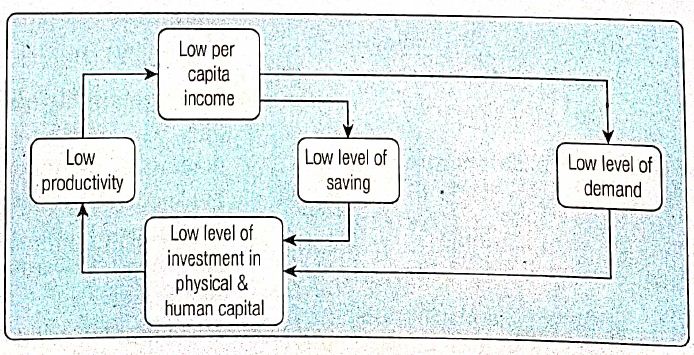
EU > CM > CU > FTA
EU > CM< CU > FTA
EU< CM < CU < FTA
3.
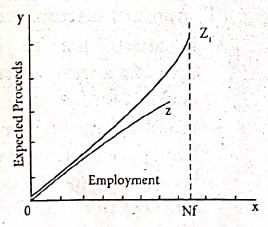
Who published the book, "The Purchasing Power of Money” in 1911.
Arthur
Hicks
Irving Fisher
Pigou
4.
Find the unsuitable example for Seasonal unemployment
ice cream industry
doctors
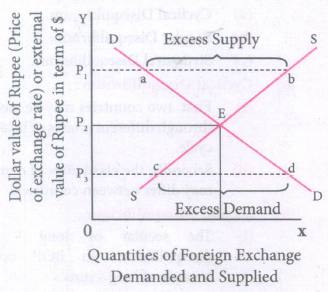
farmers
farmers
5.
What we can get by deriving the following equation? Private Final Consumption + Government Final Consumption Expenditure + Gross Domestic Capital Formation + Net Exports (Exports – Imports)
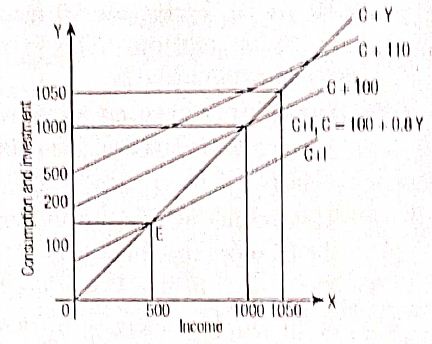
GNPMP
NDPFP
GDPMP
NDPFP
6.
Find the incorrect representation. Net Barter Terms of TradeTn= (Px / Pm) x 100
Tn = Net Barter Terms of Trade
Px = Index number of export prices
Pm = Index number of import prices
Tn = Gross Barter Terms of Trade
7.
When MPC + MPS = 1, which one of the following is wrong?
MPS = MPC
MPC + MPC > 1
MPS = 1 - MPC
MPC = 1 - MPS
8.
Non-interference of the state is a characteristic features of the ___________.
Socialist Economy
Capitalist Economy
Traditional Economy
Command Economy
9.
Which is not the feature of economic growth?
Concerned with developed nations
Gradual change
Concerned with quantitative aspect
Wider concept
10.
The word biotic means environment
living
non-living
physical
None of the above
11.
Which of the following canons of taxation was not listed by Adam smith?
Canon of equality
Canon of certainty
Canon of convenience
Canon of simplicity
12.
Which of the following countries is not a member of SAARC?
Sri Lanka
Japan
Bangladesh
Afghanistan
13.
Who among the following enunciated the concept of single factoral terms of trade?
Jacob Viner
G.S.Donens
Taussig
J.S.Mill
14.
ARDC started functioning from
June 3, 1963
July 3, 1963
June 1, 1963
July 1, 1963
15.
Irving Fisher’s Quantity Theory of Money was popularized in
1908
1910
1911
1914
16.
If the Keynesian consumption function is C=10+0.8 Y then, and disposable income is ₹ 100, what is the average propensity to consume?
₹ 0.8
₹ 800
₹ 810
₹ 0.9
17.
J.B. Say is a _______.
Neo Classical Economist
Classical Economist
Modern Economist
New Economist
18.
Per capita income is obtained by dividing the National income by__________
Production
Population of a country
Expenditure
GNP
19.
Income method is measured by summing up of all forms of__________
Production
Taxes
expenditure
Income
20.
Identify the economic system where only private ownership of production exists
Capitalistic Economy
Socialistic Economy
Globalisic Economy
Mixed Economy
21.
Write a brief note on “Buffer Stock Facility”
22.
State the terms of “MV = PT”
23.
Write a note on “wage-price rigidity” Keynes.
24.
25.
What are the components of GST?
26.
Write the meaning of Special Drawing rights.
27.
What is Stagflation?
28.
29.
What is the difference between NNP and NDP?
30.
‘Circular Flow of Income’ - Define.
31.
Write briefly about “Structural Adjustment Facility”
32.
What are the steps involved in income method?
33.
What are the six basic characteristics of under developed economy?
34.
Discuss the important statistical organizations (offices) in India.
35.
Elucidate major causes of vicious circle of poverty with diagram
36.
Describe Canons of Taxation.
37.
State the objectives of Foreign Direct Investment.
38.
Differentiate autonomous and induced investment.
39.
Explain about aggregate supply with the help of diagram.
40.
Describe the different types of economic systems.
41.
Write a note on Indian Finance Commission.
42.
Explain other types of inflation (on the basis of inducement).
43.
Find the regression equation Y on X and X on Y for the following data:
| Y | 45 | 48 | 50 | 55 | 65 | 70 | 75 | 72 | 80 | 85 |
| X | 25 | 30 | 35 | 30 | 40 | 50 | 45 | 55 | 60 | 65 |
44.
Bring out the arguments against planning.
45.
Briefly explain the relationship between GDP growth and the quality of environment.
46.
Explain the scope of public finance.
47.
Bring out the functions of World Bank.
48.
How the Rate of Exchange is determined? Illustrate.
49.
50.
Elucidate the functions of Commercial Banks
51.
What are the causes and effects of inflation on the economy?
52.
Illustrate the working of Multiplier.
53.
Narrate the equilibrium between ADF and ASF with diagram
54.
Discuss the scope of Macro Economics.
1.
(a)
| I | II | III | IV |
| 3 | 2 | 1 | 4 |
2.
(b)
EU > CM > CU > FTA
3.
(c)
Irving Fisher
4.
(b)
doctors
5.
(c)
GDPMP
6.
(d)
Tn = Gross Barter Terms of Trade
7.
(b)
MPC + MPC > 1
8.
(b)
Capitalist Economy
9.
(d)
Wider concept
10.
(a)
living
11.
(d)
Canon of simplicity
12.
(b)
Japan
13.
(a)
Jacob Viner
14.
(d)
July 1, 1963
15.
(c)
1911
16.
(d)
₹ 0.9
17.
(b)
Classical Economist
18.
(b)
Population of a country
19.
(d)
Income
20.
(a)
Capitalistic Economy
21.
The buffer stock financing facility was started in 1969. The purpose of this scheme was to help the primary goods (food grains) producing countries to finance contributions to buffer stock arrangements for the stabilisation of primary product prices.
22.
Fisher points out that in a country during any given period of time, the total quantity of money (MV) will be equal to the total value of all goods and services bought and sold (PT).
MV = PT
Supply of Money = Demand for Money
This equation is referred to as “Cash Transaction Equation”
23.
i. According to Keynes there is wageprice rigidity.
ii. In the real world it is not possible to reduce the wages on account of government policy and due to the existence of trade unions.
iii. So the wages are more or less rigid rather than flexible
24.
25.
(i) CGST - Central Goods and Services Tax
(ii) SGST - State Goods and Services Tax
(iii) IGST - Integrated Goods and Services Tax
26.
(i) Also called 'Paper Gold', SDR is a form of international reserves created by the IMF in 1969 to solve the problem of international liquidity.
(ii) They are allocated to IMF members in proportion to their quotas.
(iii) It is used as a means of payment to meet balance of payments deficits.
27.
Stagflation is a combination of stagnant economic growth, high unemployment and high inflation.
28.
29.
(i) NDP = GDP - Depreciation.
(ii) NNP = GNP - Depreciation.
(iii) The difference between NDP and NNP is the net factor income from abroad.
(iv) In NDP it is excluded but in NNP it is included.
30.
(i) Circular flow of income is a model of an economy showing connections between different sectors of an economy.
(ii) It shows flows of income, goods and services and factors of production between economic agents such as firms, households, government and nations.
31.
(i) The IMF established Structural Adjustment Facility (SAF) in March 1986 to provide additional balance of payments assistance on concessional terms to the poorer member countries.
(ii) In December 1987, the Enhanced Structural Adjustment Facility (ESAF) was set up to augment the availability of concessional resources to low income countries.
(iii) The purpose of SAF and ESAF is to force the poor countries to undertake strong macroeconomic and structural programmes to improve their balance of payments positions and promote economic growth
32.
1. The enterprises are classified into various industrial groups.
2. Factor incomes are grouped under labour income, capital income and mixed income.
i) Labour income - Wages and salaries, fringe benefits, employer’s contribution to social security.
ii) Capital income – Profit, interest, dividend and royalty
iii) Mixed income – Farming, sole proprietorship and other professions.
3. National income is calculated as domestic factor income plus net factor incomes from abroad.
33.
(1) Primary production
(2) Population Pressures
(3) Underemployment
(4) Economic backwardness
(5) Capital deficiency
(6) Foreign trade orientation
34.
Central Statistical Office (CSO)
(i) It is responsible for co-ordination of statistical activities in the country and for evolving and maintaining statistical standards.
(ii) It compiles National Accounts, conducts Annual Survey of Industries and Economic Census, compiles Index of Industrial Production and Consumer Price Indices.
(iii) It deals with social statistics, training, international co-operation, Industrial Classification, etc.
National Sample Survey
Organisation
NSSO has four divisions:
(i) Survey Design and Research Division
(ii) Field Operations. Division
(iii) Data Processing Division
(iv) Co-ordination and Publication Division
The Programme Implementation Wing has 3 Divisions:
(i) Twenty Point Programme
(ii) Infrastructure Monitoring and Project Monitoring
(iii) Member of Parliament Local Area Development Scheme.
1. There is National Statistical Commission and one autonomous Institute, i.e., Indian Statistical Institute.
35.
(i) The cause for vicious circle of poverty is demand and supply.
(ii) On the supply side, the low level of real income leads to low level of saving and investment and to deficiency of capital.
(iii) Deficiency of capital leads to low productivity and back to low income.
(iv) On the demand-side, low level of real income leads to low demand so investment is less, therefore deficiency of capital, low productivity and low income.
36.
Canon of Ability
1. The Government should impose tax in such a way that the people have to pay taxes according to their ability.
2. Rich person should pay more tax.
Canon of Certainty
1. There is no uncertainty regarding the rate of tax or the time of payment.
Canon of Convenience
1. The method of tax collection and the timing of the tax payment should be convenient to the people.
Canon of Economy
1. The Government should impose only those taxes whose collection costs are very less and cheap.
37.
FDI has the following objectives.
(i) Sales Expansion
(ii) Acquisition of resources
(iii) Diversification
(iv) Minimization of competitive risk
38.
| S. No | Autonomous Investment | Induced Investment |
|---|---|---|
| 2. | Independent | Planned |
| 3. | Income inelastic | Income elastic |
| 4. | Welfare motive | Profit motive |
39.
(i) Aggregate supply refers to the value of total output of goods and services produced in an economy in a year ie national product or income.
(ii) The components of aggregate supply are:
(iii) Aggregate (desired) consumption expenditure (C)
(iv) Aggregate (desired) private savings (S)
(v) Net tax payments (T)
(vi) Personal (desired) transfer payments to the foreigners (Rf)
AS = C + S + T + Rf
In this figure 2 aggregate supply curves are drawn for the assumption of fixed money wages and variable wages.
Explanation
(i) Z Curve is linear (fixed money wages)
(ii) Z1 curve is non-linear (wage rate increases with employment)
(iii) When full employment level of Nf is reached output cannot be increased by employing more men.
(iv) So aggregate supply curve becomes inelastic (Vertical straight line).
(v) In reality aggregate supply curve will be like Z1 .
(vi) If prices are high and wages low, the producers will employ more labourers.
(vii) 4YAggregate supply is an important factor in determining the level of economic activity.
40.
Capitalism:
(i) The means of production are privately owned.
(ii) Manufacturers produce goods and services with profit motive.
(iii) Individual can take up any occupation and develop any skill. E.g. USA.
Socialism:
(i) All resources are owned and operated by the government.
(ii) Public welfare is the main motive.
(iii) There is equality in the distribution of income and wealth. E.g. China
Mixedism:
(i) Both private and public sectors co-exist and work together.
(ii) Resources are owned by individuals and the government. E.g. India
41.
(i) Finance Commission aims to reduce the fiscal imbalances between the centre and the states (Vertical imbalance) and also between the states (horizontal imbalance). It promotes inclusiveness.
(ii) A Finance Commission is set up once in every 5 years. It is normally constituted two years before the period. It is a temporary Body.
(iii) The 14th Finance Commission was set up in 2013. Its recommendations were valid for the period from 1st April 2015 to 31st March 2020.
(iv) The 15th Finance Commission has been set up in November 2017. Its recommendations will be implemented starting 1 April 2020
42.
(i) Currency Inflation:
The excess supply of money in circulation causes rise in price level.
(ii) Credit Inflation
When banks are liberal in lending credit, the money supply increases and thereby rising prices.
(iii) Deficit Induced Inflation:
The deficit budget is generally financed through printing of currency by the Central Bank. As a result, prices rise.
(iv) Profit Induced Inflation:
When the firms aim at higher profit, they fix the price with higher margin. So, prices go up.
(v) Scarcity Induced Inflation:
Scarcity of goods happens either due to fall in production (e.g. farm goods) or due to hoarding and black marketing.
(vi) TaxInducedInflation:
(1) Increase in indirect taxes like excise duty, custom duty and sales tax may lead to rise in price.
(2) This is also called taxflation.
43.
| S.No | X | X - X | (X - X)2 | Y | Y - Y | (Y - Y)2 | XY |
| 1 | 45 | -19.5 | 380.25 | 25 | -18.5 | 342.25 | 360.75 |
| 2 | 48 | -16.5 | 272.25 | 30 | -13.5 | 182.25 | 222.75 |
| 3 | 50 | -14.5 | 210.25 | 35 | -8.5 | 72.25 | 123.25 |
| 4 | 55 | -9.5 | 90..25 | 30 | -13.5 | 182.25 | 128.25 |
| 5 | 65 | 0.5 | 0.25 | 40 | -3.5 | 12.25 | -1.75 |
| 6 | 70 | 5.5 | 30.25 | 50 | 6.5 | 42.25 | 35.75 |
| 7 | 75 | 10.5 | 110.25 | 45 | 1.5 | 2.25 | 15.75 |
| 8 | 72 | 7.5 | 56.25 | 55 | 11.5 | 132.25 | 86.25 |
| 9 | 80 | 15.5 | 240.25 | 60 | 16.5 | 272.25 | 255.75 |
| 10 | 85 | 20.5 | 420.25 | 65 | 21.5 | 462.25 | 440.75 |
| 10 | 645 | 1810.50 | 435 | 1702.5 | 1667.5 |
\(\bar{X}=\frac{645}{10}=64.5
\)
\(\sigma x=\sqrt{\frac{\sum(x-\bar{x})^{2}}{n}}
\)
\(=\sqrt{\frac{1810.50}{10}}
\)
\(=\sqrt{181.05}=13.4
\)
\(\bar{\gamma}=\frac{435}{10}=43.5
\)
\(\sigma y=\sqrt{\frac{\sum(y-\bar{y})^{2}}{n}}
\)
\(=\sqrt{\frac{1702.5}{10}}=\sqrt{170.25}=13.05
\)
\(r=\frac{\sum x y^{\prime}}{\sqrt{\sum x^{2}} \sqrt{\sum y^{2}}}
\)
\(=\frac{1667.5}{\sqrt{1810.50} \sqrt{1702.5}}
\)
\(=\frac{1667.5}{42.55 \times 41.25}=\frac{1667}{1755}=0.95
\)
\(\bar{x} =64.5
\)
\(\bar{y} =43.5
\)
\(\sigma y =13.05
\)
\(\sigma x =13.4\)
r =0.95
The regression X on Y is
\(x-\bar{x} =r \times \frac{\sigma x}{\sigma y} \times(y-\bar{y})
\)
\(x-64.5 =0.95 \times\left(\frac{13.4}{13.05}\right) \times y-43.5 \)
x-64.5 =(0.95 x 1.03) x y-43.5
x =0.9785 x (y-43.5)+64.5
x =0.9785 y-42.56+64.5
x =0.9785 y+21.94
The regression Y on X is
\(y-\bar{y}=r \times \frac{v y}{\sigma x} \times(x-\bar{x})
\)
\(y-43.5=0.95 \times \frac{13.05}{13.4} \times x-64.5\)
y=0.95(0.97) x (x-64.5)+43.5
y=0.9215 x (x-64.5)+43.5
y=0.9215 x-59.44 + 43.5
Ans: y=0.9215 x-15.94
44.
Introduction:
(i) Planning may retard private initiatives, hamper freedom of choice, involve huge cost of administration and stop automatic adjustment of price mechanism.
(i) Loss of freedom
1. Regulations and restrictions are the backbone of a planned economy.
2. Economic freedom consists of freedom of consumption, freedom of choice of occupation, freedom to produce and the freedom to fix prices for the products.
3. Under planning, crucial decisions are made by the Central Planning Authority.
4. The consumers, producers and the workers enjoy no freedom of choice.
5. Hayek in his book 'Road to Serfdom' explains that centralized planning leads to loss of personal freedom and ends in economic stagnation.
(ii) Elimination of Initiative
1. Planning follows routine proocedure and may cause stagnation in growth.
2. Absence of private ownership and profit discourages entrepreneurs from risk taking.
3. Attractive profit is the incentive for searching new ideas, new methods.
4. All enjoy equal reward under planned economy irrespective of their effort, efficiency.
5. So, nobody is interested in undertaking new and risky ventures.
6. The bureaucracy and red tapism cause procedural delay and time loss.
7. So, even socialist countries like Russia and China offer incentives to private firms.
(iii) High cost of Management
1. Plan formulation and implementation involve an army of staff for data collection and administration.
2. Lewis remarks, "The better we try to plan, the more planners we need".
3. Inadequate data, faulty estimations and improper implementation of plans result in wastage of resources and cause either surplus or shortages.
(iv) Difficulty in advance
calculations
1. Advance calculations in a precise manner is impossible with regard to consumption and production.
2. It is also difficult to put the calculations into practice under planning.
Conclusion
1. The arguments against planning are mostly concerned with centralized and totalitarian planning.
45.
(i) Strong economic growth or high GDP growth leads to excessive use of resources.
(ii) Natural resources are essential inputs for production in many sectors;
(iii) Production and consumption lead to pollution and other pressures on the environments.
(iv) Poor environmental quality affects economic growth and well being by lowering the quantity and quality of resources or due to health impact.
(v) There is the need to balance growth and the sustainability of eco system.
(vi) So we have to ensure our sustainable existence, consume less and curb economic growth.
46.
Public Finance
(i) Public finance is a study of the financial aspects of Government.
Public Revenue:
(i) Public revenue deals with the methods of raising revenue such as tax and non-tax, the principles of taxation, rates of taxation, impact, incidence and shifting of taxes and their effects.
Public Expenditure
(i) It studies the fundamental principles that govern the Government expenditure, effects of public expenditure and control of public expenditure.
Public Debt
(i) Public debt deals with the methods of raising loans from internal and external sources.
(ii) The burden, effects and redemption of public debt fall under this head.
Financial Administration
(i) This part deals with the Annual master financial plan of the Government, the budget, the various objectives, steps in preparing a public budget passing or sanctioning, allocation, evaluation and auditing.
Fiscal Policy
(i) Taxes, subsidies, public debt and public expenditure are the instruments of fiscal policy.
47.
Investment for productive purposes
(i) World Bank helps in reconstruction and development of territories of member nations through investment for productive purposes.
(ii) It encourages the development of productive facilities and resources in less developed countries.
Balanced growth of international trade
(i) Promoting the long range balanced growth of trade at international level and the maintaining equilibrium in BoPs of member nations by encouraging international investment.
Provision of loans and guarantees
(i) Arranging the loans or providing guarantee on loans by various other channels and execute important projects.
Promotion of foreign private investment
(i) This is done by means of guarantees on loans and other investment made by private investors.
(ii) The Bank supplements private investment by providing finance for productive purpose out of its own resources or from borrowed funds.
Technical services
(i) The World Bank facilitates different kinds of technical services to the member countries through Staff College and experts.
48.
(i) The equilibrium rate of exchange is determined in the foreign exchange market according to the general theory of value, by the interaction of demand and supply,
(ii) Y axis represents exchange rate, be cos value of rupee in terms of dollars
(iii) X axis represents demand and supply of forex.
(iv) E is the equilibrium point where DD intersects SS. The exchange rate is P2.
49.
50.
Introduction
The functions of commercial banks are broadly classified into primary, and secondary functions
1) Primary Functions:
Accepting Deposits
Demand Deposits
1. It refers to deposits that can be withdrawn by individuals without any prior notice to the bank.
2. Depositors can withdraw money at any time by writing a withdrawal slip or a cheque or from ATM centres
Time Deposits
1. It refers to deposits that are made for certain committed period of time.
2. It has higher interest.
3. Deposits can be withdrawn only after a specific time period
Advancing Loans
1. Banks grant loans to individuals and businesses in the form of overdraft, cash credit and discounting bills of exchange.
2) Secondary Functions
Agency Functions
1. Commercial banks act as agents of customers by performing various functións.
Collecting Cheques
1. Banks collect cheques and bills of exchange on behalf of their customers through clearing house facilities provided by the central bank.
Collecting Income
1. Banks collect dividends, pension, salaries, rents and interests on investment on behalf of their customers.
2. A credit voucher is sent to customers for information when any income is collected by the bank.
Paying Expenses
1. Telephone bills, insurance premium, school fees and rents can be paid through banks.
2. A debit voucher is sent to customers for information when expenses are paid by the bank.
3) General Utility Functions
Providing Locker Facilities
1. Locker is provided for safe custody of jewellery, shares, debentures and other valuable items.
2. This minimizes the risk of loss due to theft at home.
Issuing Traveller's Cheques
1. Banks issue traveller's cheques to individuals for travelling outside the country.
2. These cheques are safe and easy way to protect money.
Dealing in Foreign Exchange
1. Banks provide foreign exchange to businessmen dealing in exports and imports.
2. But they need to take the permission of the Central Bank for dealing in foreign exchange.
4) Transferring Funds
1. Funds are transferred by means of draft, telephonic transfer and electronic transfer.
5) Letter of Credit
1. Commercial banks issue letters of credit to their customers to certify their credit worthiness.
Underwriting Securities
1. As public have full faith in the credit worthiness of banks, public do not hesitate in buying the securities underwritten by banks.
Electronic Banking
1. It includes services, such as debit cards, credit cards and Internet banking.
6) Other Functions
Money Supply
E.g: A bank lends Rs.5 lakh to an individual and opens a demand deposit in the name of that individual.
1. Bank makes a credit entry of 25 lakh in that account.
2. This leads to creation of demand deposits in that account.
3. Thus, without printing additional money, the supply of money is increased.
Credit Creation
1. It means the multiplication of loans and advances
2. Banks receive deposits from the public and use these deposits to give loans.
3. However, loans offered are many times more than the deposits received by banks.
Collection of Statistics
1. Banks collect and publish statistics relating to trade, commerce and industry and advice customers and public authorities on financial matters.
51.
Causes:
Increase in Money Supply:
1. Increase in money supply leads to increase in aggregate demand.
2. The higher the growth rate of nominal money supply, the higher is the rate of inflation.
Increase in Disposable Income:
1. When disposable income increases, it raises their demand for goods and services.
2. Disposable income may increase with the rise in national income or reduction in taxes or saving of the people.
Increase in Public Expenditure:
1. Government activities have been expanding due to developmental activities and social welfare programmes.
2. This is also a cause for price rise.
Increase in Consumer Spending:
1. The demand for goods and services increases when they are given credit to buy goods on hire-purchase and instalment basis.
Cheap Monetary Policy:
1. Cheap monetary policy leads to increase in the money supply which raises demand for goods and services.
Deficit Financing:
1. To meet the expenses, government resorts to deficit financing by borrowing from the public and even by printing more notes.
2. This raises aggregate demand leading to inflation.
Black Assets, Activities and Money:
1. It leads to corruption, tax evasion.
2. People spend black money lavishly.
3. Black marketing and hoarding reduces the supply of goods and increases.
Repayment of Public Debt:
1. Whenever government repays its past internal debt to the public, money supply increases.
Increase in Exports:
1. When exports are encouraged, domestic supply of goods decline, prices rise.
Effects:
On Production:
1. When inflation is very moderate it is an incentive to traders and producers.
2. When profit increases the business men increase their investments in production leading to more employment and income.
3. Hyper inflation leads to depreciation of the value of money and discourages savings.
4. It may even drain out the foreign capital already invested in the country.
5. The reduced capital accumulation, discourage entrepreneurs and business men from taking business risk.
6. Inflation also leads to hoarding of essential goods by traders and consumers leading to still higher inflation rate.
7. Encourages investment in speculative activities rather than productive purposes.
On Distribution:
Debtors and Creditors:
1. During inflation debtors are the gainers.
2. Debtors had borrowed when the purchasing power of money was high and now repay the loans when the purchasing power of money is low due to rising prices.
Fixed-income Groups:
1. They are worst hit because their incomes being fixed has no relationship with the rising cost of living.
Entrepreneurs:
1. Inflation is a boon to manufacturers, traders, merchants, businessmen, because it serves as a tonic for business enterprise.
2. They get windfall gains as the prices of their stocks suddenly go up.
Investors:
1. Those who invest in fixed interest yielding bonds and securities lose during inflation.
2. Those who invest in shares stand to gain by rich dividends and appreciation in value of shares.
52.
Introduction
The concept of multiplier Was first developed by R.F. Khan in terms of employment. J.M Keynes redefined it as investment multiplier.
Definition
Multiplier is defined as the ratio of the change in national income to change in investment.
\(K=\Delta Y / \Delta I\)
The value of multiplier depends on MPC.
\(\mathrm{K}=\frac{1}{1-\mathrm{MPC}} \text { since } \mathrm{MPC}+\mathrm{MPS}=1\)
\(k=\frac{1}{N 118}\)
Multiplier is inversely related to MPS and directly with MPC.
If MPC is, 0.75, MPS is 0.25 then K=4.00
\(\frac{1}{1-0.75} \text { or } \frac{1}{0.25}=4\)
| MPC | MPS | k |
| 0.00 | 1.00 | 1 |
| 0.10 | 0.90 | 1.11 |
| 0.50 | 0.50 | 2.00 |
| 0.75 | 0.25 | 4.00 |
Working
(i) Suppose government undertakes investment expenditure equal to र100 cr on public works.
(ii) Income of labourers and suppliers of materials increases by र100 cr
(iii) If MPC is 0.8 that is 80 %. र80 cr is spent on consumption र20 cr salved
(iv) Suppliers of goods get an income of र80 cr. They spend र64 cr (ie 80% of र80 cr).
(v) In this manner consumption expenditure and increase in income act in a chain like manner.
53.
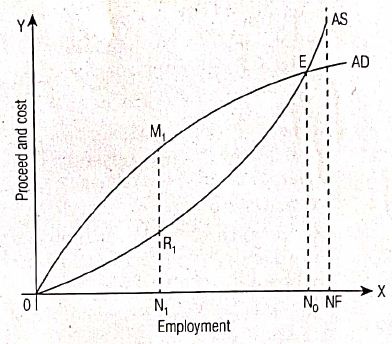
Introduction
Under the Keynes theory of employment, a simple two sector economy consisting of the household sector and the business sector is taken to understand the equilibrium between ADF and ASF.
Explanation
1. AD and AS reach equilibrium at E. The employment level is No
2. At ON1employment, the aggregate supply is N1R1. But the aggregate demand is M1N1.
3. The expected level of profit is M1R1.
4. To attain this level of profit, entrepreneurs will employ more labourers, till they reach point E i.e. ONo.
5. Beyond ONo, the aggregate demand curve is below the aggregate supply curve showing loss.
6. So they will never employ more than ONo labour.
7. The equilibrium level of employment need not be the full employment level (No).
8. The difference between No - N1 is the level of unemployment.
Conclusion
Thus the concept of effective demand becomes significant in explaining the under employment equilibrium.
54.
National Income:
(i) Measurement of national income and its composition by sectors are the basic aspects of macro economic analysis.
(ii) It gives a long term understanding of the growth process of an economy.
Inflation:
(i) Estimating the general price level based on wholesale price, index, consumer price.
Business Cycle:
(i) Cyclical movements can be studied based on aggregate economic variables.
Poverty and Unemployment:
(i) Clear understanding about the magnitude of poverty and unemployment helps allocation of resources and adapting corrective measures.
Economic Growth:
(i) The growth and development of an economy and the factors determining them could be understood only through macro analysis.
Economic Policies:
(i) Macro Economics is used to frame economic policies.
(ii) Economic policies are used to solve the basic problems, to overcome the obstacles and to achieve growth.

12th Standard Syllabus & Materials
12th Standard
TN 12th Computer Applications களப்பெயர் முறைமை (DNS) Sample Question Papers Study Material - QB365 Set A
NEW12th Standard
TN 12th Computer Applications வலையமைப்பு எடுத்துக்காட்டுகள் மற்றும் நெறிமுறைகள் Sample Question Papers Study Material - QB365 Set A
NEW12th Standard
TN 12th Computer Applications கணினி வலையமைப்பு ஓர் அறிமுகம் Sample Question Papers Study Material - QB365 Set A
NEW12th Standard
TN 12th Computer Applications PHP-உடன் MySQL-ஐ இணைத்தல் Sample Question Papers Study Material - QB365 Set A



Tamilnadu Stateboard 12th Standard Subjects

Maths

Chemistry

Physics

Biology

Computer Science

Business Maths and Statistics
Economics

Commerce

Accountancy

History

Computer Applications
Biology
Computer Technology
Computer Applications
Computer Science
Business Maths and Statistics
Commerce
Economics
Maths
Chemistry
Physics
Computer Technology
History
Accountancy

Tamil

English

French
Tamilnadu Stateboard Standards

