
 100% FREE ACCESS
8th Standard CBSE Syllabus & Materials
8th Standard CBSE
CBSE 8th Social Science Theme D - Factors of Production - New Model Questions Papers Study Material - QB365 Set A
NEW8th Standard CBSE
CBSE 8th Social Science Theme C - Universal Franchise and India's Electoral System - New Model Questions Papers Study Material - QB365 Set A
NEW8th Standard CBSE
CBSE 8th Social Science Theme B - The Rise of the Marathas - New Model Questions Papers Study Material - QB365 Set A
NEW8th Standard CBSE
CBSE 8th Social Science Theme B - Reshaping India's Political Map - New Model Questions Papers Study Material - QB365 Set A
NEW8th Standard CBSE
CBSE 8th Social Science Theme A - Natural Resources and Their Use - New Model Questions Papers Study Material - QB365 Set A
NEW8th Standard CBSE
CBSE 8th Science Keeping Time with Skies - New Model Questions Papers Study Material - QB365 Set A

Published on: 22/09/2018
Top Important Question
Download CBSE Class 8th Standard CBSE Social Science question papers, sample papers, important questions, and previous year solved papers in PDF format. Get free study materials, NCERT solutions, and exam preparation resources for Class 8th Standard CBSE Social Science
Questions + Answers key
Take MCQ Social Science Test
1.
An advertisement for Lipton tea suggested that royalty all over the world was associated with this tea. When did the advertisement appear?
1920
1925
1922
1932
2.
When New Delhi was built, the National Museum and the National Archives were both located close to the
Supreme Court
Parliament House
Viceregal Palace
Red Fort
3.
Who was the last Viceroy of India?
Lord Ripon
Lord Mountbatten
Lord William Bentinck
Lord Wellesley
4.
The British thought surveys were important for
effective administration
effective judgement
writing history
None of the above
5.
James Rennel produced the first map of India in
1785
1782
1885
1830
6.
Usually, census operations in India are held
every five years
every seven years
every ten years
every twelve years
7.
The British preserve official documents because
the preserved documents reveal the progress made by the country in the past.
one can study the notes and reports which were prepared in the past.
their copies may be made and used in modern times.
All of the above
8.
The National Archives of India came up in the
1920s
1930s
1940s
1950s
9.
A History of British India was written by
Mahatma Gandhi
Lord Mountbatten
James Mill
Dadabhai Naoroji
10.
The first Governor-General of India was
Lord Dalhousie
Warren Hastings
Lord Canning
Lord William Bentinck
11.
What were the terms and treaty of Allahabad?
12.
Answer the following questions related to picture given below:
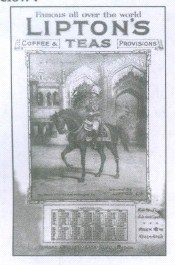
(i) What is depicted in this picture?
(ii) Why are old advertisements important to us?
(iii) What does this advertisement suggest?
13.
How did the advent of printing press help in spreading news and information in a more effective way?
14.
What was the effect of colonisation on India?
15.
What is census? When was it conducted for the first time in India?
16.
Read the excerpt and answer the questions that follow: Here is a passage from Edmund Burke's eloquent opening speech during the impeachment of Warren Hastings: "I impeach him in the name of the people of India, whose rights he has trodden under his foot and whose country he has turned into a desert. Lastly in the name of human nature itself, in the name of both the sexes, in the name of every age, in the name of every rank, I impeach the common enemy and oppressor of all.
(i) Who was Warren Hastings?
(ii) Why was he impeached?
17.
Why did English develop a strong army?
18.
Read the source given and answer the questions that follow:
Newspapers provide an account of the movements in different parts of the country. Here is a report of a police strike in 1946. More than 2000 policemen in Delhi refused to take their food on Thursday morning as a protest against their low salaries and the bad quality of food supplied to them from the Police Lines kitchen. As the news spread to the other police stations, the men there also refused to take food. One of the strikers said: "The food supplied to us from the Police Lines kitchen is not fit for human consumption. Even cattle would not eat the chapattis and dal which we have to eat."
(i) Do you remember the source of this literary evidence?
(ii) To which event the above source is related?
(iii) What was the grievance of the policemen?
(iv) What is the importance of these types of literary sources?
19.
| Law | Why is it Necessary? | Whose Interest does the law Protect? |
| Minimum Wages Act specifies that wages should not be below a specified minimum. | Many workers are denied fair wages by their employers. Because they badly need work, workers have no bargaining power and are paid low wages | This law is meant to protect the interests of all workers particularly, farm labourers, construction workers, factory workers, domestic workers etc |
| Law specifying that there be adequate safety measures in workplaces. For example, alarm system, emergency exits, properly - functioning machinery | - | - |
| Law requiring that the quality of goods meet certain prescribed standards. For example, electrical appliances have to meet safety standards | Consumers might be put to risk by the poor quality of products such as electrical appliances, food, medicines | - |
| Law requiring that the prices of essential goods are not high. For example, sugar kerosene, foodgrains | - | The interests of the poor who will otherwise be unable to afford these goods |
| Law requiring that factories do not pollute air or water | - | - |
| Laws against child labour in workplaces. | - | - |
| Law to form workers unions/associations. | By organising themselves into unions, workers can use their combined power to demand fair wages and better working conditions. |
- |
20.
Why did the tribals agitate under British rule?
21.
How was the cultivation traditionally practised by tribal groups carried out?
22.
Historians divided Indian history into ancient, medieval and modern. But this division too has its problems. What are these problems?
23.
Mill justified the British rule in India. Is it clear by his periodisation of history? Justify.
24.
What is Renaissance?
25.
What do you meant by the 'civilizing mission'?
26.
What is a Directory?
27.
What is Nationalism?
28.
Where was National Archives in India located and when did it come up?
29.
How would you prevent bleeding from a wound on the arm?
30.
What precautions should one take when one enters a building that has cracked or collapsed because of an earthquake?
31.
What is a seismograph? Where is it usually kept in your city? If you live in a village, can you find out where the nearest seismograph is kept?
32.
Can you point to a few other situations where laws (or rules) exist but people do not follow them because of poor enforcement?
(For example, over-speeding by motorists). What are the problems in enforcement? Can you suggest some ways in which enforcement can be improved?
33.
Why do you think enforcement of safety laws is important in any factory?
34.
Nawab of Awadh
35.
A person controlled by other
36.
A royal edict
37.
Portuguese Explorer
38.
Mughal Governors
39.
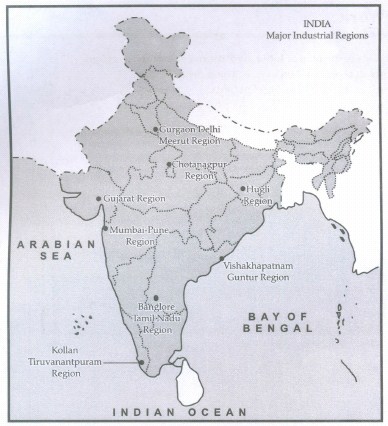
Mention the major industrial regions of India and show them on the outline map of India.
1.
(c)
1922
2.
(c)
Viceregal Palace
3.
(b)
Lord Mountbatten
4.
(a)
effective administration
5.
(b)
1782
6.
(c)
every ten years
7.
(d)
All of the above
8.
(a)
1920s
9.
(c)
James Mill
10.
(b)
Warren Hastings
11.
Following were the terms and treaty of Allahabad:
(i) The kingdom of Awadh was restored to the Nawab Shuja-ud-daullah.
(ii) The nawab paid the company a sum of Rs.50 lakhs and the company promised to support Awadh against any outside attack, using its own troops, but the expenses would be borne by the nawab.
(iii) The Mughal empire granted the Company the 'Diwani' of Bengal, Bihar and Orrisa.
(iv) The company gave the Mughal emperor an annual pension of Rs.26 Lakhs.
12.
(i) The third son of Queen Victoria of Britain, Prince Arthur-the Duke of Connaught, seated on horseback, is depicted in this picture.
(ii) Old advertisements are important because they help us to understand how markets were created for new products at that time, and secondly, how new tastes were popularized among the people.
(iii) The advertisement of Lipton tea created in 1922 suggested that royalty all over the world consumed this tea.
13.
(i) Before the advent of printing press, documents were written by hand, this was time consuming and when the printing press arrived, the speed of work improved.
(ii) Newspapers were published and the issues in them were debated upon by the common people.
(iii) The reformers and leaders were able to convey their ideas to masses in short time.
(iv) Poets and novelists were also able to express their thoughts. Thus, printing presses helped in spreading news and information in a more effective way.
14.
The effect of colonisation on India are as follows:
(i) The British came to our country and established their rule, subjugating local nawabs and rajas.
(ii) The British established control over the economy and society, collected revenue to meet all their expenses, bought the goods they wanted at low prices, produced crops they needed for export.
(iii) The British rule brought about the changes in values and tastes, customer and practices. It brought about the changes in the political, economic, social and cultural sphere.
15.
A census is a procedure of systematically acquiring and recording information about the members of a given population. It is a regularly occurring and official count of a particular population. History of Census conducted in India is as follows:
The oldest recorded census in India is thought to have occurred around 300 BCE during the reign of the emperor Chandragupta Maurya under the leadership of Kautilya or Chanakya. The census of India has been conducted 15 times as of 2011. It has been conducted every ten years. The proper national census started in 1871.
16.
(i) Warren Hastings was the first Governor-General of Bengal. He introduced many administrative reforms, notably in the sphere of justice.
(ii) In his ten-year tenure, Warren Hastings greatly extended and regularized the Company's rule in India. He resigned in 1784. When Warren Hastings went back to England in 1785, Edmund Burke charged him of being personally responsible for high crimes and misdemeanors in Bengal. He was impeached in 1787 in the British Parliament that lasted seven years. Hastings spent most of his wealth on his defence.
17.
The English developed a strong army due to the following reasons :
(i)The army was needed to establish control upon the vast empire.
(ii) It was also required to suppress internal revolts against the British.
(iii) The army consisted of Indian soldiers who were known as sepoys.
(iv) The army was well disciplined, well trained and regularly paid.
18.
(i) The report was published in 'The Hindustan Times' of 22 March, 1946.
(ii) This report was about a strike by policemen against the unhealthy food provided by the government.
(iii) The grievance of policemen was that the government did not treat them well and provided unhealthy and inedible food.
(iv)These type of literary sources provide the information about those events and activities that do not find mention in official records. These types of sources inform us about condition of contemporary society and events.
19.
| Law | Why is it Necessary? | Whose Interest does the law Protect? |
| Minimum Wages Act specifies that wages should not be below a specified minimum. | Many workers are denied fair wages by their employers. Because they badly need work, workers have no bargaining power and are paid low wages | This law is meant to protect the interests of all workers particularly, farm labourers, construction workers, factory workers, domestic workers etc |
| Law specifying that there be adequate safety measures in workplaces. For example, alarm system, emergency exits, properly - functioning machinery | Workplaces have lower safety measures because companies want to cut costs and increase profits | This law is meant for the health, welfare and safety of workers |
| Law requiring that the quality of goods meet certain prescribed standards. For example, electrical appliances have to meet safety standards | Consumers might be put to risk by the poor quality of products such as electrical appliances, food, medicines | To protect and secure the lives of the general public against accidents. |
| Law requiring that the prices of essential goods are not high. For example, sugar kerosene, foodgrains | To keep prices of essential items stable and prevent middle-men from making profits. | The interests of the poor who will otherwise be unable to afford these goods |
| Law requiring that factories do not pollute air or water | To keep the environment, including air and water clean |
The law protects the interests of the public. Clean air and water is necessary for healthy living. |
| Laws against child labour in workplaces. | Children might be exploited and forced to work in dangerous conditions which would harm their life | The law protects the interest of children. |
| Law to form workers unions/associations. | By organising themselves into unions, workers can use their combined power to demand fair wages and better working conditions. |
The law protects the interests of workers and prevents their exploitation. |
20.
The tribals agitated under British rule because:
(i) The powers and functions of tribal chiefs were reduced to keeping their lane titles and renting out their lands only.
(ii) They lost much of their economic and administrative power over their tribes and had to pay tribute to the British.
(iii) Their method of shifting cultivation was stopped and they had to settle down at fixed places to become peasant cultivators. Besides, they had to give fixed revenue to the state.
(iv) Their gathering of forest products for use or sale was stopped, as the British declared forests as Reserved meaning that the tribals could not either live in the forests or enter them at will or take out forest produce.
21.
The tribals traditionally practiced hum cultivation, i.e. shifting cultivation. This was done on small patches of land, mostly in forests. The cultivators cut the trees to allow sunlight to reach the ground and burnt the vegetation on the land to clear it for cultivation. Then they spread the ash of the vegetation to fertilize the soil, as it contained potash. Then they scratched the soil to prepare it for cultivation. They used the axe to cut trees and the hoe to scratch soil in order to prepare the land for cultivation.
Then the seeds were scattered on the field instead of ploughing the land and sowing the seeds. Once the crop was ready and harvested, they moved to another area. A field that had been cultivated once was left fallow for several years to recover its fertility.
22.
Many historians have divided Indian history into ancient, medieval and modern. This periodisation has been borrowed from the West.
According to them, a modern period was associated with the growth of science, reason, democracy, liberty, and equality. This view was accepted by the Western thinkers after the French Revolution.
Medieval period was a term used to describe a society where all these features of modern society did not exist.
If we accept this periodisation for our country, there must arise some problems. These are
We cannot justify the British Raj of India as the modern period.
At that time, people did not have equality, freedom or liberty. There was no economic growth and progress in the society.
23.
In his book, 'A History of British India', James Mill divided Indian history into three periods-. Hindu, Muslim, and British. He thought that all Asian societies were at a lower level of civilisation than Europe. Mill pointed out that before the British came to India, Hindu and Muslim despots ruled India. At that time, some factors like religious intolerance, caste taboos, and superstitious practices dominated India's social life. Mill felt that only British rule could save the Indians from the darkness. Thus, he advocated the theory of expanding colonisation, i.e. the British should conquer all the territories in India to ensure enlightenment and happiness for Indians. He strongly believed that India can be capable of progress only with the help of the British. In this way, he justified the British rule in India.
24.
It means re-birth and refers to European history from 14th to 16th century when there was revival of art, learning and culture
25.
This term is used by Europeans for modernizing the people of Asia and Africa to whom they considered as belonging to inferior races.
26.
It was an executive council in frame which was set up under the new constitution in 1795. It gave the right to vote to the citizens.
27.
The system of rigid allegiance, devotion and loyalty towards one's nation is known as Nationalism
28.
The National Archives in India came up in 1920s and it is located in Delhi
29.
Applying pressure with cotton and bandage is very effective in preventing bleeding from a wounded arm.
30.
When entering a building which has been cracked or collapsed because of an earthquake, one should keep away from unconsolidated items and walls, keep in mind the possibility of aftershocks and rush outside with the survivor as quickly as he can.
31.
Seismograph is an earthquake sensitive detection or an instrument used for recording the intensity and duration of seismic waves. It is usually kept at the geological center.
32.
Yes, some situations where laws (or rules) exist but people do not follow are the following
1. Zebra crossing for road crossing
2. Giving and taking of dowry
3. Employing children under 14 years' age
The problems in enforcement are:
1. Lack of adequate staff
2. Untrained staff
3. Irresponsible citizens
Some ways in which enforcement can be improved:
1. Strict punishments for breaking laws
2. Deployment of adequate number of staff for enforcing the laws.
33.
Enforcement of safety laws is important in any factory for the security of its workers and people living near the factory. It is important for preventing serious disasters like Bhopal gas tragedy from happening
34.
()
Shujauddaulah
35.
()
Puppet
36.
()
Farman
37.
()
Vasco da Gama
38.
()
Musket
39.
India has eight industrial regions and they are:
(i) Mumbai-Pune Region: It extends from Thane to Pune and the adjoining districts of Nasik and Sholapur.
(ii) Hugli Region: It extends from Bansbaria in the north to Birlanagar in the south.
(iii) Bangalore- Tamil Nadu Region: It extends from Banglore to all parts of Tamil Nadu except Villupuram.
(iv) Gujarat Region: It lies between Ahmedabad and Vadodara in the south to Jamnagar in the west.
(v) Chhotanagpur Region: It extends over Jharkhand, northern Odisha and western West Bengal.
(vi) Vishakhapatnam-Guntur Region: It extends from Vishakhapatnam district to Kurnool and Prakasam district in the south.
(vii) Gurgaon-Delhi-Merrut Region: It includes Gurgaon, Delhi, Shahadara, Faridabad, Ghaziabad, Meerut, Modinagar, Ambala, Agra and Mathura.
(viii) Kollam- Thiruvananthapuram Region: It is spread over Thiruvananthapuram, Kollam, Alwaye, Ernakulam, and Alappuzha districts.

8th Standard CBSE Syllabus & Materials
8th Standard CBSE
CBSE 8th Science Particulate Nature of Matter - New Model Questions Papers Study Material - QB365 Set A
NEW8th Standard CBSE
CBSE 8th Science Pressure, Winds, Stroms and Cyclones - New Model Questions Papers Study Material - QB365 Set A
NEW8th Standard CBSE
CBSE 8th Mathematics Quadrilaterals - New Model Questions Papers Study Material - QB365 Set A
NEW8th Standard CBSE
CBSE 8th Mathematics A story of Numbers - New Model Questions Papers Study Material - QB365 Set A



CBSE 8th Standard CBSE Subjects
CBSE Standards




