
 100% FREE ACCESS
6th Standard Syllabus & Materials
6th Standard
TN 6th Tamil பருவம் 1 - இயல் 1 - மொழி -தமிழ்த்தேன் - இன்பத்தமிழ் Sample Question Papers Study Material - QB365 Set A
NEW6th Standard
TN 6th English T1 - Supplementary - The Apple Tree and The Farmer Sample Question Papers Study Material - QB365 Set A
NEW6th Standard
TN 6th English T1 - Prose - When The Trees Walked Sample Question Papers Study Material - QB365 Set A
NEW6th Standard
TN 6th Social Science T3 - CIV - Road Safety Sample Question Papers Study Material - QB365 Set A
NEW6th Standard
TN 6th Social Science T3 - CIV - Local Bodies - Rural and Urban Sample Question Papers Study Material - QB365 Set A
NEW6th Standard
TN 6th Social Science T3 - CIV - Democracy Sample Question Papers Study Material - QB365 Set A

Published on: 30/11/2018
It is a very useful question paper for Matriculation and state board students for their exam preparation. This is the right time to grab the model question papers and practice for the board exams. Start revising all the portions for half yearly and get good marks in your examination. Here is the model question paper for the nearing half yearly examination for Samacheer 6th social science. The questions are prepared based on the state board syllabus.
All the important questions from every chapter are covered in this question paper. By practicing repeatedly you will get the idea of answering the questions and this improves the speed of answering. This will save the time and you can complete all the questions without any last our tension. Get more model question papers and practice for your examination.
Everyone has the same aim that is to reach the top rank list. We are paving the way for you to reach your goal. practice with important question papers and get set ready to crack your exams with confidence.
Download Tamil Nadu 6th Standard Social Science question papers, model tests, one-mark questions, important questions, and public exam papers in PDF format. Free study materials and answer keys for TN State Board students.
Questions + Answers key
Take MCQ Social Science Test
1.
According to Gandhiji, the villages are __________ of the nation.
2.
The National Bird of India is ________________.
3.
____________________ was the son of Bindusara.
4.
____________ system is an ancient learning method.
5.
The four planets nearer to the Sun are called __________ Planets
6.
There were many dangers involved in ___________ .
7.
Bihu festival is celebrated in__________
8.
The word planet means ___________ .
9.
Group of people form ____________ .
10.
Ashoka Chakra has __________ spokes.
11.
What is Savings?
12.
What is the Constitution of India?
13.
Write the names of three major festivals celebrated in India.
14.
Discuss the sources available to know about Tamil cities.
15.
How do you know that Indus people traded with other countries?
16.
How would you define archaeology?
17.
Name any two artefacts?
18.
Apartheiod, the racist policy was brought to an end by
Martin Luther
Nelson Mandela
Mother Theresa
Tagore
19.
The solar system is believed to have formed about ___________billion years ago
3
4.5
3.5
5
20.
Punjab is well known for_________________ dance.
Bihu
Dandia
Bhangra
Dumhal
21.
Who was the first ruler to give up war after victory
Bimbisar
Raja Raja Chola
Akbar
Ashoka
22.
The dancing girl statue was made out of
gold
silver
bronze
iron
23.
Gender-based stereotypes are often portrayed in
films
advertisements
TV serials
All of these
24.
The frozen continent is
North America
Australia
Antarctica
Asia
25.
The Tropic of Capricorn faces the Sun directly on
March 21
June 21
September 23
December 22
26.
Which city is not related to the Bay of Bengal?
Poompuhar
Madurai
Korkai
Kancheepuram
27.
Indus Civilisation belonged to
Old Stone age
Medieval stone age
New stone age
Metal age
28.
Viharas are temples.
29.
Hundred of lakes were built in Poompuhar.
30.
Artifacts form one of the important archaeological sources
31.
Many rock cut temples were made during the Pallava period.
32.
Archaeological survey of India is responsible for preservation of cultural monuments in the country
33.
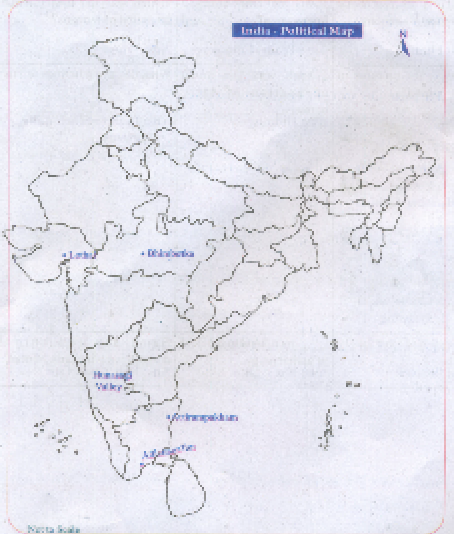
On the outline map of India, mark the following places:
1.Adichanallur
2.Attirampakkam
3.Bhimbetka
4.Hunasagi Valley
5.Lothal
34.
The velocity of Earth’s rotation is zero at poles.
35.
Though human beings are natural resources, why are they classified separately?
36.
Write any three differences between Hinayana and Mahayana sects of Buddhism?
37.
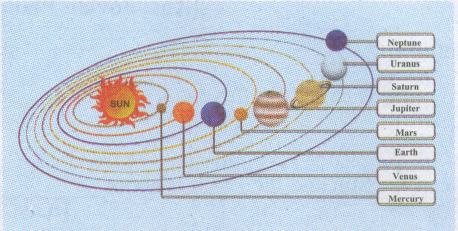
Study the picture and answer the given questions.
a. Which is the closest planet to the Sun?
b. Which is the largest planet?
c. Which is the fart~est planet from the Sun?
d. Which is the second smallest planet?
38.
Agriculture was one of their occupations. How can you prove this? (with findings)
39.
Explain the solution to the removal of inequality and discrimination in Indian society?
40.
What are the causes of Prejudice?
41.
Various discrimination in India. Discuss.
42.
Give the important features of the Pacific Ocean.
43.
Distinguish between a Mountain and a Plateau
44.
Neithal
45.
Cosmos
46.
Ambedkar
47.
Rajasthan
48.
Mehergarh
49.
| Poompuhar was located on which river bank? | Name the ancient city which had Tamil Sangam | Name a Sangam literary work |
| Which Greek historian gave accounts about the Pandya kingdom? | To which Tamil kingdom did the southern districts of Tamil Nadu belong to during the Sangam Age? | Name the Chinese traveler who stayed and studied in Nalanda University. |
| Thirunavukarasar mentioned Kanchi as | What is the name of evening market during the Sangam Age? | Name the temple built by Pallava king Rajasimha at Kanchi. |
| Which district is known as the district of lakes? | What is trade? | Name a port located on the shore of Bay of Bengal. |
1.
()
back bone
2.
()
peacock
3.
()
Ashoka
4.
()
The Gurukula
5.
()
Inner or Terrestrial
6.
()
Hunting
7.
()
Assam
8.
()
Wanderer
9.
()
Community
10.
()
24
11.
The amount from the income which is left for future needs after consumption is called savings.
12.
(i) The Constitution is an authentic document containing the basic ideas, principles and laws of a country.
(ii) It also defines the rights and duties of the citizens.
(iii) The laws governing a country originate from the Constitution.
(iv) Every country is ruled on the basis of its Constitution.
13.
(i) Pongal
(ii) Deepavali
(iii) Holi
14.
(i) Tamil Literature
(ii) Accounts of foreign travellers
(iii) Archaeological finds provide us information about the ancient town of Tamilagam.
15.
(i) Indus people were great traders.
(ii) There is evidence for extensive maritime trade with Mesopotamia. Indus seals have been found as for as Mesopotamia which are modern day Iraq, Kuwait and parts of syria.
(iii) King -Naram-Sin of Akkadian Empire (Sumerian) has written about buying jewellery from the land of Melukha (a region in the Indus Valley).
(iv) Cylindrical seals similar to those found in Persian Gulf and Mesopotamia have also been found in the Indus area.
(v) A naval dockyard has been discovered in Lothal. It shows the maritime activities of the Indus people.
16.
Archaeology is the study of pre historic humans remained materials used by pre historic humans.
17.
(i) Potteries
(ii) Toys
(iii) Tools
(iv) Ornaments
18.
(b)
Nelson Mandela
19.
(b)
4.5
20.
(c)
Bhangra
21.
(d)
Ashoka
22.
(c)
bronze
23.
(d)
All of these
24.
(c)
Antarctica
25.
(d)
December 22
26.
(b)
Madurai
27.
(d)
Metal age
28.
(b)
29.
(b)
30.
(a)
31.
(a)
32.
(a)
33.
34.
The statement is true, because, at the poles the distance around the earth is zero, and zero divided by 24 hours result in a speed is zero.
\(\therefore \text { Velocity }=\frac{\text { Distance }(0)}{\text { Time }(24)}=\frac{0}{24}=0\)
35.
(i) Though, human beings are basically natural resources, we classify human beings separately.
(ii) Education health, knowledge and skill have made them a valuable resource.
(iii) Eg: Doctors, Teachers, Scientists.
36.
| S.No | HINAYANA | MAHAYANA |
| 1. | Did not worship idols or images of Buddha. | Worshiped images of Buddha. |
| 2. | Practiced austerity | Observed elaborate rituals. |
| 3. | Believed that salvation of the individual as its goal. | Believed that salvation of all beings as its |
| 4. | Used Prakrit language. | Used Sanskrit language. |
| 5. | Confined to India. | Spread to Central Asia, Ceylon, Burma, Nepal, Tibet China, Japan, where middle path was accepted. |
37.
a. Mercury
b. Jupiter
c. Uranus
d. Mars
38.
Agriculture was one of their occupation:
(i) Granaries were used to store food grains.
(ii) The remains of wheat, barley, millets, sesame and pulses have been found there.
(iii) A granary with walls made of mud bricks, which are still in a good condition, has been discovered in Rakhigarhi, a village in Haryana, belonging to mature Harappan phase.
39.
The remedial measures for abolishing inequality and discrimination in Indian society are as follows.
(i) Wider access to quality based services like healthcare and education for all.
(ii) Be aware of current gender bias.
(iii) Make women more visible in public life and institution to eradicate gender disparity.
(iv) Be open to learning about other religions.
(v) Promoting community dining in the classroom may help the students to sit together without any bias of caste, religion or gender.
(vi) Socialise with people of all types outside home.
(vii) Effective implementation of laws.
40.
Some common social factors. that contributes to the rise of prejudice are
(i) Socialisation
(ii) Conforming behaviours
(iii) Economic benefits
(iv) Authorita, rian personality
(v) Ethno-cntrism
(vi) Group losure
(vii) Conflicts
41.
(i) The different forms of inequalities such as caste inequality, religious inequality, race inequality or gender inequality give rise to discrimination.
(ii) Discrimination can happen on the basis of colour, class, religion gender etc.
(iii) Treating dark-skinned people differently from fair-skinned people, giving more importance to people of higher than to those of lower caste and thinking boys are smarter than girls are all thoughts of discrimination.
(iv) Article 15(1) of the constitution states that the State not to discriminate against any citizen on grounds only of religion, race, caste, sex, place of birth or any of them.
42.
(i) The important features of the pacific ocean:
(ii) The pacific ocean is the largest and deepest ocean on the earth.
(iii) It covers about one-third of the earth's total area and spreads for about 168.72 million sq.km
(iv) This oceans shape is roughly triangular with its apex in the north at the bering strait which connects the pacific ocean with the arctic ocean.
(v) The bering sea, the china sea and the Philippines sea, the sea of Japan and Tasman sea are some of the marginal seas of the pacific ocean.
(vi) Indonesia, philippines, japan, hawaii, newzealand are some of the islands located in this ocean.
(vii) The deepest point mariana trench is 10,994m and is located in the pacific ocean.
(viii) A chain of volcanoes is located around the pacific ocean called the pacific ring of fire.
43.
| S.No | Mountains | Plateaus |
| 1. | A landform that rises over 600 metre above its surroundings and has steep slopes is called a mountain. | Plateaus are the elevated portions of the Earth that have flat surfaces bounded by steep slopes. The elevation of plateaus may be a few hundred metre or several thousand metre. |
| 2. | Example: Himalayas | Example: Chotanagpur Plateau |
44.
Coastal Region
45.
Universe
46.
India's first law minister
47.
Ghoomer
48.
Neolithic
49.
| Poompuhar was located on which river bank? Cauvery |
Name the ancient city which had Tamil Sangam Madurai |
Name a Sangam literary work Pattinappallai |
| Which Greek historian gave accounts about the Pandya kingdom? Megasthanese |
To which Tamil kingdom did the southern districts of Tamil Nadu belong to during the Sangam Age? Pandya Nadu |
Name the Chinese traveller who stayed and studied in Nalanda University. Hieun Tsang |
| Thirunavukarasar mentioned Kanchi as Kalviyil Kayaillatha Kanchi |
What is the name of evening market during the Sangam Age? Allangadi |
Name the temple built by Pallava king Rajasimha at Kanchi. Kailasanathar TempIe |
| Which district is known as the district of lakes? Kancheepuram |
What is trade? The action of buying and selling goods and services |
Name a port located on the shore of Bay of Bengal. Poompuhar Port |

6th Standard Syllabus & Materials
6th Standard
TN 6th Social Science T3 - GEO - Understanding Disaster Sample Question Papers Study Material - QB365 Set A
NEW6th Standard
TN 6th Social Science T3 - GEO - Globe Sample Question Papers Study Material - QB365 Set A
NEW6th Standard
TN 6th Social Science T3 - GEO - Asia and Europe Sample Question Papers Study Material - QB365 Set A
NEW6th Standard
TN 6th Social Science T3 - HIS - South Indian Kingdoms Sample Question Papers Study Material - QB365 Set A



Tamilnadu Stateboard 6th Standard Subjects
Tamilnadu Stateboard Standards



