
 100% FREE ACCESS
12th Standard Syllabus & Materials
12th Standard
TN 12th Computer Applications மின்னணு தரவு பரிமாற்றம் Sample Question Papers Study Material - QB365 Set A
NEW12th Standard
TN 12th Computer Applications மின் - வணிக பாதுகாப்பு அமைப்புகள் Sample Question Papers Study Material - QB365 Set A
NEW12th Standard
TN 12th Computer Applications மின்னணு செலுத்தல் முறைகள் Sample Question Papers Study Material - QB365 Set A
NEW12th Standard
TN 12th Computer Applications மின் - வணிகம் Sample Question Papers Study Material - QB365 Set A
NEW12th Standard
TN 12th Computer Applications திறந்த மூல கருத்துருக்கள் Sample Question Papers Study Material - QB365 Set A
NEW12th Standard
TN 12th Computer Applications வலையமைப்பு வடமிடல் Sample Question Papers Study Material - QB365 Set A

Published on: 29/09/2020
12th Physics English Medium Important 5 Mark Book Back (New Syllabus 2020)
Download Tamil Nadu 12th Standard Physics question papers, model tests, one-mark questions, important questions, and public exam papers in PDF format. Free study materials and answer keys for TN State Board students.
Questions + Answers key
Take MCQ Physics Test1.
A monochromatic light of wavelength of 500 nm strikes a grating and produces fourth order maximum at an angle of 30°. Find the number of slits per centimeter.
2.
A beam of light of wavelength 600 nm from a distant source falls on a single slit 1 mm wide and the resulting diffraction pattern is observed on a screen 2 m away. What is the distance between the first dark fringes on either side of the central bright fringe?
3.
Compute the binding energy of \(_{ 2 }^{ 4 }{ He }\) nucleus using the following data: Atomic mass of Helium atom MA(He) = 4.00260u and that of hydrogen atom, mH = 1.00785u.
4.
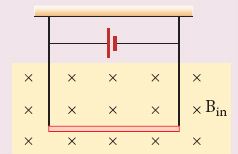
A conductor of linear mass density 0.2 g m–1 suspended by two flexible wire as shown in figure. Suppose the tension in the supporting wires is zero when it is kept inside the magnetic field of 1 T whose direction is into the page. Compute the current inside the conductor and also the direction of the current. Assume g = 10 m s–2
5.
Calculate the instantaneous value at 60o, average value and RMS value of an alternating current whose peak value is 20 A.
6.
A rectangular coil of area 6 cm2 having 3500 turns is kept in a uniform magnetic field of 0.4 T. Initially, the plane of the coil is perpendicular to the field and is then rotated through an angle of 180o . If the resistance of the coil is 35 Ω, find the amount of charge flowing through the coil.
7.
For the given capacitor configuration
(a) Find the charges on each capacitor
(b) potential difference across them
(c) energy stored in each capacitor
8.
Two cells each of 5V are connected in series with a 8 Ω resistor and three parallel resistors of 4 Ω, 6 Ω, and 12 Ω. Draw a circuit diagram for the above arrangement. Calculate
(i) the current drawn from the cells
(ii) current through each resistor
9.
Find the heat energy produced in a resistance of 10 Ω when 5 A current flows through it for 5 minutes.
10.
A battery has an emf of 12 V and connected to a resistor of 3 Ω. The current in the circuit is 3.93 A. Calculate
(a) terminal voltage and the internal resistance of the battery
(b) power delivered by the battery and power delivered to the resistor
11.
A water molecule has an electric dipole moment of 6.3 x 10⁻³⁰ Cm. A sample contains 1022 water molecules, with all the dipole moments aligned parallel to the external electric field of magnitude 3 x 10⁵ NC-1. How much work is required to rotate all the water molecules from θ = 0° to 90°?
12.
Calculate the de Broglie wavelength of a proton whose kinetic energy is equal to 81.9 x 10⁻¹⁵ J. (Given: mass of proton is 1836 times that of electron).
13.
How many photons of frequency 1014 Hz will make up 19.86 J of energy?
14.
A small telescope has an objective lens of focal length 125 cm and an eyepiece of focal length 2 cm.
(a) What is the magnification of the telescope?
(b) What is the separation between the objective and the eyepiece?
(c) What is the angular separation between two stars when viewed through this telescope if they subtend 1' for bare eye?
15.
Calculate the range of the variable capacitor that is to be used in a tuned-collector oscillator which has a fixed inductance of 150 μH. The frequency band is from 500 kHz to 1500 kHz.
16.
Lights of two wavelengths 560 nm and 420 nm are used in Young’s double slit experiment. Find the least distance from the central fringe where the bright fringes of the two wavelengths coincide. Given D = 1 m and d = 3 mm.
17.
Calculate the radius of the earth if the density of the earth is equal to the density of the nucleus.[mass of earth 5.97 x 1024 kg].
18.
An electron moving perpendicular to a uniform magnetic field 0.500 T undergoes circular motion of radius 2.50 mm. What is the speed of electron?
19.
An inverter is common electrical device which we use in our homes. When there is no power in our house, inverter gives AC power to run a few electronic appliances like fan or light. An inverter has inbuilt step-up transformer which converts 12 V AC to 240 V AC. The primary coil has 100 turns and the inverter delivers 50 mA to the external circuit. Find the number of turns in the secondary and the primary current.
20.
A magnetron in a microwave oven emits electromagnetic waves (em waves) with frequency f = 2450 MHz. What magnetic field strength is required for electrons to move in circular paths with this frequency?
21.
A parallel plate capacitor filled with mica having εr = 5 is connected to a 10 V battery. The area of the parallel plate is 6 cm2 and separation distance is 6 mm.
(a) Find the capacitance and stored charge.
(b) After the capacitor is fully charged, the battery is disconnected and the dielectric is removed carefully.
Calculate the new values of capacitance, stored energy and charge.
22.
In a Wheatstone’s bridge P = 100 Ω, Q = 1000 Ω and R = 40 Ω. If the galvanometer shows zero deflection, determine the value of S.
23.
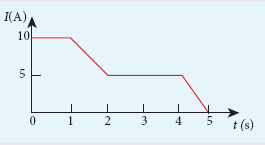
The current through an element is shown in the figure. Determine the total charge that pass through the element at a) t = 0 s, b) t = 2 s, c) t = 5s
1.
λ = 500 nm = 500 x 10-9 m; m = 4;
θ = 30°; number of lines per cm = ?
Equation for diffraction maximum in grating is, sin θ = Nm λ
Rewriting, \(N=\cfrac { sin\theta }{ m\lambda } \)
Substituting,
\(N=\frac{0.5}{4 \times 500 \times 10^{-9}}\)
= 2.5 x 10⁵ m-1
= 2.5 x 103 cm-1
2.
⋋2 = 600 x 10-9 m, ⇒ d = 1 x 10⁻³ m, D =2m
n⋋ = dsinθ
For first dark fringe
n = 1 For minimum
d sinθ = ⋋, here
CO = Nc (approximately)
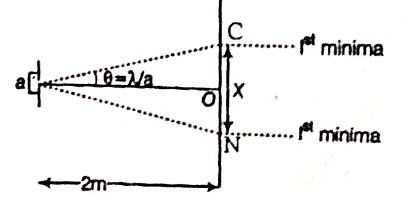
From Fig, sinθ \(=\frac{x/2}{D} =x/2D\)
\(sin \theta =\frac{ \lambda}{d} \)
\(\lambda/d=x/2D\)
\(\therefore x =\frac{2D\lambda}{d}=\frac{2 \times 2 \times 600\times 10^{-9}}{ 10^{-3}} \)
\(x=2.4 \times10^{-3}m =2.4\mathrm{~mm} \)
3.
Binding energy BE = [ZmH + Nmn - MA]c2
For helium nucleus, Z = 2, N = A–Z = 4–2 = 2
Mass defect
Δm = [(2 x 1.00785u) + (2 x 1.008665 u) -4.00260u] Δm = 0.03043 u
B.E = 0.03043u x c2
B.E = 0.03043 x 931 MeV = 28.33 MeV
[∵ luc2 = 931 MeV]
The binding energy of the \(_{ 2 }^{ 4 }{ He }\) nucleus is 28.33 MeV.
4.
Linear mass density of the conductor is = 0.2 g/m
Mass per unit length \(\frac{M}{l}=0.2 \times 10^{-3} \mathrm{~kg} / \mathrm{m}\)
Magnetic field B = 1T.
Acceleration due to gravity, g = 10 ms-2
Force \(=\frac{m}{l} \times g\)
= 0.2 x 10-3 x 10 = 0.2 x 10⁻²
F = 2 x 10⁻³ N ....(1)
If the coil is placed in the magnetic field then the force acting on the coil is
F= BIl ....(2)
From the equation (1) and (2) we get
BIl = 2 x 10⁻³
∴ 1 x L x I = 2 x 10⁻³
∴ I = 2 x 10⁻³ A [∴ l = 1m]
∴ I = 2mA
5.
Angle, \( \theta=60^{\circ}\)
Peak value of current, \(I_{P_m}=20 \mathrm{~A}\)
(i) Instantaneous value of current at 60o,
\(i =I_m \sin \theta \)
\(=20 \times \sin 60^{\circ}=\frac{20 \times \sqrt{3}}{2} \)
\(=10 \times 1.732 \)
\(i =17.32 \mathrm{~A}\)
(ii) Average value of current,
\(I_{\mathrm{av}}=0.637 I_m \)
\(I_{\mathrm{av}}=0.637 \times 20 \)
\(I_{\mathrm{av}}=12.74 \mathrm{~A}\)
(iii) RMS value of current,
\(I_{\mathrm{rms}}=0.707 I_m=0.707 \times 20 \)
\(I_{\mathrm{rms}}=14.14 \mathrm{~A}\)
6.
Area of a rectangular coil, \(A=6 \times 10^{-4} \mathrm{~m}^2, Resistance \ \mathrm{R}=35 \Omega\)
Number of turns of the coil, N = 3500 turns
Magnetic field, B = 0.4 T
Angle of orientation, \(\theta=\pi-\frac{\pi}{2}=\frac{\pi}{2} \mathrm{rad}=90^{\circ}\)
Induced emf, e=N A B sin θ
\(e=3500 \times 6 \times 10^{-4} \times 0.4 \times \sin 90^{\circ}\)
\(=3500 \times 2.4 \times 10^{-4} \times 1 \)
\(=840 \times 10^{-3} \mathrm{V} \)
\(I=\frac{e}{R}=\frac{1440 \times 10^{-1}}{35} \)
\(I=24 \times 10^{-3} A\)
Charge, Q = It
\(=24 \times 10^{-3} \times 2 \)
\(=48 \times 10^{-3} \mathrm{C} \)
\(\therefore Charge Q=48 \times 10^{-3} \mathrm{C}\)
7.
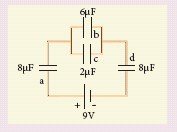
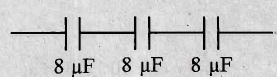
Cp = Cb + Cc
\(C_{P}=6+2=8 \mu \mathrm{F} \)
\(\frac{1}{C_{s}}=\frac{1}{C_a}+\frac{1}{C_p}=\frac{1}{C_d} \)
\(C_{s}=\frac{1}{8}+\frac{1}{8}+\frac{1}{8}=\frac{3}{8} \)
\(\therefore C_{s}=\frac{8}{3} \mu \mathrm{F} \)
Total capacitance \(C_{s}=\frac{8}{3} \times 10^{-6} \mathrm{~F} \)
Total Charge, \(Q=C_{s} V=\frac{8}{3} \times 10^{-6} \times 9 \)
\(Q_{a}=24 \mu C\)
(a) Charge on capacity \(Q_{a}=24 \mu C\) .....(1)
Charge on capacitor \(Q_{b}=24 \times \frac{6}{8}=18 \mu \mathrm{C} \) ..............(2)
Charge on capacitor \(Q_{c}=24 \times \frac{2}{8}=6 \mu \mathrm{C} \) ..............(3)
Charge on capacitor \(Q_{d}=24 \times \frac{8}{8}=24 \mu \mathrm{C} \) ..............(4)
(b) Potential difference across \(C_{a} \ is\ V_{a}=\frac{Q_{a}}{C_{a}} \)
\(=\frac{24}{8}=3 \mathrm{~V} \) ...(5)
Potential difference across \(C_{b}\ is \ V_{b}=\frac{Q_{b}}{C_{b}} \)
\(=\frac{18}{6}=3 \mathbf{V}\) ........(6)
Potential difference across \(C_{c}\ is \ V_{c}=\frac{Q_{c}}{C_{c}}=\frac{6}{2}=3 \mathrm{~V} \) ......(7)
Potential difference across \(C_{d}\ is \ V_{d}=\frac{Q_{d}}{C_{d}} \)
\(=\frac{24}{8}=3 \mathbf{V} \) ....(8)
(c) Energy stored in each capacitor \(U=\frac{1}{2} C V^{2}\)
Energy stored in \(\mathrm{C}_{\mathrm{a}} \text { is } U_{a}=\frac{1}{2} C_{a} V_{a}^{2}\)
\(U_{\mathrm{a}}=\frac{1}{2} \times 8 \times 10^{-6} \times 3 \times 3=36 \mu \mathrm{J}\) ....(9)
Energy stored in \(C_{b}\ is \ U_{b}=\frac{1}{2} C_{b} V_{b}^{2} \)
\(U=\frac{1}{2} \times 6 \times 10^{-6} \times 3 \times 3 \)
\(=27 \mu \mathrm{J} \) ........(10)
Energy stored in Ce is \(U_{c} =\frac{1}{2} C_{c} V_{c}^{2} \)
\(=\frac{1}{2} \times 2 \times 10^{-6} \times 3 \times 3=9 \mu \mathrm{J} \) ......(11)
Energy stored in Cd is \(U_{d} =\frac{1}{2} C_{d} V_{d}^{2} \)
\(U_d=\frac{1}{2} \times 8 \times 10^{-6} \times 3 \times 3 \)
\(=36 \times 10^{-6} \mathrm{~J}=36 \mu \mathrm{J} \) .........(12)
8.
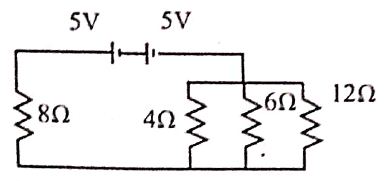
Circuit Diagram:
Here, 2 cells are in series,
\(\therefore \varepsilon_{\mathrm{tot}} =\varepsilon+\varepsilon=2 \varepsilon \)
\(\varepsilon_{\mathrm{tot}} =10 \mathrm{~V}\)
Here 4, 6 and 12 are in parallel
\(\therefore \frac{1}{\mathrm{R}_{\mathrm{p}}} =\frac{1}{\mathrm{R}_1}+\frac{1}{\mathrm{R}_1}+\frac{1}{\mathrm{R}_1}=\frac{1}{4}+\frac{1}{6}+\frac{1}{12} \)
\(\mathrm{R}_{\mathrm{p}} =2 \Omega\)
Now, the circuit becomes,
(i) current drawn from the cell (through the circuit) is,
\(\mathrm{I}=\frac{\mathrm{V}}{\mathrm{R}_{\mathrm{s}}}=\frac{10}{8+2}=1 \mathrm{~A}\)
Potential drop across the parallel combination of 3 resistors is \(\mathrm{V}^{\prime}=1 R_P=1 \times 2=2 \mathrm{~V}\)
(ii) Current through 8 resistor is I =1 A
\((\because 8 \Omega, 2 \Omega \text { in series) }\)
Current through \(\mathrm{R}=4 \Omega \ is, \mathrm{I}=\frac{\mathrm{V}^{\prime}}{\mathrm{R}}=\frac{2}{4}=0.5 \mathrm{~A}\)
Current through \(\mathrm{R}=6 \Omega \ is, \mathrm{I}=\frac{\mathrm{V}^1}{\mathrm{R}}=\frac{2}{6}=0.33 \mathrm{~A}\)
Current through \(\mathrm{R}=12 \Omega \ is, \mathrm{I}=\frac{\mathrm{V}^1}{\mathrm{R}}=\frac{2}{12}=0.17 \mathrm{~A}\)
9.
R = 10 Ω, I = 5 A, t = 5 minutes = 5 x 60 s
H = I2 R t
= 52 x 10 x 5 x 60
= 25 x 10 x 300
= 25 x 3000
= 75000 J (or) 75 kJ
10.
The given values I = 3.93 A, ξ = 12 V,
R = 3 Ω
(a) The terminal voltage of the battery is equal to voltage drop across the resistor
V = IR = 3.93 x 3 = 11.79 V
The internal resistance of the battery,
\(r=\left[ \frac { \xi -V }{ V } \right] R=\left[ \frac { 12-11.79 }{ 11.79 } \right] \times 3=0.05\Omega \)
(b) The power delivered by the battery P = Iξ = 3.93 x 12 = 47.1 W
The power delivered to the resistor = I2 R = 46.3 W
The remaining power = (47.1 – 46.3) = 0.8 W is delivered to the internal resistance and cannot be used to do useful work. (it is equal to I2 r).
11.
When the water molecules are aligned in the direction of the electric field, it has minimum potential energy. The work done to rotate the dipole from θ = 0° to 90° is equal to the potential energy difference between these two configurations.
W = ΔU = U(90°) - U(0°)
From the equation U =−pE cosθ = −\(\hat p.\hat E\) ,
we write U = − pE cosθ, Next, we calculate the work done to rotate one water molecule from θ = 0° to 90°.
For one water molecule
W = - pE cos90o + pE cos0o = pE
W= 6.3 x 10-30 x 3 x 105 = 18.9 x 10⁻²⁵J
For 1022 water molecules, the total work done is
Wtot = 18.9 x 10-25 x 1022 = 18.9 x 10⁻³J
12.
\(\text { K.E }=81.9 \times 10^{-15} \mathrm{~J} \)
\(\lambda =\frac{\mathrm{h}}{\sqrt{2 \mathrm{mk}}}=\frac{6.626 \times 10^{-34}}{\sqrt{2 \times 9.1 \times 10^{-3} \times 1836 \times 81.9 \times 10^{-15}}} \)
\(\lambda =\mathbf{4 . 0 0} \times 10^{-14} \mathrm{~m} \)
13.
\(v=10^{14} \mathrm{~Hz} ; \mathrm{E}=19.86 \mathrm{~J} \)
\(E=nhv \Rightarrow n=\frac{E}{hv}\)
\(=\frac{19.86}{6.626 \times 10^{-34} \times 10^{14}}=2.99 \times 10^{20} \)
\(\mathrm{n} \simeq 3 \times 10^{20} \)
14.
fo = 125 cm; fe = 2 cm; m = ? L = ?; θi = ?
(a) Equation for magnification of telescope,
\(m=\cfrac { { f }_{ o } }{ { f }_{ e } } \)
Substituting, \(m=\cfrac { 125 }{ 2 } =62.5\)
(b) Equation for approximate length of telescope, L = fo+ fe
Substituting, L = 125 + 2 = 127 cm = 1.27 m
(c) Equation for angular magnification,\(m=\cfrac { { \theta }_{ 1 } }{ { \theta }_{ 0 } } \)
Rewriting, \({ \theta }_{ 1 }=m\times { \theta }_{ 0 }\)
Substituting,
\({ \theta }_{ i }=62.5\times 1'=62.5'=\cfrac { 62.5 }{ 60 } =1.04^{ o }\) = 1o2'30''
15.
Resonant frequency, \({ f }=\frac { 1 }{ 2\pi \sqrt { LC } } \)
On simplifying, we get C = \(\frac { 1 }{ { 4\pi }^{ 2 }{ { f }^{ 2 } }L } \)
i) When frequency = 500 kHz,
\(C=\frac { 1 }{ 4\times { 3.14 }^{ 2 }\times { (500\times { 10 }^{ 3 }) }^{ 2 }\times 150\times { 10 }^{ -6 } } \)
= 676 pF
ii) When frequency = 1500 kHz,
\(C=\frac { 1 }{ 4\times { 3.14 }^{ 2 }\times { (1500\times { 10 }^{ 3 }) }^{ 2 }\times 150\times { 10 }^{ -6 } } \)
= 75 pF
Therefore, the capacitor range is 75 to 676 pF.
16.
λ1 = 560 nm = 560 x 10-9m;
λ1 = 420 nm = 420 x 10-9m;
D = 1 m; d = 3 mm = 3 x 10⁻³m
Here, n and λ are inversely proportional for a given y.
Here, nth order bright fringe of longer wavelength λ1 coincides with (n+1)th order bright fringe of shorter wavelength λ2.
Equation for nth bright fringe is, \({ y }_{ n }=n\cfrac { \lambda D }{ d } \)
Here, \(n\cfrac { { \lambda }_{ 1 }D }{ d } =(n+1)\cfrac { { \lambda }_{ 2 }D }{ d } \) (as λ1>λ2)
\({ n\lambda }_{ 1 }=\left( n+1 \right) { \lambda }_{ 2 }\) (or) \(\cfrac { { \lambda }_{ 1 } }{ { \lambda }_{ 2 } } =\cfrac { (n+1) }{ n } ;1+\frac{1}{n}=\frac{\lambda_1}{\lambda_2}\)
\(1+\cfrac { 1 }{ n } =\cfrac { 560\times { 10 }^{ -9 } }{ 420\times { 10 }^{ -9 } } \) (or) \(1+\cfrac { 1 }{ n } =\cfrac { 4 }{ 3 } \)
\(\frac{1}{n}=\frac{1}{3}\) (or) n = 3
Thus, the 3rd bright fringe of λ1 and the 4th bright fringe of λ2 coincide at the least distance y.
The least distance from the central fringe where the bright fringes of the two wavelengths coincide is, \(y_{n}=n \frac{\lambda D}{d}\)
\(y_{n}=3 \times \frac{560 \times 10^{-9} \times 1}{3 \times 10^{-3}}=560 \times 10^{-6} \mathrm{~m}\)
\(y_{n}=0.560 \times 10^{-3} \mathrm{~m}=0.560 \mathrm{~mm}\)
17.
Density \(\rho=2.3 \times 10^{17} \mathrm{kgm}^{-3}\), Mass M = 5.97 x 1024 kg
\(\rho=\frac{M}{V}=\frac{M}{\frac{4}{3}\pi R^3}\)
\(R=\left[\frac{M}{\frac{4}{3} \pi \rho}\right]^{\frac{1}{3}}=\left[\frac{3 \mathrm{M}}{4 \pi \rho}\right]^{\frac{1}{3}}=\left[\frac{3 \times 5.97 \times 10^{24}}{4 \times 3.14 \times 2.3 \times 10^{17}}\right]^{\frac{1}{3}}=\left[0.62 \times 10^{7}\right]^{\frac{1}{3}}\)
R = 183.7 m
R ≈180 m
18.
Charge of an electron q = –1.60 × 10⁻¹⁹ C ⇒ |q| = 1 60 x 10-19 C
Magnitude of magnetic field B = 0.500 T
Mass of the electron, m = 9.11 × 10⁻³¹ kg
Radius of the orbit, r = 2.50 mm = 2.50 × 10⁻³ m
Speed of the electron, V = \(q \frac{\mathrm{rB}}{\mathrm{m}}\)
\( v = 1.60 \times 10^{-19} \times\frac{ 2.50 \times 10^{-3} \times 0.500}{9.11 \times 10^{-31}}\)
\(v=2.195 \times 10^8 \mathrm{~m} \mathrm{s} ^{-1}\)
19.
Vp = 12 V; Vs = 240 V
Is = 50 mA; Np = 100 turns
\(\frac { { V }_{ s } }{ { V }_{ P } } =\frac { { N }_{ s } }{ { N }_{ p } } =\frac { { I }_{ P } }{ { I }_{ S } } =K\)
Transformation ratio, K = \(\frac{240}{12}=20\)
The number of turns in the secondary
NS = NP x K = 100 x 20 = 2000
Primary current,
IP = K x Is = 20 x 50 mA = 1 A
20.
Frequency of the electromagnetic waves given, f = 2450 MHz
The corresponding angular frequency is
ω = 2πf = 2 x 3.14 x 2450 x 106
= 15,386 x 106 Hz
= 1.54 x 10¹⁰ s-1
The required magnetic field, B = \(\frac { { m }_{ e }\omega }{ |q| } \)
Mass of the electron, me = 9.11 x 10⁻³¹ kg
Charge of the electron,
q = -1.60 x 10⁻¹⁹C
⇒ |q| = 1.60 x 10⁻¹⁹ C
B = \(\frac { (9.11\times { 10 }^{ -31 })(1.54\times 10^{ 10 }) }{ (1.60\times 10^{ -19 }) } \) = 8.7683 x 10⁻²T
B = 0.08768 T
This magnetic field can be easily produced with a permanent magnet. So, electromagnetic waves of frequency 2450 MHz can be used for heating and cooking food because they are strongly absorbed by water molecules.
21.
(a) The capacitance of the capacitor in the presence of dielectric is
C = \(\frac { { \varepsilon }_{ r }{ \varepsilon }_{ 0 }A }{ d } =\frac { 5\times 8.85\times 10^{ -12 }\times 6 \times 10^{-4}}{ 6\times 10^{ -3 } } \)
= 44.25 x 10⁻¹³F = 4.425 pF
The stored charge is
Q = CV = 44.25 x 10-13 x 10
= 442.5 x 10⁻¹³C = 44.25pC
The stored energy is
\(U=\frac { 1 }{ 2 } \) CV2 = \(\frac { 1 }{ 2 } \) x 44.25 x 10-13 x 100
= 2.21 x 10⁻¹⁰ J
(b) After the removal of the dielectric, since the battery is already disconnected the total charge will not change. But the potential difference between the plates increases. As a result, the capacitance is decreased.
New capacitance is
C0=\(\frac { C }{ { \varepsilon }_{ r } } =\frac { 44.25\times 10^{ -12 } }{ 5 } \)
= 0.885 x 10⁻¹² F = 0.885 pF
The stored charge remains same and 44.25 pC. Hence newly stored energy is
U0 =\(\frac { { Q }^{ 2 } }{ 2{ C }_{ 0 } } =\frac { { Q }^{ 2 }{ \varepsilon }_{ r } }{ 2C } =\varepsilon _{ r }U\)
= 5 x 2.21 x 10-10J = 11.05 x 10⁻¹⁰J
The increased energy is ΔU = (11.05 - 2.21) x 10-10 J = 8.84 x 10⁻¹⁰ J
When the dielectric is removed, it experiences an inward pulling force due to the plates. To remove the dielectric, an external agency has to do work on the dielectric which is stored as additional energy. This is the source for the extra energy 8.84 x 10⁻¹⁰ J.
22.
\(\frac { P }{ Q } =\frac { R }{ S } \)
\(S=\frac { Q }{ P } \times R\)
\(S=\frac { 1000 }{ 100 } \times 40S=400\Omega \)
23.
Charge Q = Current x Time interval
= I x t
At t = 0 s,
dq = dI x t
= 5 x 0
dq = 0 C
At t = 2 s,
dg = dI x t
=5 x 2
dq = 10 C
At t = 5 s,
dg = dl x t
=0 x 5
dq = 0 C
At t= 0 s, dg = 0 C; At t = 2 s, dg = 10 C; At t= 5 s, dg = 0 C.

12th Standard Syllabus & Materials
12th Standard
TN 12th Computer Applications களப்பெயர் முறைமை (DNS) Sample Question Papers Study Material - QB365 Set A
NEW12th Standard
TN 12th Computer Applications வலையமைப்பு எடுத்துக்காட்டுகள் மற்றும் நெறிமுறைகள் Sample Question Papers Study Material - QB365 Set A
NEW12th Standard
TN 12th Computer Applications கணினி வலையமைப்பு ஓர் அறிமுகம் Sample Question Papers Study Material - QB365 Set A
NEW12th Standard
TN 12th Computer Applications PHP-உடன் MySQL-ஐ இணைத்தல் Sample Question Papers Study Material - QB365 Set A



Tamilnadu Stateboard 12th Standard Subjects

Maths

Chemistry
Physics

Biology

Computer Science

Business Maths and Statistics

Economics

Commerce

Accountancy

History

Computer Applications
Biology
Computer Technology
Computer Applications
Computer Science
Business Maths and Statistics
Commerce
Economics
Maths
Chemistry
Physics
Computer Technology
History
Accountancy

Tamil

English

French
Tamilnadu Stateboard Standards

