
 100% FREE ACCESS
12th Standard Syllabus & Materials
12th Standard
TN 12th Computer Applications மின்னணு தரவு பரிமாற்றம் Sample Question Papers Study Material - QB365 Set A
NEW12th Standard
TN 12th Computer Applications மின் - வணிக பாதுகாப்பு அமைப்புகள் Sample Question Papers Study Material - QB365 Set A
NEW12th Standard
TN 12th Computer Applications மின்னணு செலுத்தல் முறைகள் Sample Question Papers Study Material - QB365 Set A
NEW12th Standard
TN 12th Computer Applications மின் - வணிகம் Sample Question Papers Study Material - QB365 Set A
NEW12th Standard
TN 12th Computer Applications திறந்த மூல கருத்துருக்கள் Sample Question Papers Study Material - QB365 Set A
NEW12th Standard
TN 12th Computer Applications வலையமைப்பு வடமிடல் Sample Question Papers Study Material - QB365 Set A

Published on: 01/10/2019
JUNE MONTHLY TEST - 2019
Download Tamil Nadu 12th Standard Biology question papers, model tests, one-mark questions, important questions, and public exam papers in PDF format. Free study materials and answer keys for TN State Board students.
Questions + Answers key
Take MCQ Biology Test1.
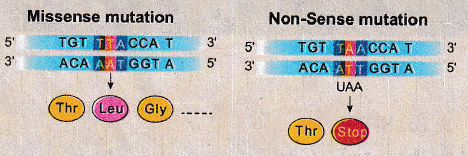
Changing the codon AGC to AGA represents _______.
missense mutation
nonsense mutation
frameshift mutation
deletion mutation
2.
3.
Select the correct statement from the ones given below with respect to dihydrid cross.
Tightly linked genes on the same chromosomes show very few combinations
Tightly linked genes on the same chromosomes show higher combinations
Genes far apart on the same chromosomes show very few recombinations
Genes loosely linked on the same chromosomes show similar recombinations as the tightly linked ones
4.
In Mendel’s experiments with garden pea, round seed shape (RR) was dominant over wrinkled seeds (rr), yellow cotyledon (YY) was dominant over green cotyledon (yy). What are the expected phenotypes in the F2 generation of the cross RRYY x rryy?
Only round seeds with green cotyledons
Only wrinkled seeds with yellow cotyledons
Only wrinkled seeds with green cotyledons
Round seeds with yellow cotyledons and wrinkled seeds with yellow cotyledons
5.
Consider the following statement(s)
i) In Protandrous flowers pistil matures earlier
ii) In Protogynous flowers pistil matures earlier
iii) Herkogamy is noticed in unisexual flowers
iv) Distyly is present in Primula
i and ii are correct
ii and iv are correct
ii and iii are correct
i and iv are correct
6.
Assertion(A) : Sporopollenin preserves pollen in fossil deposits
Reason (R): Sporopollenin is resistant to physical and biological decomposition
assertion is true; reason is false
assertion is false; reason is true
Both Assertion and reason are not true
Both Assertion and reason are true.
7.
Identify the incorrect pair
sporopollenin - exine of pollen grain
tapetum – nutritive tissue for developing microspores
Nucellus – nutritive tissue for developing embryo
obturator – directs the pollen tube into micropyle
8.
Match the following
| I) | External fertilization | i) | pollen grain |
| II) | Androecium | ii) | anther wall |
| III) | Male gametophyte | iii) | algae |
| IV) | Primary parietal layer | iv) | stamens |
| I | II | III | IV |
| iv | i | ii | iii |
| I | II | III | IV |
| iii | iv | i | ii |
| I | II | III | IV |
| iii | iv | ii | i |
| I | II | III | IV |
| iii | i | iv | ii |
9.
10.
11.
What is meant by true breeding or pure breeding lines / strain?
12.
‘Pollination in Gymnosperms is different from Angiosperms’ – Give reasons.
13.
List any two strategy adopted by bisexual flowers to prevent self-pollination.
14.
Mention the contribution of Hofmeister towards Embryology.
15.
16.
What is meant by cytoplasmic inheritance
17.
List out the functions of tapetum.
18.
A detached leaf of Bryophyllum produces new plants. How?
19.
What is gene mapping? Write its uses
20.
Write the steps involved in molecular mechanism of DNA recombination with diagram.
21.
If you cross dominant genotype PV/PV male Drosophila with double recessive female and obtain F1 hybrid. Now you cross F1 male with double recessive female.
i) What type of linkage is seen?
ii) Draw the cross with correct genotype.
iii) What is the possible genotype in F2 generation?
22.
Explain polygenic inheritance with an example.
23.
Give a detailed account on parthenocarpy. Add a note on its significance.
1.
(a)
missense mutation
2.
(c)
3.
(a)
Tightly linked genes on the same chromosomes show very few combinations
4.
(d)
Round seeds with yellow cotyledons and wrinkled seeds with yellow cotyledons
5.
(b)
ii and iv are correct
6.
(d)
Both Assertion and reason are true.
7.
(c)
Nucellus – nutritive tissue for developing embryo
8.
(b)
| I | II | III | IV |
| iii | iv | i | ii |
9.
10.
11.
A true breeding lines means it has undergone continuous self pollination having stable trait inheritance from parent to off spring.
12.
Gymnosperms - Pollination is said to be direct as the pollen are deposited directly on the exposed ovules Angiosperms - Pollination is said to be indirect as the pollen are deposited on the stigma of the pistil.
13.
Dichogamy stamens and stigmas mature at different times (protandry, Protogyny) Herkogamy - Stamens and stigmas are arranged in such a way, self pollination become impossible.
14.
Hofmeister described the structure of pollen tetrad
15.
16.
It is based on independent, self-replicating extra chromosomal unit called plasmogene located in the cytoplasmic organelles, chloroplast & Mitochondrion.
17.
Supplies nutrition to the developing microspores contributes sporopollenin through, ubisch bodies. This plays an important role in pollen wall formation. The pollen kit material is contributed by tapetal cells, and is later, transferred to the pollen surface. Exine protein responsible for rejection reaction are derived from tapetal cells.
18.
In Bryophyllum, the leaf is succulent and notched on its margin. Adventitious buds (epiphyllous buds) develop at these notches. They develop into new plants forming a root system. They become independent plants when the leaf gets decayed.
19.
The diagrammatic representation of position of genes and related distances between the adjacent genes is called gene mapping.
Uses
(i) Used to determine gene order.
(i) Identify the locus of a gene.
(i) Calculate the distance between genes.
(i) Useful in predicting results of dihybrid and trihybrid crosses.
(i) Allows the geneticists to understand the overall genetic complexity of particular organism.
20.
The widely accepted model of DNA recombination during crossing over is Holliday's hybrid DNA model.
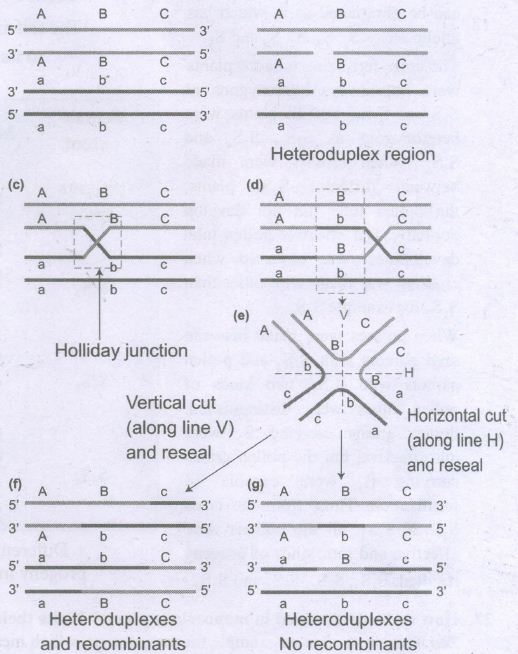
Steps involved are:
1. Homologous DNA molecules are paired side by side with their duplicated copies of DNAs
2. One strand of both DNAs cut in one place by the enzyme endonuclease.
3. The cut strands cross and join the homologous strands forming the Holliday structure or Holliday junction.
4. The Holliday junction migrates away from the original site, a process called branch migration, as a result heteroduplex region is formed.
5. DNA strands may cut along through the vertical (V) line or horizontal (H) line.
6. The vertical cut will result in heteroduplexes with recombinants.
7. The horizontal cut will result in heteroduplex with non recombinants.
21.
(i) Incomplete linkage
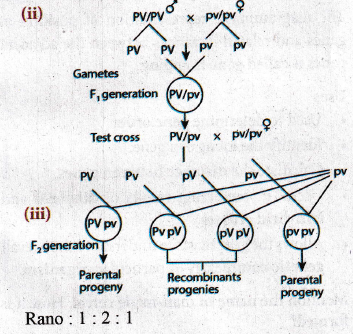
Rano : 1:2:1
22.
(i) Polygenic inheritance - Several genes combine to affect a single trait.
(ii) A group of genes that together determine (contribute) a characteristic of an organism is called polygenic inheritance. It gives explanations to the inheritance of continuous traits which are compatible with Mendel's Law.
(iii) The first experiment was demonstrated by H. Nilsson - Ehle (1909) in wheat kernels.
(iv) He crossed the two pure breeding wheat varieties dark red & white.
(v) Dark red genotypes R1R1R2R2 and
(vi) white genotypes are r1r1r2r2
(vii) In the F1 generation medium red were obtained R1r1R2r2.
(viii) F1 wheat plant produces four types of gametes R1R2, R1r2, r1R2, r1r2.
(xi) The intensity of the red colour is determined by the number of R genes in the F2 generations.
(x) Four R genes - Dark red kernel.
(xi) Three R genes - Medium dark red kernel
(xii) Two R genes - Medium red kernel
(xiii) One R gene - Light red kernel.
(xiv) Absence of R gene - White kernel.
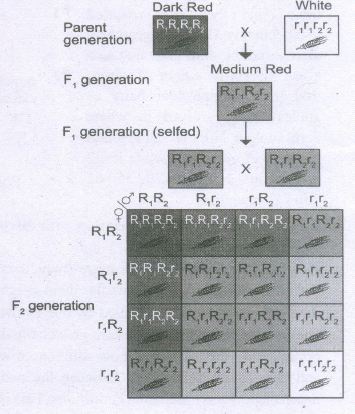
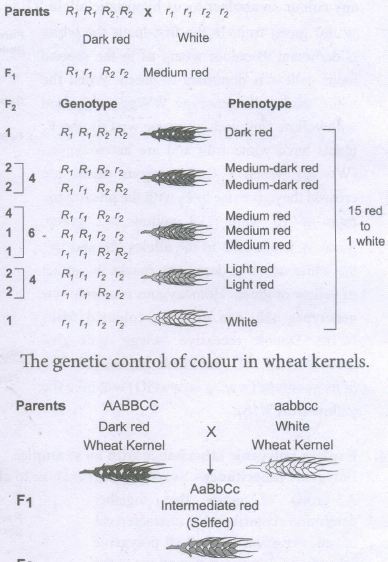
F2
| 1 | 6 | 15 | 20 | 15 | 6 | 1 |
| Dark red | Moderate red | Red | Intermediate red | light red | very light red | white |
(xv) In F2 generation plants have kernels with wide range of colour variation.
(xvi) This is due to that the genes are segregating and recombination takes place.
(xvii) The cumulative effect of several pairs of gene i interaction gives rise to many shades of kernel colour.
23.
(i) The production and development of seedless fruit is called parthenocarpy.
(ii) Fruit like structures may develop from the ovary without the act of fertilization. Such fruits are called parthenocarpic fruits
Examples: Seedless-Banana, Grapes, Papaya
(i) Parthenocarpy is of three types
1) Genetic Parthenocarpy
(i) Arises due to hybridization or mutation.
2) Environmental Parthenocarpy
Environmental conditions like frost, fog, low or high temperature induce Parthenocarpy.
Example - low temperature for 3-19 hours induces parthenocarpy in Pear.
3) Chemically induced Parthenocarpy
(i) By the application of growth promoting hormones like auxins and gibberellins.
Significance:
(i) Seedless fruits - Significance in Horticulture have commercial value useful for the preparation of jarns, jellies, sauces, fruit drinks,
(ii) High proportion of edible part is available

12th Standard Syllabus & Materials
12th Standard
TN 12th Computer Applications களப்பெயர் முறைமை (DNS) Sample Question Papers Study Material - QB365 Set A
NEW12th Standard
TN 12th Computer Applications வலையமைப்பு எடுத்துக்காட்டுகள் மற்றும் நெறிமுறைகள் Sample Question Papers Study Material - QB365 Set A
NEW12th Standard
TN 12th Computer Applications கணினி வலையமைப்பு ஓர் அறிமுகம் Sample Question Papers Study Material - QB365 Set A
NEW12th Standard
TN 12th Computer Applications PHP-உடன் MySQL-ஐ இணைத்தல் Sample Question Papers Study Material - QB365 Set A



Tamilnadu Stateboard 12th Standard Subjects

Maths

Chemistry

Physics
Biology

Computer Science

Business Maths and Statistics

Economics

Commerce

Accountancy

History

Computer Applications
Biology
Computer Technology
Computer Applications
Computer Science
Business Maths and Statistics
Commerce
Economics
Maths
Chemistry
Physics
Computer Technology
History
Accountancy

Tamil

English

French
Tamilnadu Stateboard Standards

