
 100% FREE ACCESS
12th Standard Syllabus & Materials
12th Standard
TN 12th Computer Applications மின்னணு தரவு பரிமாற்றம் Sample Question Papers Study Material - QB365 Set A
NEW12th Standard
TN 12th Computer Applications மின் - வணிக பாதுகாப்பு அமைப்புகள் Sample Question Papers Study Material - QB365 Set A
NEW12th Standard
TN 12th Computer Applications மின்னணு செலுத்தல் முறைகள் Sample Question Papers Study Material - QB365 Set A
NEW12th Standard
TN 12th Computer Applications மின் - வணிகம் Sample Question Papers Study Material - QB365 Set A
NEW12th Standard
TN 12th Computer Applications திறந்த மூல கருத்துருக்கள் Sample Question Papers Study Material - QB365 Set A
NEW12th Standard
TN 12th Computer Applications வலையமைப்பு வடமிடல் Sample Question Papers Study Material - QB365 Set A

Published on: 18/04/2020
Download Tamil Nadu 12th Standard Business Maths and Statistics question papers, model tests, one-mark questions, important questions, and public exam papers in PDF format. Free study materials and answer keys for TN State Board students.
Questions + Answers key
Take MCQ Business Maths and Statistics Test1.
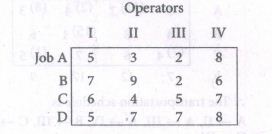
Solve the following assignment problem. Cell values represent cost of assigning job A, B, C and D to the operators I, II, III and IV.
2.
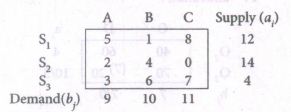
Find the initial basic feasible solution for the following transportation problem by Vogel's approximation method.
3.
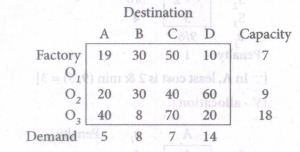
Determine how much quantity should be stepped from factory to various destinations for the following transportation problem using the least cost method.
4.
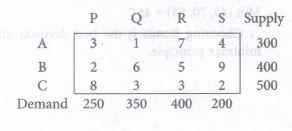
Determine an initial basic feasible solution to the following transportation problem using North West corner rule.
5.
For the given pay-off matrix, choose the best alternative for the given states of nature under
(i) Maximin (ii) Minimax princple
| Alternative | States of Nature | ||
| Good | Fair | Bad | |
| A | 100 | 60 | +50 |
| B | 80 | 50 | +10 |
| C | 40 | 20 | +5 |
6.
A person wants to invest in one of three alternative investment plans: Stock, Bonds and Debentures. It is assumed that the person wishes to invest all of the funds in a plan. The pay-off matrix based on three potential economic conditions is given in the following table:
| Alternative | Economic conditions | ||
| High growth(Rs.) | Normal growth(Rs.) | Slow growth (Rs.)s | |
| Stocks | 10000 | 7000 | 3000 |
| Bonds | 8000 | 6000 | 1000 |
| Debentures | 6000 | 6000 | 6000 |
Determine the best investment plan using each of following criteria i) Maxmin ii) Minimax.
7.
The following table summarizes the supply, demand and cost information for four factors S1, S2, S3, S4. shipping goods to three warehouses D1, D2, D3.
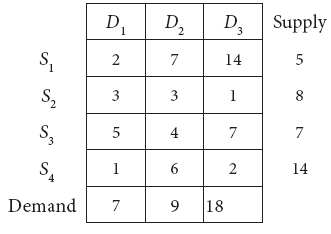
Find an initial solution by using north west corner rule. What is the total cost for this solution?
8.
Following pay-off matrix, which is the optimal decision under each of the following rule
(i) maxmin
(ii) minimax
| Act | States of nature | |||
| S1 | S2 | S3 | S4 | |
| A1 | 14 | 9 | 10 | 5 |
| A2 | 11 | 10 | 8 | 7 |
| A3 | 9 | 10 | 10 | 11 |
| A4 | 8 | 10 | 11 | 13 |
9.
10.
A farmer wants to decide which of the three crops he should plant on his 100-acre farm. The profit from each is dependent on the rainfall during the growing season. The farmer has categorized the amount of rainfall as high medium and low. His estimated profit for each is shown in the table.
| Rainfall | Estimated Conditional Profit(Rs.) | ||
| crop A | crop B | crop C | |
| High | 8000 | 3500 | 5000 |
| Medium | 4500 | 4500 | 5000 |
| Low | 2000 | 5000 | 4000 |
If the farmer wishes to plant only crop, decide which should be his best crop using
(i) Maximin
(ii) Minimax
11.
Given the following pay-off matrix(in rupees) for three strategies and two states of nature.
| Strategy | States-of-nature | |
| E1 | E2 | |
| S1 | 40 | 60 |
| S2 | 10 | -20 |
| S3 | -40 | 150 |
Select a strategy using each of the following rule
(i) Maximin
(ii) Minimax
12.
Three jobs A, B and C one to be assigned to three machines U, V and W. The processing cost for each job machine combination is shown in the matrix given below.
Determine the allocation that minimizes the overall processing cost.
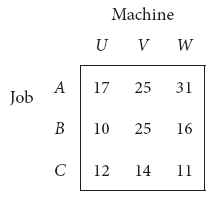
(cost is in Rs. per unit)
13.
Find the initial basic feasible solution of the following transportation problem :
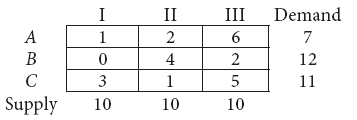
Using (i) North West Corner rule
(ii) Least Cost method
(iii) Vogel’s approximation method
14.
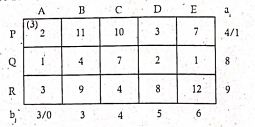
Determine basic feasible solution to the following transportation problem using North west Corner rule.
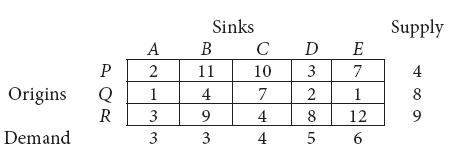
15.
Obtain an initial basic feasible solution to the following transportation problem by using least- cost method.
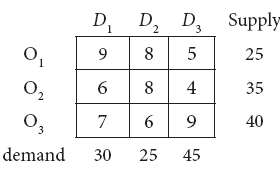
16.
Determine an initial basic feasible solution of the following transportation problem by north west corner method
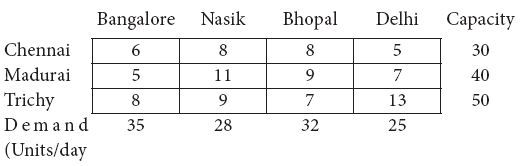
17.
Find an initial basic feasible solution of the following problem using north west corner rule.
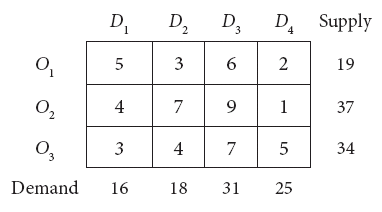
18.
Consider the following pay-off matrix
| Alternative | Pay – offs (Conditional events) | |||
| A1 | A2 | A3 | A4 | |
| E1 | 7 | 12 | 20 | 27 |
| E2 | 10 | 9 | 10 | 25 |
| E3 | 23 | 20 | 14 | 23 |
| E4 | 32 | 24 | 21 | 17 |
Using minmax principle, determine the best alternative.
19.
A business man has three alternatives open to him each of which can be followed by any of the four possible events. The conditional pay offs for each action - event combination are given below:
| Alternative | Pay – offs (Conditional events) | |||
| A | B | C | D | |
| X | 8 | 0 | -10 | 6 |
| Y | -4 | 12 | 18 | -2 |
| A3 | 14 | 6 | 0 | 8 |
Determine which alternative should the businessman choose, if he adopts the maximin principle.
20.
Consider the following pay-off (profit) matrix Action States
| Action | States | |||
| (s1) | (s2) | (s3) | (s4) | |
| A1 | 5 | 10 | 18 | 25 |
| A2 | 8 | 7 | 8 | 23 |
| A3 | 21 | 18 | 12 | 21 |
| A4 | 30 | 22 | 19 | 15 |
Determine best action using maximin principle.
21.
Solve the following assignment problem.
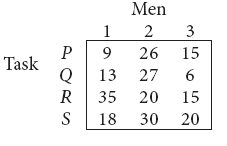
22.
Determine how much quantity should be stepped from factory to various destinations for the following transportation problem using the least cost method
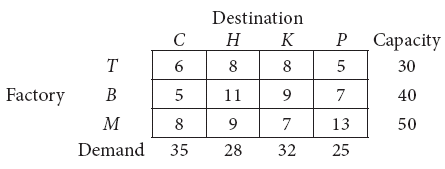
Cost are expressed in terms of rupees per unit shipped.
23.
Obtain an initial basic feasible solution to the following transportation problem using least cost method.
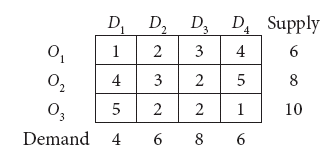
Here Oi and Dj denote ith origin and jth destination respectively.
24.
Determine an initial basic feasible solution to the following transportation problem using North West corner rule.
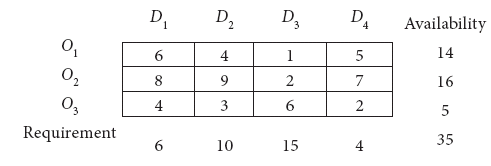
Here Oi and Dj represent ith origin and jth destination.
25.
Obtain the initial solution for the following problem
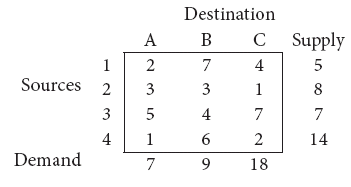
26.
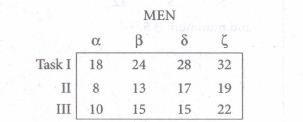
Solve the following assignment problem.
27.
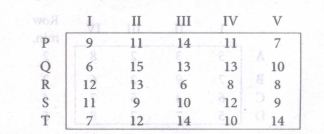
Consider the problem of assigning five jobs to five persons. The assignment costs are given as follows. Determine the optimum assignment.
28.
A natural truck-rental service has a surplus of one truck in each of the cities 1,2,3,4,5 and 6 and a deficit of one truck in each of the cities 7,8,9,10,11 and 12. The distance(in kilometers) between the cities with a surplus and the cities with a deficit are displayed below:
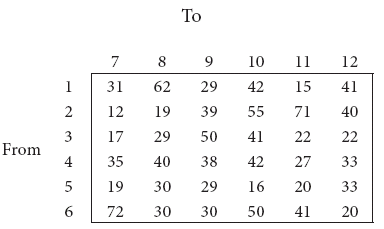
How should the truck be dispersed so as to minimize the total distance travelled?
29.
A car hire company has one car at each of five depots a,b,c,d and e. A customer in each of the fine towers A,B,C,D and E requires a car. The distance (in miles) between the depots (origins) and the towers(destinations) where the customers are given in the following distance matrix.
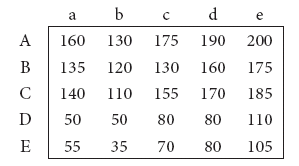
How should the cars be assigned to the customers so as to minimize the distance travelled?
30.
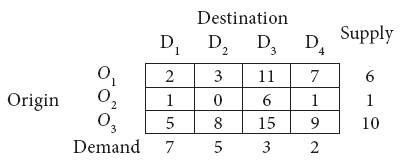
Explain Vogel’s approximation method by obtaining initial feasible solution of the following transportation problem.
31.
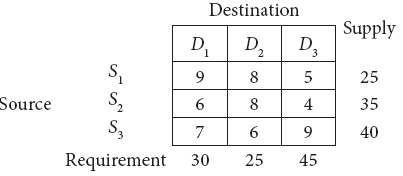
Determine an initial basic feasible solution to the following transportation problem by using North West Corner rule
32.
Consider the following transportation problem
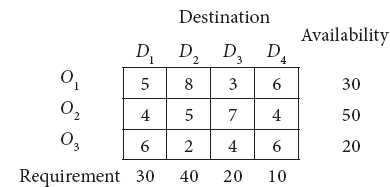
Determine an initial basic feasible solution using
(a) Least cost method
(b) Vogel’s approximation method.
33.
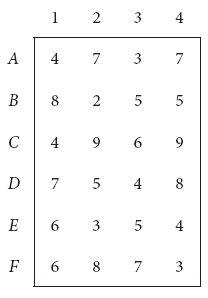
Assign four trucks 1, 2, 3 and 4 to vacant spaces A, B, C, D, E and F so that distance travelled is minimized. The matrix below shows the distance.
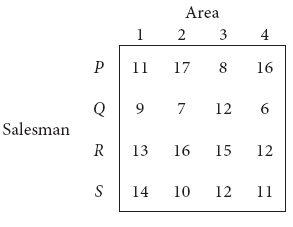
34.
Find the optimal solution for the assignment problem with the following cost matrix.
35.
A departmental head has four subordinates and four tasks to be performed. The subordinates differ in efficiency and the tasks differ in their intrinsic difficulty. His estimates of the time each man would take to perform each task is given below :
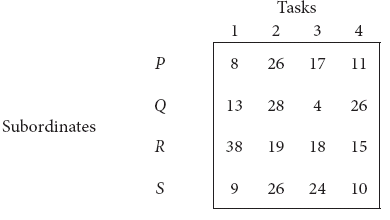
How should the tasks be allocated to subordinates so as to minimize the total man-hours?
36.
A computer centre has got three expert programmers. The centre needs three application programmes to be developed. The head of the computer centre, after studying carefully the programmes to be developed, estimates the computer time in minitues required by the experts to the application programme as follows.
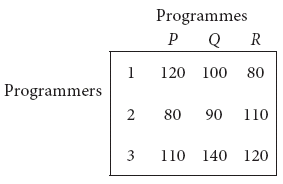
Assign the programmers to the programme in such a way that the total computer time is least.
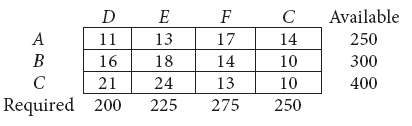
37.
Obtain an initial basic feasible solution to the following transportation problem by north west corner method.
38.
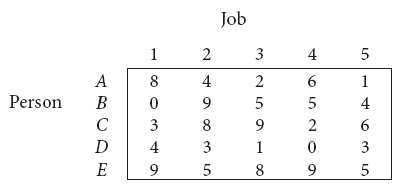
Consider the problem of assigning five jobs to five persons. The assignment costs are given as follows. Determine the optimum assignment schedule.
39.
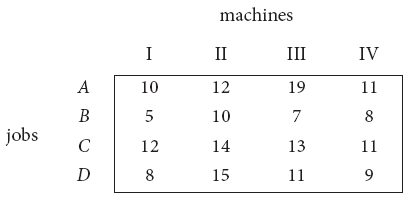
Solve the following assignment problem. Cell values represent cost of assigning job A, B, C and D to the machines I, II, III and IV.
40.
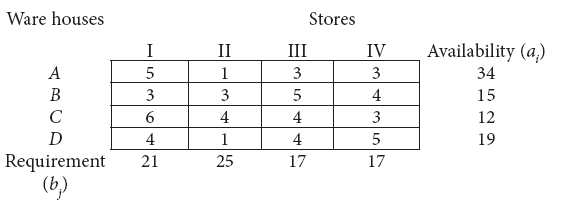
Obtain an initial basic feasible solution to the following transportation problem using Vogel’s approximation method.
41.
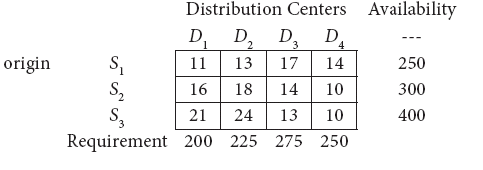
Find the initial basic feasible solution for the following transportation problem by VAM
42.
Consider the following pay-off (profit) matrix action, states
| Action | States | |
| B1 | B2 | |
| A1 | 8 | 6 |
| A2 | 9 | 2 |
| A3 | 6 | 4 |
Determine the best action using maximin principle.
43.
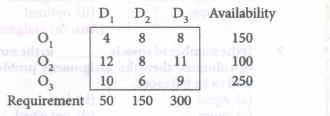
Determine an initial basic feasible solution to the following transportation problem using feast cost method.
44.
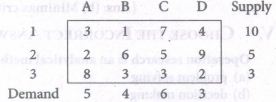
Obtain the initial solution for the following problem using north-west corner rule.
45.
What is the difference between Assignment Problem and Transportation Problem?
46.
47.
What is the Assignment problem?
48.
What do you mean by balanced transportation problem?
49.
What is feasible solution and non degenerate solution in transportation problem?
50.
Write mathematical form of transportation problem.
51.
What is transportation problem?
1.
Here the number of rows and columns are equal.
∴ The given assignment problem is balanced.
Step 1 :
Select a minimum element in each row and subtract this from all the elements in its row.
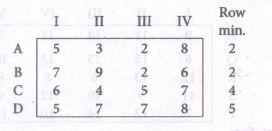
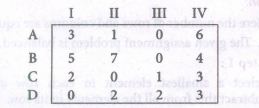
Here IV column has no zero. Go to step 2.
Step 2:
Select the minimum element in each column and subtract this from all the elements in its column.
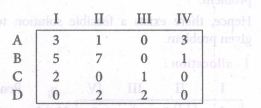
Since each row and column contains atleast one zero, assignments can be made.
Step 3:
Examine the rows with only one zero. Mark that. zero by and draw a vertical line.
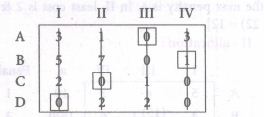
Thus, all the assignments have been made.
The optimal assignment schedule and total cost is
| Job | Operator | Cost |
|---|---|---|
| A | III | 2 |
| B | IV | 6 |
| C | II | 4 |
| D | I | 5 |
| Total Cost | Rs. 17 | |
2.
Σai = 12 + 14 + 4 = 30
Σbj = 9 + 10 + 11 = 30
Σai = Σbj
∴ The given problem is a balanced transportation problem.
Hence, there exists a feasible solution to the given problem.
I - allocation :
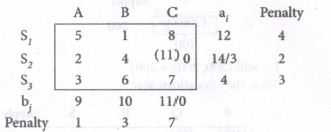
[∵ the highest penalty is 7, In C, least cost is 0 & min (11, 14) = 11]
II - allocation :
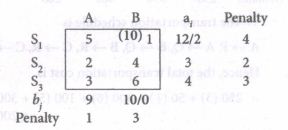
[∵ the highest penalty is 4, In S1'least cost is 1& min (10, 12) = 10]
III - allocation :
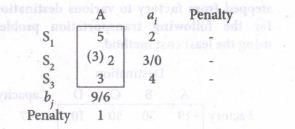
[∵ In A, least cost is 2 & min (9, 3) = 3]
IV - allocation :
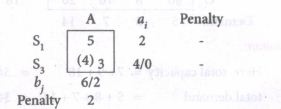
[∵ In A, least cost is 3 & min (6,4) = 4]
V - allocation :
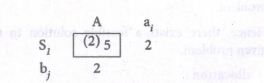
[∵ min (2, 2) = 2]
Thus, the allocations are
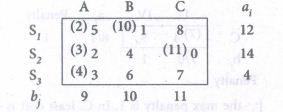
∴ The transportation schedule is
S1 → A, S1 → B, S2 → A, S2 → C S3 → A
Hence, the total transportation cost is
= 2(5) + 10(1) + 3(2) + 11(0) + 4(3)
= 10 + 10 + 6 + 0 + 12 = Rs. 38
3.
Here, total capacity = 7+ 9 + 18 = 34
total demand = 5 + 8 + 7 + 14 = 34
Total capacity = Total demand
∴ The given problem is a balanced transportation problem.
Hence, there exists a feasible solution to the given problem,
I - allocation:
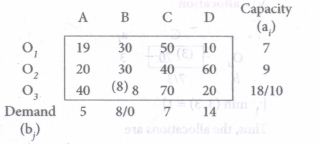
[∵ The least cost is 8 & min (8, 18) = 8]
II - allocation:
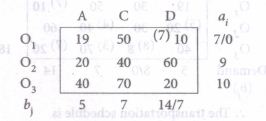
[∵ The least cost is 7 & min (7,14) = 7]
III - allocation:
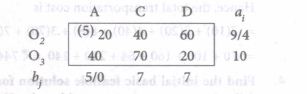
[∵ The least cost is 20 & min (5, 9) = 5]
IV - allocation:
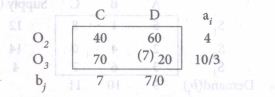
[∵ The least cost is 40 & min (4, 7) = 4]
VI - allocation:
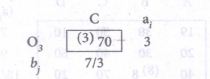
[∵ min (3, 3) = 1]
Thus, the allocations are
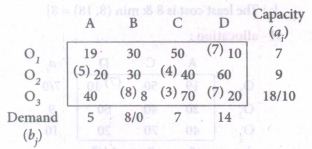
∴ The transportation schedule is
O1 → D1, O2 → A1, O2 → C1, O3 → B1 , O3 → C1, O3 → D1,
Hence, the total transportation cost is
= 7(10) + 5(20) + 4(40) + 8(8) + 3(70) + 7(20)
= 70+ 100+ 160+64+210+ 140 = Rs. 744
4.
Here total supply = 300 + 400 + 500 = 1200
Total demand = 250 + 350 + 400 + 200 =1200
∴ Total supply = total demand
The given problem is a balanced transportation problem.
Hence, there exists a feasible solution to the given problem
I-allocation:
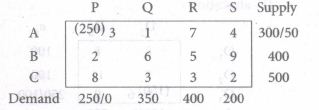
[∵ Min (250, 300) = 250]
II-allocation:
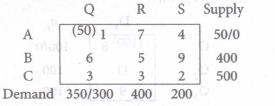
[∵ Min (50,350) = 50]
III-allocation:
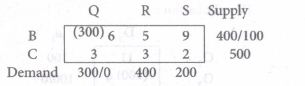
[∵ Min (300,400) = 300]
IV-allocation:
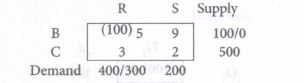
[∵ Min (400,100) = 100]
V-allocation:
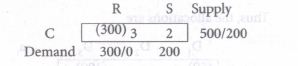
[∵ Min (300, 500) = 300]
VI-allocation:
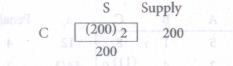
[∵ Min (200, 200) = 200]
Thus, the allocations are
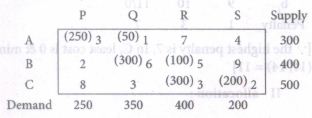
∴ The transportation schedule is
A → P, A → Q, B → Q, B → R, C → R, C → S
Hence, the total transportation cost is
= 250 (3) + 50 (1) + 300 (6) + 100 (5) + 300 (3) + 200 (2)
= 750 + 50 + 1800 + 500 + 900 + 400
= Rs. 4400
5.
| Alternative | States of Nature | Minimum | Maximum | ||
| Good | Fair | Bad | |||
| A | 100 | 60 | +50 | +50 | 100 |
| B | 80 | 50 | +10 | 10 | 80 |
| C | 40 | 20 | +5 | 5 | 40 |
(i) Max (50, 10, 5) = 50
∴ A is the best alternative under maximin principle
(ii) Min (100, 80,40) = 40
∴ C is the best alternative under minimax principle
6.
| Economic Conditions | |||||
| Alternative | High growth | Normal growth | Slow growth | Minimum payoff | Maximum payoff |
| Stocks | 10000 | 7000 | 3000 | 3000 | 10000 |
| Bonds | 8000 | 6000 | 1000 | 1000 | 8000 |
| Debentures | 6000 | 6000 | 6000 | 6000 | 6000 |
(i) Max (3000, 1000, 6000) = 6000
∴ Debentures is the best using maximin principle
(ii) Max (10000, 8000, 6000) = 6000
∴ Debentures is the best using minimax principle.
7.
West Corner Method :
Here total supply = 5 + 8 + 7 + 14 = 34
total demand = 7 + 9 + 18 = 34
total supply = total demand
∴ The given problem is a balanced transportation problem.
Hence, there exists a feasible solution to the given problem.
I - allocation:
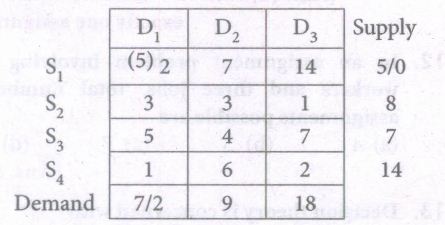
[∵ min (5, 7) = 5]
II - allocation:
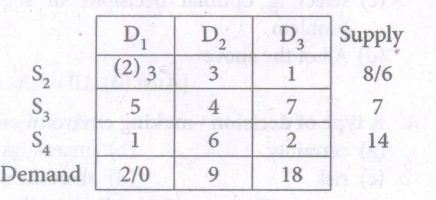
[∵ min (2, 8) = 2]
III - allocation:
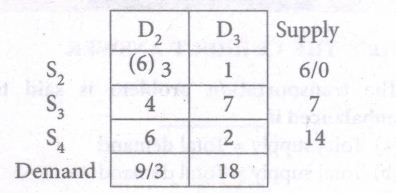
[∵ min (9, 6) = 6]
IV - allocation:
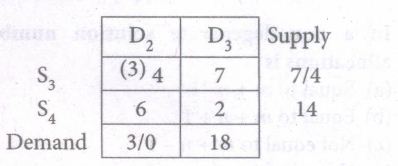
[∵ min (3, 7) = 3]
V - allocation:
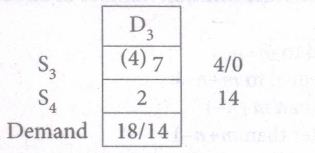
[∵ min (18, 4) = 4]
VI - allocation:
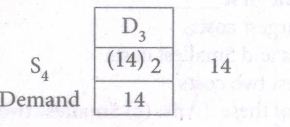
[∵ min (14, 14) = 14]
Thus, the allocation are
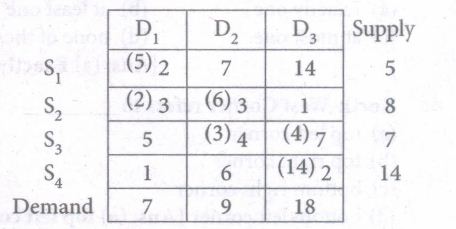
∴ The transportation schedule is
S1 → D1, S2 → D1, S2 → D2, S3 → D2, S3 → D3, S4 → D4
Hence total transportation cost
= 5 (2) + 2 (3) + 6 (3) + 3 (4) + 4 (7) + 14 (2)
= 10 + 6 + 18 + 12 + 28 + 28 = Rs. 102
8.
| Act | States of Nature | Minimum payoff | Maximum payoff | |||
| Rainfall | S1 | S2 | S3 | S4 | ||
| A1 | 14 | 9 | 10 | 5 | 5 | 14 |
| A2 | 11 | 10 | 8 | 7 | 7 | 11 |
| A3 | 9 | 10 | 10 | 11 | 9 | 11 |
| A4 | 8 | 10 | 11 | 13 | 8 | 13 |
(i) Max (5, 7, 9, 8) = 9
∴ A3 is the optimal decision according to maximin principle
(ii) Min (14, 11, 11, 13) = 11
∴ A2 and A3 are optimal decisions according to minimax principle
9.
10.
| Estimated Conditional Profit 0 | |||||
| Rainfall | High | Medium | Low | Minimum payoff | Maximum payoff |
| Crop A | 8000 | 4500 | 2000 | 2000 | 8000 |
| Crop B | 3500 | 4500 | 5000 | 3500 | 5000 |
| Crop C | 5000 | 5000 | 4000 | 4000 | 5000 |
(i) Max (2000,3500,4000) = 4000
∴ Crop C is the best according to maximin criteria
(ii) Min (8000,5000,5000) = 5000
∴ Crop B and C are best according to minimax criteria
11.
| Strategy | States-of-nature | Minimum payoff | Maximum payoff | |
| E1 | E2 | |||
| S1 | 40 | 60 | 40 | 60 |
| S2 | 10 | -20 | -20 | 10 |
| S3 | -40 | 150 | -40 | 150 |
(i) Max (40,-20,-40) = 40
∴ Strategy S1 is the best accordirtg to maximum criteria
(ii) Min (60,10,150) = 10
∴ Strategy S2 is the best accordirtg to minimax principle.
12.
Here number of rows and columns are equal
∴ The given assignment problem is balanced.
Step 1 : Select a minimum element in each row and subtract this from all the elements in its row.
| A | 0 | 8 | 14 | 17 |
| B | 0 | 15 | 6 | 10 |
| C | 1 | 3 | 0 | 11 |
Here column V has no zero. Go to Step 2.
Step 2 : Select the minimum element in each column and subtract this from all the elements in its column.
| U | V | W | |
| A | 0 | 5 | 14 |
| B | 0 | 12 | 6 |
| C | 1 | 0 | 0 |
| Column minimum |
3 | ||
New, each row and column contains atleast one zero. Hence, assignments can be made.
Step 3 : Examine the rows with exactly one zero. Mark it by Ԡ and draw a vertical line.
After examining the row, examine the column with one zero mark it by Ԡ and draw a horizontal line.
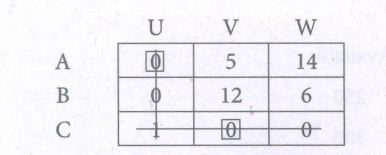
New the elements not lying on the line are
| 5 | 14 |
| 12 | 6 |
and min is 5 subtract 5 from all these number and add 5 to 1which lies in the intersecting lines. Other numbers remains the same.
A new cost matrix will be formed and repeat step 3.
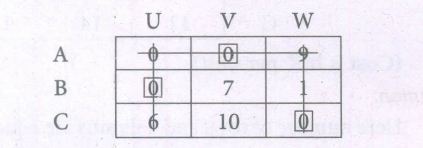
Thus, all the 3 assignments have been made.
∴The optimal assignment schedule and total cost is
| Job | Machine | Cost |
| A | V | 25 |
| B | U | 10 |
| C | W | 11 |
Total cost = Rs. 46
13.
i) The total transportation cost is
x11 = 7, x21 = 3, x22 = 9, x32 = 1, x33 = 10
= (7 \(\times\)1) + (3\(\times\)0) + (9\(\times\)4) + (1\(\times\)1) + (10\(\times\)5)
Total Cost = 94
ii) Total Transportation cost
x11 = 7, x21 = 10, x23 = 2, x32 = 10, x33 = 1
\( =(7 \times 6)+(10 \times 0)+(2 \times 2)+(10 \times 1)+(1 \times 5) \)
= 42 + 0 + 4 + 10 + 5
Total Cost = 61
iii) Total transportation cost
x11 = 7, x21 = 2, x23 = 10, x31 = 1, x32 = 10
\( =7 \times 1+2 \times 0+10 \times 2+1 \times 3+10 \times 1 \)
= 7 + 20 + 3 + 10
Total Cost = 40
14.
First allocation :
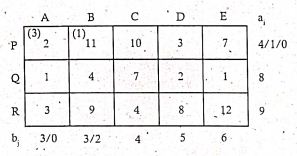
Second allocation :
Third allocation :
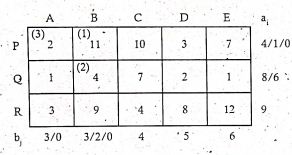
Fourth allocation :
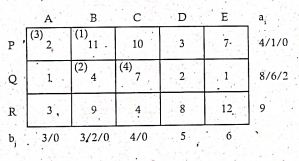
Fifth allocation :
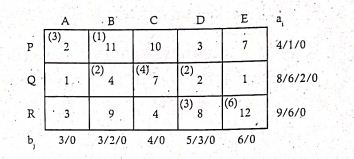
Sixth allocation :
\( =(3 \times 2)+(1 \times 11)+(2 \times 4)+(4 \times 7)+ (2 \times 2)+(3 \times 8)+(6 \times 12) \)
= 6 + 11 + 8 + 28 + 4 + 24 + 72 = Rs. 153
Total Cost = 153
15.
First allocation:
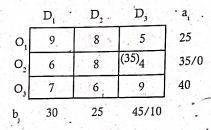
Second allocation:
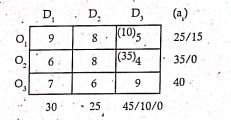
Third allocation:
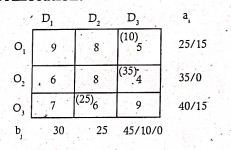
Fourth allocation:
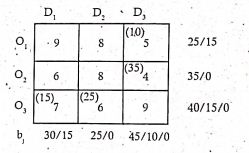
Final allocation:
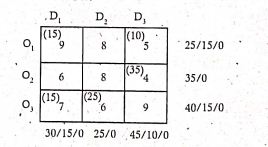
The total transportation cost is
\( =(15 \times 9)+(10 \times 5)+(35 \times 4) +(15 \times 7)+(25 \times 6) \)
= 135 + 50 + 140 + 105 + 150 = Rs. 580
16.
First allocation:
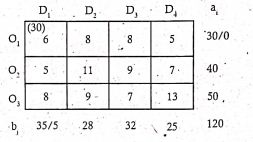
Second allocation:
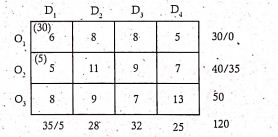
Third allocation:
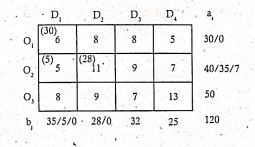
Fourth allocation:
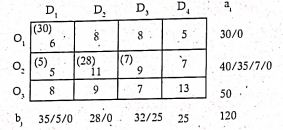
Fifth allocation:
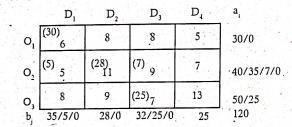
Final allocation:
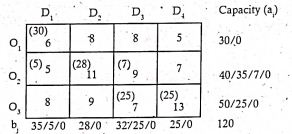
The transportation cost is
\( = (30 \times 6)+(5 \times 5)+(28 \times 11)+ (7 \times 9)+(25 \times 7)+(25 \times 13) \)
= 180 + 25 + 308 + 63 + 175 + 325
= Rs. 1076
17.
First allocation:
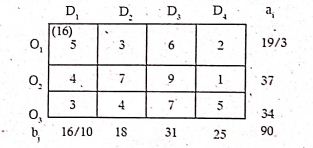
Second allocation:
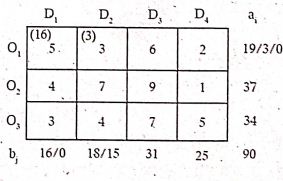
Third allocation:
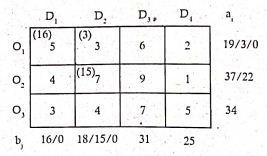
Fourth allocation:
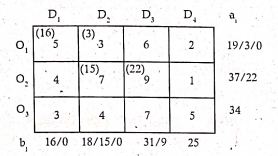
Fifth allocation:
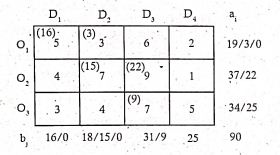
Final allocation:
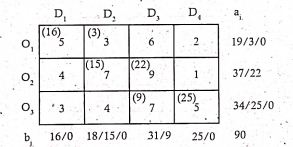
The trasportation cost:
\( =(16 \times 5)+(3 \times 3)+(15 \times 7)+(22 \times 9) +(9 \times 7)+(25 \times 5) \)
\(=80+9+105+198+63+125=Rs. 580\)
18.
| Alternative | Pay – offs (Conditional events) | Minimum pay off | |||
| A1 | A2 | A3 | A4 | ||
| E1 | 7 | 12 | 20 | 27 | 27 |
| E2 | 10 | 9 | 10 | 25 | 25 |
| E3 | 23 | 20 | 14 | 23 | 23 |
| E4 | 32 | 24 | 21 | 17 | 32 |
min( 27, 25, 23, 32) = 23. Since the minimum cost is 23, the best alternative is E3 according to minimax principle.
19.
| Alternative | Pay – offs (Conditional events) | Minimum Pay off | |||
| A | B | C | D | ||
| X | 8 | 0 | -10 | 6 | -10 |
| Y | -4 | 12 | 18 | -2 | -4 |
| A3 | 14 | 6 | 0 | 8 | 0 |
Max (–10,–4, 0) = 0. Since the maximum payoff is 0, the alternative Z is selected by the businessman
20.
| Action | States | Minimum | |||
| (s1) | (s2) | (s3) | (s4) | ||
| A1 | 5 | 10 | 18 | 25 | 5 |
| A2 | 8 | 7 | 8 | 23 | 7 |
| A3 | 21 | 18 | 12 | 21 | 12 |
| A4 | 30 | 22 | 19 | 15 | 15 |
Max (5,7,12,15) = 15 ஃ Action A4 is the best
21.
Since the number of columns is less than the number of rows, given assignment problem is unbalanced one. To balance it , introduce a dummy column with all the entries zero. The revised assignment problem is
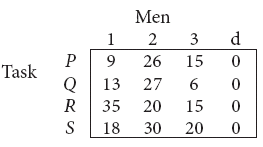
Here only 3 tasks can be assigned to 3 men.
Step 1: Its not necessary, since each row contains zero entry. Go to Step 2.
Step 2:
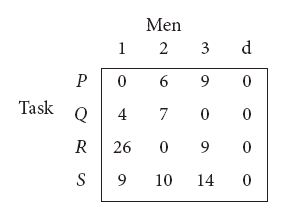
Step 3 (Assignment) :
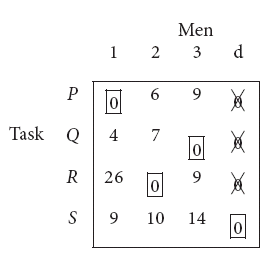
Since each row and each columncontains exactly one assignment,all the three men have been assigned a task. But task S is not assigned to any Man. The optimal assignment schedule and total cost is
| Task | Men | cost |
| P | 1 | 9 |
| Q | 3 | 6 |
| R | 2 | 20 |
| s | d | 0 |
| Total cost | 35 | |
The optimal assignment (minimum) cost = Rs. 35
22.
Total Capacity = Total Demand
\(\therefore\) The given problem is balanced transportation problem.
Hence there exists a feasible solution to the given problem.
Given Transportation Problem is
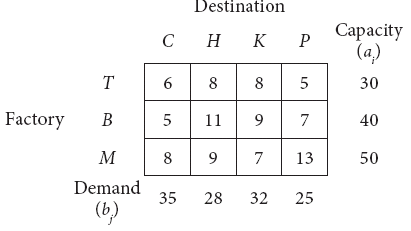
First Allocation:
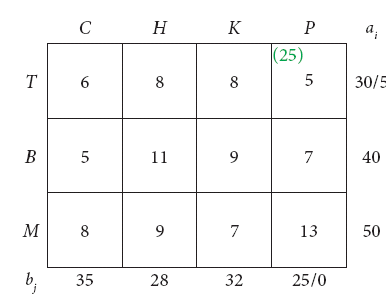
Second Allocation:
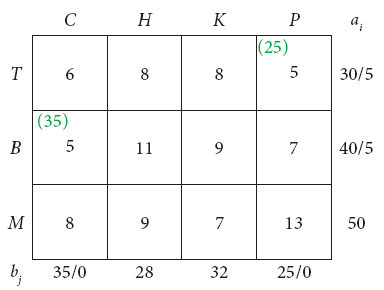
Third Allocation:
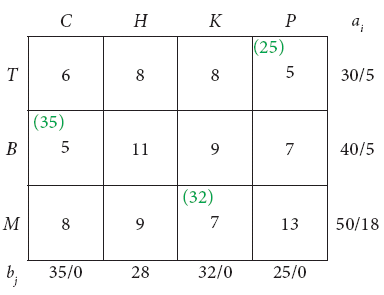
Fourth Allocation:
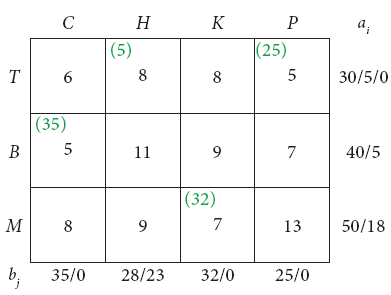
Fifth Allocation:
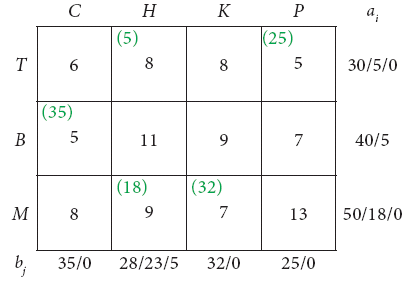
Sixth Allocation:
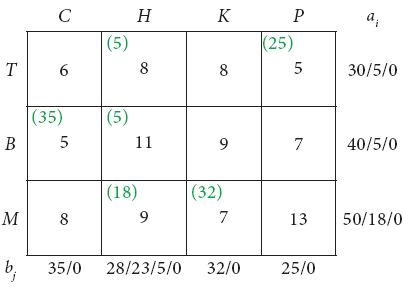
Transportation schedule :
T⟶H,T⟶P,B⟶C,B⟶H,M⟶H,M⟶K
The total Transportation cost = ( 5×8) + (25×5)+ (35×5) + (5×11)+ (18×9) + (32×7)
= 40+125+175+55+162+224
= Rs.781
23.
Total Supply = Total Demand = 24
\(\therefore\)The given problem is a balanced transportation problem.
Hence there exists a feasible solution to the given problem.
Given Transportation Problem is:
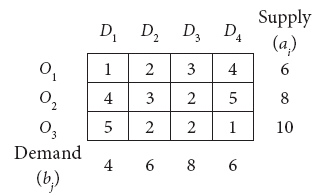
The least cost is 1 corresponds to the cells (O1, D1) and (O3, D4)
Take the Cell (O1, D1) arbitrarily.
Allocatemin (6,4) = 4 units to this cell.
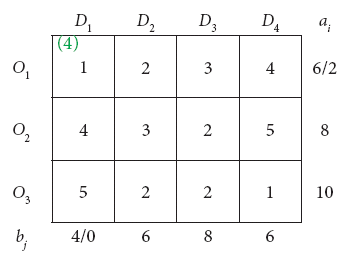
The reduced table is
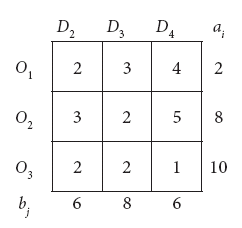
The least cost corresponds to the cell (O3, D4). Allocate min (10,6) = 6 units to this cell.
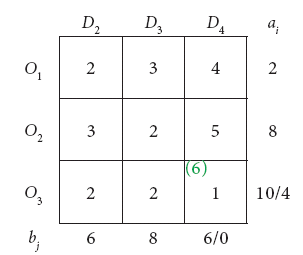
The reduced table is
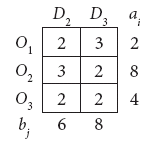
The least costis 2 corresponds to the cells (O1, D2), (O2, D3), (O3, D2), (O3, D3)
Allocate min (2,6) = 2 units to this cell.
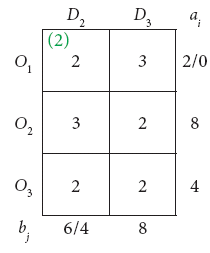
The reduced table is
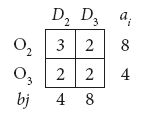
The least cost is 2 corresponds to the cells (O2, D3), (O3, D2), (O3, D3)
Allocate min ( 8,8) = 8 units to this cell.
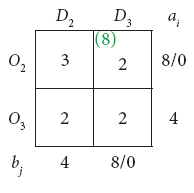
The reduced table is
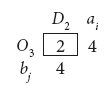
Here allocate 4 units in the cell (O3, D2)
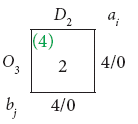
Thus we have the following allocations:
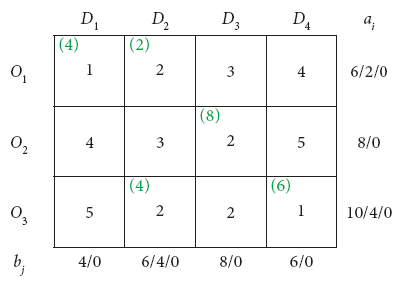
Transportation schedule :
O1⟶D1, O1⟶D2,O2⟶D3,O3⟶D2,O3⟶D4
Total transportation cost
= (4×1)+ (2×2)+(8×2)+(4×2)+(6×1)
= 4+4+16+8+6
= Rs. 38.
24.
Given transportation table is
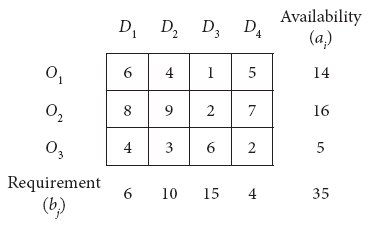
Total Availability = Total Requirement
Therefore the given problem is balanced transportation problem.
Hence there exists a feasible solution to the given problem.
First allocation :
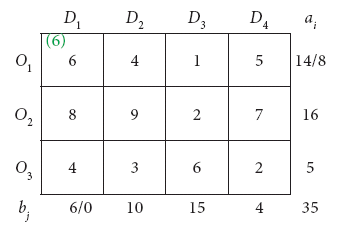
Second allocation :
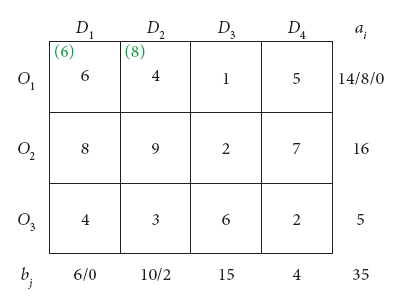
Third Allocation :
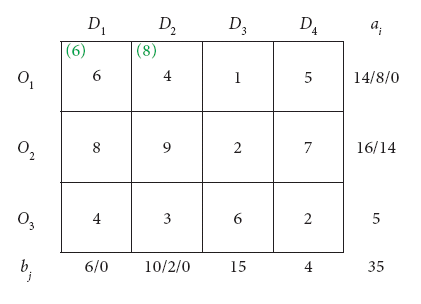
Fourth Allocation :
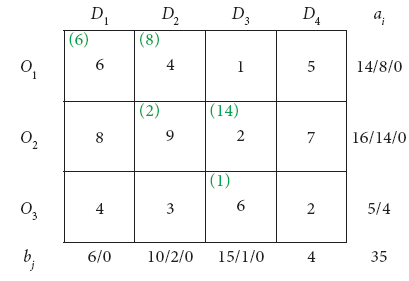
Fifth allocation :
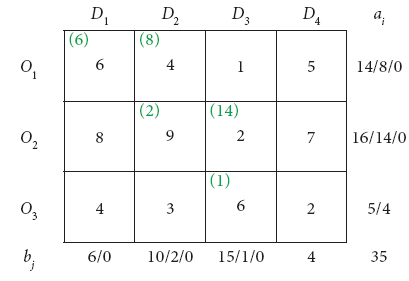
Final allocation :
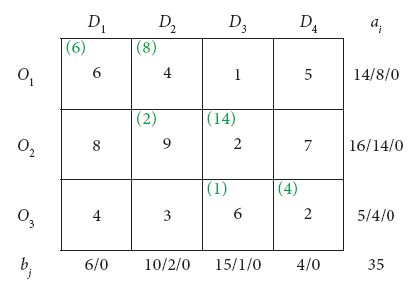
Transportation schedule : O1⟶D1, O1⟶D2, O2⟶D2, O2⟶D3, O3⟶D3,O3⟶D3.
The transportation cost
= (6\(\times\)6)+(8\(\times\)4)+(2\(\times\)9)+(14\(\times\)2)+(1\(\times\)6)+(4\(\times\)2)
= Rs.128
25.
Here total supply = 5 + 8 + 7 + 14 = 34, Total demand = 7 + 9 + 18 = 34
(i.e) Total supply =Total demand
Therefore The given problem is balanced transportation problem.
\(\therefore\) we can findan initial basic feasible solution to the given problem.
From the above table we can choose the cell in the North West Corner. Here the cell is (1, A)
Allocate as much as possible in this cell so that either the capacity of first row is exhausted or the destination requirement of the first column is exhausted.
i.e. x11 = min (5, 7) = 5
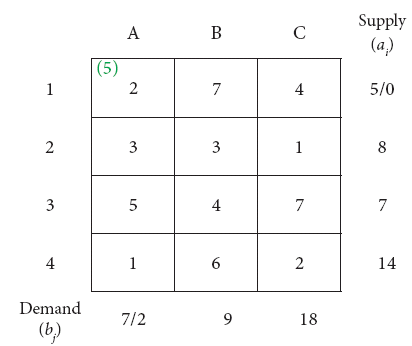
Reduced transportation table is
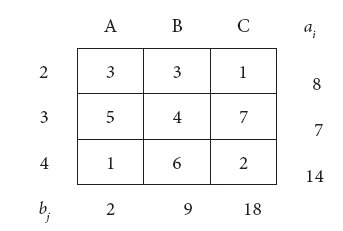
Now the cell in the North west corner is (2, A)
Allocate as much as possible in the first cell so that either the capacity of second row is exhausted or the destination requirement of the first column is exhausted.
i.e. x12 = min (2, 8) = 2
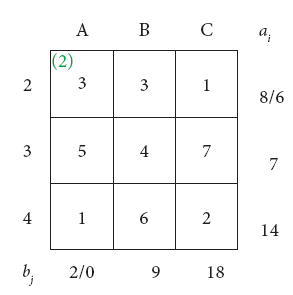
Reduced transportation table is
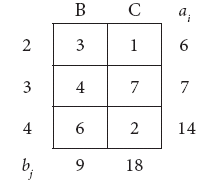
Here north west corner cell is (2, B) Allocate as much as possible in the first cell so that either the capacity of second row is exhausted or the destination requirement of the second column is exhausted.
i.e. x22 = min (6, 9) = 6
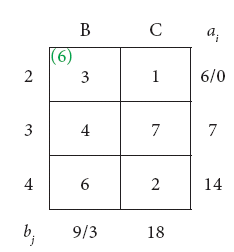
Reduced transportation table is
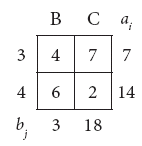
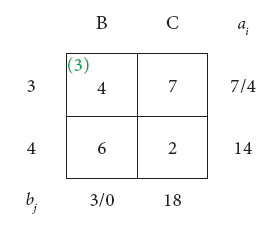
Here north west corner cell is (3,B).
Allocate as much as possible in the first cell so that either the capacity of third row is exhausted or the destination requirement of the second column is exhausted.
i.e. x32 = min (7, 3) = 3
Reduced transportation table is
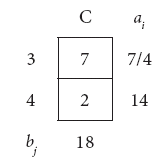
Here north west corner cell is (3,C) Allocate as much as possible in the first cell so that either the capacity of third row is exhausted or the destination requirement of the third column is exhausted.
i.e. x33 = min (4, 18) = 4
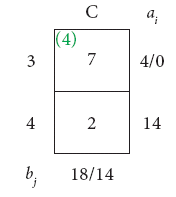
Reduced transportation table and final allocation is x44 = 14
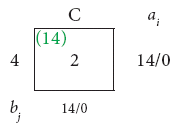
Thus we have the following allocations
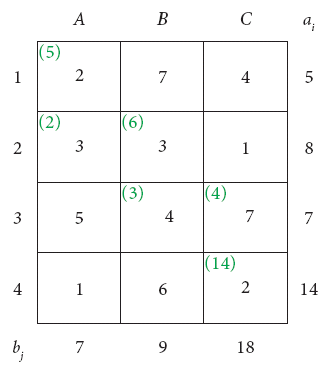
Transportation schedule : 1⟶A, 2⟶B, 3⟶B, 3⟶C, 4⟶C
The total transportation cost.
= (5 \(\times\) 2) + (2 x\(\times\) 3) + (6 \(\times\) 3) + (3 \(\times\) 4) + (4 \(\times\) 7) + (14 \(\times\) 2)
= Rs. 102
26.
Since the number of rows is less then the number of columns, given assignment problem is unbalanced one.
To balance it, introduce a dummy row with all the entries zero.
The revised assignment problem is
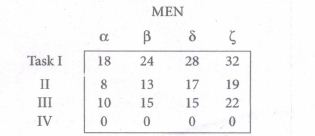
Here only 3 tasks can be assigned to 3 men.
Step 1 :
Select the smallest element in each row and subtract it will all the elements in its row.
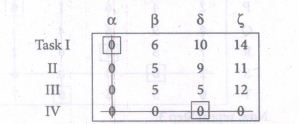
Here each row and column has atleast one zero.
Step 2:
Examine the row with only one zero, mark that zero by \(\Box\) and draw a vertical line.
After examining all the rows, examine the column with single zero, mark that zero by \(\Box\) and draw a horizontal line.
Step 3:
Only two assignment have been made.
The elements not lying on the line are
\(\begin{matrix} 6 & 10 & 14 \\ 5 & 9 & 11 \\ 5 & 5 & 12 \end{matrix}\)
and minimum is 5.
Subtract 5 from all these numbers. Other numbers remains the same.
A new cost matrix will be found .and repeat step 2.
∴ The new cost matrix is
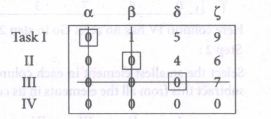
Thus, 3 assignments have been made.
The optical assignment schedule and total cost is
| Task | MEN | Cost |
| I | α | 18 |
| II | β | 13 |
| III | δ | 15 |
| Total Cost | Rs. 46 | |
27.
Here the number of rows and columns are equal.
∴ The given assignment problem is balanced.
Step 1 :
Select a smallest element in each row and subtract this from all the elements in its row.
∴ The cost matrix of the given assignment problem is
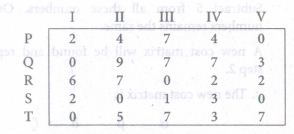
Here column IV has no zero. Go to step 2.
Step 2:
Select the smallest element in each column and subtract this from all the elements in its column.
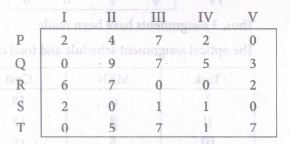
Since each row and column contains atleast one zero, assignments can be made.
Step 3:
Examine the row with exactly one zero. Mark the zero by \(\Box \) and draw a vertical line. After examining all the rows examine the column with one zero. mark the zero by \(\Box\) and draw a horizontal line.
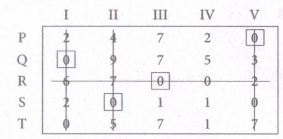
Here only 4 assignments have been made.
The numbers not lying on the line are
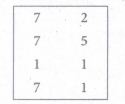
and min. of these numbers is 1.
Now subtract 1 from all these numbers and add 1 to the numbers on the intersecting line (ie. 6, 7, 2). Other numbers remains the same.
∴ The new cost matrix is
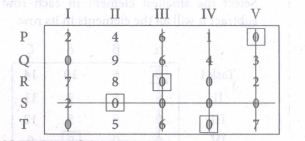
Now, repeat Step 3.
Thus, all the 5 assignments have been made.
The optimal assignment schedule and total cost is
| Person | Job | Cost |
| P | V | 7 |
| Q | I | 6 |
| R | III | 6 |
| S | II | 9 |
| T | IV | 10 |
| Total Cost | Rs. 38 | |
28.
Here the number of rows and columns are equal.
∴ The given assignment problem is balanced.
Step 1: Select a minimum element in each row and subtract this from all the elements in its row.
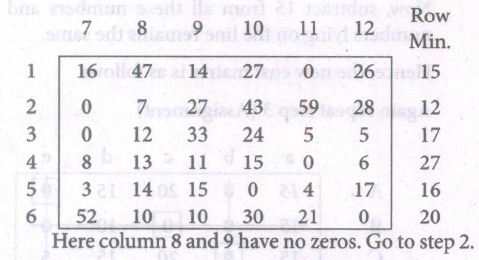
Step 2: Select the minimum element in each column and subtract this from all the elements in its column
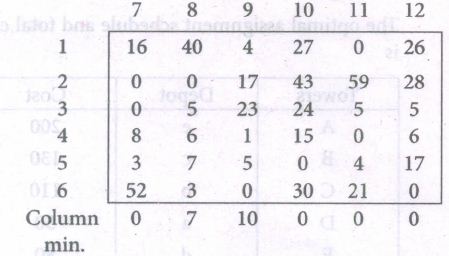
Since each row and column contains atleast one zero, assignments can be made.
Step 3: (Assignment)
Examine the rows with exactly one zero. Mark the zero by and draw a vertical line.
After examining the rows, examine the columns with exactly one zero. Mark the zero by and draw a horizontal line.
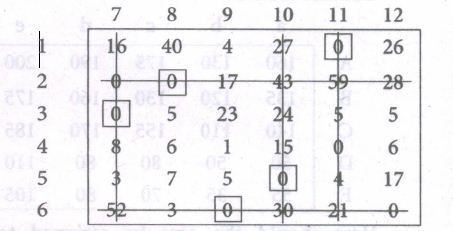
Only 4 assignments are made
Number not lying on the line are
| 40 | 4 | 26 |
| 5 | 23 | 5 |
| 6 | 1 | 6 |
| 7 | 5 | 17 |
and minimum of these numbers are 1.
This number 1 should be subtracted from the above number and 1 should be added to the numbers which are on the intersecting lines (ie. 52,43,59,30,21)and the other numbers remains the same.
A new cost matrix is as follows and repeat step 3.
New cost matrix is
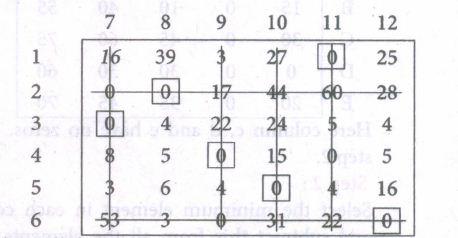
Thus, all the six assignments have been made.
∴ The optimal assignment schedule and total cost is
| Cities From | Cities To | Cost |
| 1 | 11 | 15 |
| 2 | 8 | 19 |
| 3 | 7 | 17 |
| 4 | 9 | 38 |
| 5 | 10 | 16 |
| 6 | 12 | 20 |
| Total Cost | Rs. 125 | |
29.
Here the number of rows and columns are equal.
∴ The given assignment problem is balanced.
Step 1: Select a minimum element in each row and subtract this from all the elements in its row.
∴ The cost matrix of the given assignment problem is
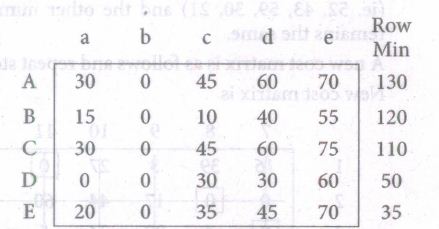
Here column c, d and e have no zeros. Go to step 2.
Step 2 : Select the minimum element in each column and subtract this from all the elements in its column.
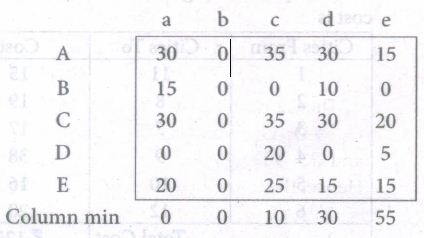
Since each row and column contains exactly atleast one zero, assignments can be made.
Step 3: (Assignment)
Examine the rows with exactly one zero. Mark that zero by and draw a vertical line.
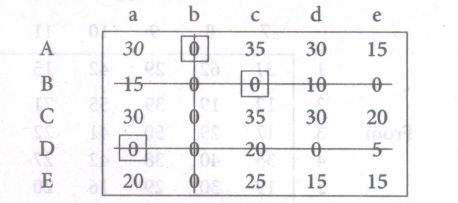
Also examine the columns with exactly one zero. Mark that zero by and draw a horizontal line.
Here, numbers not lying on the line are and minimum of these number is 15.
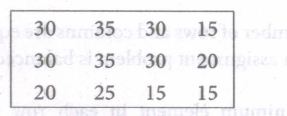
Now, subtract 15 from all these numbers and numbers lying on the line remains the same.
Hence, the new cost matrix is as follows.
Again repeat step 3 (Assignment)
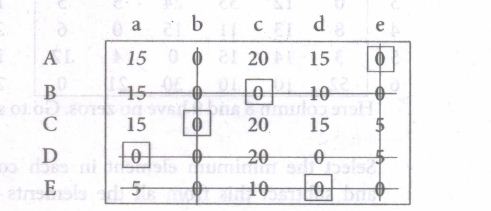
Thus, all the 5 assignments have been made.
The optimal assignment schedule and total cost is
| Towers | Depot | Cost |
|---|---|---|
| A | e | 200 |
| B | c | 130 |
| C | b | 110 |
| D | a | 50 |
| E | d | 80 |
| Total Cost | Rs. 570 | |
30.
Here total supply = 6 + 1 + 10 = 7
total demand = 7 + 5 + 3 + 2 = 17
total supply = total demand
∴ The given problem is a balanced transportation problem.
Hence, there exists a feasible solution for the given transportation problem.
NWC:
I. allocation:
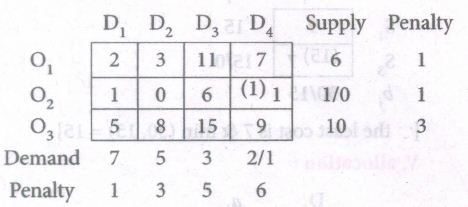
[∵ highest penalty = 6. 1 & min (1, 2) = 1]
II. allocation:
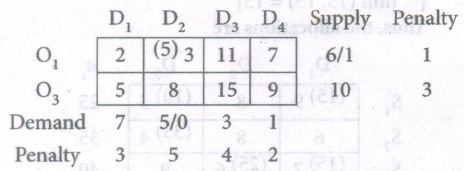
[∵ highestpenalty= 5. In D2, leastcost= 3&min (5,6) = 5]
III. allocation:
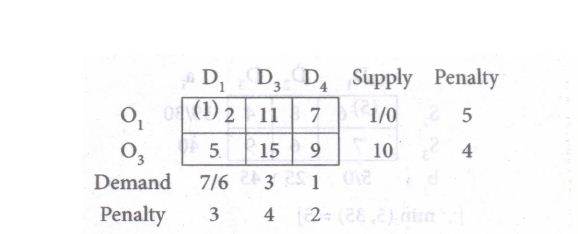
[∵ highest penalty = 5. In O1, & least cost = 2 &min (7, 1) = 1]
IV. allocation:
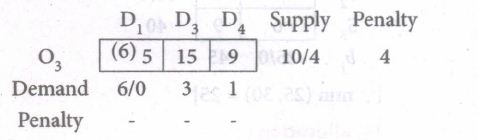
[∵ highest penalty = 4. In O3, least cost is 5 &min (6, 10) = 6]
V. allocation:
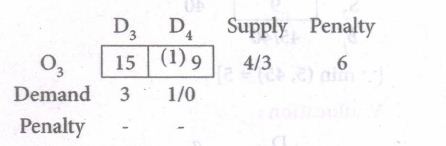
[In O3 least cost = 9 & min (1,4) = 1]
VI. allocation:
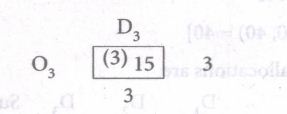
[∵ min (3, 3) = 3]
Thus, the allocations are
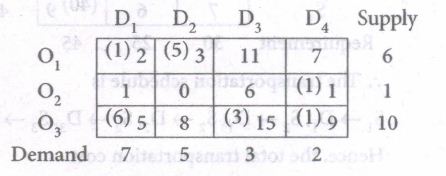
∴ The transportation schedule is
O1 → D1, O1 → D2, O2 → D4, O3 → D3 O3 → D1 and O3 → D4
Hence, the total transportation cost
= 1(2) + 5(3) + 1(1) + 6(5) + 3(15) + 1(9)
= 2 + 15 + 1 + 30 + 45 + 9 = Rs. 102
31.
Here total supply = 25 + 35 + 40 = 100
total requirement = 30 + 25 + 45 100
total supply = total requirement
∴ The given problem is a balanced transportation problem.
Hence, there exists a feasible solution for the given transportation problem.
North West Corner Rule:
I - allocation:
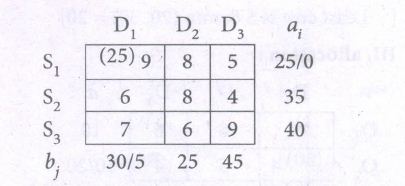
[∵ min (25, 30) = 25]
II - allocation:
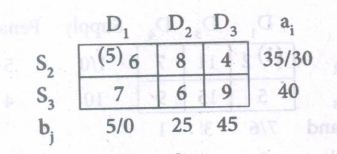
[∵ min (5, 35) = 5]
III - allocation:
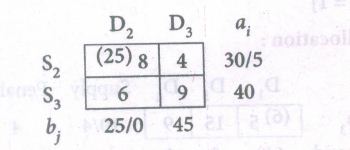
[∵ min (25, 30) = 25]
IV - allocation:
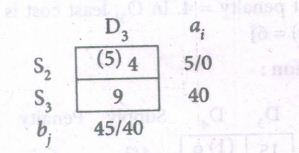
[∵ min (5, 45) = 5]
V - allocation:
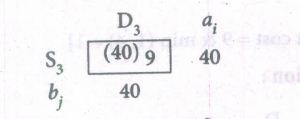
[∵ min (40, 40) = 40]
Thus, the allocations are
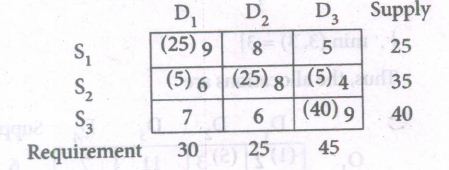
∴ The transportation schedule is
S1 → D1, S2 → D1, S2 → D2, S2 → D3, S3 → D3
Hence, the total transportation cost
= 25(9) + 5(6) + 25(8) + 5(4) + 40(9)
= 225 + 30 + 200 + 20 + 360
= Rs. 835
32.
Here total availability= 30 + 50 + 20 = 100
total requirement = 30 + 40 + 20 + 10 = 100
total availability = total requirement
∴ The given problem is a balanced transportation problem.
Hence, there exists a feasible solution to the given problem,
(a) Least Cost Method :
I - allocation:
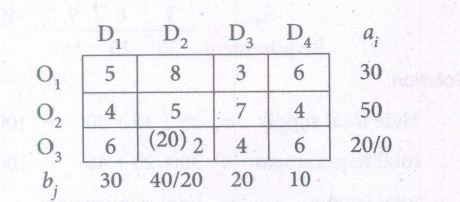
[∵ Least cost is 2 & min (20, 40) = 20]
II - allocation:
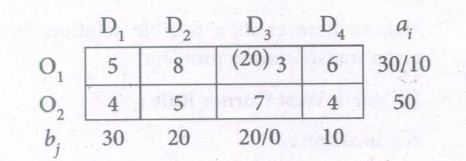
[∵ Least cost is 3 & min (20, 30) = 20]
III - allocation:
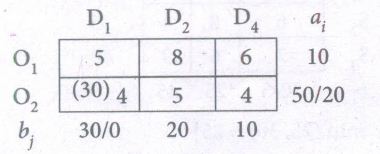
[∵ Least cost is 4 & min (50, 30) = 30]
IV - allocation:
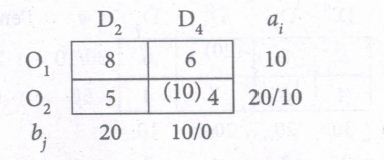
[∵ Least cost is 4 & min (10, 20) = 10]
V - allocation:
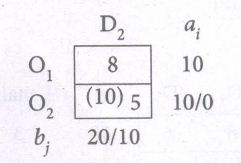
[∵ Least cost is 5 & min (10, 20) = 10]
VI - allocation:
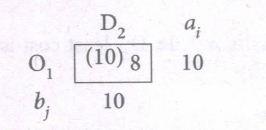
[∵ min (10, 10) = 10]
Thus, the allocations are
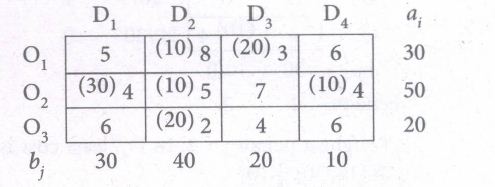
∴ The transportation schedule is
O1 → D2, O1 → D3, O2 → D1, O2 → D2, O2 → D4, O3 → D2
Hence, the total transportation cost
= 10(81) + 20(3) + 30(4) + 10(5) +10(4) +20(2)
= 80 + 60 + 120 + 50 + 40 + 40 = Rs. 390
(b) North West Corner method :
I - allocation:
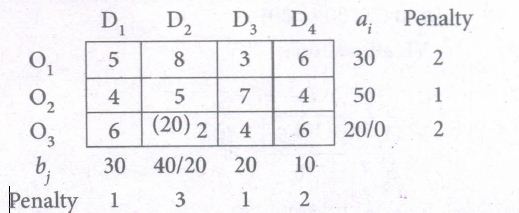
[∵ Highest penalty = 3. In D2, least cost is 2 & min (20,40) = 20]
II - allocation:
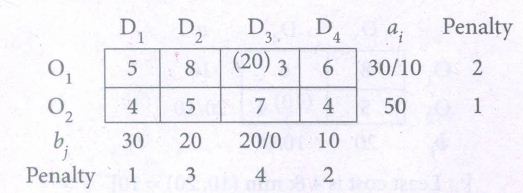
[∵ Highest penalty = 4. In D3, least cost is 3 & min (20, 30) = 20]
III - allocation:
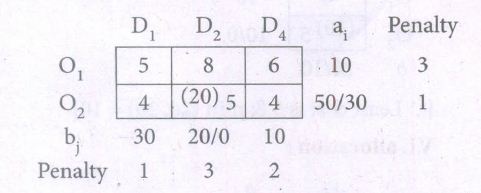
[∵ Highest penalty = 3. In D2, least cost is 5 & min (20, 50) = 20]
IV - allocation:
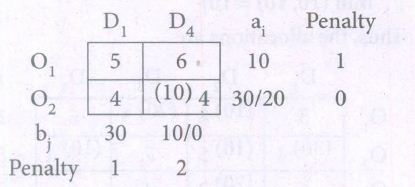
[∵ Highest penalty = 2. In D4, least cost is 4 & min (10, 30) = 10]
V - allocation:
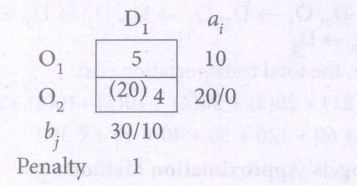
[∵ Highest penalty = 4. In D1, least cost is 4 & min (20, 30) = 20]
VI - allocation:
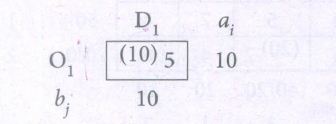
[∵ min (10, 10) = 20]
Thus, the allocations are
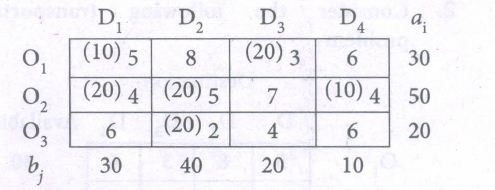
∴ The transportation schedule is
O1 → D1, O1 → D3, O2 → D1, O2 → D2, O3 → D2, and O2 → D4
Hence, the total transportation cost
= 10(5) + 20(3) + 20(4) + 20 (5) + 10(4) + 20(2)
= 50 + 60 + 80 + 100 + 40 + 40 = Rs. 370
33.
Since the number of columns is less than the number of rows, given assignment problem is unbalanced one.
To balance it, introduce dummy columns with all the entries zero.
∴ The revised assignment problem is
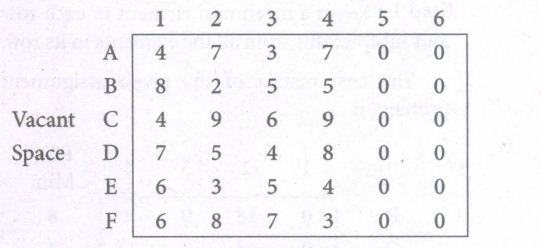
Step 1 : Select the smallest element in each row and subtract this from all the elements in its row.
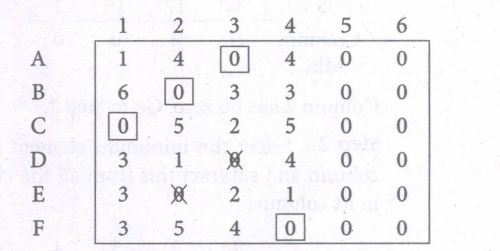
Since each row and column has atleast one zero, assignments can be made.
Step 2 : Examine the rows with atleast one row.
Row A & B have exactly one row. Mark them by and mark X by other zeros in its column.
Row C & F also has only one zero.
Here only 4 vacant space can be assigned to 4 trucks.
∴ The optimal assignments schedule and total cost is
| Vacant space | Truck | Cost |
|---|---|---|
| A | 3 | 3 |
| B | 2 | 2 |
| C | 1 | 4 |
| F | 4 | 3 |
| Total Cost | Rs. 12 | |
∴ The optimal assignment (minimum) cost = Rs. 12
34.
Here, the number of rows and columns are equal.
∴ The given assignment problem is balanced.
Step 1 : Select a smallest element in each row and subtract this from all the elements in its row.
∴ The cost matrix: of the given assignment problem is
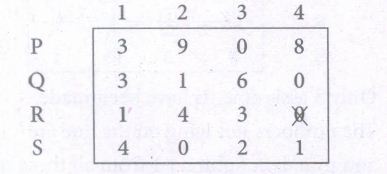
Column 1 contains no zero. Go to step 2.
Step 2 : Select the smallest element (1) in column 1 and subtract this from all the elements in its column.
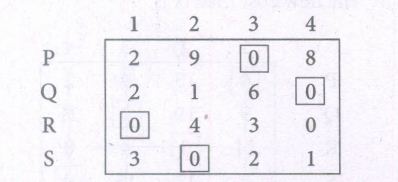
Since each row and column contains atleast one zero, assignments can be made.
Step 3 : Examine the rows with only one zero.
Row P, Q and S contains exactly one zero, mark them by 0 and mark the other zeros in the column byX.
Thus, all the four assignments have been made.
∴ The optimal assignment schedule and total cost is
| Salesman | Area | Cost |
|---|---|---|
| P | 3 | 8 |
| Q | 4 | 6 |
| R | 1 | 13 |
| S | 2 | 10 |
| Total Cost | Rs. 37 | |
35.
Here the number of rows and columns are equal
∴ The given assignment problem is balanced.
Step 1 : Select a minimum element in each row and subtract this from all the elements in its row.
∴ The cost matrix of the given assignment problem is
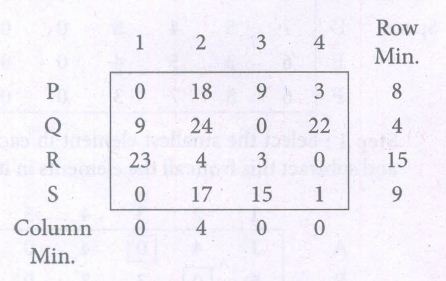
Column 2 has no zero. Go to Step 2.
Step 2 : Select the minimum element in each column and subtract this from all the elements in its column.
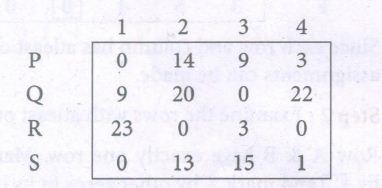
Since each row and column contains atleast one zero, assignments can be made.
Step 3 : Examine the rows with exactly one zero, mark it by and draw a vertical line.
After examining the rows, examine the columns with exactly one zero.
Mark it by and draw a horizontal line.
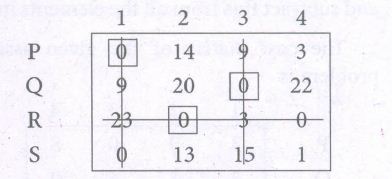
Only 3 assignments have been made.
The numbers not lying on the line are and min. is 1. Subtract 1 from all these numbers and add 1 to 23 which lies on the intersecting lines. Other numbers remain the same.
A new cost matrix is formed and repeat step 3.
∴ The new cost matrix is
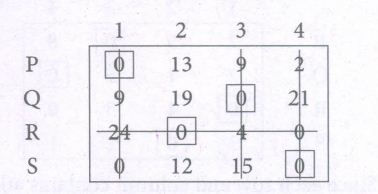
Thus, all the 4 assignments have been made.
∴The optimal assignment schedule and total cost is
| Subordinates | tasks | cost |
|---|---|---|
| P | 1 | 8 |
| Q | 3 | 4 |
| R | 2 | 19 |
| S | 4 | 10 |
| Total Cost | Rs. 41 | |
36.
Here, the number of rows and columns are equal
∴ The given assignment problem is balanced.
Step I : Select a smallest element in each row and subtract this from all the elements in its row.
∴ The given assignment problem is
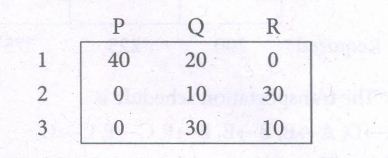
Here column 2 has no zero. Go to Step 2.
Step 2 : Select the smallest element (10) and subtract it from all the elements in its column.
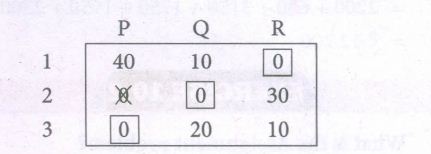
Step 3 : Examine the rows with only one zero mark that zero by Ԡ. Mark other zeros in its column by X.
Row 1 and Row 3 contains only one zero. Mark the other zeros by X
Column 2 contains exactly one zero. Mark it by Ԡ
Thus, all the 3 assignments have been made.
Hence, the optimal assignment schedule and total cost is
| Programmers | Programmes | Cost |
| 1 | R | 80 |
| 2 | Q | 90 |
| 3 | P | 110 |
Total cost = Rs. 280
Thus, the optimal assignment (minimum) cost = Rs. 280
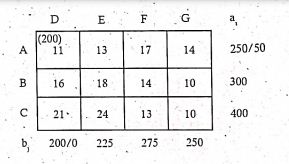
37.
First allocation :
Second allocation :
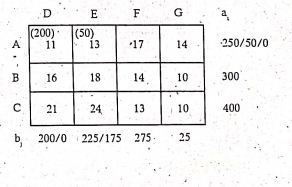
Third allocation :
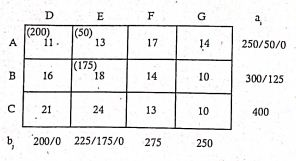
Fourth allocation :
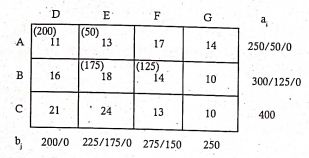
Fifth allocation :
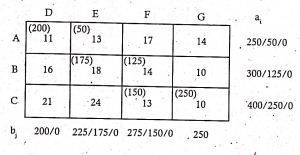
The transportation cost is
\( =(200 \times 11)+(50 \times 13)+(175 \times 18)+ (125 \times 14)+(150 \times 13)+(250 \times 10) \)
= 2200 + 650 + 3150 + 1750 + 650 + 2500
= 10900
38.
Here the number of rows and columns are equal.
\(\therefore\) The given assignment problem is balanced.
Now let us find the solution.
Step 1: Select a smallest element in each row and subtract this from all the elements in its row.
The cost matrix of the given assignment problem is
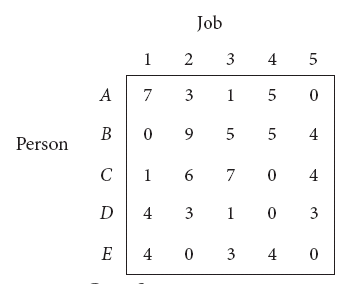
Column 3 contains no zero. Go to Step 2.
Step 2: Select the smallest element in each column and subtract this from all the elements in its column.
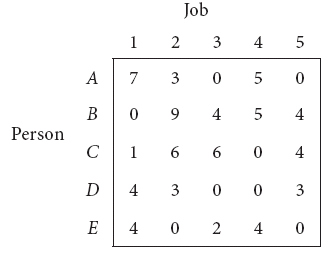
Since each row and column contains atleast one zero, assignments can be made.
Step 3: (Assignment):
Examine the rows with exactly one zero. Row B contains exactly one zero. Mark that zero by \(\square\) (i.e) Person B is assigned to Job 1. Mark other zeros in its column by ×.
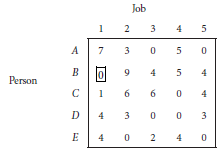
Now, Row C contains exactly one zero. Mark that zero by \(\square\). Mark other zeros in its column by × .
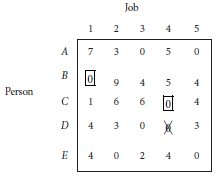
Now, Row D contains exactly one zero. Mark that zero by \(\square\) . Mark other zeros in its column by × .
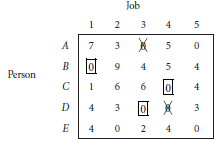
Row E contains more than one zero, now proceed column wise. In column 1, there is an assignment. Go to column 2. There is exactly one zero. Mark that zero by \(\square\) . Mark other zeros in its row by × .
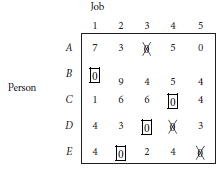
There is an assignment in Column 3 and column 4. Go to Column 5. There is exactly one zero. Mark that zero by \(\square\) . Mark other zeros in its row by × .
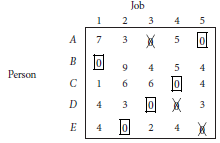
Thus all the five assignments have been made. The Optimal assignment schedule and total cost is
| Person | Job | cost |
| A | 5 | 1 |
| B | 1 | 0 |
| C | 4 | 2 |
| D | 3 | 1 |
| E | 2 | 5 |
| Total cost | 9 | |
The optimal assignment (minimum) cost = Rs. 9
39.
Here the number of rows and columns are equal.
\(\therefore\)The given assignment problem is balanced.
Now let us find the solution.
Step 1: Select a smallest element in each row and subtract this from all the elements in its row.
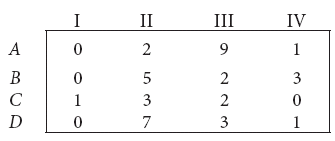
Look for atleast one zero in each row and each column.Otherwise go to step 2.
Step 2 : Select the smallest element in each column and subtract this from all the elements in its column.
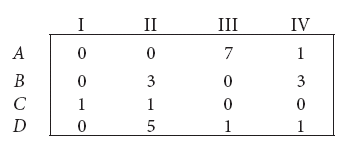
Since each row and column contains atleast one zero, assignments can be made.
Step 3 (Assignment):
Examine the rows with exactly one zero. First three rows contain more than one zero. Go to row D.
There is exactly one zero. Mark that zero by \(\square\) (i.e) job D is assigned to machine
I . Mark other zeros in its column by\(\text { X }\).
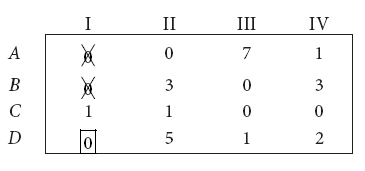
Step 4: Now examine the columns with exactly one zero. Already there is an assignment in column I. Go to the column II. There is exactly one zero. Mark that zero by \(\square\) . Mark other zeros in its row by\(\text { X }\).
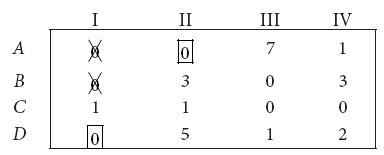
Column III contains more than one zero. Therefore proceed to Column IV, there is exactly one zero. Mark that zero by \(\square\) . Mark other zeros in its row by \(\text { X }\).
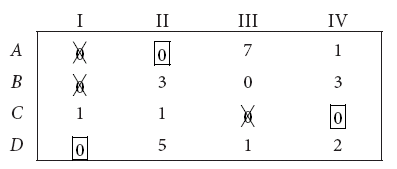
Step 5: Again examine the rows. Row B contains exactly one zero. Mark that zero by \(\square\).
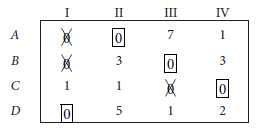
Thus all the four assignments have been made. The optimal assignment schedule and total cost is
\(\begin{array}{|c|c|c|} \hline \text { Job } & \text { Machine } & \text { cost } \\ \hline \text { A } & \text { II } & 12 \\ \hline \text { B } & \text { III } & 7 \\ \hline \text { C } & \text { IV } & 11 \\ \hline \text { D } & \text { I } & 8 \\ \hline {\text { Total cost }} \ && 38 \\ \hline \end{array}\)
The optimal assignment (minimum) cost
= Rs. 38
40.
Here \(\sum { { a }_{ i }=\sum { { b }_{ j } } =80 } \)
(i.e) Total Availability = Total Requirement
\(\therefore\) The given problem is balanced transportation problem.
Hence there exists a feasible solution to the given problem.
First Allocation:
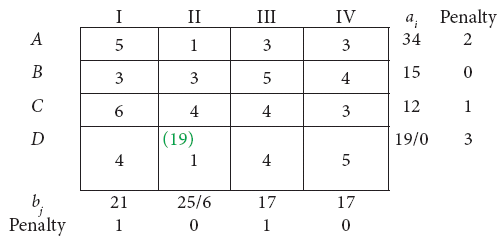
Second Allocation:
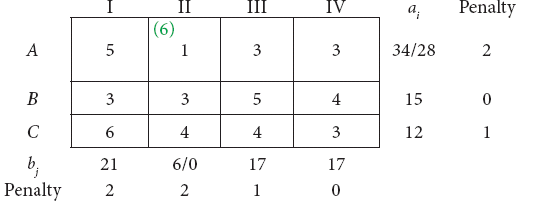
Third Allocation:
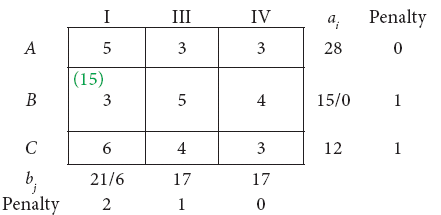
Fourth Allocation:
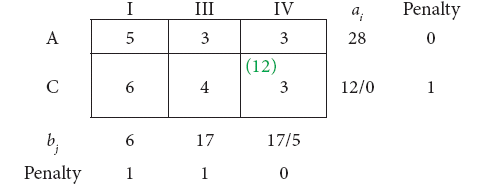
Fifth Allocation:
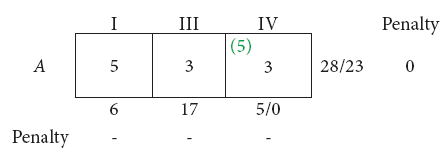
Sixth Allocation:
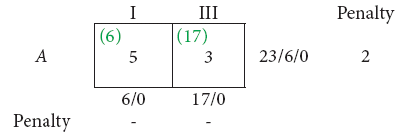
Thus we have the following allocations:
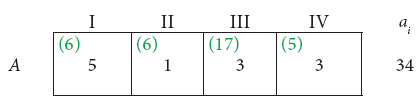
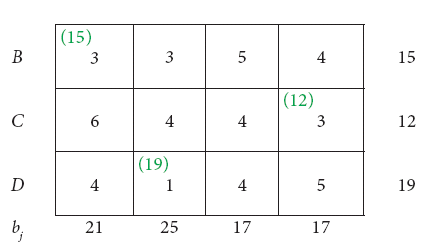
Transportation schedule :
A⟶I, A⟶II, A⟶III, A⟶IV, B⟶I, C⟶IV, D⟶II
Total transportation cost:
= (6×5)+(6+1)+(17×3)+(5×3)+(15×3)+(12×3)+(19×1)
= 30+6+51+15+45+36+19
= Rs.202
41.
Here \(\sum { { a }_{ i }=\sum { { b }_{ j } } =950 } \)
(i.e) Total Availability = Total Requirement
\(\therefore\) The given problem is balanced transportation problem.
Hence there exists a feasible solution to the given problem.
First let us find the difference (penalty) between the first two smallest costs in each row and column and write them in brackets against the respective rows and columns
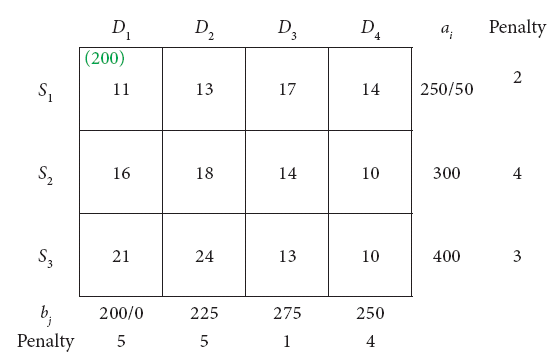
Choose the largest difference. Here the difference is 5 which corresponds to column D1 and D2. Choose either D1 or D2 arbitrarily.
Here we take the column D1. In this column choose the least cost. Here the least cost corresponds to (S1, D1). Allocate min (250, 200) = 200 units to this Cell.
The reduced transportation table is
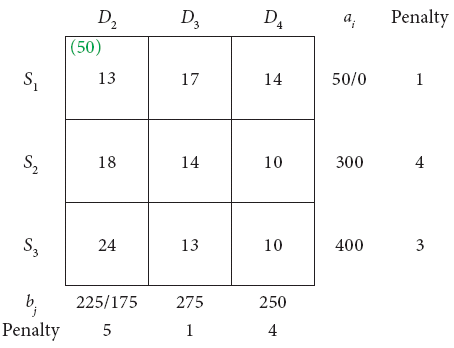
Choose the largest difference. Here the difference is 5 whichcorresponds to column D2. In this column choose the least cost. Here the least cost corresponds to (S1, D2) . Allocate min(50,175) = 50 units to this Cell.
The reduced transportation table is
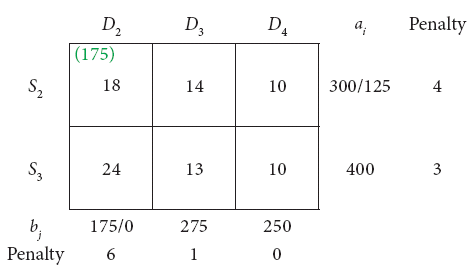
Choose the largest difference. Here the difference is 6 which corresponds to column
D2. In this column choose the least cost. Here the least cost corresponds to (S2, D2). Allocate min(300,175) =175 units to this cell.
The reduced transportation table is
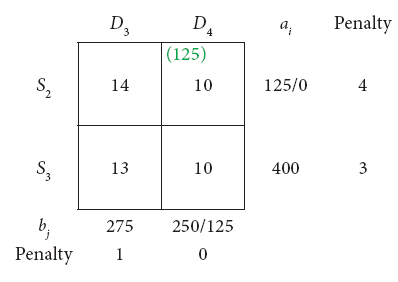
Choose the largest difference. Here the difference is 4 corresponds to row S2. In this row choose the least cost. Here the least cost corresponds to (S2, D4). Allocate min(125, 250) = 125 units to this Cell.
The reduced transportation table is
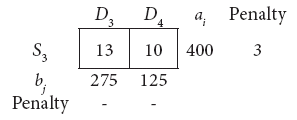
The Allocation is
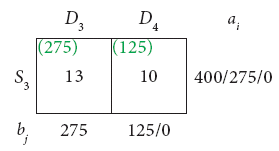
Thus we have the following allocations:
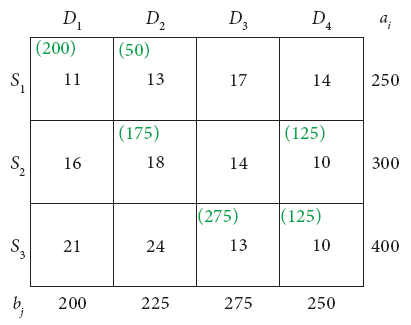
Transportation schedule :
S1⟶D1,S1⟶D2,S2⟶D2,S2⟶D4,S3⟶D3,S3⟶D4
This initial transportation cost
= (200 x 11)+(500 x 13)+(175 x 18)+(125 x 10)+(275 x 12)+(1255 x 10)
= Rs.12,075
42.
| Action | States | Minimum | |
| B1 | B2 | ||
| A1 | 8 | 6 | 6 |
| A2 | 9 | 2 | 2 |
| A3 | 6 | 4 | 4 |
Max (6, 2, 4) = 6
∴ Action Al is the best according to maximin principle
43.
Here total availability = 150 + 100 + 250 = 500
total requirement = 50 + 150 + 300 = 500
∴ Total availability = total requirement
∴ The given problem is a balanced transportation problem
Hence, there exists a feasible solution to the given problem
I - allocation:
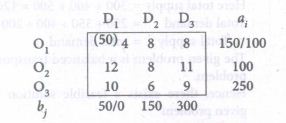
[∵ least cost is 4 & min (50,150) = 50]
II - allocation:
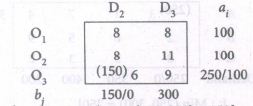
[∵ least cost is 6 & min (150, 250) = 150]
III - allocation:
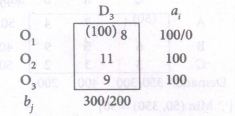
[∵ least cost is 8 & min (300, 100) = 100]
IV - allocation:
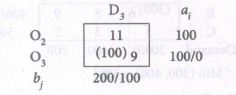
[∵ least cost is 9 & min (200,100) = 100]
V - allocation:
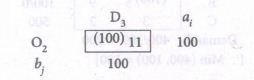
[∵ min (100, 100) = 100]
Thus, the allocations are
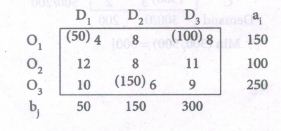
∴ The transportation schedule is
O1 → D1, O1 → D3, O2 → D3, O3 → D2, O3 → D3
Hence, the total transportation cost is
= 50(4) + 100(8) + 100(11) + 150(6) + 100(9)
= 200 + 800 + 1100 + 900 + 900
= Rs. 3900
44.
Here, total supply = 10 + 5 + 3 = 18
total demand = 5 + 4 + 6 + 3 = 18
∴ Total supply = total demand
∴ The given problem is a balanced transportation problem.
∴ We can find an initial basic feasible solution to the given problem.
I - allocation:
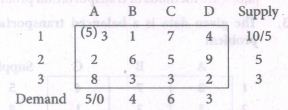
[∵ min (5, 10) = 5]
II - allocation:
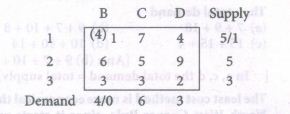
[∵ min (4, 5) = 4]
III - allocation:
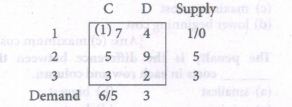
[∵ min (1, 6) = 1]
IV - allocation:
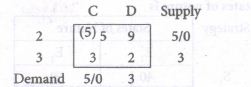
[∵ min (5, 5) = 5]
V - allocation:
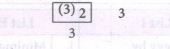
[∵ min (3, 3) = 3]
Thus, the allocations are
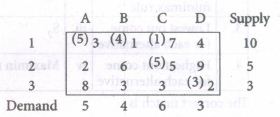
∴ The transportation schedule is
1 → A, 1 → B, 1 → C, 2 → C, 3 → D
Hence, the total transportation cost
= 5(3) + 4(1) + 1(7) + 5(5) + 3(2)
= 15 + 4 + 7 + 25 + 6 = Rs. 57
45.
The assignment problem is a special case of transportation problem where the number of sources and destinations are equal. Here, jobs represent sources and machines represent destinations.
46.
47.
To assign the different jobs to the different machines (one job per machine) to minimize the overall cost is known as assignment problem.
48.
If the total supply = total demand, then the given problem is a balanced transportation problem.
49.
A feasible solution to a transportation problem is a set of non negative values xij (i = 1, 2, m, j = 1, 2, ....... n) that satisfies the constraints.
If a basic feasible solution to a transportation problem contains exactly m + n - l allocations. in independent positions, it is called a non degenerate basic feasible solution. Here m is the number of rows and n is the number of columns in a transportation problem.
50.
The objective function is minimize Z = \(\overset { m }{ \underset { i=1 }{ \Sigma } } \overset { n }{ \underset { j=1 }{ \Sigma } } { { C }_{ ij } }{ x }_{ ij }\) subject to the constraints
\(\overset { n }{ \underset { j=1 }{ \Sigma } }{ x }_{ ij } = a_i, i=1,2,.....m\) (Supply constraints)
\(\overset { m }{ \underset { i=1 }{ \Sigma } }{ x }_{ ij } = b_j, j=1,2,.....n\) (demand constraints)
xij ≥, 0 for all i, j (non-negative restrictions)
51.
A transportation problem is to determine the amount to be transported from each origin to each destinations such that the total transportation cost is minimized.

12th Standard Syllabus & Materials
12th Standard
TN 12th Computer Applications களப்பெயர் முறைமை (DNS) Sample Question Papers Study Material - QB365 Set A
NEW12th Standard
TN 12th Computer Applications வலையமைப்பு எடுத்துக்காட்டுகள் மற்றும் நெறிமுறைகள் Sample Question Papers Study Material - QB365 Set A
NEW12th Standard
TN 12th Computer Applications கணினி வலையமைப்பு ஓர் அறிமுகம் Sample Question Papers Study Material - QB365 Set A
NEW12th Standard
TN 12th Computer Applications PHP-உடன் MySQL-ஐ இணைத்தல் Sample Question Papers Study Material - QB365 Set A



Tamilnadu Stateboard 12th Standard Subjects

Maths

Chemistry

Physics

Biology

Computer Science
Business Maths and Statistics

Economics

Commerce

Accountancy

History

Computer Applications
Biology
Computer Technology
Computer Applications
Computer Science
Business Maths and Statistics
Commerce
Economics
Maths
Chemistry
Physics
Computer Technology
History
Accountancy

Tamil

English

French
Tamilnadu Stateboard Standards

