
 100% FREE ACCESS
6th Standard CBSE Syllabus & Materials
6th Standard CBSE
CBSE 6th Social Science The Value of Work - New Sample Question Papers Study Material - QB365 Set A
NEW6th Standard CBSE
CBSE 6th Social Science Family and Community - New Sample Question Papers Study Material - QB365 Set A
NEW6th Standard CBSE
CBSE 6th Social Science India's Cultural Roots - New Sample Question Papers Study Material - QB365 Set A
NEW6th Standard CBSE
CBSE 6th Social Science India,That is Bharat - New Sample Question Papers Study Material - QB365 Set A
NEW6th Standard CBSE
CBSE 6th Social Science Timeline and sources of history - New Sample Question Papers Study Material - QB365 Set A
NEW6th Standard CBSE
CBSE 6th Social Science Oceans and Continents - New Sample Question Papers Study Material - QB365 Set A

Published on: 02/08/2018
From the chapter Light, Shadows and Reflections, some of the important questions are covered in this question paper. The questions are covers from the Higher Order Thinking Questions and Value Based Questions.
Download CBSE Class 6th Standard CBSE Science question papers, sample papers, important questions, and previous year solved papers in PDF format. Get free study materials, NCERT solutions, and exam preparation resources for Class 6th Standard CBSE Science
Questions + Answers key
Take MCQ Science Test
1.
Name the things other than source of light and opaque object required to see the shadow.
2.
In respect to the direction of source of light, what is the direction of shadow?
3.
Briefly state that what a dark part of shadow is called as.
4.
Through which pipe, we can see the candle, straight pipe or curved pipe?
5.
Mention the name of an object which partially allows the light to pass through it.
6.
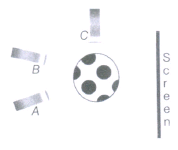
Three torches A, Band C shown in figure are switched ON one by one. The light from which of the torches will not form a shadow of the ball on the screen?
7.
Differentiate between a luminous and non-luminous objects.
8.
Suggest any two means for the conversion of a transparent glass sheet into a translucent sheet.
9.
A student covered a torch with red cellophane sheet to obtain red light. Using the red light, she obtains a shadow of an opaque object. She repeats this activity with green and blue light. Will the colour of the light affect the shadow? Explain.
10.
Three identical towels of red, blue and green colour are hanging on a cloth line in the sun. What would be the colour of shadows of these towels?
11.
Images are similar to shadows.
12.
Lateral inversion is a phenomenon of changing left to right and vice-versa.
13.
Mirror does not change the direction of light falls
14.
Light is not a form of energy.
15.
Moon is luminous.
16.
Light helps us to__________________objects.
17.
Shadows are______________ from images.
18.
Reflection of mirror gives us_____________images.
19.
Shadows are formed by _________________object.
20.
Pinhole camera forms_____________ image.
21.
Shadow of an object is always seen in
blue
black
red
None of these
22.
The objects which partially allow the light to pass through it are called
transparent
luminous
opaque
tanslucent
23.
Which one of the following is the natural source of light?
Sun
Tubelight
Electric bulb
None of these
24.
Which of the following is a transparent object?
Glass shut
Pencil
Chair
Table
25.
Two students while sitting across a table looked down onto its top surface. They noticed that they could see their own and each other's image. The table top is likely to be made of
unpolished wood
red stone
glass sheet
wood top covered with cloth
26.
A football match is being played at night in a stadium with flood lights ON. You can see the shadow of a football kept at the ground but cannot see its shadow when it is kicked high in the air. Explain.
27.
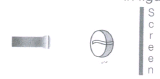
A student had a ball, a screen and a torch in working condition. He tried to form a shadow of the ball on the screen by placing them at different positions. Sometimes,1he shadow was not obtained. Explain.
1.
A screen like cardboard, wall and ground is required to see the shadow.
2.
In respect to the direction of source of light, the direction of shadow is always opposite to it.
3.
Limbra is called the dark part of shadow.
4.
As the light travels in a straight line path, so we can see the candle through a straight pipe.
5.
The object which partially allows the light to pass through it is a translucent Object, e.g. wax paper.
6.
The light from the torch C will not form a shadow on the screen because light travels in a straight path and will form the shadow on the same path from which it is coming.
7.
Luminous objects are those objects which emit the light of their own e.g. the stars, the sun, burning candle, etc. While non-luminous objects are those objects which do not emit light of their own, e.g. Blackboard, moon, earth, etc.
8.
The two ways through which a transparent glass sheet can be converted into a translucent sheet are
(i) If one side of butter paper gets covered, then a transparent glass sheet turns into a translucent one.
(ii) By smearing a thin layer of oil.
9.
Shadow is just an absence of light at that place. Shadow is not affected by the colours of the object because the amount of light is preventing to pass, will remain same. The shadow is affected by the shape of the object only. If the object is large, the shadow will be large and vice-versa.
10.
Shadow does not change on changing the colour. Shadow will always show the absence of light at that place. So, the shadow colour will remain same in all the cases. Thus, the shadow of all the towels are black in colour.
11.
(b)
12.
(a)
13.
(b)
14.
(b)
15.
(b)
16.
()
see
17.
()
different
18.
()
clear
19.
()
opaque
20.
()
inverted
21.
(b)
black
22.
(d)
tanslucent
23.
(a)
Sun
24.
(a)
Glass shut
25.
(c)
glass sheet
26.
The shadow of the object cannot be caught if the screen and the object are very far from each other. This is the same case, the shadow of the football cannot be seen on the ground when it is kicked high in the air. This happens because if we take the object away and away from the screen, the image becomes smaller and smaller and a time comes when it disappears from the screen.
27.
Sometimes, the shadow of the object (ball) may not be formed because of improper arrangement. It may be that the direction of the torchlight is not towards the screen. The shadow will be formed only if screen, torch and ball are in the same straight line (as shown in figure).

6th Standard CBSE Syllabus & Materials
6th Standard CBSE
CBSE 6th Social Science Locating Places on the Earth - New Sample Question Papers Study Material - QB365 Set A
NEW6th Standard CBSE
CBSE 6th Science A Journey Through States of Water - New Sample Question Papers Study Material - QB365 Set A
NEW6th Standard CBSE
CBSE 6th Science Temperature and its Measurement - New Sample Question Papers Study Material - QB365 Set A
NEW6th Standard CBSE
CBSE 6th Science Materials Around Us - New Sample Question Papers Study Material - QB365 Set A



CBSE 6th Standard CBSE Subjects
CBSE Standards




