
 100% FREE ACCESS
6th Standard Syllabus & Materials
6th Standard
TN 6th Tamil பருவம் 1 - இயல் 1 - மொழி -தமிழ்த்தேன் - இன்பத்தமிழ் Sample Question Papers Study Material - QB365 Set A
NEW6th Standard
TN 6th English T1 - Supplementary - The Apple Tree and The Farmer Sample Question Papers Study Material - QB365 Set A
NEW6th Standard
TN 6th English T1 - Prose - When The Trees Walked Sample Question Papers Study Material - QB365 Set A
NEW6th Standard
TN 6th Social Science T3 - CIV - Road Safety Sample Question Papers Study Material - QB365 Set A
NEW6th Standard
TN 6th Social Science T3 - CIV - Local Bodies - Rural and Urban Sample Question Papers Study Material - QB365 Set A
NEW6th Standard
TN 6th Social Science T3 - CIV - Democracy Sample Question Papers Study Material - QB365 Set A

Published on: 11/10/2021
Science exam quarterly
Download Tamil Nadu 6th Standard Science question papers, model tests, one-mark questions, important questions, and public exam papers in PDF format. Free study materials and answer keys for TN State Board students.
Questions + Answers key
Take MCQ Science Test1.
Bacteria are very small _________ microorganism.
Prokaryotic
Eukaryotic
Protozoa
Acellular
2.
Our body needs _________ for muscle building.
carbohydrate
fat
Protein
Water
3.
Kangaroo rat lives in
Aquatic habitat
Desert habitat
Grass land habitat
Mountain habitat
4.
Lizards breathe through their
Skin
Gills
Lungs
Trachea
5.
The important function of stomata is __________.
Conduction
Transpiration
Photosynthesis
Absorption
6.
______ is not made of matter
gold ring
iron nail
light ray
oil drop
7.
Which among the following is an oscillatory motion?
Rotation of the earth about its axis
Revolution of the moon about the earth
To and fro movement of a vibrating string
All of these.
8.
9.
The height of a tree can be measured by
Metre scale
plastic ruler
Metre rod
measuring tape
10.
Tail of a bird acts as a rudder which helps to ____________.
11.
Fixation and absorption are the main functions of _____________.
12.
Chillies are removed from ‘upma’ by ___________ method.
13.
Motion of a potter’s wheel is an example for__________ motion.
14.
The distance between Delhi and Chennai can be measured in _______________.
15.
A vehicle covers a distance of 400km in 5 hour. Calculate its speed.
16.
Make a list of the functions of root and stem.
17.
What is motion? Classify different types of motion with examples.
18.
Distinguish the properties of solid, liquid and gas. Draw a suitable diagram.
19.
Mention the features that help a bird to fly is the air?
20.
Write the adaptive features of Polar bear and Penguin.
21.
Mr. Raghu returns home on a hot summer day and wants to have buttermilk. Mrs. Raghu has only curd. What can she do to get buttermilk? Explain
22.
Why do gases not have fixed shape?
23.
Distinguish between terrestrial and aquatic habitats.
24.
Compare the taproot and fibrous root systems.
25.
Find the answer for the following questions within the grid.
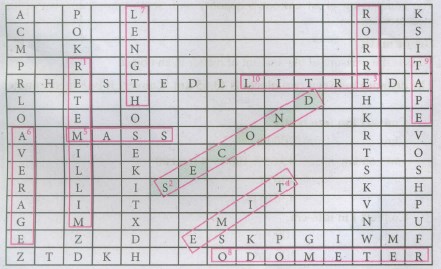
1. 10-3 is one_____
2. SI Unit of time is_____
3. Cross view of reading a measurement leads to______
4. ____is the one what a clock reads.
5. _____is the amount of substance present in an object.
6. ______can be taken to get the final reading of the recordings of different students for a single measurement.
7. ______is a fundamental quantity.
8. _____shows the distance covered by an automobile
9. A tailor uses to take______ measurements to stitch the cloth.
10. Liquids are measured with this physical quantity.
26.
Fibrous Root
27.
Photosynthesis
28.
Stem
29.
Desert
30.
Mountain
1.
(c)
Protozoa
2.
(c)
Protein
3.
(b)
Desert habitat
4.
(c)
Lungs
5.
(c)
Photosynthesis
6.
(c)
light ray
7.
(c)
To and fro movement of a vibrating string
8.
(b)
9.
(d)
measuring tape
10.
()
control the direction of the movements
11.
()
root
12.
()
hand picking
13.
()
Rotatory
14.
()
Kilometre
15.
Distance travelled (d) = 400 km
Time taken (t) = 5 hour
Average Speed (s) = \(\frac{d}{t}=\frac{400}{5}=80\)
Average Speed = 80 kmph (or) Km/hr.
16.
FUNCTIONS OF THE ROOT:
i) The root fixes the plant to the soil.
ii) Absorbs water and minerals from the soil.
iii) Stores food in some plants like Carrot and beetroot
FUNCTIONS OF THE STEM:
i) The stem supports the branches, leaves, flowers and fruits.
ii) Transports Water and minerals from roots to upper aerial plant parts.
iii) Transports the prepared food from leaves to other parts through stem.
iv) Stores food as in the case of sugarcane
17.
When there is a change of position of an object with respect to time then it is called motion.
Types of motion:
a) Based on path:
i) Linear motion - a person walking on a straight path
ii) Curvilinear motion - throwing ball
iii) Circular motion - swirling stone tied to the rope
iv) Rotatory motion - a rotating top
v) Oscillatory motion - pendulum of clock
vi) Zig zag (or) Irregular motion - the motion of a bee
b) Based on duration:
i) period motion - movement of hour hand of a clock
ii) Non-periodic - motion flapping of a flag in wind
c) Based on speed:
9) Uniform motion - motion of a train at a constant speed
ii) Non-uniform motion - a vehicle moves in different speed
18.
| PARTTCLES IN A SOLID |
PARTICLES IN A LIQUID | PARTICLES IN GASEOUS |
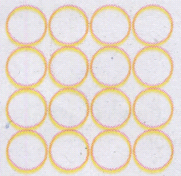 |
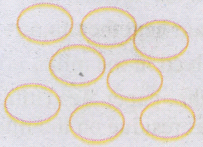 |
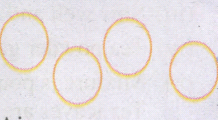 |
| S.No. | SOLID STATE | LIQUID STATE | GASEOUS STATE |
| 1. | Definite shape and volume | No definite shape, liquids attain the shape of the vessel in which they are kept. | Gases have neither a definite shape nor a definite volume. |
| 2. | Incompressible | Compressible to a small extent. | Highly compressible |
| 3. | There is little space between the particles of solid. | These particles have a greater space between them. | The space between gas particles is the greatest. |
| 4. | These particles attract each other very strongly. | The force of attraction between liquid particles is lesser than solid particles. | Thd force of attraction is least between gaseous particles. |
| 5. | Particles of solid cannot move freely. | These particles move freely. | Gaseous particles are in a continuous, random motion. |
19.
i) Birds have streamlined body covered with feathers. This body shape provides minimum resistance to air.
ii) They have a pair of wings to fly in the air.
iii) They have hollow and light bones.
20.
Adaptive features of polar Bear : Thick skin for protection, White fur.
Adaptive features of Penguin : Paddle to swim, walk with two legs.
21.
(i) By churning the curd, the solid butter will be collicted on the sides of the vessel.
(ii) The insoluble butter will be separated from the buttermilk and thus the buttermilk will be obtained.
22.
(i) The atoms of a gas never stop moving.
(ii) They are not affected by gravity.
(iii) They spread out in order to occupy the available space.
23.
| Terrestrial plant | Aquatic plant |
| (i) Terrestrial habitats are the ones that are found on land like forest, grassland and desert. | (i) Aquatic habitat includes area that are permanently covered by water and surrounding areas that are occationally covered by water. |
| (ii) They are classified into three types. 1. Desert habitat 2. Grassland habitat 3. Forest habitat |
(ii) They are two types 1. Fresh water habitat 2. Marine water habitat |
24.
| TAP ROOT SYSTEM | FIBROUS ROOT SYSTEM |
|---|---|
| (i) It consists of a single root called tap root and some smaller lateral roots arise from the tap root. | (i) It consists of a cluster of roots arising from the base of the stem. |
| (ii) They are seen in dicotyledonous plants. | (ii) It is generally seen in monocotyledonous plants. |
| (iii) Ex: Bean, Mango | (iii) Ex: Grass, paddy, maize |
25.
1. Millimetre
2. Second
3. Error
4. Time
5. Mass
6. Average
7. Length
8. Odometer
9. Tape
10. Litre
26.
Monocot
27.
Leaves
28.
Branches
29.
Dry place
30.
Himalayas

6th Standard Syllabus & Materials
6th Standard
TN 6th Social Science T3 - GEO - Understanding Disaster Sample Question Papers Study Material - QB365 Set A
NEW6th Standard
TN 6th Social Science T3 - GEO - Globe Sample Question Papers Study Material - QB365 Set A
NEW6th Standard
TN 6th Social Science T3 - GEO - Asia and Europe Sample Question Papers Study Material - QB365 Set A
NEW6th Standard
TN 6th Social Science T3 - HIS - South Indian Kingdoms Sample Question Papers Study Material - QB365 Set A



Tamilnadu Stateboard 6th Standard Subjects
Tamilnadu Stateboard Standards




