
 100% FREE ACCESS
6th Standard CBSE Syllabus & Materials
6th Standard CBSE
CBSE 6th Social Science The Value of Work - New Sample Question Papers Study Material - QB365 Set A
NEW6th Standard CBSE
CBSE 6th Social Science Family and Community - New Sample Question Papers Study Material - QB365 Set A
NEW6th Standard CBSE
CBSE 6th Social Science India's Cultural Roots - New Sample Question Papers Study Material - QB365 Set A
NEW6th Standard CBSE
CBSE 6th Social Science India,That is Bharat - New Sample Question Papers Study Material - QB365 Set A
NEW6th Standard CBSE
CBSE 6th Social Science Timeline and sources of history - New Sample Question Papers Study Material - QB365 Set A
NEW6th Standard CBSE
CBSE 6th Social Science Oceans and Continents - New Sample Question Papers Study Material - QB365 Set A

Published on: 02/03/2019
Model Revision Test
Download CBSE Class 6th Standard CBSE Science question papers, sample papers, important questions, and previous year solved papers in PDF format. Get free study materials, NCERT solutions, and exam preparation resources for Class 6th Standard CBSE Science
Questions + Answers key
Take MCQ Science Test
1.
Find the odd one out from the following:
(a) Chair, Bed, Table, Baby, Cupboard
(b) Rose, Jasmine, Boat, Marigold, Lotus
(c) Aluminium, Iron, Copper, Silver, Sand
(d) Sugar, Salt, Sand, Copper Sulphate
2.
Sarthak advises his mother not to sieve wheat flour before making dough. Can you state why?
3.
An earthworm does not have bones or legs, then how does it move?
4.
What does the positive terminal of dry cell consist of?
5.
Look at the given figure.
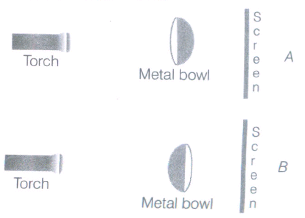
Will there be any difference in the shadow formed on the screen A and B?
6.
Condensation is the reverse of evaporation. How?
7.
Explain the term non-periodic motion.
8.
Pressure can change the shape of material. Give an example to support this statement.
9.
Name the disease caused by the deficiency of vitamin-C.
10.
Flowers of which plants are used as vegetables?
11.
Explain how will you test that the 'tea dust' is not adulterated with iron powder.
12.
Paheli has a rose plant in her garden. How can she increase the number of rose plants in the garden?
13.
Explain the reason of using a silver glass as a mirror.
14.
Which type of movement would have been possible if
(a) our elbow had a fixed joint.
(b) we were to have a ball and socket joints between our neck and head.
15.
We need standard unit of measurements for a quantity. Explain why.
16.
Give the name of two objects each which can be made from the following materials.
(a) Glass
(b) Iron
(c) Gold
(d) Aluminium
17.
Tearing of paper is said to be a change that cannot be reversed. What about paper recycling?
18.
There are many great varieties of mango in India. Generally mango plant is a big tree. Some varieties of mango are produced by small mango plants as shown in figure.
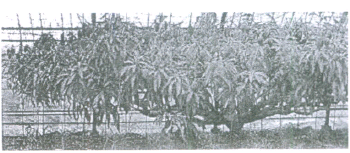
What would you call this mango plant? Herb, shrub or tree. Justify your answer.
19.
Paheli avoids eating vegetables but likes to eat biscuits, noodles and white bread. She frequently complains of stomachache and constipation. What are the food items that she should include in her diet to get rid of the problem? Give reason for your answer.
20.
Can you identify the major ingredients of pizza. Which of the ingredients of pizza
(a) come from plants
(b) do not come from plants
21.
Separation of seeds from cotton bolls is known as:
Weaving
Knitting
Giruting
Spinning
22.
Which of the following does not belong to the group?
Window pane
Cellophane sheet
Mirror
Air
23.
A material that allows the electricity to pass through it is :
Conductor
Insulator
Transistor
None of these
24.
Which of the following gases protects us from ultraviolet rays?
Oxygen
Ozone
Carbon dioxide
Nitrogen
25.
Which of these is not an organ for taking in oxygen?
Lungs
Gills
Stomata
Atmosphere
26.
Change that leads to the formation of a new substance is called
Chemical change
Physical change
Biological change
None of these
27.
Which of the following combinations of features would you observe in grass?
Parallel venation and fibrous root
Parallel venation and tap root
Reticulate venation and fibrous root
Reticulate venation and tap root
28.
In lateral inversion:
Image is upside down
Image bends laterally
Left of an object appears right of the image
Image gets inverted
29.
The method used to separate the components of
Threshing
Sieving
Winnowing
None of these
30.
Find the odd one out:
Rotation of earth about its axis
Tabla surface
Blades of rotating fan
Moving vehicle on straight road
31.
Both seeds and leaves of this plant are edible. Which plant is this?
Potato
Cabbage
Radish
Mustard
32.
Materials that can be recycled are collected in
red bins
blue bins
33.
A bar magnet is immersed in a heap of iron filings and pulled out. The amount of iron filings Clinging to the
North pole is almost equal to the South pole
North pole is much less than the South pole
North pole is much less than the South pole
magnet will be same all along its length
34.
Filament of a torch bulb is
a metal case
metal tip at the centre of the base
two thick wires
a thin wire
35.
A camel's hump stores which of the following for use in emergency situations?
Air
Water
Fat
Carbohydrates
36.
Hibernation is an adaptation for
preventing loss of water
escaping hot weather
escaping cold weather
None of the above
37.
Paheli observed the shadow of a tree at 8:00 AM, 12:00 noon and 3:00 PM. Which of the following statements is closest to her observation about the shape and size of the shadow?
The shape of the shadow of the tree changes but the size remains the same.
The size of the shadow of the tree changes but the shape remains the same.
Both the size and shape of the shadow of the tree change.
Neither the shape nor the size of the shadow changes.
38.
Which of the following joints is immovable?
Shoulder and arm
Knee and joint
Upper jaw and skull
Lower jaw and upper jaw
39.
How many muscles work together to move a bone?
One
Two
Three
Four
40.
Catch water where it falls is the basic idea behind
recycling of water
makinq dams to store water
rainwater harvesting
condensation of water vapour
41.
Which one is the purest form of water?
River water
Groundwater
Rainwater
Ocean water
42.
You are provided three scales A, B and C as shown in figure to measure a length of 10 cm.
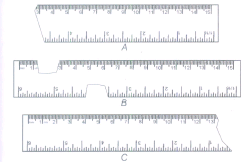
For the correct measurement of the length, you will use the scale
only A
only B
only C
Any of the three scales
43.
Which of the following materials is not lustrous?
Gold
Silver
Wood
Diamond
44.
Read the following sentences about photosynthesis.
(i) Sunlight, carbon dioxide, chlorophyll and water are necessary.
(ii) Oxygen is absorbed.
(iii) Leaves carry out photosynthesis.
(iv) Proteins are made during photosynthesis
Choose the correct pair of sentences that is true to photosynthesis
(iii) and (iv)
(i) and (iii)
(ii) and (iv)
(i) and (iv)
45.
The buds at the tip of the stem or its branches are called
axillary buds
nodal buds
apical buds
growing buds
46.
Which of the following materials did people use in ancient times for making clothes?
(i) Leaves of trees
(ii) Newspaper
(iii) Metal foils
(iv) Animal skins and furs
(i) and (ii)
(i) and (iii)
(ii) and (iii)
(i) and (iv)
47.
Pick the change that can be reversed from the following.
Cutting of trees
Melting of ghee
Burning of candle
Blooming of flower
48.
Boojho's grandmother is suffering from diabetes. Her doctor advised her to take 'Iassi' with less fat content. Which of the following methods would be most appropriate for Boojho to prepare it?
Filtration
Decantation
Churning
Winnowing
49.
Which of the following nutrients is not present in milk?
Protein
Vitamin-C
Calcium
Vitamin-D
50.
From the given options, choose a food obtained from animals.
Sugar
Honey
Jaggery
Jam
51.
Classify the following fibres as natural and synthetic: Acrylic, Wool, Jute, Polyester, Rayon. Give reason also.
52.
Write the main drawbacks of plastics.
53.
Describe an electric cell with the help of a labelled diagram.
54.
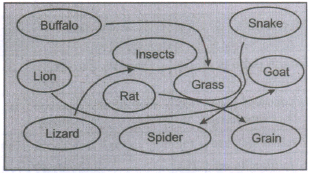
Connect the animal with the food it eats by an arrow using different colours in Fig. One is done for you.
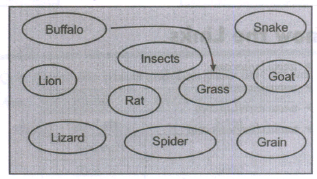
1.
(a) Baby
(b) Boat
(c) Sand
(d) Sand
2.
The wheat flour contains husk, which is rich in carbohydrates, so Sarthak advises his mother not to sieve wheat flour before making dough.
3.
An earthworm does not have bones or legs. It has muscles which help them to lengthen and shorten the body to move.
4.
Positive terminal of dry cell consists of carbon
5.
No, there will not be any difference because the length and breadth of an object are same in both the cases.
6.
Condensation refers to changing of water vapour into liquid on cooling which is just the opposite of evaporation.
7.
Non-periodic motion is a motion which does not repeat in equal intervals of time.
8.
Pressure changes the shape of material, e.g. when an inflated balloon is pressed between both hands, its shape and size change.
9.
Scurvy is caused by deficiency of vitamin-C.
10.
Pumpkin flowers are used as vegetables.
11.
We can do simple experiment for this
(i) Take tea dust on a paper.
(ii) Take a bar magnet in your hand.
(iii) Shake the bar magnet over this dust.
(iv) If some particles are attracted strongly towards this magnet, then definitely tea dust will have iron powder.
12.
Paheli can increase the numbers of rose plants in the garden by planting stem cutting of the rose plant. This will lead to reproduction.
13.
As we know that the silvered glass surface is very smooth and shiny as well. So, this type of surface helps informing the clear image. So, silvering makes it shiny and this shiny surface in turn helps in reducing the absorption.
14.
(a) If our elbow had a fixed joint, we would not be able to bend/fold our arms. A fixed joint does not allow any movement.
(b) If we were to have a ball and socket joints between our neck and head, we would be able to rotate our head 360°. A ball and socket joint allows movement in all directions.
15.
We need standard unit of measurements because the unit like handspan, foot, cubit differ from person to person or even indifferent countries. So, for a uniform measurement, standard unit of measurement is really required.
16.
(a) Glass Window pane, tumbler.
(b) Iron Rods, girders, buckets, nails.
(c) Gold Jewellery, coins.
(d) Aluminium Aeroplane, window frames.
17.
We can get the paper on paper recycling but it is not the same original paper that we get. The colour and texture of the paper change.
18.
The mango tree has very strong main stem as seen in other trees. It does not matter, when the branching starts in mango, it will always be called mango tree even if in dwarf varieties. It cannot be categorised as shrub.
19.
Paheli should include roughage in her diet. Roughage is the fibrous matter in food which cannot be digested. It has no nutritive value but its presence is essential for normal functioning of the digestive system. Thus, Paheli must include whole grains, pulses, fresh fruits and vegetables in her diet as fibre (roughage) is found in these food items.
20.
Ingredients of pizza are maida, butter, cheese and vegetables.
(a) Maida and vegetables come from plants.
(b) Butter and cheese do not come from plants. They come from animals.
21.
(c)
Giruting
22.
(d)
Air
23.
(a)
Conductor
24.
(b)
Ozone
25.
(d)
Atmosphere
26.
27.
28.
(c)
Left of an object appears right of the image
29.
(c)
Winnowing
30.
(d)
Moving vehicle on straight road
31.
(d)
Mustard
32.
(b)
blue bins
33.
(a)
North pole is almost equal to the South pole
34.
(d)
a thin wire
35.
(c)
Fat
36.
(c)
escaping cold weather
37.
(c)
Both the size and shape of the shadow of the tree change.
38.
(c)
Upper jaw and skull
39.
(b)
Two
40.
(c)
rainwater harvesting
41.
(a)
River water
42.
(d)
Any of the three scales
43.
(c)
Wood
44.
(b)
(i) and (iii)
45.
(c)
apical buds
46.
(d)
(i) and (iv)
47.
(b)
Melting of ghee
48.
(c)
Churning
49.
(b)
Vitamin-C
50.
(b)
Honey
51.
Natural fibres: Wool and Jute.
i) Wool is an animal fibre which is obtained from sheep.
ii) Jute is a plant fibre which is obtained from plant.
Synthetic fibres: Acrylic, Polyester, Rayon.
iii) These are man-made fibres which are prepared from different chemical substances.
52.
The drawbacks of plastics are as follows
(i) The major drawback of plastic is its non-degradability.
(ii) Consuming food packed in plastic bags could be harmful to our health.
(iii) All kinds of plastics give out harmful gases, on burning. These gases may cause many health problems, such as cancer, in humans.
(iv) Some animals such as cows swallow plastic bags filled with garbage, and they can die due to this.
(v) The plastics also block the sewerage system and the drains as a result of which the water spills over the roads during rains.
53.
An electric cell consists of a cylindrical pot which is covered by a thick paper sheet.
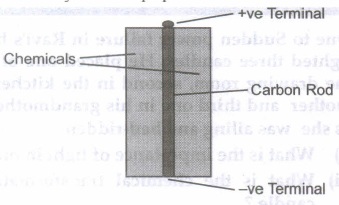
It consists of two terminals. One is called positive terminal and the other is called negative terminal. The metal cap is the positive terminal and the metal disc is the negative terminal of the electric cell.
The production of electric current takes place due to the chemical reactions inside the cell. The chemicals are present between the outermost covering of the cell and carbon rod.
54.

6th Standard CBSE Syllabus & Materials
6th Standard CBSE
CBSE 6th Social Science Locating Places on the Earth - New Sample Question Papers Study Material - QB365 Set A
NEW6th Standard CBSE
CBSE 6th Science A Journey Through States of Water - New Sample Question Papers Study Material - QB365 Set A
NEW6th Standard CBSE
CBSE 6th Science Temperature and its Measurement - New Sample Question Papers Study Material - QB365 Set A
NEW6th Standard CBSE
CBSE 6th Science Materials Around Us - New Sample Question Papers Study Material - QB365 Set A



CBSE 6th Standard CBSE Subjects
CBSE Standards




