
 100% FREE ACCESS
11th Standard Syllabus & Materials
11th Standard
TN 11th Tamil இயற்கை வேளாண்மை,சுற்றுச்சூழல் -செய்யுள் - மனோன்மணீயம் Important Questions And Answers Study Material - QB365 Set A
NEW11th Standard
TN 11th Tamil என்னுயிர் என்பேன் -துணைப்பாடம் - இசைத்தமிழர் இருவர் Important Questions And Answers Study Material - QB365 Set A
NEW11th Standard
TN 11th Tamil மொழி கலை -செய்யுள் - ஒவ்வொரு புல்லையும் Important Questions And Answers Study Material - QB365 Set A
NEW11th Standard
TN 11th Tamil பீடு பெற நில் - இலக்கணம் - பகுபத உறுப்புகள் Important Questions And Answers Study Material - QB365 Set A
NEW11th Standard
TN 11th Tamil பீடு பெற நில் - துணைப்பாடம் - வாடிவாசல் Important Questions And Answers Study Material - QB365 Set A
NEW11th Standard
TN 11th Tamil பீடு பெற நில் - செய்யுள் - குறுந்தொகை Important Questions And Answers Study Material - QB365 Set A

Published on: 27/04/2019
Most expected three mark questions in Basic Concepts of Chemistry and Chemical Calculations - IV
Download Tamil Nadu 11th Standard Chemistry question papers, model tests, one-mark questions, important questions, and public exam papers in PDF format. Free study materials and answer keys for TN State Board students.
Questions + Answers key
Take MCQ Chemistry Test
1.
Balance the following equation by oxidation number method. MnO4- + Fe2+ \(\rightarrow\) Mn2+ + Fe3+ (Acidic medium)
2.
The density of water at room temperature is 1.0 g/mI. How many molecules are there in a drop of water if its volume is 0.05 ml ?
3.
Chlorine is prepared in the laboratory by treating manganese dioxide (MnO2) with aqueous hydrochloric acid according to the reaction.
\({ 4HCl }_{ (aq) }+{ Mn }O_{ { 2 }_{ (s) } }\rightarrow 2H_{ 2 }{ O }_{ (1) }+{ MnCl }_{ { 2 }_{ (aq) } }+{ Cl }_{ { 2 }_{ (g) } }\)
How many grams of HCI react with 5.0 g of manganese dioxide?
(Atomic mass of Mn = 55 g).
4.
In three moles of ethane (C2H6) calculate the following:
(i) Number of moles of carbon atoms.
(ii) Number of moles of hydrogen atoms.
(iii) Number of molecules of ethane.
5.
Determine the empirical formula of an oxide of iron which has 69.9% iron and 30.1% oxygen by mass
6.
Balance the following equation using oxidation number method.
7.
What are competitive electron transfer reaction? Give example
8.
What is disproportionation reactions? Give example
9.
What are displacement reactions? Give its types. Explain with example.
10.
What is decomposition reaction? Give two examples.
11.
What is combination reaction? Give example
12.
What is the steps involve in the calculation of molecular formula from empirical formula?
13.
A compound on decomposition in the laboratory produces 24.5 g of nitrogen and 70 g of oxygen. Calculate the empirical formula of the compound.
14.
How would you calculate the equivalent mass of anhydrous oxalic acid and hydrated oxalic acid.
15.
0.6 g of a metal gives on oxidation 1 g of its oxide. Calculate its equivalent mass
16.
Calculate the molar mass of 20 L of gas weighing 23.2 g at STP.
17.
Calculate the molar volume of 146 g of HCI gas and the number of molecules present in it
18.
Calculate the number of atoms present in 1 Kg of gold
19.
Calculate the mass of the following atoms in amu,
(a) Helium (mass of He = 6.641 x 10⁻²⁴g)
(b) Silver (mass of Ag = 1.790 X 10⁻²²g)
20.
Explain about the classification of matter.
21.
Balance by oxidation number method : Mg + HNO3 \(\rightarrow\) Mg(NO3)2 + NO2 + H2O
22.
A sample of hydrated copper sulphate is heated to drive off the water of crystallization, cooled and reweighed 0.869 g of CuSO4.aH2O gave a residue of 0.556 g. Find the molecular formula of hydrated copper sulphate.
23.
Calculate the equivalent mass of hydrated ferrous sulphate
24.
How much copper can be obtained from 100 g of anhydrous copper sulphate ?
25.
Define equivalent mass of a salt.
26.
Distinguish among the different physical states of matter.
27.
Calculate the mass of sodium (in kg) present in 95 kg of a crude sample of sodium nitrate whose percentage purity is 70%.
28.
Calculate the equivalent, mass of hydrated sodium carbon.
29.
How much volume of nitrogen and hydrogen are required-to produce 100 cm3 of ammonia ?
30.
How much volume of hydrogen is liberated when 0.12g of magnesium reacts with dilute hydrochloric acid ?
31.
What is the amount of silver oxide formed when 11.04g of silver carbonate is strongly heated ? Write the balanced chemical equation for the .reaction.
Ag2C03 \(\rightarrow\)2AgO + CO2.
32.
Mass of one atom of an element is 6.66 x 10⁻²³ g.How many moles of element are there in 0.320 kg ?
33.
An organic compound has the following composition by mass:C = 40.92%, H = 4.58% and the rest oxygen. The molar mass of the compound is 176g mol. Determine the molecular formula of the compound.
34.
An organic compound contains the following composition by mass: C = 92.3%, H = 7.7%. At STP, 10L of the gas has the mass 11.6g. Find the molecular formula of the compound.
35.
A substance an analysis, gave the following percentage composition, Na = 43.4%, C = 11.3%, 0 = 43.3% calculate its empirical formula
36.
Calculate the volume occupied at STP by the following: 0.5 mole of methane
37.
Calculate the number of atoms / molecules present in the following 46 gram of sodium
38.
Calculate the number of atoms / molecules present in the following 1 kg of acetic acid (CH3COOH)
39.
Calculate the number of atoms / molecules present in the following 100 gram of sulphur dioxide
40.
Calculate the number of atoms / molecules present in the following 1.8 gram of water
41.
Calculate the number of atoms / molecules present in the following : 10 gram of mercury
42.
Explain the term "mole".
43.
Calculate the molecular masses of the following : C6H12O6
44.
Calculate the molecular masses of the following : H2C2O4.2H2O,
45.
Calculate the molecular masses of the following : NaOH
46.
Calculate the molecular masses of the following : KMnO4,
47.
The relative abundance of 10Af36, 10Ar38,10.Ar40are 0.337%,0.063% and 99.6% respectively. Calculate the average atomic weight of Argon:
48.
The relative abundance of 6C12,6C13 and 6C14 are 98.892%, 1.108% and 2 x 10⁻¹⁰respectively. Calculate the average atomic mass of carbon.
49.
Calculate the mass of the following atoms in a.m.u (unified atomic mass).
50.
Define a.m.u or unified atomic mass.
51.
Give two examples of elementary molecules which are
(i) Monoatomic
(ii) Diatomic and
(iii) Polyatomic.
52.
Define the following:
(i) Element
(ii) Compound.
53.
Balance the following reaction:
Sb3++ Mn\({ O }_{ 4 }^{ - }\)\(\rightarrow \) Sb5++ Mn2+
54.
Calculate the number of moles present in 9 grams of ethane.
55.
Balance the following equation using oxidation number method
As2 S3 + HNO3 + H2O \(\rightarrow\) H3 AsO4 + H2 SO4 + NO
56.
A Compound on analysis gave the following percentage composition C = 54.55%, H = 9.09%, O = 36.36%. Determine the empirical formula of the compound.
1.
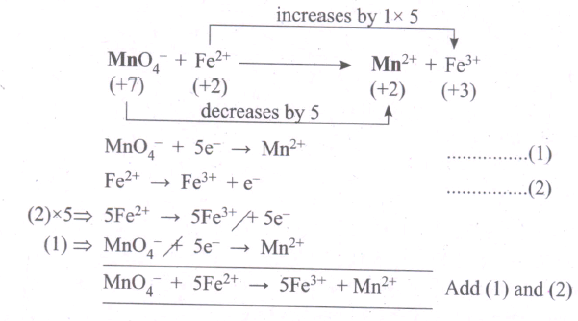
To balance O and H atoms, H2O and H+ are added.
MnO4- + 5Fe2+ + 8H+ \(\rightarrow\) 5Fe3+ + Mn2+ + 4H2O
2.
Volume of drop of water = 0.05 ml
Mass of a drop of water = Volume x Density
= 0.05 ml x 1.0 g / ml.
= 0.05 g
Molar mass of water (H2O) = 18 g
18 g of water = 1 mole
0.05 g of water = \(\frac { 1 }{ 18 } \times 0.05\)
= 0.0028 mol.
No. of molecules present in one mole of water = 6.023 x 10²³
No. of molecules present in 0.0028 mole of water = \(\frac { 6.023\times { 10 }^{ 23 }\times 0.0028 }{ 1 } \)
= 1.68 x 10²¹ water molecules.
3.
1 mole of MnO2 = 55 + 32 = 87 g.
87 g of MnO2 reacts with 4 moles of HCI. i.e. = 4 x 36.5 = 146 g of HCI.
\(\therefore\) 5 g of MnO2 wilI react with \(\frac { 146 }{ 87 } \) x 5.0 = 8.40 g.
4.
(i) 1 mole of C2H6 contains 2 moles of Carbon atoms.
\(\therefore\) 3 moles of C2H6 wilI have 6 moles of Carbon atoms.
(ii) 1 mole of C2H6 contains 6 moles of Hydrogen atoms.
\(\therefore\) 3 moles of C2H6 wilI have 18 moles of Hydrogen atoms.
(iii) 1 mole of C2H6 contains 6.023 x 10²³number of molecules.
\(\therefore\) 3 moles of C2H6 will contain 3 x 6.023 x 1023molecules.
5.
| Element | Percentage | Atomic mass | Relative No. of atoms | Simple ratio | Simplest whole number ratio |
|---|---|---|---|---|---|
| Fe | 69.9% | 55.85 | \(\frac { 69.9 }{ 55.85 } =1.25\) | \(\frac { 1.25 }{ 1.25 } =1\) | 1 x 2 = 2 |
| O | 30.1% | 16 | \(\frac { 30.1 }{ 16 } =1.88\) | \(\frac { 1.88 }{ 1.25 } =1.5\) | \(\frac { 3 }{ 2 } \times 2=3\) |
\(\therefore\) The empirical formula is Fe2O3.
6.
S + HNO3 H2SO4 + NO2 + H2O
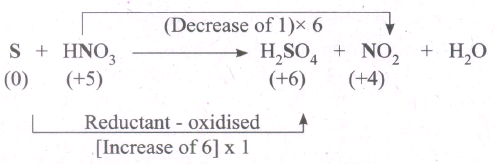
2. S + 6HNO3 \(\rightarrow\) H2SO4 + NO2 + H2O
3. Balance the equation (except O and H).
S + 6HNO3 \(\rightarrow\) H2SO4 + 6NO2 + H2O
4. Balance O atoms by adding 2H2O.
S + 6HNO3 \(\rightarrow\) H2SO4 + 6NO2 + 2H2O
7.
These are the reactions in which redox reactions take place in different vessels and it is an indirect redox reaction. There is a competition for the release of electrons among different metals.
Example: Zn releases electrons to Cu and Cu releases electrons to Silver and so on.
Zn(s) + Cu2+ \(\rightarrow\) Zn2+(aq) + Cu(s) (Here Zn - oxidised; Cu2+ - reduced)
Cu(S) + 2Ag+ \(\rightarrow\) Cu2+(aq)+ 2Ag(s) (Here Cu - oxidised; Ag+ - reduced)
8.
The reactions in which an element undergoes simultaneously both oxidation and reduction are called as disproportionation reactions
Example: P4 + 3NaOH + 3H2O \(\rightarrow\) PH3 + 3NaH2PO2
2HCHO + H2O \(\rightarrow\) CH3OH + HCOOH
9.
The reactions in which one ion or atom in a compound is replaced (or substituted) by an ion or atom of the other element are called displacement reactions.
AB + C \(\rightarrow\) AC + B
Example: Metal displacement
CuSO4 + Zn \(\rightarrow\) ZnSO4 + Cu
Example: Non-metal displacement
2KBr +C12 \(\rightarrow\) 2KCI + Br2
10.
Chemical reactions in which a compound splits up into two or more simpler substances are called decomposition reaction
A B \(\rightarrow\) A + B
Example: 2KClO3 \(\rightarrow\) 2KCl + O2
PCl5 \(\rightarrow\) PCl3 +Cl2
11.
When two or more substances combine to form a single substance, the reactions are called combination reactions
A + B \(\rightarrow\) C
Example: 2MG + O2 \(\rightarrow\) 2MgO
12.
Molecular mass and empirical formula are used to deduce molecular formula of the compound.
Steps to calculate molecular formula:
1. Empirical formula is found out from the percentage composition of elements
2. Empirical formula mass can be found from the empirical formula
3. Molecular mass is found out from the given data
4. Molecular formula = (Empirical formula)n
5. where, n = \(\frac { molecular\ mass }{ empirical\ formula\ mass } \)
13.
| Element | Percentage | Atomic mass | Relative No. of atoms | Simple ratio of atoms | Simplest whole number ratio |
|---|---|---|---|---|---|
| N | 24.5% | 14 | \(\frac { 24.5 }{ 14 } =1.75\) | \(\frac { 1.75 }{ 1.75 } =1\) | 1 x 2 = 2 |
| O | 70% | 16 | \(\frac { 70 }{ 16 } =4.38\) | \(\frac { 4.38 }{ 1.75 } =2.5\) | \(\frac { 5 }{ 2 } \times 2=5\) |
\(\therefore\) The empirical formula is N2O5.
14.
In acid medium,
\(\overset { \overset { COOH }{ \underset { COOH }{ | } } }{ \overset { Oxalic\ acid }{ \left( 90\ g \right) } } +\underset { (16g) }{ \left[ O \right] } \longrightarrow { 2CO }_{ 2 }+{ H }_{ 2 }O\)
16 g of oxygen is used for oxidation of 90 g of oxalic acid.
\(\therefore\) 8 g of oxygen will oxidize = \(\frac { 90 }{ 16 } \times 8\) = 45 g eq-1.
Equivalent mass of Anhydrous oxalic acid 45 g eq-1.
Equivalent mass of \(\overset { COOH }{ \underset { COOH }{ | } } .{ 2H }_{ 2 }O=\frac { Molar\ mass }{ basicity } \)
= \(\frac { 126 }{ 2 } \)
= 63 g eq-1.
15.
Mass of metal = 0.6
Mass of metal oxide = 1 g
\(\therefore\) Mass of oxygen = .1 - 0.6 = 0.4 g
0.4 g of oxygen combines with 0.6 g of metal.
\(\therefore\) 8 g of oxygen will combine with \(\frac { 0.6 }{ 0.4 } \times 8\)
Equivalent mass of the metal = 12 g eq-1
16.
Molar mass = \(\frac { weight\ of\ the\ substance\ \times \ Molar\ volume }{ Volume\ of\ the\ substance\ at\ STP } \)
Molar volume at STP = 2.24 x 10⁻² m3
= 22.4 L (or) 22400 cc
Molar mass of the gas at STP = \(\frac { 23.2\times 22.4 }{ 20 } \)
= 25.984 g
17.
Molar mass of HCl = 36.5 g
The molar volume of 36.5 g (1 mole) of He 1 = 2.24 x 10⁻²m3.
\(\therefore\) The volume of 146 g (4 moles) of HCI = \(\frac { 2.24\times { 10 }^{ -2 } }{ 36.5 } \times 146\)
= 8.96 x 10⁻²m3
No. of molecules in 146 g of HCI = 4 N
= 4 x Avogadro Number
= 4 x 6.023 x 1023
= 24.092 x 1023
= 2.4092 x 1024 molecules.
18.
The atomic mass of Gold = 197 g mol-1.
197 g of gold contains 6.023 x 10²³atoms of gold.
\(\therefore\) 1000 g of gold will contain = \(\frac { 1000\times 6.023\times { 10 }^{ 23 } }{ 197 } \)
= 3.055 x 1024 atoms of Gold.
19.
1 amu = 1.66056 x 10⁻²⁴
(a) The mass of He hum atom in amu = \(\frac { 6.641\times { 10 }^{ -24 } }{ 1.66056\times { 10 }^{ -24 } } \) = 3.9992 amu
(b) The mass of Silver atom in amu = \(\frac { 1.790\times { 10 }^{ -22 } }{ 1.66056\times { 10 }^{ -24 } } \) = 107.79 amu
20.
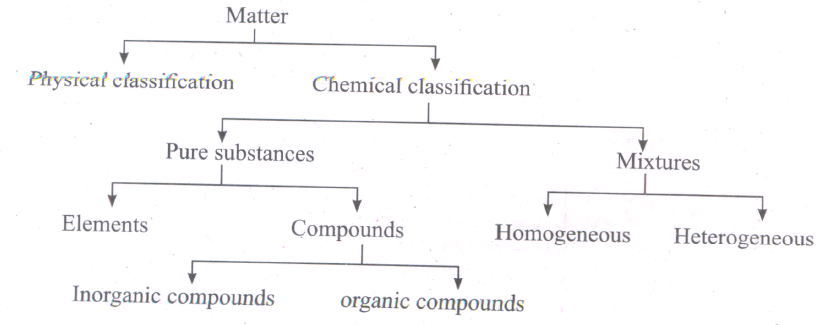
21.
Step 1:
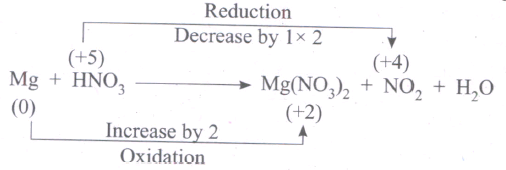
Step 2 : Mg + 2HNO3 \(\rightarrow\) Mg(NO3)2 + NO2 + H2O
Step 3 . To balance the number of oxygen atoms and hydrogen atoms 2HNO3 is multiplied by 2.
Mg + 4HNO3 \(\rightarrow\) Mg(NO3)2 + 2NO2 + H2O
Step 4. To balance the number of hydrogen atoms, the H2O molecule is multiplied by 2.
Mg + 4HNO3 \(\rightarrow\) Mg(NO3)2 + 2NO2 + 2H2O
22.
0.869 g of CuSO4.aH2O gave a residue of 0.556 g of Anhydrous CuSO4.
\(\therefore\) Weight of a H2O molecule = 0.869 - 0.556
= 0.313 g
Molecular weight of H2O = (1 x 2) + 16 = 2 + 16 = 18
No. of moles of water = \(\frac { mass }{ Molecular\ mass } \)
CuSO4.5H2O - Molecular mass = 63.5 + 32 + 64 + 90.
= 249.5 g
249.5 g of CuSO4.5H2O on heating gives 159.5 g of CuSO4.
0.869 g of CuSO4.aH2O on heating gives
= \(\frac { 159.5 }{ 249.5 } \times 0.869\)
= 0.556 g of anhydrous CuSO4.
\(\therefore\) a = 5
23.
Hydrated ferrous sulphate = FeSO4.7H2O
Ferrous sulphate - Reducing agent
Ferrous sulphate reacts with an oxidising agent in acid medium according to the equation.
2FeSO4 + H2SO4 + [O] \(\rightarrow\) Fe2(SO4)3 + H2O
2 x 152g 16g
16 parts by mass of oxygen oxidised 304 g of FeSO4.
8 parts by mass of oxygen will oxidise \(\frac { 304 }{ 16 } \times 8\) Parts by mass of FeSO4.
= 152
Equivalent mass of Ferrous sulphate (Anhydrous) = 152
Equivalent mass of crystalline Ferrous sulphate FeSO4 7H2O
= 152 + 126 = 278
24.
Anhydrous copper sulphate = CuSO4
Molecular mass of CuSO4 = 63.5 + 32 + (16 x 4)
= 63.5 + 32 + 64
= 159.5 g
159.5 g of CuSO4 contains 63.5 g of copper.
\(\therefore\) 100 g of CuSO4 contains \(\frac { 63.5 }{ 159.5 } \times 100\) = 0.39811 x 100
= 39.81 g of Copper.
25.
Equivalent mass of a salt:
It is defined as the number of parts by mass of the salt that is produced by the neutralization of one equivalent of an acid by a base. Therefore the equivalent mass of the salt is equal to its molar mass.
26.
Differences among three physical states of matter (solid, liquid and gas) are as follows.
| S.No | Properties | Solid | Liquid | Gas |
|---|---|---|---|---|
| 1. | Volume | Definite | Definite | No Definite |
| 2. | Shape | Definite | No Definite | No Definite |
| 3. | Molecular arrangement | Very closely packed | Loosely packed | Very loosely packed |
| 4. | Freedom of movement | Not much freedom | Move around and better than solid | Move easy and fast |
| 5. | Compressibility | Non compressible | Less compressible | Easily compressible |
27.
Mass of impure sample of sodium nitrate (NaNO3) = 95 x 1000g
Mass of pure sample of sodium nitrate (NaNO3) = 95 x 1000 x \(\frac { 70 }{ 100 } \)
= 66500 g
1 mole of pure NaNO3 = 85 g
85 g NaNO3 = 523 g of Na
66,500 of NaNO3 = \(\frac { 23 }{ 85 } \) x 66500 g of Na
= 17994.1 gram
= 17.99 kg
28.
Hydrated sodium carbonate has the formula Na2CO3.10H2O
Molecular mass of Na2CO3.10H2O = { 2 x atomic mass of Na + 1 x atomic mass of C + 3 x atomic mass of oxygen + 10 x molar mass of H2O
= 2 x 23 + 12 + 3 x 16 + 10 x 18
= 46 + 12 + 48 + 180
= 286 u
2 NaOH + H2CO3 ⟶ Na2CO3 + 2H2O
Equivalent mass of NaOH = Molar mass of NaOH
2 equivale it of NaOH = 1 equivalent of Na2CO3
1 equivalent of NaOH = 1/2 equivalent mass of Na2CO3
Equivalent mass = \(\frac { Molar\quad mass }{ 2 } \)
=\(\frac { 286 }{ 2 } \) = 143 g eq-1
29.
The balanced equation for the reaction is,
N2 + 3H2 \(\rightarrow\) 2NH3
According to the equation,
2 x 22400 cm3 of NH3 is produced by 1 mol of N2 = 22400 cm3
100 cm3 of NH3 will be produced by = \({22400\over2\times22400}\times100=50cm^3\)
Similarly, 2 x 22400 cm3 of NH3 are produced by = 3 x 22400 cm3 of H2
100cm3 of NH3 Will be produced by =\({3\times22400\over2\times22400}\times100=150cm^3\)
30.
The balanced chemical equation for the reaction is
Mg + 2HCI \(\rightarrow\) MgCl2 + H2
Atomic mass of Mg = 24g mol-1
According to the equation,
1 mol of Mg (24 g) will liberate 1 mol of H2 = 22.4L at STP
24g of Mg = 22.4 L of H2 at STP
\(0.12g \ of \ Mg={22.4\over24}\times0.12g \ of H_2 \ at STP\)
= 0.112 L or
= 112 cm3 at STP
31.
Molar mass of A g2CO3 = \(\{2\times atomic\ mass\ of \ Ag+atomic\ mass\ of\ C +3\times atomic\ mass \ of\ 'O'\)
= 2 x 10⁸ + 12 + 3 x 16
= 276 u
Molar mass of AgO = atomic mass of Ag+ atomic mass of '0'
= 108 + 16 = 124g mol-1
When silver carbonate is heated, carbon dioxide leaves as gas and silver oxide remains as a residue.
According to the equation,
One mol of Ag2C03leaves = 2 mol of AgO as residue
276 g of Ag20 = 124g of AgO
\(11.04 \ of \ Ag_2O={124\over276}\times 11.04g \ of \ AgO\)
= 4.96g
32.
No. of mol = \(\frac { Weight\ of\ the\ substance\ in\ gram }{ Gram\ molecular\ mass } \)
Step - 1 : Find the gram molecular weight of the atom.
Mass of 6.3023 x 10²³ atoms = 1 mole
= 1 gram molecular weight
Mass of one atom of the element = 6.626 x 10⁻²³ g
Mass of 6.023 x 10²³ atoms = 6.626 x 10-23 x 6.023 x 1023
= 40.1
Therefore, the gram molecular weight of the element is 40.1g
Step -2 : To find the number of mol in 0.320 kg
Number of mol = \(\frac { 0.320\times 1000g }{ 40.1g } \)
= 7.98 ≃ 8 mol.
33.
| Element | % of composition | Atomic Mass | relative no of moles | Simple ratio | Simplest Whole Number ratio |
|---|---|---|---|---|---|
| C | 40.92 | 12 | \(\frac { 40.92 }{ 12 } =3.41\) | \(\frac { 3.41 }{ 3.40 } =1\) | 3 |
| H | 4.58 | 1 | \(\frac { 4.58 }{ 1 } =4.58\) | \(\frac { 4.58 }{ 3.40 } =1.35\) | 4 |
| O | 54.45 | 16 | \(\frac { 54.45 }{ 10 } =3.40\) | \(\frac { 3.40 }{ 3.40 } =1\) | 3 |
The empirical formula is C3H403
Empirical formula mass = 3 x 12 + 4 x 1 + 3 x 16 = 88
Molar mass = 176g mol-1
n = \(\frac { molar\quad mass }{ Empirical\quad formula } =\frac { 176 }{ 88 } =2\)
Molecular formula = (Empirical formula)n
= (C3H4O3)2
= C6H8O6
34.
| Element | % of Composition | Atomic mass | Relative No.of moles | Simple ratio | Simplest Whole number ratio |
|---|---|---|---|---|---|
| C | 92.3 | 12 | \(\frac { 92.3 }{ 12 } =7.7\) | \(\frac { 7.7 }{ 7.7 } =1\) | 1 |
| H | 7.7 | 1 | \(\frac { 7.7 }{ 1 } =7.7\) | \(\frac { 7.7 }{ 7.7 } =1\) | 1 |
The empirical formula is CH
The empirical formula mass = 12 + 1 = 13
To find the molecular mass:
10 L of the gas at STP weigh = 11.6g
22.4L of the gas at STP will weigh = \(\frac { 11.6 }{ 10 } \times 22.4\)
\(=25.98=26\)
\(n=\frac { Molar\ name }{ Empirical\ formula\ mass } \)
= \(\frac { 26 }{ 13 } =2\)
Hence, the molecular formula = (Empirical formula)
(CH)2 = C2H2
The molecular formula of the compound is C2H2
35.
| Element | % of Composition | atomic mass | relative no.of moles | Simple ratio | Simplest whole number ratio |
|---|---|---|---|---|---|
| Na | 43.4 | 23 | \(\frac { 43.4 }{ 23 } =1.886\) | \(\frac { 1.886 }{ 0.94 } =2.0\) | 2 |
| C | 11.3 | 12 | \(\frac { 11.3 }{ 12 } =0.942\) | \(\frac { 0.942 }{ 0.94 } =1.0\) | 1 |
| O | 43.3 | 16 | \(\frac { 0.942 }{ 0.94 } =1.0\) | \(\frac { 2.70 }{ 0.94 } =2.8\) | 3 |
The empirical Formula is Na2Co3
36.
1 mol of CH4 = 22400 cm3 at NTP
0.5 mol of CH4 = 22400 x 0.5
= 11200 cm3 at NTP
37.
Atomic mass of sodium = 23 a.m.u
1 mol of Na = 23g = 6.023 x 10²³ atoms
46 g = \({6.023\times 10^{23}\over 23}\times 46 \ atoms\)
= 12.046 x 10²³ atoms
38.
Molecular formula of acetic acid is CH3 COOH.
Molecular mass of acetic acid = 60
1 mol of acetic acid = 60g of acetic acid
= 6.023 x 10²³molecules
1000 g of acetic acid = \({6.023\times10^{23}\over 60}\times 1000\)
=1.0 x1025 molecules.
39.
Molecular formula of sulphur dioxide = S02
Molecular mass of sulphur dioxide = 64
1 mole of S02 = 64 g of S02 = 6.023 x 10²³molecules
\(100g of SO_2={6.023\times 10^{23}\over64}\times 100 \)
= 9.41 x 10²³ molecules.
40.
Molecular mass of H20 = 18
gram molecular mass of H20 = 18g
1 mol of H20 = 18g of H20 = 6.023 x 10²³molecules of water
1.8g of H20 = \({6.023\times10^{23}\over18}\times1.8 \)
\(=6.023\times10^{22} molecules\)
41.
Atomic mass of Hg = 200.59
(i) Gram atomic mass of Hg = 200.59 g
1 mol of Hg = 200g = 6.023 x 10²³atoms
\(10g={6.023\times 10^{23}\over200}\times 10\)
= 0.301 x 1023
= 3.01 x 10²² atoms
42.
(i) Mole is the SI unit to represent a specific amount of a substance.
(ii) One mole is the amount of substance of a system which contains as many elementary particles as there are in 12g of carbon -12-isotope.
(iii) Mole represents the mass in gram of 6.022 x 10²³entities (atom or molecule / ion).
(iv) 1 mole of any substance contains 6.023 x 10²³entities.
43.
C6H12O6 (glucose)
\(Molecular \ mass \ of \ C_6H_{12}O_6=\{{6\times atomic \ mass \ of \ C +12 \times \ atomic \ mass \ of \ H+6\times \ atomic \ mass \ of \ O}\)
= 6 \(\times\)12 + 12\(\times\)1 + 6\(\times\)16
= 72 + 12 + 96 = 180u
44.
H2C2O4.2H2O(crystalline oxalic acid)
\(Molecular \ mass \ of \ H_2C_2O_4.2H_2O= \{{2\times atomic \ mass \ of \ H + 2 \times \ atomic \ mass \ of \ C+4\times \ atomic \ mass \ of \ o+2\times moecular \ mass \ of H_2O}\)
= 2 x 1 + 2 x 12 + 4 x 16 + 36
= 2 + 24 + 64 + 36 = 126 u.
45.
\(Molecular \ mass \ of \ NaOH=\{{1\times atomic \ mass \ of \ Na + 1 \times \ atomic \ mass \ of \ O+1\times \ atomic \ mass \ of \ H}\)
= 1 \(\times\) 23 + 1\(\times\)16 + 1\(\times\)1
= 23 + 16 + 1 = 40 u
46.
\(Molecular \ mass \ of \ KMnO_4=\{{1\times atomic \ mass \ of \ K + 1 \times \ atomic \ mass \ of \ Mn +4 \times atomic \ mass \ of \ o}\)
atomic mass of K = 39.098 = 39
atomic mass of Mn = 54.938 = 55
atomic mass of 'O' = 15.999 = 16
\(\therefore\) Molecular mass of KMnO4 = 39 + 55 + 4 x 16
=·158 u
47.
\(Average \ atomic \ mass \ of \ Argon={36\times \% abundance of \ Ar^{36}+38\times \% abundance of Ar^{38} +40 \times \% abundance of Ar^{40}\over 100}\)
given % abundance of Ar36 = 0.337
Ar38 = 0.063
Af40 = 99.6
Average atomic mass of Argon = \(36\times 0.337 +38\times 0.063+40\times 99.6\over 100\)
=\(12.132+2.394+3.984\over100\)
=\(3998.5\over100\) = 39.98 a.m.u
48.
\(Average \ atomic \ mass \ of \ carbon ={12\times \%abundance \ of \ C^{12}+13 \times \% \ abundance \ of \ C^{13}+14\% abundance of c^{14} \over 100} \)
given % abundances Of C12 = 98.892
C13 = 1.108
CI4 = 2 x 10⁻¹⁰
Since 2 x 10⁻¹⁰is so small compound to 100, it can be neglected .
\(Average \ atomic \ mass \ of \ carbon ={12\times 98.892 +13 \times 1.108 \over 100} \)
= 12.01 a.m.u
49.
(i) Oxygen: (average mass of oxygen atom = 2.656 x 1O-23g
1 a.m.u = 1.6605 x 1O-27kgor 1.6605 x 1O-24gram)
(ii) Mass of an oxygen atom = 2.656 x 1O-23g
The mass of oxygen atom In a.m.u = \({Average \ mass \ of \ oxygen \ atom \ in \ gram\over1.6605\times10^{-24}}\)
\(={2.656\times10^{-23}g\over1.6605 \times 10^{-24}g}\)
= 1.599 x10
= 15.99 a.m.u
50.
The quantity \(1\over12\) mass of an atom of carbon -12 is known as the atomic mass unit. (a.m.u). The
actual mass of one atom ofcarbon-12 is 1.9914 x 10⁻²³g or 1.9914 x 10⁻²⁶kg.
Thus,
\(\boxed{1a.m.u={1.9924\times10^{-23}\over12}=1.66\times10^{-27}kg}\)
\(\therefore\)Atomic mass 0f an element =\({Mass \ of \ one \ atom \ of \ the \ element \over 1 a.m.u}\)
51.
(i) Monoatomic molecules: Copper (Cu) and Gold (Au)
(ii) Diatomic molecule: Hydrogen (H2) and Oxygen (O2)
(iii) Polyatomic molecule: Phosphorous (P4) and Sulphur (S8)
52.
(i) An element consists of only one type of atom ..An atom is the smallest electrically neutral - particle, being made up of fundamental particles, namely electrons, protons and neutrons.
(ii) Compounds are made up of molecules which contain two or more atoms of different elements. Properties of compounds are different.from those of their constituent elements. The constituents of a compound is present in a fixed ratio by weight.
53.
.png)
Equalise the increase/decrease in Oxidation number by multiplying with suitable numbers.
5Sb3++ 2Mn\({ O }_{ 4 }^{ - }\)\(\rightarrow \) Sb5++ Mn2+
Balance all other atoms except O and H
5Sb3++ 2Mn\({ O }_{ 4 }^{ - }\)\(\rightarrow \) 5Sb5++ 2Mn2+
Balance Oxygen atom by adding H2O on the side falling short of oxygen.
5Sb3++ 2Mn\({ O }_{ 4 }^{ - }\)\(\rightarrow \) 5Sb5++ 2Mn2+ +8H2O
Balance hydrogen atom by adding H+ on the side falling short of hydrogen atoms.
5Sb3++ 2Mn\({ O }_{ 4 }^{ - }\)\(\rightarrow \) 5Sb5++ 2Mn2+ +8H2O + 16H+
54.
Molar mass of ethane, C2H6 = (2 x 12) + (6 x 1) = 30 g mol-1
n = mass / molar mass = 9g / 30 g mol-1 = 0.3 mole
55.
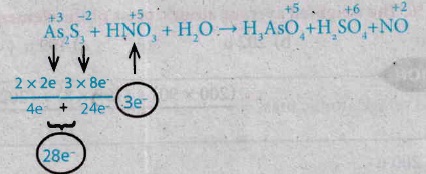
Equate the total no. of electrons in the reactant side by cross multiplying.
\(\Rightarrow 3 \mathrm{As}_{2} \mathrm{~S}_{3}+28 \mathrm{HNO}_{3}+\mathrm{H}_{2} \mathrm{O} \rightarrow \mathrm{H}_{3} \mathrm{AsO}_{4}+\mathrm{H}_{2} \mathrm{SO}_{4}+\mathrm{NO}\)
Based on reactant side, balance the products
\(\Rightarrow 3 \mathrm{As}_{2} \mathrm{~S}_{3}+28 \mathrm{HNO}_{3}+\mathrm{H}_{2} \mathrm{O} \rightarrow 6 \mathrm{H}_{3} \mathrm{AsO}_{4}+9 \mathrm{HSO}_{4}+28 \mathrm{NO}\)
Product side : 36 hydrogen atoms & gg Orygen atoms
Reactant side : 28 hydrogen atoms & 74 Orygen atoms
Difference is 8 hydrogen atoms & 4 oxygen atoms
∴ Add 4 H2O molecule on the reactant side.
Balanced equation is,
\(3 \mathrm{As}_{2} \mathrm{~S}_{3}+28 \mathrm{HNO}_{3}+4 \mathrm{H}_{2} \mathrm{O} \rightarrow 6 \cdot \mathrm{H}_{3} \mathrm{AsO}_{4}+9 \mathrm{H}_{2} \mathrm{SO}_{4}+28 \mathrm{NO}\)
56.
| Elements | Percentage | Atomic Mass |
Relative No. of moles = percentage/Atomic mass |
Simple ratio of |
|---|---|---|---|---|
| C | 54.55% | 12 | \(\frac { 54.55 }{ 12 } =4.55\) | \(\frac { 4.54 }{ 2.27 } =2\) |
| H | 9.09% | 1 | \(\frac { 9.09 }{ 1 } =9.09\) | \(\frac { 9.09 }{ 2.27 } =4\) |
| O | 36.36% | 16 | \(\frac { 36.06 }{ 16 } =2.27\) | \(\frac { 2.27 }{ 2.27 } =1\) |
| Empirical Formulla = C2H4O | ||||

11th Standard Syllabus & Materials
11th Standard
TN 11th Tamil பீடு பெற நில் - செய்யுள் - காவடிச்சிந்து Important Questions And Answers Study Material - QB365 Set A
NEW11th Standard
TN 11th Tamil பீடு பெற நில் - உரைநடை - மலை இடப்பெயர்கள் : ஓர் ஆய்வு Important Questions And Answers Study Material - QB365 Set A
NEW11th Standard
TN 11th Tamil மாமழை போற்றுதும் - துணைப்பாடம் - யானை டாக்டர் Important Questions And Answers Study Material - QB365 Set A
NEW11th Standard
TN 11th Tamil மாமழை போற்றுதும் - செய்யுள் - ஐங்குறுநூறு Important Questions And Answers Study Material - QB365 Set A



Tamilnadu Stateboard 11th Standard Subjects

Maths

Commerce

Economics

Biology

Business Maths and Statistics

Accountancy

Computer Science

Physics
Chemistry
Maths
Biology
Economics
Physics
Chemistry

History
Business Maths and Statistics

Computer Science
Accountancy

Computer Applications
History
Computer Technology
Commerce
Computer Applications
Computer Technology

Tamil

English

French
Tamilnadu Stateboard Standards
