
 100% FREE ACCESS
6th Standard CBSE Syllabus & Materials
6th Standard CBSE
CBSE 6th Social Science The Value of Work - New Sample Question Papers Study Material - QB365 Set A
NEW6th Standard CBSE
CBSE 6th Social Science Family and Community - New Sample Question Papers Study Material - QB365 Set A
NEW6th Standard CBSE
CBSE 6th Social Science India's Cultural Roots - New Sample Question Papers Study Material - QB365 Set A
NEW6th Standard CBSE
CBSE 6th Social Science India,That is Bharat - New Sample Question Papers Study Material - QB365 Set A
NEW6th Standard CBSE
CBSE 6th Social Science Timeline and sources of history - New Sample Question Papers Study Material - QB365 Set A
NEW6th Standard CBSE
CBSE 6th Social Science Oceans and Continents - New Sample Question Papers Study Material - QB365 Set A

Published on: 01/08/2018
In New Empires and Kingdoms contains important questions in CBSE 6th Standard Social Science. It also covered with the most important questions in New Empires and Kingdoms.
Teachers please subscribe Now and Create Unlimited 6th Standard Social Science question papers with answer keys. For subscription, please Click Here.
Download CBSE Class 6th Standard CBSE Social Science question papers, sample papers, important questions, and previous year solved papers in PDF format. Get free study materials, NCERT solutions, and exam preparation resources for Class 6th Standard CBSE Social Science
Questions + Answers key
Take MCQ Social Science Test
1.
What does Samudragupta's prashasti tell?
2.
Do you think ordinary people would have read and understood the prashastis? Give reasons for your answer.
3.
Mention three authors who wrote about Harshavardhana
4.
What do you think may have been the advantages and disadvantages of having hereditary officers?
5.
What was the difference between the way in which Samudragupta treated the rulers of Aryavarta and Dakshinapatha? Can you suggest any reasons for this difference?
6.
Zero is a special symbol which was invented by
India
Arabs
Japan
Europe
7.
The technique of making paper was first introduced in which of the following countries?
Korea
Japan
India
China
8.
Who was Aryabhata?
A politician
An astronomer
A teacher
A writer
9.
Who among the following persons composed Silappadikaram?
Banbhatta
Kalidasa
Ilango
None of these
10.
Where was the image of the chief deity placed?
Bhitargaon
Garbhagriha
Shikhara
None of these
11.
Iron pillar is located in which of the following cities?
New Delhi
Sarnath
Ajmer
Bulandshahar
12.
Which of the following is the sacred book of Islam?
The Bible
The Gita
The Quran
The Avesta
13.
Who was the chief judicial officer in the reign of Samudragupta?
Harishena
Ravikirti
FaXian himself
Samudragupta
14.
Ravikirti was the court poet of which of the following kings?
Pulakeshin
Pulakeshin II
Chandragupta II
Samudragupta
15.
Harishena was the court poet of
Harsha
Samudragupta
Chandragupta
Banabhatta
16.
How many rulers were there in Dakshinapatha?
17.
Coin of which period depicted Samudragupta is playing the veena?
18.
Who were the most important ruling dynasties in South India?
19.
Kumara Devi belonged to which gana?
20.
What is the meaning of the word prashasti?
21.
Who was Pulakeshin II? Mention his main achievements, as describes his prashasti?
22.
Describe some of the main achievements of the Pallavas and the Chalukyas.
23.
The Prathama-kulika stands for the ______________
24.
Harshacharita is the biography of______________
25.
The court poet of Pulakeshin II was ____________
26.
The kingdom of the Pallavas spread from the region around their capital, _____________to the Kaveri delta.
27.
The _____________and Chalukyas were the most important ruling dynasties in South India.
28.
The ruler of Northern India was called Dakshinapatha.
29.
Sandhi-vigrahika means a minister of war and peace.
30.
Harishena was Pulakeshin II's court poet.
31.
Aihole was the capital of Chalukya.
32.
Harshavardhana took over the kingdom of Kanauj after the death of his brother-in-law.
33.
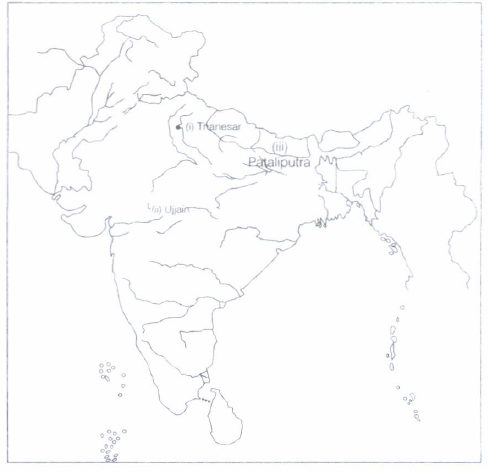
Mark the following important cities and kingdoms on the outline map of India:
(i) Thanesar (ii) Ujjain (iii) Pataliputra
1.
In Samudragupta's prashasti, the poet praised the king in glowing terms-as a warrior, as a king who won victories in battle, who was learned and the best of poets. He is also described as equal to the Gods.
2.
Prashasti is a Sanskrit word which means 'in praise of.' Hence, the prashastis are composed in praise of contemporary kings. They were written by either royal poets or written by the visitors who visited India during this time. Mainly these prashastis were written in Sanskrit which was difficult for common men to read and understand.
3.
The three authors who wrote about Harshavardhana were:
(i) Hien-T-Sangs (Xuan Zang)
(ii) Banabhatta
(iii) He himself has written some books.
4.
The advantages and disadvantages of having hereditary officers are described below:
Advantages
(i) The father could train his son from an early age in the office that he held.
(ii) There will be a continuity of policy.
Disadvantages
(i) An incompetent son may come to hold the office.
(ii) Other more competent persons will be deprived of the opportunity to run the office.
5.
In Aryavarta, there were nine rulers who were uprooted and their kingdoms were made a part of Samudgragupta's empire.
In Dakshinapatha, there were twelve rulers. They surrendered to Samudragupta after being defeated and he then allowed them to rule again.
Samudragupta adopted different policies because Dakshinapatha was far away from his capital, since the means of transport were primitive, it was difficult to keep the rulers under control.
6.
(a)
India
7.
(d)
China
8.
(b)
An astronomer
9.
(c)
Ilango
10.
(b)
Garbhagriha
11.
(a)
New Delhi
12.
(c)
The Quran
13.
(a)
Harishena
14.
(b)
Pulakeshin II
15.
(b)
Samudragupta
16.
()
There were twelve rulers in Dakshinapatha.
17.
()
Coin of Gupta period depicted Samudragupta is playing the veena.
18.
()
The Pallavas and Chalukyas were the most important dynasties in South India.
19.
()
Kumara Devi belonged to Lichchhavi gana.
20.
()
Prashasti is a Sanskrit word meaning 'in praise of'.
21.
(i) The best known Chalukya ruler was Pulakeshin II. We known about him from a prashasti. This prashasti (inscription) was composed by Pulakeshin II's court poet Ravikirti. This tells us about his ancestors, who are traced back through four generations from father to son.
(ii) Pulakeshin II evidently got the Kingdom from his uncle. According to Ravikirti
(a) He led expeditions along both the West and the East coast.
(b) Pulakeshin II checked the advance of Harsha. Harsha means happiness.
(c) Pulakeshin II also attacked the Pallava king, who took shelter behind the walls of Kanchipuram. However the successors of Pulakeshin II were not very capable and therefore the Chalukyas victory was short-lived.
22.
The main achievements of the Pallavas and the Chalukyas were:
(i) The Pallavas and Chalukyas were that most important ruling dynasties in South India. The kingdom of the Pallavas spread from the region around their capital, Kanchipuram to the Kaveri delta, while that of the Chalukyas was centred around the Raichur Doab, between the rivers Krishna and Tungabhadra.
(ii) The Pallavas and Chalukyas frequently attacked one another's areas, particularly they attacked the capital cities, which were prosperous towns.
(iii) Aihole, the capital of the Chalukyas, was an important trading and commercial centre. Initially this town developed as a religious centre, with a number of temple.
(iv) During the days of Pulakeshin II, the Chalukyas defeated Harshavardhana. But this victory was short-lived.
(v)Ultimately, both the Pallavas and the Chalukyas gave way to new rulers belonging to Rashtrakuta and Chola dynasties.
23.
()
Chief craftsman
24.
()
Harshavardhana
25.
()
Ravikirti
26.
()
Kanchipuram
27.
()
Pallavas
28.
(b)
29.
(a)
30.
(b)
31.
(a)
32.
(a)
33.

6th Standard CBSE Syllabus & Materials
6th Standard CBSE
CBSE 6th Social Science Locating Places on the Earth - New Sample Question Papers Study Material - QB365 Set A
NEW6th Standard CBSE
CBSE 6th Science A Journey Through States of Water - New Sample Question Papers Study Material - QB365 Set A
NEW6th Standard CBSE
CBSE 6th Science Temperature and its Measurement - New Sample Question Papers Study Material - QB365 Set A
NEW6th Standard CBSE
CBSE 6th Science Materials Around Us - New Sample Question Papers Study Material - QB365 Set A



CBSE 6th Standard CBSE Subjects
CBSE Standards




