
 100% FREE ACCESS
12th Standard Syllabus & Materials
12th Standard
TN 12th Computer Applications மின்னணு தரவு பரிமாற்றம் Sample Question Papers Study Material - QB365 Set A
NEW12th Standard
TN 12th Computer Applications மின் - வணிக பாதுகாப்பு அமைப்புகள் Sample Question Papers Study Material - QB365 Set A
NEW12th Standard
TN 12th Computer Applications மின்னணு செலுத்தல் முறைகள் Sample Question Papers Study Material - QB365 Set A
NEW12th Standard
TN 12th Computer Applications மின் - வணிகம் Sample Question Papers Study Material - QB365 Set A
NEW12th Standard
TN 12th Computer Applications திறந்த மூல கருத்துருக்கள் Sample Question Papers Study Material - QB365 Set A
NEW12th Standard
TN 12th Computer Applications வலையமைப்பு வடமிடல் Sample Question Papers Study Material - QB365 Set A

Published on: 16/08/2020
Download Tamil Nadu 12th Standard Maths question papers, model tests, one-mark questions, important questions, and public exam papers in PDF format. Free study materials and answer keys for TN State Board students.
Questions + Answers key
Take MCQ Maths Test1.
Find the rank of the following matrices which are in row-echelon form :
\(\left[ \begin{matrix} -2 & 2 & -1 \\ 0 & 5 & 1 \\ 0 & 0 & 0 \end{matrix} \right] \)
2.
Find the rank of the following matrices by minor method:
\(\left[\begin{array}{l} 1 -2 -10 \\ 3 -6 -31 \end{array}\right]\)
3.
Identify the type of the conic for the following equations:
3x2+2y2 = 14
4.
If z1 = 3 + 4i, z2 = 5 -12i, and z3 = 6 + 8i, find |z1|, |z2|, |z3|, |z1+z2|, |z2-z3| and |z1+z3|
5.
Find centre and radius of the following circles.
x2+ (y + 2)2 = 0
6.
If α and β are the roots of the quadratic equation 2x2−7x+13 = 0 , construct a quadratic equation whose roots are α2 and β2.
7.
Simplify the following i7
8.
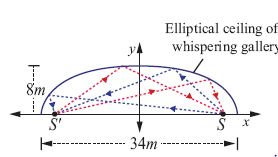
A room 34m long is constructed to be a whispering gallery. The room has an elliptical ceiling, as shown in Figure. If the maximum height of the ceiling is 8 m, determine where the foci are located.
9.
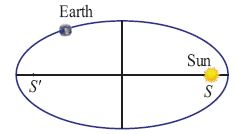
The maximum and minimum distances of the Earth from the Sun respectively are 152 × 106 km and 94.5 × 10⁶ km. The Sun is at one focus of the elliptical orbit. Find the distance from the Sun to the other focus.
10.
Find the equation of the ellipse in each of the cases given below:
length of latus rectum 4, distance between foci 4 \( \sqrt{ 2}\) , centre (0, 0) and major axis as y - axis.
11.
Write in polar form of the following complex numbers
\(2+i2\sqrt { 3 } \)
12.
Obtain the Cartesian equation for the locus of z = x + iy in each of the following cases:
|z - 4| = 16
13.
Find a polynomial equation of minimum degree with rational coefficients, having 2 +√3 i as a root.
14.
A = \(\left[ \begin{matrix} 1 & \tan { x } \\ -\tan { x } & 1 \end{matrix} \right] \), show that ATA-1 = \(\left[ \begin{matrix} \cos { 2x } & -\sin { 2x } \\ \sin { 2x } & \cos { 2x } \end{matrix} \right] \)
15.
Find a polynomial equation of minimum degree with rational coefficients, having 2-\(\sqrt{3}\) as a root.
16.
Find the vertex, focus, equation of directrix and length of the latus rectum of the following: y2−4y−8x+12 = 0
17.
Simplify: \(\left( -\sqrt { 3 } +3i \right) ^{ 31 }\)
18.
Suppose z1, z2 and z3 are the vertices of an equilateral triangle inscribed in the circle |z| = 2. If z1 = 1 + i\(\sqrt { 3 } \) then find z2 and z3.
19.
On lighting a rocket cracker it gets projected in a parabolic path and reaches a maximum height of 4 m when it is 6 m away from the point of projection. Finally it reaches the ground 12 m away from the starting point. Find the angle of projection.
20.
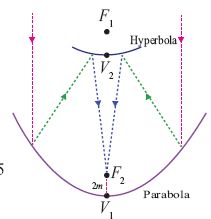
Certain telescopes contain both parabolic mirror and a hyperbolic mirror. In the telescope shown in figure the parabola and hyperbola share focus F1 which is 14m above the vertex of the parabola. The hyperbola’s second focus F2 is 2m above the parabola’s vertex. The vertex of the hyperbolic mirror is 1m below F1. Position a coordinate system with the origin at the centre of the hyperbola and with the foci on the y-axis. Then find the equation of the hyperbola.
21.
Solve the equation z3+ 27 = 0
22.
An amount of Rs. 65,000 is invested in three bonds at the rates of 6%, 8% and 9% per annum respectively. The total annual income is Rs. 4,800. The income from the third bond is Rs. 600 more than that from the second bond. Determine the price of each bond. (Use Gaussian elimination method.)
23.
The upward speed v(t)of a rocket at time t is approximated by v(t) = at2 + bt + c, 0 ≤ t ≤ 100 where a, b and c are constants. It has been found that the speed at times t = 3, t = 6, and t = 9 seconds are respectively, 64, 133, and 208 miles per second respectively. Find the speed at time t = 15 seconds. (Use Gaussian elimination method.)
24.
25.
Find the inverse of each of the following by Gauss-Jordan method:
\(\left[ \begin{matrix} 2 & -1 \\ 5 & -2 \end{matrix} \right] \)
26.
Find the centre, foci, and eccentricity of the hyperbola 11x2 − 25y2 −44x + 50y −256 = 0
27.
Determine k and solve the equation 2x3-6x2+3x+k = 0 if one of its roots is twice the sum of the other two roots.
28.
Solve the equation (2x-3) (6x-1) (3x-2) (x-2)-5 = 0
29.
Solve the equation x4-9x2+20 = 0.
1.
Let A = \(\left[ \begin{matrix} -2 & 2 & -1 \\ 0 & 5 & 1 \\ 0 & 0 & 0 \end{matrix} \right] \). Then A is a matrix of order 3 × 3 and ρ(A) ≤ 3.
The only third order minor is |A| = \(\left| \begin{matrix} -2 & 2 & -1 \\ 0 & 5 & 1 \\ 0 & 0 & 0 \end{matrix} \right| \) = (-2)(5)(0) = 0. So ρ(A) ≤ 2.
There are several second order minors. We find that there is a second order minor, for example, \(\left| \begin{matrix} -2 & 2 \\ 0 & 5 \end{matrix} \right| \) = (-2)(5) = -10 ≠ 0. So, ρ(A) = 2.
Note that there are two non-zero rows. The third row is a zero row.
2.
\(\left[ \begin{matrix} 1 \\ 3 \end{matrix}\begin{matrix} -2 \\ -6 \end{matrix}\begin{matrix} -1 \\ -3 \end{matrix}\begin{matrix} 0 \\ 1 \end{matrix} \right] \)
Let A =\(\left[ \begin{matrix} 1 \\ 3 \end{matrix}\begin{matrix} -2 \\ -6 \end{matrix}\begin{matrix} -1 \\ -3 \end{matrix}\begin{matrix} 0 \\ 1 \end{matrix} \right] \)
A is a matrix of order (2 \(\times\) 4)
∴ \(\rho \)(A) ≤ min(2, 4) = 2
The highest order of minor of A is 2
It is \(\left| \begin{matrix} 1 & -2 \\ 3 & -6 \end{matrix} \right| \) = -6 + 6 = 0
Also, \(\left| \begin{matrix} -1 & 0 \\ -3 & 1 \end{matrix} \right| \) = -1 + 0 = -1 ≠ 0
∴ \(\rho \)(A) = 2
3.
Here A = 3, C = 2 and F = -14
A ≠ C and A and C are of the same sign.
Hence, the given equation represents an ellipse.
4.
Using the given values for z1, z2 and z3 we get |z1| = |3+4i| =\(\sqrt { { 3 }^{ 2 }+{ 4 }^{ 2 } } =5\)
|z2| = |5-12i| = \(\sqrt { { 5 }^{ 2 }+(-12)^{ 2 } } =13\)
|z3| = |6+8i| = \(\sqrt { { 6 }^{ 2 }+{ 8 }^{ 2 } } =10\)
|z1+z2| = |(3+4i)+(5-12i)| = |8-8i| = \(\sqrt { 128 } =8\sqrt { 2 } \)
|z2-z3| = |(5-12i)-(6+8i)| = |1-20i| = \(\sqrt { 401 } \)
|z1+z3| = |(3+4i)+(6+8i)| = |9+12i| = \(\sqrt { 225 } =15\)
Note that the triangle inequality is satisfied in all the cases
|z1+z3| = |z1|+|z3| = 15
5.
Equation of the circle is x2 + (y + 2)2 = 0
Compare with(x-h)2+(y-k)2 = r2
h = 0, k = -2, r2 = 0
Centre (h, k) = (0, -2)
radius is 0.
6.
Since α and β are the roots of the quadratic equation, we have α + β =\(\frac { 7 }{ 2 } \) and αβ = \(\frac { 13 }{ 2 } \).
Thus, to construct a new quadratic equation,
Sum of the roots = α2+β2 = (α+β)2-2αβ =\(\frac { -3 }{ 4 } \)
Product of the roots = α2β2 = (αβ)2 = \(\frac { 169 }{ 4 }\)
Thus a required quadratic equation is x2+\(\frac { 3 }{ 4 } x+\frac { 169 }{ 4 } \)= 0.
From this we see that 4x2+3x+169 = 0 is a quadratic equation with roots α2 and β2.
7.
(i)7= (i)4+3 = (i)3 = -i
8.
The length a of the semi major axis of the elliptical ceiling is17 m. The height b of the semi minor axis is 8 m. Thus c2 = a2 -b2 = 172 - 82
then c =\(\sqrt { 289-64 } =\sqrt { 225 } =15\)
For the elliptical ceiling the foci are located on either side about 15 m from the centre, along its major axis.
9.
AS = 94.5 × 10⁶ km,
SA' = 152 × 106 km
a+c = 152 × 106
a-c = 94.5 × 10⁶
Subtracting 2c = 57.5 × 106 = 575 × 105 km
Distance of the Sun from the other focus is SS' = 575 × 105 km.
10.
Length of latus rectum = 4,
distance between foci = 4\(\sqrt { 2 } \) major axis is y-axis
Given \(\frac { { 2b }^{ 2 } }{ a } =4\) and distance between foci = 2ae = 4\(\sqrt { 2 } \)
⇒ ae = \(2\sqrt { 2 } \)
⇒a2e2 = 8 ....(1)
\(\frac { { 2b }^{ 2 } }{ a } =4\Rightarrow { b }^{ 2 }=2a\) ...(2)
We know b2 = a2(1 - e2)
b2 = a2 - a2e2
2a = a2 - 8
[using (1) and (2)]
a2 - 2a - 8 = 0
On factorising we get
(a - 4)(a + 2) = 0
a = 4 or-2
a = 4
⇒ [∴ a = -2 is not possible]
⇒ ae = 16
∴ From (2), b2 = 2(4) = 8
Hence, the equation of the ellipse is
\(\frac { { x }^{ 2 } }{ 8 } +\frac { { y }^{ 2 } }{ 16 } =1\) [∵ Major axis is y -axis]
.JPG)
11.
2 +i2\(\sqrt { 3 } \)
Let 2+i2\(\sqrt { 3 } \) = x + iy = r (cosθ + i sinθ)
r = modulus =\(\\ \sqrt { { x }^{ 2 }+{ y }^{ 2 } } \)
=\(\\ \sqrt { { 2 }^{ 2 }+(2\sqrt { 3 } )^{ 2 } } \)
= \(\sqrt { 4+12 } =\sqrt { 16 } \) = 4
α = tan-1\(\left| \frac { y }{ x } \right| =tan^{ -1 }\left| \frac { 2\sqrt { 3 } }{ 2 } \right| \)
= \(tan^{ -1 }(\sqrt { 3 } )=\frac { \pi }{ 3 } \)
Since the complex number 2+i2 \(\sqrt { 3 } \) lies in the I quadrant, [x, y both +ve] its principal value θ = α = \(\frac { \pi }{ 3 } \)
∴ Its polar form is 2+i2\(\sqrt { 3 } \)
= 4\(\left[ cos\left( 2k\pi +\frac { \pi }{ 3 } \right) +isin\left( 2k\pi +\frac { \pi }{ 3 } \right) \right] ,k\in Z\).
12.
|z-4| = 16
Given z = x + iy
|z - 4| = 16
⇒ |x + iy - 4| = 16
⇒ |(x- 4) + iy| = 16
⇒ \(\\ \sqrt { (x-4)^{ 2 }+{ y }^{ 2 } } \) = 16
⇒ (x - 4)2 + y2 = 162
[Squaring both sides]
⇒ x2-8x + 16 + y2 = 256
⇒ x2-8x + y2+ 16-256 = 0
⇒ x2-8x + y2-240 = 0 Which is the required Cartesian equation.
The locus of the point is a circle.
13.
Since \(2+i\sqrt { 3 } \) is a root of the polynomial equation, its conjugate 2-i\(\sqrt3\) is also a root of the equation:
∴ Sum of the roots \(=2+i\sqrt { 3 } +2-i\sqrt { 3 } =4\)
Product of the roots \(=(2+i\sqrt { 3 } )(2-i\sqrt { 3 } )\)
\(={ 2 }^{ 2 }+{ (\sqrt { 3 } })^{ 2 }\)
\([\because (a+ib)(a-ib)={ a }^{ 2 }+{ b }^{ 2 }]\)
= 4 + 3 = 7
Hence, the polynomial equation of minimum degree with rational co-efficients is
x2 - x (sum of the roots) + product of the roots = 0
\(\Rightarrow { x }^{ 2 }-x(4)+7=0\)
\(\Rightarrow { x }^{ 2 }-4x+7=0\)
14.
Given A = \(\left[ \begin{matrix} 1 & \tan { x } \\ -\tan { x } & 1 \end{matrix} \right] \)
|A| = 1 + tan2 x
∴ A-1 = \(\frac { 1 }{ |A| } \)adjA
= \(\frac { 1 }{ 1+tan^{ 2 } } \left[ \begin{matrix} 1 & -tanx \\ tanx & 1 \end{matrix} \right] \)
[Interchange the elements in the leading diagonal and change the sign of elements in the off diagonal]
AT= \(\\ \left[ \begin{matrix} 1 & -tanx \\ tanx & 1 \end{matrix} \right] \)
∴ ATA-1
=\(\left[ \begin{matrix} 1 & -tanx \\ tanx & 1 \end{matrix} \right] \frac { 1 }{ 1+tan^{ 2 }x } \left[ \begin{matrix} 1 & -tanx \\ tanx & 1 \end{matrix} \right] \)
=\(\frac { 1 }{ 1+tan^{ 2 }x } \left[ \begin{matrix} 1 & -tanx \\ tanx & 1 \end{matrix} \right] \left[ \begin{matrix} 1 & -tanx \\ tanx & 1 \end{matrix} \right] \)
=\(\frac { 1 }{ 1+tan^{ 2 }x } \left[ \begin{matrix} 1-tan^{ 2 }x & -tanx-tanx \\ tanx+tanx & -tan^{ 2 }x+1 \end{matrix} \right] \)
=\(\left[ \begin{matrix} \frac { 1-{ tan }^{ 2 }x }{ 1+{ tan }^{ 2 }x } & \frac { -2tanx }{ 1+{ tan }^{ 2 }x } \\ \frac { 2tanx }{ 1+{ tan }^{ 2 }x } & \frac { 1-{ tan }^{ 2 }x }{ 1+tan^{ 2 }x } \end{matrix} \right] \)
ATA-1 =\(\left[ \begin{matrix} cos2x & -sin2x \\ sin2x & cos2x \end{matrix} \right] \)
Hence proved.
15.
Since 2-\(\sqrt{3}\)i is a root and the coefficients are rational numbers, 2+\(\sqrt{3}\)i is also a root. A required polynomial equation is given by
x2 −(Sum of the roots) x + Product of the roots = 0
and hence
x2- 4x +1 = 0 is a required equation.
16.
y2 - 4y - 8x + 12 = 0
y2-4y = 8x-12
Adding 4 both sides, we get,
y - 4y + 4 = 8x - 12 + 4 = 8x - 8
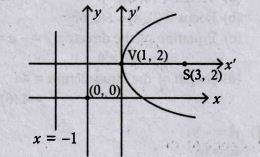
⇒ (y - 2)2 = 8(x - 1)
This is a right open parabola and latus
rectum is 4a = 8 ⇒ a = 2.
(a) Vertex is (1, 2) ⇒ h = 1, k = 2
(b) focus is (h + a, 0 + k)
⇒ (1 + 2, 0 + 2)
⇒ (3, 2)
(c) Equation of directrix is x = h - a
⇒ x = 1-2
⇒ x = -1
(d) Length of latus rectum is 4a = 8 units.
17.
\(\left( -\sqrt { 3 } +3i \right) ^{ 31 }\)
Let \(-\sqrt { 3 } +3i=r\left( cos\theta +isin\theta \right) \). Then, we get
\(r=\sqrt { \left( -\sqrt { 3 } \right) ^{ 2 }+{ 3 }^{ 2 } } =\sqrt { 12 } =2\sqrt { 3 } \)
\(\alpha ={ tan }^{ -1 }\left| \frac { 3 }{ -\sqrt { 3 } } \right| ={ tan }^{ -1 }\sqrt { 3 } =\frac { \pi }{ 3 } \)
\(\theta =\pi -\alpha =\pi -\frac { \pi }{ 3 } =\frac { 2\pi }{ 3 } \) (\(\because\) \(\sqrt { 3 } +3i\) lies in II Quadrant)
Therefore,\(-\sqrt { 3 } +3i=2\sqrt { 3 } \left( cos\frac { 2\pi }{ 3 } +isin\frac { 2\pi }{ 3 } \right) \)
Raising power 31 on both sides,
\(\left( -\sqrt { 3 } +3i \right) ^{ 31 }=\left( 2\sqrt { 3 } \right) ^{ 31 }\left( cos\frac { 2\pi }{ 3 } +isin\frac { 2\pi }{ 3 } \right) ^{ 31 }\)
= \(\left( 2\sqrt { 3 } \right) ^{ 31 }\left( cos\left( 20\pi +\frac { 2\pi }{ 3 } \right) +isin\left( 20\pi +\frac { 2\pi }{ 3 } \right) \right) \)
= \(\left( 2\sqrt { 3 } \right) ^{ 31 }\left( cos\frac { 2\pi }{ 3 } +isin\frac { 2\pi }{ 3 } \right) \)
= \(\left( 2\sqrt { 3 } \right) ^{ 31 }\left( cos\left( \pi -\frac { \pi }{ 3 } \right) +isin\left( \pi -\frac { \pi }{ 3 } \right) \right) \)
= \(\left( 2\sqrt { 3 } \right) ^{ 31 }\left( -cos\frac { \pi }{ 3 } +isin\frac { \pi }{ 3 } \right) =\left( 2\sqrt { 3 } \right) ^{ 31 }\left( -\frac { 1 }{ 2 } +i\frac { \sqrt { 3 } }{ 2 } \right) \).
18.
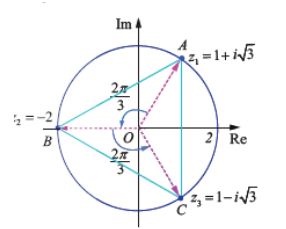
|z| = 2 represents the circle with centre (0, 0) and radius 2.
Let A, B, and C be the vertices of the given triangle. Since the vertice z1, z2,and z3 form an equilateral triangle inscribed in the circle|z| = 2, the sides of this triangle AB, BC, and CA subtend \(\frac { 2\pi }{ 3 } \) radians (120 degree) at the origin (circumcenter of the triangle).
(The complex number ze16 is a rotation of z by \(\theta\) radians in the counter clockwise direction about the origin.)
Therefore, we can obtain z2 and z3 and by the rotation of z1 by \(\frac { 2\pi }{ 3 } and\ \frac { 4\pi }{ 3 } \) respectively.
Given that \(\vec { OA } ={ z }_{ 1 }=1+i\sqrt { 3 } \)
\(\vec { OB } ={ z }_{ 1 }e^{ i\frac { 2\pi }{ 3 } }=\left( 1+i\sqrt { 3 } \right) e^{ i\frac { 2\pi }{ 3 } }\)
= \(\left( 1+i\sqrt { 3 } \right) \left( cos\frac { 2\pi }{ 3 } +isin\frac { 2\pi }{ 3 } \right) \)
= \(\left( 1+i\sqrt { 3 } \right) \left( -\frac { 1 }{ 2 } +i\frac { \sqrt { 3 } }{ 2 } \right) =-2;\)
\(\vec { OC } ={ z }_{ 1 }{ e }^{ i\frac { 4\pi }{ 3 } }={ z }_{ 2 }{ e }^{ i\frac { 2\pi }{ 3 } }=-2e3^{ i\frac { 2\pi }{ 3 } }\)
= \(-2\left( cos\frac { 2\pi }{ 3 } +isin\frac { 2\pi }{ 3 } \right) \)
= \(-2\left( -\frac { 1 }{ 2 } +i\frac { \sqrt { 3 } }{ 2 } \right) =1-i\sqrt { 3 } \)
Therefore, z2 = -2 and z3 = 1-i\(\sqrt { 3 } \)
19.
By taking the vertex; at the origin, the parabola is open downward.
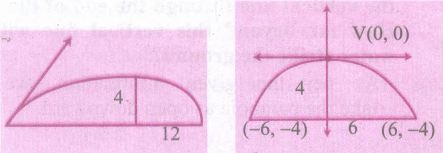
Its equation is x2 = -4ay
It passes through (6, -4)
∴ 36 = -4a(-4) ⇒ 4a = - \(\frac { 36 }{ 4 } \) = 9
∴ (1) becomes, x2 = -9y
To find the slope at (-6, -4)
Differentiating (1) with respect to 'x' we get,
2x = -9\(\frac { dy }{ dx } \)
⇒ \(\frac { dy }{ dx } =\frac { -2x }{ 9 } \)
At (-6, -4), \(\frac { dy }{ dx } =-2\frac { (-6) }{ 9 } =\frac { 12 }{ 9 } =\frac { 4 }{ 3 } \)
∴ \(tan\theta =\frac { 4 }{ 3 } \Rightarrow \theta ={ tan }^{ -1 }\left( \frac { 4 }{ 3 } \right) \)
∴ The angle of projection is tan-1 \(\left( \frac { 4 }{ 3 } \right) \)
20.
Let V1 be the vertex of the parabola and
V2 be the vertex of the hyperbola.
\(\overset { \_ \_ \_ \_ \_ \_ }{ { F }_{ 1 }{ F }_{ 2 } } \) = 14−2 = 12m, 2c = 12, c = 6
The distance of centre to the vertex of the hyperbola is a = 6−1 = 5
b2 = c2 - a2
= 36−25 = 11.
Therefore the equation of the hyperbola is \(\frac { { y }^{ 2 } }{ 25 } -\frac { { x }^{ 2 } }{ 11 } =1\)
21.
z3 = -27 = (-1 \(\times\) 3)3 = -1 \(\times\) 33
z = \((-1)^{ \frac { 1 }{ 3 } }\times 3^{ 3\times \frac { 1 }{ 3 } }=(-1)^{ \frac { 1 }{ 3 } }\)\(\times\) 3
∴ z = 3\(\left[ cos\pi +isin\pi \right] ^{ \frac { 1 }{ 3 } }\)
[∵ cos π = -1 and sin π = 0]
= 3\(\left[ cos\frac { 1 }{ 3 } (2k\pi +\pi )isin\frac { 1 }{ 3 } (2k\pi +\pi ) \right] \)
k = 0, 1, 2
When k = 0,
z = 3\(\left[ cos\frac { 1 }{ 3 } (\pi )isin\frac { 1 }{ 3 } (\pi ) \right] =3cos\frac { \pi }{ 3 } \)
When k = 1
z = 3\(\left[ cos\frac { 1 }{ 3 } (3\pi )isin\frac { 1 }{ 3 } (3\pi ) \right] \)
= 3[cos π + i sin π] = 3(-1+0)
When k = 2
z = 3\(\left[ cos\frac { 1 }{ 3 } (5\pi )isin\frac { 1 }{ 3 } (5\pi ) \right] =3\left[ cos5\frac { \pi }{ 3 } \right] \)
Hence, the roots are 3 cis\(\frac { \pi }{ 3 } \), -3, 3 c is 5\(\frac { \pi }{ 3 } \)
22.
Let the price of bond invested in 6%, 8% and 9% rates be let Rs. x, Rs. y and Rs. z respectively
∴ By the given data, x + y + z = 65000 ..........(1)
\(\frac { 6\times x\times 1 }{ 100 } +\frac { 8\times y\times 1 }{ 100 } +\frac { 9\times z\times 1 }{ 100 } \) = 4800
[∵ Intrest = \(\frac { PNR }{ 100 } \)]
⇒ \(\frac { 6x }{ 100 } +\frac { 8y }{ 100 } +\frac { 9z }{ 100 } \)= 4800
⇒ 6x+8y+9z = 480000 ............(2)
Also, \(\frac { 9z }{ 100 } =600+\frac { 8y }{ 100 } \)
⇒ \(\frac { -8y }{ 100 } +\frac { 9y }{ 100 } \) = 600
⇒ -8y+9z = 60000 ............(3)
Reducing the augmented matrix to an equivalent row-echelon form by using elementary row operation, we get
\(\left[ \begin{matrix} 1 & 1 & 1 \\ 6 & 8 & 9 \\ 0 & -8 & 9 \end{matrix}|\begin{matrix} 65000 \\ 480000 \\ 60000 \end{matrix} \right] \)
\(\overset { { R }_{ 2 }\rightarrow { R }_{ 2 }-6{ R }_{ 1 } }{ \longrightarrow } \left[ \begin{matrix} 1 & 1 & 1 \\ 0 & 2 & 3 \\ 0 & -8 & 9 \end{matrix}|\begin{matrix} 65000 \\ 90000 \\ 60000 \end{matrix} \right] \)
\(\overset { { R }_{ 3 }\rightarrow { R }_{ 3 }+4{ R }_{ 2 } }{ \longrightarrow } \left[ \begin{matrix} 1 & 1 & 1 \\ 0 & 2 & 3 \\ 0 & 0 & 21 \end{matrix}|\begin{matrix} 65000 \\ 90000 \\ 420000 \end{matrix} \right] \)
Writing the equivalent from the row echelon matrix we get,
x+y+z = 65000 ...........(1)
2y+z = 90000 ...........(2)
21z = 42000
⇒ z = \(\frac { 420000 }{ 21 } \) = 20000
Substituting z = 20,000 in (2),
2y + 3(20,000) = -90000
⇒ 2y+60,000 = 90,000
⇒ 2y = 90,000 - 60,000
= 30,000
⇒ y = \(\frac { 30,000 }{ 2 } \) = 15,000
Substitutingy = 15,000 and z = 20,000 in (1) we get,
x + 15,000 + 20,000 = 65000
⇒ x + 35,000 = 65000
⇒ x = 65,000 - 35,000
⇒ 30,000
Thus the price of 6% bond is f 30,000 the price of 8% bond is f 15,000 and the price of 9% bond is f 20,000 is Rs. 20,000.
23.
Since v(3) = 64, v(6) = 133,and v(9) = 208 , we get the following system of linear equations
9a + 3b + c = 64 ,
36a + 6b + c = 133 ,
81a + 9b + c = 208 .
We solve the above system of linear equations by Gaussian elimination method.
Reducing the augmented matrix to an equivalent row-echelon form by using elementary row
operations, we get
[A | B] = \(\left[ \begin{matrix} 9 & 3 & 1 \\ 36 & 6 & 1 \\ 81 & 9 & 1 \end{matrix}|\begin{matrix} 64 \\ 133 \\ 208 \end{matrix} \right] \overset { { R }_{ 2 }\longrightarrow { R }_{ 2 }-4{ R }_{ 1 },{ R }_{ 3 }\longrightarrow { R }_{ 3 }-9{ R }_{ 1 } }{ \longrightarrow } \left[ \begin{matrix} 9 & 3 & 1 \\ 0 & -6 & -3 \\ 0 & -18 & -8 \end{matrix}|\begin{matrix} 64 \\ -123 \\ -368 \end{matrix} \right] \overset { { R }_{ 2 }\longrightarrow { R }_{ 2 }\div \left( -3 \right) ,{ R }_{ 3 }\div \left( -2 \right) }{ \longrightarrow } \left[ \begin{matrix} 9 & 3 & 1 \\ 0 & 2 & 1 \\ 0 & 9 & 4 \end{matrix}|\begin{matrix} 64 \\ 41 \\ 184 \end{matrix} \right] \)
\(\overset { { R }_{ 3 }\longrightarrow 2{ R }_{ 3 } }{ \longrightarrow } \left[ \begin{matrix} 9 & 3 & 1 \\ 0 & 2 & 1 \\ 0 & 18 & 8 \end{matrix}|\begin{matrix} 64 \\ 41 \\ 368 \end{matrix} \right] \overset { { R }_{ 3 }\longrightarrow { R }_{ 3 }-9{ R }_{ 2 } }{ \longrightarrow } \left[ \begin{matrix} 9 & 3 & 1 \\ 0 & 2 & 1 \\ 0 & 0 & -1 \end{matrix}|\begin{matrix} 64 \\ 41 \\ -1 \end{matrix} \right] \overset { { R }_{ 3 }\longrightarrow \left( -1 \right) { R }_{ 3 } }{ \longrightarrow } \left[ \begin{matrix} 9 & 3 & 1 \\ 0 & 2 & 1 \\ 0 & 0 & 1 \end{matrix}|\begin{matrix} 64 \\ 41 \\ 1 \end{matrix} \right] \).
Writing the equivalent equations from the row-echelon matrix, we get
9a + 3b + c = 64, 2b + c = 41, c = 1.
By back substitution, we get c = 1, b = \(\frac { \left( 41-c \right) }{ 2 } =\frac { \left( 41-1 \right) }{ 2 } \) = 20, a = \(\frac { 64-3b-c }{ 9 } =\frac { 64-60-1 }{ 9 } =\frac { 1 }{ 3 } \).
So, we get v(t) = \(\frac { 1 }{ 3 }\)t2 + 20t + 1. Hence, v(15) = \(\frac { 1 }{ 3 }\) (225) + 20(15) + 1 = 75 + 300 + 1 = 376.
24.
25.
\(\left[ \begin{matrix} 2 & -1 \\ 5 & -2 \end{matrix} \right] \)
Let A =\(\left[ \begin{matrix} 2 & -1 \\ 5 & -2 \end{matrix} \right] \)
Applying Gauss - Jordan method, we get
[A|I2] =\(\left[ \begin{matrix} 2 & -1 \\ 5 & -2 \end{matrix}|\begin{matrix} 1 & 0 \\ 0 & 1 \end{matrix} \right] \)
\(\overset { { R }_{ 1 }\rightarrow { R }_{ 1 }\div 2 }{ \longrightarrow } \left[ \begin{matrix} 1 & -\frac { 1 }{ 2 } \\ 5 & -2 \end{matrix}|\begin{matrix} \frac { 1 }{ 2 } & 0 \\ 0 & 1 \end{matrix} \right] \)
\(\overset { { R }_{ 2 }\rightarrow { R }_{ 2 }-5{ R }_{ 1 } }{ \longrightarrow } \left[ \begin{matrix} 1 & -\frac { 1 }{ 2 } \\ 5 & -2 \end{matrix}|\begin{matrix} \frac { 1 }{ 2 } & 0 \\ -\frac { 5 }{ 2 } & 1 \end{matrix} \right] \)
\(\overset { { R }_{ 2 }\rightarrow { R }_{ 2 }\times 2 }{ \longrightarrow } \left[ \begin{matrix} 1 & -\frac { 1 }{ 2 } \\ 0 & 1 \end{matrix}|\begin{matrix} \frac { 1 }{ 2 } & 0 \\ -5 & 2 \end{matrix} \right] \)
\(\overset { { R }_{ 1 }\rightarrow { R }_{ 1 }+\frac { 1 }{ 2 } { R }_{ 2 } }{ \longrightarrow } \left[ \begin{matrix} 1 & 0 \\ 0 & 1 \end{matrix}|\begin{matrix} -2 & 1 \\ -5 & 2 \end{matrix} \right] \)
∴ We get A-1=\(\left[ \begin{matrix} -2 & 1 \\ -5 & 2 \end{matrix} \right] \)
26.
Rearranging terms in the equation of hyperbola to bring it to standard form,
we have, 11(x2-4x)-25(y2-2y)-256 = 0
11(x− 2)2−25(y−1)2 = 256−44+25
11(x−2 )2− 25 (y−1)2 = 275
\(\frac { { \left( x-2 \right) }^{ 2 } }{ 25 } -\frac { { \left( y-1 \right) }^{ 2 } }{ 11 } =1\)
Centre (2, 1) a2 = 25, b2 = 11
c2 = a2 +b2
= 25 +11 = 36
Therefore, c = ±6
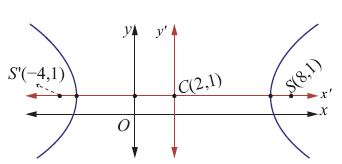
and e = \(\frac { c }{ a } =\frac { 6 }{ 5 } \)and the coordinates of foci are(8, 1) and(-4, 1) from figure.
27.
Given cubic equation is 2x3-6x2+3x+k = 0
Here, a = 2, b = -6, c = 3, d = k
Let ∝, β, ૪ be the roots
Given ∝ = 2(β+૪) ⇒ \(\frac{\alpha}{2}\) = β+૪ ...(1)
Now, \(\alpha +\beta +\gamma =\frac { -b }{ a } =-\frac { (-6) }{ 2 } =3\)
\(\frac { \alpha }{ 2 } +\alpha =3\Rightarrow \frac { \alpha +2\alpha }{ 2 } =3\Rightarrow \frac { 3\alpha }{ 2 } =3\)
\(\Rightarrow \alpha =2\)
\(\alpha \beta \gamma =\frac { -d }{ a } =\frac { -k }{ 2 } \Rightarrow 2.\beta \gamma =\frac { -k }{ 2 } \)
\(\beta \gamma =\frac { -k }{ 4 } ...(2)\)
Also, \(\alpha \beta +\beta \gamma +\gamma \alpha =\frac { c }{ a } \)
\(2\beta +\beta \gamma +2\gamma =\frac { 3 }{ 2 } \)
\(2(\beta +\gamma )+\beta \gamma =\frac { 3 }{ 2 } \)
\(\alpha \frac { -k }{ 4 } =\frac { 3 }{ 2 } \quad [from(1)\& (2)]\)
Also, \(2-\frac { k }{ 4 } =\frac { 3 }{ 2 } [\because \alpha =2]\)
\(2-\frac { 3 }{ 2 } =\frac { k }{ 4 } \Rightarrow \frac { 1 }{ 2 } =\frac { k }{ 4 } \)
\(\\ k=\frac { 4 }{ 2 } \Rightarrow k=2\)
From(2), \(\beta \gamma =\frac { -k }{ 4 } =\frac { -2 }{ 4 } =\frac { -1 }{ 2 } \)\(\Rightarrow \gamma =\frac { -1 }{ 2\beta } \)
From \((1),\beta +\gamma =\frac { \alpha }{ 2 } =\frac { 2 }{ 2 } =1\)
Substituting \(\gamma =\frac { -1 }{ 2\beta } \) We get
\(\beta -\frac { 1 }{ 2\beta } =1\Rightarrow 2{ \beta }^{ 2 }-1=2\beta \Rightarrow 2\beta -2\beta -1=0\)
\(\beta =\frac { 2\pm \sqrt { 4-4(2)(-1) } }{ 4 } =\frac { 2\pm \sqrt { 4+8 } }{ 4 } \)
\(=\frac { 2\pm \sqrt { 12 } }{ 4 } =\frac { 2\pm 2\sqrt { 3 } }{ 4 } \)
\(\beta =\frac { 1\pm \sqrt { 3 } }{ 2 } \)
Hence the roots are \(2,\frac { 1+\sqrt { 3 } }{ 2 } ,\frac { 1-\sqrt { 3 } }{ 2 } \) and k = 2
28.
The given equation is same as
(2x-3)(3x-2)(6x-1)(x-2)-5 = 0
After a computation, the above equation becomes
(6x2-13x+6)(6x2-13x+12)-5 = 0
By taking y = 6x2-13x, the above equation becomes
(y+6)(y+12)-5 = 0
which is same as
y2+18y+7 = 0
Solving this equation, we get y = −1 and y = −7.
Substituting the values of y in y = −6x2-13x, we get
6x2-13x+1 = 0
6x2-13x+7 = 0
Solving these two equations, we get
x = 1, x = \(\frac { 7 }{ 6 } \), x = \(\frac { 13 + \sqrt { 145 } }{ 12 } \) and x = \(\frac { 13-\sqrt { 145 } }{ 12 } \)
as the roots of the given equation.
29.
The given equation is
x4- 9x2 + 20 = 0
This is a fourth degree equation. If we replace x2 by y then we get the quadratic equation
y2- 9y + 20 = 0
It is easy to see that 4 and 5 as solutions for y2- 9y + 20 = 0. Now taking x2 = 4 and x2 = 5, we get 2, -2, \(\sqrt{5}\), -\(\sqrt{5}\) as solutions of the given equation.
We note that the technique adopted above can be applied to polynomial equations like x6-17x3+30 = 0, ax2k+ bxk + c = 0 and in general polynomial equations of the form anxkn + an-1xk(n-1) + .... + a1xk + a0 = 0 where k is any positive integer.

12th Standard Syllabus & Materials
12th Standard
TN 12th Computer Applications களப்பெயர் முறைமை (DNS) Sample Question Papers Study Material - QB365 Set A
NEW12th Standard
TN 12th Computer Applications வலையமைப்பு எடுத்துக்காட்டுகள் மற்றும் நெறிமுறைகள் Sample Question Papers Study Material - QB365 Set A
NEW12th Standard
TN 12th Computer Applications கணினி வலையமைப்பு ஓர் அறிமுகம் Sample Question Papers Study Material - QB365 Set A
NEW12th Standard
TN 12th Computer Applications PHP-உடன் MySQL-ஐ இணைத்தல் Sample Question Papers Study Material - QB365 Set A



Tamilnadu Stateboard 12th Standard Subjects
Maths

Chemistry

Physics

Biology

Computer Science

Business Maths and Statistics

Economics

Commerce

Accountancy

History

Computer Applications
Biology
Computer Technology
Computer Applications
Computer Science
Business Maths and Statistics
Commerce
Economics
Maths
Chemistry
Physics
Computer Technology
History
Accountancy

Tamil

English

French
Tamilnadu Stateboard Standards

