
 100% FREE ACCESS
6th Standard CBSE Syllabus & Materials
6th Standard CBSE
CBSE 6th Social Science The Value of Work - New Sample Question Papers Study Material - QB365 Set A
NEW6th Standard CBSE
CBSE 6th Social Science Family and Community - New Sample Question Papers Study Material - QB365 Set A
NEW6th Standard CBSE
CBSE 6th Social Science India's Cultural Roots - New Sample Question Papers Study Material - QB365 Set A
NEW6th Standard CBSE
CBSE 6th Social Science India,That is Bharat - New Sample Question Papers Study Material - QB365 Set A
NEW6th Standard CBSE
CBSE 6th Social Science Timeline and sources of history - New Sample Question Papers Study Material - QB365 Set A
NEW6th Standard CBSE
CBSE 6th Social Science Oceans and Continents - New Sample Question Papers Study Material - QB365 Set A

Published on: 27/07/2018
Some of the important questions are prepared from this chapter On the Trail of the Earliest People. The important questions are covers from the Higher Order Thinking Questions and Value Based Questions.
Teachers can prepared question paper with answer key within five minutes. Please Click Here for subscribe.
Download CBSE Class 6th Standard CBSE Social Science question papers, sample papers, important questions, and previous year solved papers in PDF format. Get free study materials, NCERT solutions, and exam preparation resources for Class 6th Standard CBSE Social Science
Questions + Answers key
Take MCQ Social Science Test
1.
What were the major agricultural produces at that time?
2.
How did the archaeologists know about the factories?
3.
Make two columns in your notebook. In the left hand column, list the foods hunter-gatherers ate. In the right hand column, list some of the foods you eat. Do you notice any similarities/differences?
4.
Where do we find ostriches today?
5.
What do you think the term Neolithic means?
6.
What do we use fire for today?
7.
If you had to describe the place you live in, which of the terms would you choose?
Habitation
Factory
Habitation-cum-factory
Any other
8.
Traces of ash gave the indication of
use of metal
use of match box
use of kerosene
use of fire
9.
Most of the rock shelters were close to
Shivalik
Himalaya
River
Narmada valley
10.
Edible plants are
poisonous
non-poisonous
tool making plants
used in making huts
11.
Where were the early Palaeolithic sites found?
12.
What were the factory sites?
13.
Where is Bhimbetka located?
14.
How did the hunter-gatherers use stone tools?
15.
Name any two grain bearing grasses.
16.
How was wood used in the past?
17.
Answer the questions based on the picture given below:
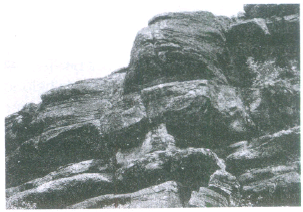
(i) Where are the above sites located?
(ii) Bhimbetka is located in which state?
(iii) Which valley is closer to these rock shelters?
18.
What were the major changes in the climate of the world, around 12,000 years ago?
19.
In Hunsgi, tools were made of ______________
20.
Hunter-gatherers chose to live in caves and rock shelters because ____________
21.
The pebble from which the tool was to be made called ________
22.
Ostriches were found in India during the ______ period.
23.
Wood was also used to make huts and tools.
24.
Grains such as wheat and rice grew naturally.
1.
At that time, major agricultural produces were several grain bearing grasses including wheat, barley and rice grew naturally in different parts of the sub-continent. Men, women and children probably collected these grains as food and learnt where they grew and when they ripened.
2.
Archaeologists have found blocks of stone tools that were made and perhaps discarded because they were not perfect and chips of waste stone left behind at these sites.
So, from these evidences, the archaeologists knew about the factories.
3.
| Food ate by hunter- gatherers | Foods in use today |
| Fruits, roots, seeds, nuts, leaves, stalks, eggs and meat. |
Unprocessed food like fruits, roots, seeds, nuts, leaves, stalks, eggs etc |
| Processed foods like burger, pizza, ice-cream, meat etc |
The major difference between eating pattern of early people and present-day people is that the early people ate only unprocessed food while present-day's people focus on processed food.
4.
Now-a-days, in India, it has been rarest, but in the African countries we can find them.
5.
The term Neolithic means a New Stone Age, which was period in the development of human technology, beginning about 10,000 years ago.
6.
Today, we use fire:
(i) to cook food.
(ii) as a source of light.
(iii) as a source of heat in winter season.
(iv) in industries, mills ere.
7.
(c)
Habitation-cum-factory
8.
(d)
use of fire
9.
(d)
Narmada valley
10.
(b)
non-poisonous
11.
()
A number of early Palaeolithic sites were found at Hunsgi in Karnataka.
12.
()
The places where stone was found and where people made tools are known as factory sites.
13.
()
Bhimbetka is located in the state of Madhya Pradesh, also known as habitation sites.
14.
()
Stone tools were used to cut meat and bone, scrape bark and hides, chop fruit and roots.
15.
()
Wheat and barley.
16.
()
Wood was used as firewood. It was also used to make huts and tools.
17.
(i) These sites are located in Bhimbetka.
(ii) Bhimbetka is located in Madhya Pradesh.
(iii) The Narmada Valley is close to these rock shelters.
18.
There were major changes in the climate of the world. Climate became relatively warm than the past. This warm condition led to some major changes:
(i) There was development of grasslands in many areas. As a result, the number of animals, which survived on grass, was increased. These animals were deer, antelope, goat, sheep and cattle.
(ii) This increasing number of animals helped people to start thinking about herding and rearing of these animals. Fishing became important.
(iii) At that time, several grains bearing grasses like wheat, barley, rice grew naturally and men became aware about where these grew and when they ripened. These grains were collected by men, women and children and they started thinking about growing these plants on their own.
19.
()
limestone
20.
()
they wanted to protect themselves from wild animals and bad weather.
21.
()
the core
22.
()
Palaeolithic
23.
(a)
24.
(a)

6th Standard CBSE Syllabus & Materials
6th Standard CBSE
CBSE 6th Social Science Locating Places on the Earth - New Sample Question Papers Study Material - QB365 Set A
NEW6th Standard CBSE
CBSE 6th Science A Journey Through States of Water - New Sample Question Papers Study Material - QB365 Set A
NEW6th Standard CBSE
CBSE 6th Science Temperature and its Measurement - New Sample Question Papers Study Material - QB365 Set A
NEW6th Standard CBSE
CBSE 6th Science Materials Around Us - New Sample Question Papers Study Material - QB365 Set A



CBSE 6th Standard CBSE Subjects
CBSE Standards




