
 100% FREE ACCESS
12th Standard Syllabus & Materials
12th Standard
TN 12th Maths Applications of Matrices and Determinants Sample Question Papers Study Material - QB365 Set A
NEW12th Standard
TN 12th Computer Applications மின்னணு தரவு பரிமாற்றம் Sample Question Papers Study Material - QB365 Set A
NEW12th Standard
TN 12th Computer Applications மின் - வணிக பாதுகாப்பு அமைப்புகள் Sample Question Papers Study Material - QB365 Set A
NEW12th Standard
TN 12th Computer Applications மின்னணு செலுத்தல் முறைகள் Sample Question Papers Study Material - QB365 Set A
NEW12th Standard
TN 12th Computer Applications மின் - வணிகம் Sample Question Papers Study Material - QB365 Set A
NEW12th Standard
TN 12th Computer Applications திறந்த மூல கருத்துருக்கள் Sample Question Papers Study Material - QB365 Set A

Published on: 01/09/2022
QB365 provides a detailed and simple solution for every Possible Creative Questions in Class 12 Chemistry Subject - p - Block Elements - II, English Medium. It will help Students to get more practice questions, Students can Practice these question papers in addition to score best marks.
Download Tamil Nadu 12th Standard Chemistry question papers, model tests, one-mark questions, important questions, and public exam papers in PDF format. Free study materials and answer keys for TN State Board students.
Questions + Answers key
Take MCQ Chemistry Test
1.
How is chlorine manufactured by the electrolysis of brine.
2.
How does sulphuric acid react with metals at various conditions.
3.
Explain the oxidising property of sulphuric acid.
4.
How is sulphuric acid manufacture by contact process?
5.
Explain the oxidising and reducing property of SO2·
6.
Complete the following equations:
a. 4NaCI + MnO2 + 4H2SO4 \(\longrightarrow \)?
b. 6XeF4 + 12H2O\(\longrightarrow \) ?
7.
Account for the following:
(i) Reducing character decreases from SO2 to TeO2.
(ii) Xenon forms compounds with fluorine and oxygen only.
8.
Give reason for the following :
(i) N2O5 is more acidic than N2O3
(ii) Thermal stability decreases from H2O to H2Te.
(iii) Fluoride ion has higher hydration enthalpy than chloride ion.
9.
An amorphous solid (A) burns in air to form a gas (B) which turns lime water milky. The gas is also produced as a byproduct during roasting of sulphide ore. This gas decolourises acidified aqueous KMnO4 solution and reduces Fe3+ to Fe2+. Identify the solid 'A' and the gas 'B' and write the reactions involved.
10.
Complete the following reactions
(i) KCIO3\(\longrightarrow \)?
(ii) ZnS + O2\(\longrightarrow \) ?
(iii) Al2O3 + NaOH + H2O\(\longrightarrow \) ?
(iv) NaOH + SO2\(\longrightarrow \) ?
(v) KCI+ H2SO4 \(\longrightarrow \) ?
11.
Why is dioxygen a gas but sulphur a solid?
12.
Give a detailed account on allotropes of sulphur.
13.
Mention the uses of helium.
14.
Explain the structure of inter halogen compounds
15.
Give a detailed account of the interhalogen, compounds with special reference to the: compounds involving iodine. Draw their structures.
1.
(i) When a solution of brine (NaCl) is electrolysed, Na+ and Cl ions are formed.
(ii) Na+ ion reacts with OH- ions of water and forms sodium hydroxide. Hydrogen and chlorine are liberated as gases.
NaCI \(\longrightarrow \) Na+ + CI-1
H2O \(\longrightarrow \) H+ + OH-
Na+ + OH- \(\longrightarrow \) NaOH
At the cathode,
H+ + e- \(\longrightarrow \) H
H + H\(\longrightarrow \)H2
At the anode,
Cl- \(\longrightarrow \) CI + e-
CI + CI \(\longrightarrow \) Cl2
2.
Reaction with metals:
(i) Sulphuric acid reacts with metals and gives different product depending on the reactants and reacting condition
(ii) Dilute sulphuric acid reacts with metals like: tin, aluminium, zinc to give corresponding: sulphates.
Zn + H2SO4\(\longrightarrow \) ZnSO4 + H2 \(\uparrow \)
2AI + 3H2SO4 \(\longrightarrow \) Al2(SO4)3+ 3H2 \(\uparrow \)
(iii) Hot concentrated sulphuric acid reacts with copper and lead to give the respective sulphates as shown below
Cu + 2H2SO4 \(\longrightarrow \) CuSO4 + 2H2O + SO2\(\uparrow \)
Pb + 2H2SO4 \(\longrightarrow \) PbSO4 + 2H2O + SO2\(\uparrow \)
(iv) Sulphuric acid doesn't react with noble metals like gold, silver and platinum.
3.
Oxidising property of H2SO4:
Sulphuric acid is an oxidising agent as it produces nascent oxygen as shown below.
\({ H }_{ 2 }{ SO }_{ 4 }\longrightarrow { H }_{ 2 }O+\underset { nascentoxygen }{ { SO }_{ 2 } } +\left( O \right) \)
Sulphuric acid oxidises elements such as carbon, sulphur and phosphorus. It also oxides bromide and iodide to bromine and iodine respectively.
C + 2H2SO4 \(\longrightarrow \) 2SO2 + 2H2O + CO2
S + 2H2SO4 \(\longrightarrow \) 3SO2 + 2H2O
P4 + 10H2SO4 \(\longrightarrow \) 4H3PO4 + 10SO2 + 4H2O
H2S + H2SO4 \(\longrightarrow \) SO2 + 2H2O + S
H2SO4 + 2HI \(\longrightarrow \) SO2 + H2O + I2
H2SO4 + 2HBr \(\longrightarrow \) 2SO2 + 2H2O + Br2
4.
Manufacture of sulphuric acid by contact process:
The contact process involves the following steps.
(i) Initially sulphur dioxide is produced by burning sulphur or iron pyrites in oxygen/ air.
\(S+{ O }_{ 2 }\longrightarrow { SO }_{ 2 }\)
\({ 4FeS }_{ 2 }+{ 11O }_{ 2 }\longrightarrow { 2Fe }_{ 2 }{ { O }_{ 3 } }+8{ SO }_{ 2 }\)
(ii) Sulphur dioxide formed is oxidised to sulphur trioxide by air in the presence of a catalyst such as V2O5 or platinised asbestos.
(iii) The sulphur trioxide is absorbed in concentrated sulphuric acid and produces oleum (H2S2O7). The oleum is converted into sulphuric acid by diluting it with water.
\(\mathrm{SO}_{3}+\mathrm{H}_{2} \mathrm{SO}_{4} \longrightarrow \mathrm{H}_{2} \mathrm{~S}_{2} \mathrm{O}_{7} \stackrel{\mathrm{H}_{2} \mathrm{O}}{\longrightarrow} 2 \mathrm{H}_{2} \mathrm{SO}_{4}\)
(iv) To maximise the yield the plant is operated at 2 bar pressure and 720 K. The sulphuric acid obtained in this process is over 96 % pure.
5.
Oxidising property :
Sulphur dioxide, oxidises hydrogen sulphide to sulphur and magnesium to magnesium oxide.
\({ 2H }_{ 2 }S+{ SO }_{ 2 }\longrightarrow 3S+{ 2H }_{ 2 }O\)
\(2Mg+{ SO }_{ 2 }\longrightarrow 2MgO+S\)
Reducing property :
As it can readily be oxidised, it acts as a reducing agent. It reduces chlorine into hydrochloric acid.
\({ SO }_{ 2 }+2{ H }_{ 2 }O+{ { Cl }_{ 2 }\longrightarrow { H }_{ 2 }{ SO }_{ 4 }+2HCl }\)
It also reduces potassium permanganate and dichromate to Mn2+ and Cr3+ respectively.
\({ 2KMnO }_{ 4 }+5{ SO }_{ 2 }+2{ H }_{ 2 }O\longrightarrow { K }_{ 2 }{ SO }_{ 4 }+{ 2MnSO }_{ 4 }+2{ H }_{ 2 }{ SO }_{ 4 }\)
\({ K }_{ 2 }{ Cr }_{ 2 }{ O }_{ 7 }+{ 3SO }_{ 2 }+{ H }_{ 2 }{ SO }_{ 4 }\longrightarrow { K }_{ 2 }{ SO }_{ 4 }+{ Cr }_{ 2 }\left( SO_{ 4 } \right) _{ 3 }+{ H }_{ 2 }O\)
6.
(a) NaCl + MnO2 + 4H2SO4 \(\longrightarrow \) MnCl2+ 4NaHSO4 + 2H2O + Cl2
(b) 6XeF4 + 12H2O \(\longrightarrow \) 4Xe + 2XeO3 + 24HF + 3O2
7.
(i) Stability of higher oxidation state decreases down the group from S to Te because stability of lower oxidation state increases down the group from S to Te.
(ii) Fluorine and oxygen are most electronegative and very reactive. So they can ionised noble gases and form compounds.
8.
N2OS is more acidic than N2O3 because N2O3 is the anhydride of nitrous acid N2O3 dissolves in water to form the unstable acid.
\({ N }_{ 2 }{ O }_{ 3 }+{ H }_{ 2 }O\longrightarrow \underset { unstable }{ { 2HNO }_{ 2 } } \)
On the other hand, N2O5 is the anhydride of nitric acid N2O5 dissolves in water to form nitric acid
\({ N }_{ 2 }O_{ 5 }+{ H }_{ 2 }O\longrightarrow { { 2HNO }_{ 3 } }\)
N2O5 has higher acidic strength than N2O3. Acidic nature depends on oxidation number. Higher the oxidation number greater the tendency of gaining electron.
(ii) Thermal stability of hydrides decrease on moving down the group. This is due to the decrease in the bond dissociation enthalpy (H-E) of hydrides on moving down the group where E = O, S, Se, Te.
(iii) Hydration enthalpy is a measure of energy released when attractions are set up between positive or negative ions and water molecules. These attractions are stronger when the ion is smaller. Since F- ion is smaller than Cl- ion, F- ion process higher hydration enthalpy than Cl- ion.
9.
(I) Since the byproduct of roasting to sulphide ore is SO2 It turns lime water milky.
Therefore, gas 'B' must be SO2
(ii) As the gas 'B' is obtained when amorphous solid 'A' burns in air therefore, amorphous solid 'A' must be sulphur S8
\(\underset { (A) }{ { S }_{ g } } +{ 8O }_{ 2 }\overset { \Delta }{ \longrightarrow } \underset { (B) }{ { 8SO }_{ 2 } } \)
(iii) Gas (B) reduces acidified aqueous KMnO4 solution and reduces Fe3+ to Fe2+ salts as shown below:
\(\underset { (yellow) }{ { 2MnO }_{ 4 } } ^{ - }+\underset { (b) }{ { SO }_{ 2 } } +2{ H }_{ 2 }O\longrightarrow { 2Fe }^{ 2+ }+\underset { (Green) }{ { SO }_{ 4 }^{ 2- } } +{ 4H }^{ + }\)
(iv) Thus, solid 'A' is S8 and gas 'B' is SO2
10.
(i) KCIO3 \(\overset { \Delta }{ \underset { { MnO }_{ 2 } }{ \longrightarrow } } \) 2KCI + 3O2
(ii) 2 ZnS + 3O2\(\longrightarrow \) 2 ZnO + 2 SO2
(iii) AIzO3(s) + 6 NaOH(aq) + 3 H2O(l) \(\longrightarrow \) 2 Na3[AI(OH)6](aq)
(iv) 2NaOH + SO2\(\longrightarrow \)Na2SO3 + H2O
(v) 2KCl + H2SO4 \(\longrightarrow \) 2 HCl + K2SO4
11.
(i) O2 molecules are held together by weak Vander Waal's force because of small size and high electronegativity of oxygen.
(ii) In contrast, sulphur shows catenation and forms stronger S-S bonds.
(iii) Due to catenation, sulphur forms octa-atomic S8 molecules having eight membered puckered ring structure.
(iv) Because of its bigger size the force of attraction holding S8 molecules are much stronger.
(v) Hence sulphur is a solid at room temperature or in other words, that is why there is a large difference between the boiling point (also melting points) of the two elements.
12.
(a) Rhombic Sulphur (α - Sulphur):
(a) It is yellow in colour.
(b) Its melting point is 385.8K and specific gravity is 2.06
(c) It is stable form of sulphur at room temperature.
(d) It is formed on evaporating the solution of sulphur in CS2.
(e) It in insoluble in water, readily soluble in CS2 and dissolves to some extent in benzene, alcohol and ether.
(b) Monoclinic sulphur \(\left( \beta -sulphur \right) \):
(a) Its melting point is 393K and specific gravity is 1.98
(b) It is prepared by melting rhombic sulphur in a dish and cooling, till crust is formed. Two holes are made in crust and remaining liquid is powered out. On removing crust, colourless needle - shaped crystals of β - sulphur is formed.
(c) Monoclinic sulphur is stable above 369K and below 369K α - sulphur is stable.
(d) At 369K both forms are stable and this temperature is called transition temperature.
(e) Both rhombic and monoclinic sulphur have S8 molecules, these are packed to give different crystal structure S8 form is puckered and has crown shape.
Several other modifications containing 6-20 sulphur atoms per ring are synthesised
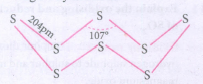
(f) In Cyclo-S6 the ng adopts chair form.
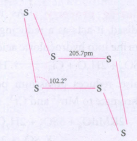
(g) At elevated temperatures (~1000K), S2 is dominant species and is, paramagnetic like O2
13.
(i) Because of its lightness and noninflammability helium is used to filling balloons for meteorological observations.
(ii) Because of its lightness it is used in inflating aeroplane tyres.
(iii) Helium oxygen mixture is used by deep sea divers in preference to nitrogen oxygen mixtures. This prevents bends when a diver comes to the surface.
(iv) A mixture of oxygen and helium is used in the treatment of asthma.
(v) Liquid helium (b.pt 4.2K) is used as cryogenic agent for carrying out various experiments at low temperatures.
(vi)It is used to produce and sustain powerful super conducting magnets of modern NMR Spectrometers and Magnetic Resonance Imaging system (MRI) for clinical diagnosis.
14.
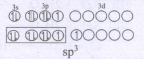
| TYPE | EXAMPLE | SHAPE | DIAGRAM | HYBRIDISATION |
|---|---|---|---|---|
| AX | ClF | Linear |  |
 |
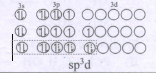
| AX3 | ClF3 | Bipyramidal (without lone pair it is T-shaped) |
 |
 |
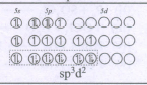
| AX5 | IF5 | Octahedral (without lone pair it is square pyramidal) |  |
 |
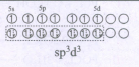
| AX7 | IF7 | Pentagonal bipyramidal |  |
 |
15.
Each halogen combines with another halogen to form several compounds known as interhalogen compounds.
| AX | AX3 | AX3 | AX7 |
| CIF | CIF2 | BrF5 | IF7 |
| ICI | ICl3 | IF5 |
Methods of Preparation interhalogen compounds:
I2+ Cl2(equimolar) \(\longrightarrow \)2ICI (AX)
Cl2 + 3F2 (Excess) 2CIF3 (AX3)
I2+ 5F2 (Excess) \(\longrightarrow \) 21F5(AX5)
IF5 + F2 (Excess)\(\overset { 573K }{ \longrightarrow } \) IF7 (AX7)
Structure of interhalogen compounds.
(i) Type AX: These are covalent compounds in which the larger halogen forms the central atom.
Eg: CIF, BrF
AX sp3 hybridisation-linear linear
(ii) Type AX3:

(a) Without lone pair of electrons, it is T-shaped.
(b) BipyramidaI structure.
(c) sp3 hybridisation. Eg: CIF3
(iii) Type AX5:

(a) Without lone pair, it iF square pyramidal
(b) Octahedral structure
(c) sp3d2 hybridisation
Eg: IF5
(iv) Type AX7:

(a) Pentagonal pyramidal.
(b) sp3d3 hybridisation Eg: IF7

12th Standard Syllabus & Materials
12th Standard
TN 12th Computer Applications வலையமைப்பு வடமிடல் Sample Question Papers Study Material - QB365 Set A
NEW12th Standard
TN 12th Computer Applications களப்பெயர் முறைமை (DNS) Sample Question Papers Study Material - QB365 Set A
NEW12th Standard
TN 12th Computer Applications வலையமைப்பு எடுத்துக்காட்டுகள் மற்றும் நெறிமுறைகள் Sample Question Papers Study Material - QB365 Set A
NEW12th Standard
TN 12th Computer Applications கணினி வலையமைப்பு ஓர் அறிமுகம் Sample Question Papers Study Material - QB365 Set A



Tamilnadu Stateboard 12th Standard Subjects

Maths
Chemistry

Physics

Biology

Computer Science

Business Maths and Statistics

Economics

Commerce

Accountancy

History

Computer Applications
Biology
Computer Technology
Computer Applications
Computer Science
Business Maths and Statistics
Commerce
Economics
Maths
Chemistry
Physics
Computer Technology
History
Accountancy

Tamil

English

French
Tamilnadu Stateboard Standards
