
 100% FREE ACCESS
6th Standard CBSE Syllabus & Materials
6th Standard CBSE
CBSE 6th Social Science The Value of Work - New Sample Question Papers Study Material - QB365 Set A
NEW6th Standard CBSE
CBSE 6th Social Science Family and Community - New Sample Question Papers Study Material - QB365 Set A
NEW6th Standard CBSE
CBSE 6th Social Science India's Cultural Roots - New Sample Question Papers Study Material - QB365 Set A
NEW6th Standard CBSE
CBSE 6th Social Science India,That is Bharat - New Sample Question Papers Study Material - QB365 Set A
NEW6th Standard CBSE
CBSE 6th Social Science Timeline and sources of history - New Sample Question Papers Study Material - QB365 Set A
NEW6th Standard CBSE
CBSE 6th Social Science Oceans and Continents - New Sample Question Papers Study Material - QB365 Set A

Published on: 30/07/2018
Some of the important questions are prepared from this chapter Playing with Numbers. The questions are covers from the Higher Order Thinking Questions and Value Based Questions.
Download CBSE Class 6th Standard CBSE Mathematics question papers, sample papers, important questions, and previous year solved papers in PDF format. Get free study materials, NCERT solutions, and exam preparation resources for Class 6th Standard CBSE Mathematics
Questions + Answers key
Take MCQ Mathematics Test
1.
What is the difference between the highest prime number and the least prime number between 1 to 50?
2.
What is the sum of any two odd numbers?
3.
Write first five multiples of 8
4.
Write all the factors of the following number: 12
5.
Write all the factors of the following number: 24
6.
HCF of two or more numbers may be one of the numbers.
7.
Two co-primes numbers are always prime numbers.
8.
All numbers which are divisible by 4 must also be divisible by 8.
9.
If a number is divisible by 3, it must be divisible by 9
10.
All prime numbers are odd.
11.
The greatest 2-digit prime number is ___________
12.
The LCM of two or more given numbers is the lowest of their common___________
13.
The LCM of 12 and 15 is __________
14.
The smallest even number is__________
15.
A number which has more than two factors is called a ________________
16.
Which of the following is a prime number?
143
131
147
161
17.
The number of distinct prime factors of the largest 4-digit number is
2
3
5
11
18.
Which of the following is not co-prime?
8. 10
11, 12
1, 3
31, 33
19.
Which of the following numbers is divisible by both 13 and 3?
1625
1296
121229
None of these
20.
Which of the following numbers is divisible by 3?
2592
5493
39583
21.
What will be the HCF of 1785, 1995 and 3351?
22.
Give the prime factorisation of each of the following number: 2907
23.
In each of the following numbers, replace * by the smallest number to make it divisible by 9. 91*67
24.
Three bells ring at intervals of 48,60 and 90 min respectively. If all the three bells ring together at 10 : 00 am. At what time will the three ball ring again that day?
25.
Test the divisibility of the following numbers.4864
26.
In a firing range, 4 shooters are firing at their respective targets. The first, second, third and fourth shooter hit three targets once in every 5s, 6s, 7s and 8s, respectively. If all of them hit their target at 9:00 am, when will they hit their target together again?
27.
Find the side of the largest possible square slabs which can be paired on the floor of a room 2m 50cm long and 1m 50cm broad. Also, find the number of such slabs to pair the floor.
1.
45
2.
Let the two odd numbers be 5 and 7.
Their sum = 5 + 7 = 12 (even number)
Taking one more example.
Let the two odd numbers be 3 and 7.
Their sum = 3 + 7 = 10 (even number)
Hence, we can say that the sum of any two odd numbers is an even number
3.
Multiples of 8
8 x 1= 8; 8 x 2 = 16; 8 x 3 = 24; 8 x 4 = 32; 8 x 5 = 40
\(\therefore\)First five multiples of 8 are 8, 16, 24, 32 and 40.
4.
We have, 12
12 = 1 x 12; 12 = 2 x 6; 12 = 3 x 4
\(\therefore\)Factors of 12 are 1, 2, 3, 4, 6 and 12.
5.
We have, 24
24 = 1x 24; 24 = 2 x 12; 24 = 3 x 8; 24 = 4 x 6
\(\therefore\) Factors of 24 are 1, 2, 3, 4, 6, 8, 12 and 24
6.
(a)
7.
(b)
8.
(b)
9.
(b)
10.
(b)
11.
()
97
12.
()
multiples
13.
()
60
14.
()
2
15.
()
composite number.
16.
(b)
131
17.
(b)
3
18.
(a)
8. 10
19.
(d)
None of these
20.
(a)
2592
21.
21
22.
32 x 17 x 19
23.
4
24.
We have to find the LCM of 48, 60 and 90 min.
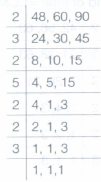
LCM = 2 x 3 x 2 x 5 x 2 x 2 x 3 = 720 min
In hour =\({720\over 60}=12h\)
\(\therefore\)Bell ring together again = (10 : 00 am + 12 hr)
= 10: 00 pm
25.
Given number is 4864. Here, unit place is 4. So, it is divisible by 2.
26.
9:14 am
27.
50, 15

6th Standard CBSE Syllabus & Materials
6th Standard CBSE
CBSE 6th Social Science Locating Places on the Earth - New Sample Question Papers Study Material - QB365 Set A
NEW6th Standard CBSE
CBSE 6th Science A Journey Through States of Water - New Sample Question Papers Study Material - QB365 Set A
NEW6th Standard CBSE
CBSE 6th Science Temperature and its Measurement - New Sample Question Papers Study Material - QB365 Set A
NEW6th Standard CBSE
CBSE 6th Science Materials Around Us - New Sample Question Papers Study Material - QB365 Set A



CBSE 6th Standard CBSE Subjects
CBSE Standards




