
 100% FREE ACCESS
12th Standard Syllabus & Materials
12th Standard
TN 12th Computer Applications மின்னணு தரவு பரிமாற்றம் Sample Question Papers Study Material - QB365 Set A
NEW12th Standard
TN 12th Computer Applications மின் - வணிக பாதுகாப்பு அமைப்புகள் Sample Question Papers Study Material - QB365 Set A
NEW12th Standard
TN 12th Computer Applications மின்னணு செலுத்தல் முறைகள் Sample Question Papers Study Material - QB365 Set A
NEW12th Standard
TN 12th Computer Applications மின் - வணிகம் Sample Question Papers Study Material - QB365 Set A
NEW12th Standard
TN 12th Computer Applications திறந்த மூல கருத்துருக்கள் Sample Question Papers Study Material - QB365 Set A
NEW12th Standard
TN 12th Computer Applications வலையமைப்பு வடமிடல் Sample Question Papers Study Material - QB365 Set A

Published on: 03/08/2019
Electromagnetic Waves
Download Tamil Nadu 12th Standard Physics question papers, model tests, one-mark questions, important questions, and public exam papers in PDF format. Free study materials and answer keys for TN State Board students.
Questions + Answers key
Take MCQ Physics Test1.
Write the frequency source of production and uses of Ultraviolet radiation.
2.
Let an electromagnetic wave propagate along the x-direction, the magnetic field oscillates at a frequency of 1010 Hz and has an amplitude of 10−5 T, acting along the y-direction. Then, compute the wavelength of the wave. Also write down the expression for electric field in this case.
3.
Consider a parallel plate capacitor which is connected to an 230 V RMS value and 50 Hz frequency. If the separation distance between the plates of the capacitor and area of the plates are 1 mm and 20 cm2 respectively. Calculate the displacement current at t = 1 s.
4.
A magnetic field is produced by ____________.
a changing electric field
a moving charge
both of them
none of them
5.
Which EM waves are used in medicine to destroy cancer cells?
radio waves
IR
૪ rays
UV rays
6.
The EM waves do not transport _______________.
energy
charge
momentum
information
7.
During the propagation of electromagnetic waves in a medium __________________.
electric energy density is double of the magnetic energy density
electric energy density is half of the magnetic energy density
electric energy density is equal to the magnetic energy density
both electric and magnetic energy densities are zero
8.
9.
What is the orgin of displacement currtent?
10.
Draw a diagram depicting oscillating electric and magnetic field of an electromagnetic wave.
11.
Why are Infrared radiation referred to as heatwaves? Name the radiations, which are next to these radiation having
(i) shorter λ
(ii) longer λ.
12.
Write the uses of Micro waves.
13.
Write the uses of Radio waves.
14.
What is meant by Fraunhofer lines?
15.
Use the formula E = h૪ (for energy of a quantum of radiation photon) and obtain the photon energy in units of ev for different parts of the Electromagnetic spectrum. In what ways are the different scales of photon energies that you obtain related to the sources of Electromagnetic radiation?
16.
In a plane Electromagnetic wave, the electric field oscillates sinusoidally at a frequency of 1.5 x 10¹⁰Hz with & an amplitude of 36 Vm-1.
(i) What is the wavelength of a wave?
(ii) What the amplitude of the oscillating magnetic field?
(iii) Straight the average energy density of the electric field \(\left( \overrightarrow { E } \right) \), is equal to average energy density of the magnetic field \(\left( \overrightarrow { B } \right) \)
17.
18.
Explain the types of emission spectrum.
19.
Discuss the source of electromagnetic waves.
20.
1.
It is produced by Sun, arc, and ionized gases. The wavelength range is 6 x 10⁻¹⁰m to 4 x 10⁻⁷m and the frequency range is 5 x 10¹⁷Hz to 7 x 10¹⁴Hz. It has less penetrating power. It can be absorbed by atmospheric ozone and harmful to human body. It is used to destroy bacteria, sterilizing the surgical instruments, burglar alarm, detect the invisible writing, finger prints and also in the study of molecular structure.
2.
Amplitude of magnetic field B = 10-5 T
Frequency, f = 1010 HZ
(i) Wavelength of the wave,
\({\lambda}=\frac{c}{f} =\frac{3 \times 10^8}{ 10^{10}} \)
= 3 x 10⁸ - 10
Wavelength = 3 x 10⁻² m
(ii) Electric field E(x,t)\(\hat i\)
Angular frequency \(\omega =2 \pi f \)
\(\omega=2 \times 3.14 \times 10^{10}=6.28 \times 10^{10} rads^{-1}\)
\(k=\frac{2 \pi}{\lambda} =\frac{2 \times 3.14}{3 \times 10^{-2}} \)
\(=\frac{6.28}{3 \times 10^{-2}}=\frac{628}{3}=2.09 \times 10^{2} \)
k = 2.09 x 10²
(iii) Eo = BoC
Eo = 10-5 x 3 x 108
Eo = 3 x 10³ V m-1
The required expression for electric field is
\(\vec{E}(x, t)=E_o \sin \left(\frac{2 \pi}{\lambda} x-2 \pi f t\right) \hat{i} N C^{-1} \)
\(\vec{E}(x , t)=3 \times 10^{3} \sin \left(2.09 \times 10^{2} \mathrm{x}-6.28 \times 10^{10} \mathrm{t}\right) \hat(-{k}) N C^{-1} \)
3.
Potential difference between the plates of the capacitor,
\(V=V_{\max } \sin 2 \pi f t\)
\(=230 \sqrt{2} \sin (2 \pi \times 50 t)\)
\(\therefore V=325 \sin 100 \pi t\)
d = 1 mm = 1 x 10⁻³ m
A = 20 cm2 = 20 x 10–4 m2
Displacement current, \(i_{d}=\epsilon_{0} \frac{d \Phi_{E}}{d t}=\epsilon_{\circ} \frac{d(\mathrm{EA})}{d t}\)
\(\therefore i_{d}=\frac{\epsilon_{0} A}{d}\left[\frac{d V}{d t}\right] \quad\left[\because E=\frac{V}{d}\right]\)
\(=\frac{\epsilon_{0} A}{d}(325)(100 \pi) \cos 100 \pi t\)
\(=\left(\begin{array}{l} 8.85 \times 10^{-12} \times 20 \times 10^{-4} \times 325 \\ \times 100 \times 3.14 \times \cos (100 \pi \times 1) \end{array}\right) /\left(1 \times 10^{-3}\right)\)
\(\begin{aligned}=1.81 \times 10^{-6} \mathrm{~A}=1.81 \mu \mathrm{A}[\because \cos (100 \pi \times 1)=1] \end{aligned}\)
4.
(c)
both of them
5.
(c)
૪ rays
6.
(b)
charge
7.
(c)
electric energy density is equal to the magnetic energy density
8.
(b)
9.
Displacement of does not arise due to motion of charge carries but it arises due to time variation of electric flux.
10.
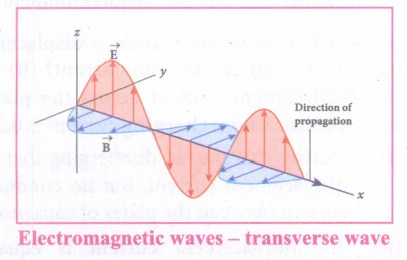
11.
Infrared radiation waves are produced by hot bodies and molecules so it is referred as heat waves. (eg. Sun)
(i) Electromagnetic waves having shorter λ than Infrared radiation are visible, U - v, X-rays, and ૪ - rays.
(ii) Electromagnetic waves having longer λ than Infrared radiation are microwaves, radiowaves.
12.
It is used in radar systems for aircraft navigation, speed of the vehicle, microwave oven for cooking, and very long-distance wireless communication through satellites.
13.
It is used in radio and television communication systems and also in cellular phones to transmit voice communication in the ultra high frequency band.
14.
When the spectrum obtained from the Sun is examined, it consists of large number of dark lines (line absorption spectrum). These dark lines in the solar spectrum are known as Fraunhofer lines.
15.
Given : Frequency of ૪ - rays = 3 x 10²⁰ Hz
Formula:
Energy of gamma rays,
E = h૪
= 6.63 x 10-34 x 3 x 1020
E = 19.8 x 10⁻¹⁴ J
∵ [ 1 eV = 1.6 x 10 - 19J; 1 T = \(\frac{1}{1.6\times 10^{-19}}\) eV]
Solution:
\(E=\frac { 19.8\times { 10 }^{ -14 } }{ 1.6\times { 10 }^{ -19 } } \)
E = 1.24 x 10⁶ eV
16.
(i) Wavelength \(\lambda =\frac { c }{ \gamma } =\frac { 3\times { 10 }^{ 8 } }{ 1.5\times { 10 }^{ 10 } } =2\times { 10 }^{ -2 }m\)
(ii) \(B=\frac { E }{ c } =\frac { 36 }{ 3\times { 1 }0^{ 8 } } =12\times { 10 }^{ -8 }T\)
Formula: (or) 1.2 x 10⁻⁷T
Average energy of magnetic field \(\overrightarrow { E } \) \({ U }_{ E }=\frac { 1 }{ 2 } .{ \varepsilon }_{ 0 }{ E }^{ 2 }\)
The average energy density of electric field \(\overrightarrow { B } \) \({ U }_{ E }=\frac { 1 }{ 2{ \mu }_{ 0 } } .{ B }^{ 2 }\)
But E = CB & C2 = \(\frac { 1 }{ { \mu }_{ 0 }{ \varepsilon }_{ 0 } } \)
\({ U }_{ E }=\frac { 1 }{ 2 } .{ \varepsilon }_{ 0 }{ E }^{ 2 }=\frac { 1 }{ 2 } .{ \varepsilon }_{ 0 }{ (CB) }^{ 2 }\)
\({ U }_{ E }=\frac { 1 }{ 2 } .{ \varepsilon }_{ 0 }.\frac { 1 }{ { \mu }_{ 0 }{ \varepsilon }_{ 0 } } { B }^{ 2 }=\frac { 1 }{ { \mu }_{ 0 }{ \varepsilon }_{ 0 } } { B }^{ 2 }={ U }_{ B }\)
\(\therefore { U }_{ E }={ U }_{ B }\)
17.
18.
Emission spectra:
When the spectrum of self luminous source is taken, we get emission spectrum. Each source has its own characteristic emission spectrum. The emission spectrum can be divided into three types:
(i) Continuous emission spectra (or continuous spectra) :
(a) If the light from incandescent lamp (filament bulb) is allowed to pass through prism (simplest spectroscope), it splits into seven colours.
(b) Thus, it consists of wavelengths containing all the visible colours ranging from violet to red (in the figure). Examples: spectrum obtained from carbon arc, incandescent solids.
(ii) Line emission spectrum (or line spectrum) :
(a) Suppose light from hot gas is allowed to pass through a prism, line spectrum is observed. Line spectra are also known as discontinuous spectra. The line spectra consists of sharp lines of definite wavelengths or frequencies.
(b) Such spectra arise due to excited atoms of elements. These lines are the characteristics of the element and are different for different elements. Examples: spectra of atomic hydrogen, helium, etc.
(iii) Band emission spectrum (or band spectrum) :
(a) Band spectrum consists of several number of very closely spaced spectral lines which overlapped together forming specific bands which are separated by dark spaces.
(b) This spectrum has a sharp edge at one end and fades out at the other end. Such spectra arise when the molecules are excited.
(c) Band spectrum is the characteristic of the molecule hence, the structure of the molecules can be studied using their band spectra. Examples, spectra of hydrogen gas, ammonia gas in the discharge tube, etc.
19.
(i) Any stationary source charge produces only electric field. When the charge moves with uniform velocity, it produces steady current which gives rise to magnetic field (not time dependent, only space· dependent) around the conductor in which charge flows.
(ii) If the charged particle accelerates, it produces magnetic field in addition to electric field. Both electric and magnetic fields are time varying fields. Since the electromagnetic waves are transverse waves, the direction of propagation of electromagnetic waves is perpendicular to the plane containing electric and magnetic field vectors.
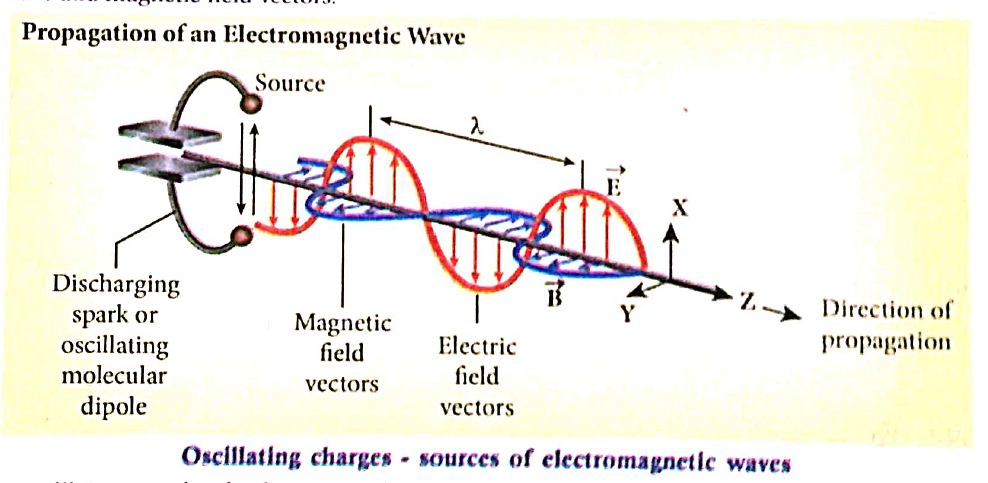
(iii) Any oscillatory motion is also an accelerating motion, so, when the charge oscillates (oscillating molecular dipole) about their mean position as shown in Figure, it produces electromagnetic waves.
(iv) Suppose the electromagnetic field in free space propagates along z-direction, and if the electric field vector points along x-axis then the magnetic field vector will be mutually perpendicular to both electric field and the direction of wave propogation. Thus,
Ex = Eo sin (kz - ωt)
By = Bo sin(Kz - ωt)
Where, Eo and Bo are amplitude of the oscillating electric and magnetic field, k is a wave number, ω is the angular frequency of the wave and \(\hat { k } \) (unit vector, here it is called propagation vector) denotes the direction of propagation of electromagnetic wave.
(vi) Note that both electric field and magnetic field oscillate with a frequency (frequency of electromagnetic wave) which is equal to the frequency of the source (here, oscillating charge is the source for the production of electromagnetic waves). In free space or in vacuum, the ratio between Eo and Bo is equal to the speed of electromagnetic wave, which is equal to speed of light c.
\(c=\frac { { E }_{ 0 } }{ { B }_{ 0 } } \)
In any medium, the ratio of Eo and Bo is equal to the speed of electromagnetic wave in that medium. Thus,
Further, the energy of electromagnetic waves comes from the energy of the oscillating charge.
20.

12th Standard Syllabus & Materials
12th Standard
TN 12th Computer Applications களப்பெயர் முறைமை (DNS) Sample Question Papers Study Material - QB365 Set A
NEW12th Standard
TN 12th Computer Applications வலையமைப்பு எடுத்துக்காட்டுகள் மற்றும் நெறிமுறைகள் Sample Question Papers Study Material - QB365 Set A
NEW12th Standard
TN 12th Computer Applications கணினி வலையமைப்பு ஓர் அறிமுகம் Sample Question Papers Study Material - QB365 Set A
NEW12th Standard
TN 12th Computer Applications PHP-உடன் MySQL-ஐ இணைத்தல் Sample Question Papers Study Material - QB365 Set A



Tamilnadu Stateboard 12th Standard Subjects

Maths

Chemistry
Physics

Biology

Computer Science

Business Maths and Statistics

Economics

Commerce

Accountancy

History

Computer Applications
Biology
Computer Technology
Computer Applications
Computer Science
Business Maths and Statistics
Commerce
Economics
Maths
Chemistry
Physics
Computer Technology
History
Accountancy

Tamil

English

French
Tamilnadu Stateboard Standards

