
 100% FREE ACCESS
11th Standard Syllabus & Materials
11th Standard
TN 11th Tamil இயற்கை வேளாண்மை,சுற்றுச்சூழல் -செய்யுள் - மனோன்மணீயம் Important Questions And Answers Study Material - QB365 Set A
NEW11th Standard
TN 11th Tamil என்னுயிர் என்பேன் -துணைப்பாடம் - இசைத்தமிழர் இருவர் Important Questions And Answers Study Material - QB365 Set A
NEW11th Standard
TN 11th Tamil மொழி கலை -செய்யுள் - ஒவ்வொரு புல்லையும் Important Questions And Answers Study Material - QB365 Set A
NEW11th Standard
TN 11th Tamil பீடு பெற நில் - இலக்கணம் - பகுபத உறுப்புகள் Important Questions And Answers Study Material - QB365 Set A
NEW11th Standard
TN 11th Tamil பீடு பெற நில் - துணைப்பாடம் - வாடிவாசல் Important Questions And Answers Study Material - QB365 Set A
NEW11th Standard
TN 11th Tamil பீடு பெற நில் - செய்யுள் - குறுந்தொகை Important Questions And Answers Study Material - QB365 Set A

Published on: 27/12/2018
+1 First Revision Test Model
Download Tamil Nadu 11th Standard Physics question papers, model tests, one-mark questions, important questions, and public exam papers in PDF format. Free study materials and answer keys for TN State Board students.
Questions + Answers key
Take MCQ Physics Test1.
Which of the following function represents a simple harmonic oscellation?
sin ωt - cos ωt
sin ωt + sin2 ωt
sin ωt - sin2 ωt
sin2 ωt
2.
If there were no gravity, which of the following will not be there for a fluid?
viscosity
surface tension
pressure
archimedes upward thrust
3.
The work done by Sun on Earth at any finite interval of time is
Positive, negative or zero
Strictly positive
Strictly negative
It is always zero
4.
A sound wave whose frequency is 5000 Hz travels in air and then hits the water surface. The ratio of its wavelengths in water and air is
4.30
0.23
5.30
1.23
5.
An ideal spring of spring constant k, is suspended from the ceiling of a room and a block of mass M is fastened to its lower end. If the block is released when the spring is un-stretched, then the maximum extension in the spring is
4\(\frac { Mg }{ k } \)
\(\frac { Mg }{ k } \)
2\(\frac { Mg }{ k } \)
\(\frac { Mg }{ 2k } \)
6.
Which of the following shows the correct relationship between the pressure and density of an ideal gas at constant temperature?
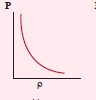

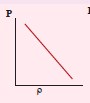
7.
An ideal refrigerator has a freezer at temperature −12°C. The coefficient of performance of the engine is 5. The temperature of the air (to which the heat ejected) is
50°C
45.2°C
40.2°C
37.5°C
8.
Which of the following is not a scalar?
viscosity
surface tension
pressure
stress
9.
The slope of the position-time graph will give ______________.
displacement
velocity
acceleration
force
10.
Three identical metal balls, each of the radius r are placed touching each ether on a horizontal surface such that an equilateral triangle is formed when centres of three balls are joined. The centre of the mass of the system is located at _____________.
line joining centres of any two balls
centre of one of the balls
horizontal surface
point of intersection of the medians
11.
A disc of the moment of inertia Ia is rotating in a horizontal plane about its symmetry axis with a constant angular speed \(\omega\). Another disc initially at rest of moment of inertia Ib is dropped coaxially on to the rotating disc. Then, both the discs rotate with the same constant angular speed. The loss of kinetic energy due to friction in this process is,
\(\frac { 1 }{ 2 } \frac { { I }_{ b }^{ 2 } }{ 2({ I }_{ a }+{ I }_{ b }) } { \omega }^{ 2 }\)
\(\frac { { I }_{ b }^{ 2 } }{ ({ I }_{ a }+{ I }_{ b }) } { \omega }^{ 2 }\)
\(\frac { { ({ I }_{ b }-{ I }_{ a }) }^{ 2 } }{ ({ I }_{ a }+{ I }_{ b }) } { \omega }^{ 2 }\)
\(\frac { 1 }{ 2 } \frac { { { I }_{ b }{ I }_{ b } } }{ ({ I }_{ a }+{ I }_{ b }) } { \omega }^{ 2 }\)
12.
A body of mass 4 m is lying in xy-plane at rest. It suddenly explodes into three pieces. Two pieces each of mass m move perpendicular to each other with equal speed v. The total kinetic energy generated due to explosion is
mv2
\(\frac{3}{2}\)mv2
2mv2
4mv2
13.
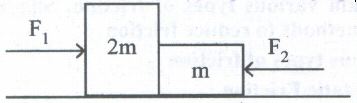
Two blocks of masses m and 2m are placed on a smooth horizontal surface as shown. In the first case only a force F1 is applied from the left. Later only a force F2 is applied from the right. If the force acting at the interface of the two blocks in the two cases is same, then F1 :F2 is
1:1
1:2
2:1
1:3
14.
15.
The velocity of a particle v at an instant t is given by v = at + br2. The dimensions of b is
[L]
[LT-1]
[LT-2]
[LT-3]
16.
Consider four masses m1, m2, m3, and m4 arranged on the circumference of a circle as shown in figure below.
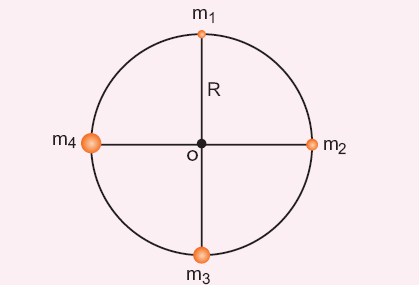
Calculate
(a) The gravitational potential energy of the system of 4 masses shown in figure.
(b) The gravitational potential at the point O due to all the 4 masses
17.
Determine gravitational potential from gravitational potential energy?
18.
Discuss the limits of the specific heat of a gas
19.
Explain how does a gas exert pressure on the bases of kinetic theory of gases.
20.
How does the wave y = sin(x − a) for a = 0, a =\(\frac { \pi }{ 4 } ,a=\frac { \pi }{ 2 } ,a=\frac { 3\pi }{ 2 } \) and a = \(\pi\) look like? Sketch this wave.
21.
What is a black body?
22.
What is Reynold’s number? Give its significance.
23.
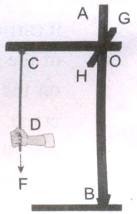
Three mutually perpendicular beams AB, OC, GH are fixed to form a structure which is fixed to the ground firmly as shown in the Figure. One string is tied to the point C and its free end D is pulled with a force F. Find the magnitude and direction of the torque produced by the force,
(i) about the points D, C, O and B
(ii) about the axis CD, OC, AB and GH.
24.
An object of mass 10 kg moving with a speed of 15 ms-1 hits the wall and comes to rest within
(a) 0.03 second
(b) 10 second.
Calculate the impulse and average force acting on the object in both the cases.
25.
Can a body be in equilibrium while in motion? If yes, give an example.
26.
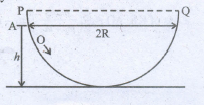
A ball of mass m is pushed down the wall of hemispherical bowl from point A. It just rises up to edge Q of the bowl. Find the speed at which baU is pushed down.
27.
A bob attached to the string oscillates back and forth. Resolve the forces acting on the bob into components. What is the acceleration experienced by the bob at an angle θ.
28.
Give the values for the following units with prefixes.
(i) 1 Mega ohm
(ii) 1 milliampere
(iii) 1 deca gram
(iv) 1 nano second
(v) 1 micro volt
(vi) 1 centimetre
29.
Write down the kinematic equations for angular motion.
30.
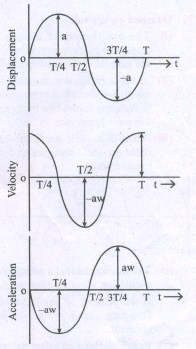
Explain briefly about the graphical representation of Displacement, velocity and acceleration in SHM.
31.
The force F acting on a body moving in a circular path depends on mass of the body (m), velocity (v) and radius (r) of the circular path. Obtain the expression for the force by dimensional analysis method. (Take the value of k = 1)
32.
A body falling freely descends 0.3m in 0.1s and 0.398m in the next 0.1s in some other planet. Find the value of g in that planet.
33.
State in the absence of any external force the velocity of the centre of mass remains constant.
34.
Derive an expression for the velocity of the body moving in a vertical circle. And also find a tension at the bottom and the top of the circle.
35.
Derive the equation of motion, range and maximum height reached by the particle thrown at an oblique angle \(\theta\) with respect to the horizontal direction.
36.
What is meant by reverberation time?
37.
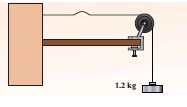
Calculate the velocity of the travelling pulse as shown in the figure below. The linear mass density of pulse is 0.25 kg m-1. Further, compute the time taken by the travelling pulse to cover a distance of 30 cm on the string.
38.
Explain damped oscillation. Give an example.
39.
If the position vector of the particle is given by \(\vec { r } ={ 3t }^{ 2 }\hat { i } +5t\hat { j } +4\hat { k } \), Find the
(a) The velocity of the particle at t = 3 s
(b) Speed of the particle at t = 3 s
(c) Acceleration of the particle at time t = 3s
40.
A lighter body collides with much more massive body at rest. Prove that the direction of lighter body is reversed and massive body remains at rest.
41.
Name the instrument to measure Sub-atomic particles.
42.
Write the relation between angular momentum and rotational kinetic energy. Draw a graph for the same. For two objects of same angular momentum, compare the moment of inertia using the graph.
43.
What is the meaning by 'pseudo force'?
1.
(a)
sin ωt - cos ωt
2.
(d)
archimedes upward thrust
3.
(c)
Strictly negative
4.
Frequency = 5000 Hz
Speed of sound in air = 332 m/s
Speed of sound in water = 1450 m/s
Wavelength of sound in air \(=\frac{332}{5000}\)
\(=66.4 \times 10^{-3}\)
\(\text { Wavelength of sound water } \lambda_{\text {water }}\)
\(=\frac{1450}{5000} =290 \times 10^{-3} \mathrm{~m} \)
\(\therefore \frac{\lambda_{\text {water }}}{\lambda_{\text {air }}} =\frac{290 \times 10^{3}}{66.4 \times 10^{-3}} =4.367 \)
5.
\(\mathrm{F} =-\mathrm{kx} \)
\(\therefore \mathrm{x} =\left|-\frac{F}{k^{\prime}}\right|=\frac{F}{k^{\prime}} \)
\(\mathrm{F} =\mathrm{Mg} \text { and } k^{\prime}=\frac{k}{2} \)
\(\therefore \mathrm{x} =\frac{M g}{\frac{k}{2}} \)
\(=\frac{2 M g}{k} \)
6.
Pressure is directly proportional to density.
7.
\(\mathrm{COP}=\frac{T_{L}}{T_{H}-T_{L}}\)
\(\mathrm{T}_{\mathrm{L}}=-12+273 =261 \mathrm{~K} \)
\(5=\frac{261}{T_{H}-261} \)
\(\therefore 5\left(T_{H}-261\right) =261 \)
\(5 \mathrm{~T}_{\mathrm{H}}-1305 =261 \)
\(5 \mathrm{~T}_{\mathrm{H}} =261+1305 =1566 \)
\(\therefore T_{H} =\frac{1566}{5} \)
\(=313.2 \mathrm{~K} \)
\(\mathrm{~T}_{\mathrm{H}}=313.2-273 =40.2^{\circ} \mathrm{C} \)
8.
(d)
stress
9.
(d)
force
10.
(d)
point of intersection of the medians
11.
The moments of inertia of two discs are Ia and Ib respectively The angular velocity of the disc A is \(\omega\).
The sum of kinetic energies of two discs before coming in contact is \(k_{1}=\frac{1}{2} I_{a} \omega_{1}^{2}+\frac{1}{2} I_{b} \omega_{2}^{2}\)
\(\text { But angular velocity of the disc be is } \omega_{2}=0 \ \text {(rest)}\)
\(\therefore k_{1}=\frac{1}{2} I_{a} \omega_{1}^{2}\)
The final kinetic energy of the two discs system \(k_{2}=\frac{1}{2} \frac{I_{a}^{2} \omega_{1}^{2}}{I_{a}+I_{b}}\)
The loss of kinetic energy is
\(k_{1}-k_{2} =\frac{1}{2} I_{a} \omega^{2}-\frac{1}{2}\left[\frac{I a^{2} \omega_{1}^{2}}{I_{a}+I_{2 b}}\right] \)
\(=\frac{1}{2} \frac{\left[I_{1}\left(I_{a}+I_{b}\right) \omega^{2}-I_{a}^{2} \omega^{2}\right]}{I_{a}+I_{b}} \)
\(k_{1}-k_{2} =\frac{1}{2} \frac{I_{a} b}{\left(I_{a}+I_{b}\right)} \omega^{2} \)
12.
Using law of conservation of momentum,
\(2 m v =\sqrt{m^{2} v^{2}+m^{2} v^{2}} \)
\(=\sqrt{2 m^{2} v^{2}} \)
\(v =\frac{\sqrt{2} m v}{2 m}=\frac{v}{\sqrt{2}} \)
Energy released in explosion = \(2 \times \frac{1}{2} m v^{2} +\frac{1}{2} \times 2 m \times\left(\frac{v^{2}}{\sqrt{2}}\right)^{2} \)
\(=m v^{2}+m \times \frac{v^{2}}{2} \)
\(=\frac{3}{2} m v^{2} \)
13.
(c)
2:1
14.
(b)
15.
\(v=a t+b t^{2}\)
\(\text { Dimensional equation is } \mathrm{LT}^{-1}\)
\(=a T=b T^{2}\)
\(\therefore \text { The dimension of } b=\frac{\mathrm{LT}^{-1}}{\mathrm{~T}^{2}}=\mathrm{LT}^{-3}\)
16.
The gravitational potential energy U(r) can be calculated by finding the sum of gravitational potential energy of each pair of particles.
\(U=-\frac { { Gm }_{ 1 }m_{ 2 } }{ { r }_{ 12 } } -\frac { { Gm }_{ 1 }m_{ 3 } }{ { r }_{ 13 } } -\frac { { Gm }_{ 1 }m_{ 4 } }{ { r }_{ 14 } } -\frac { { Gm }_{ 2 }m_{ 3 } }{ { r }_{ 23 } } -\frac { { Gm }_{ 2 }m_{ 4 } }{ { r }_{ 24 } } -\frac { { Gm }_{ 3 }m_{ 4 } }{ { r }_{ 34 } } \)
Here r12, r13 ... are distance between pair of particles
\({ r }_{ 14 }^{ 2 }={ R }^{ 2 }+{ R }^{ 2 }=2{ R }^{ 2 }\)
\({ r }_{ 14 }=\sqrt { 2 } R={ r }_{ 12 }={ r }_{ 23 }={ r }_{ 34 }\)
r13 = r =24 = 2R
\(U=-\frac { { Gm }_{ 1 }m_{ 2 } }{ \sqrt { 2 } R } -\frac { { Gm }_{ 1 }m_{ 3 } }{ { 2R } } -\frac { { Gm }_{ 1 }m_{ 4 } }{ { \sqrt { 2 } R } } -\frac { { Gm }_{ 2 }m_{ 3 } }{ \sqrt { 2 } R } -\frac { { Gm }_{ 2 }m_{ 4 } }{ 2R } -\frac { { Gm }_{ 3 }m_{ 4 } }{ \sqrt { 2 } R } \)
\(U=-\frac { G }{ R } \left[ \frac { { Gm }_{ 1 }m_{ 2 } }{ \sqrt { 2 } } -\frac { { Gm }_{ 1 }m_{ 3 } }{ { 2 } } -\frac { { Gm }_{ 1 }m_{ 4 } }{ { \sqrt { 2 } } } -\frac { { Gm }_{ 2 }m_{ 3 } }{ \sqrt { 2 } } -\frac { { Gm }_{ 2 }m_{ 4 } }{ 2 } -\frac { { Gm }_{ 3 }m_{ 4 } }{ \sqrt { 2 } } \right] \)
If all the masses are equal, then m1 = m2 = m3 = m4 = M
\(U=-\frac { G{ M }^{ 2 } }{ R } \left[ \frac { 1 }{ \sqrt { 2 } } +\frac { 1 }{ { 2 } } +\frac { 1 }{ { \sqrt { 2 } } } +\frac { 1 }{ \sqrt { 2 } } +\frac { 1 }{ 2 } +\frac { 1 }{ \sqrt { 2 } } \right] \)
\(U=-\frac { G{ M }^{ 2 } }{ R } \left[ 1+\frac { 4 }{ \sqrt { 2 } } \right] \)
\(U=-\frac { G{ M }^{ 2 } }{ R } \left[ 1+2\sqrt { 2 } \right] \)
The gravitational potential V(r) at a point O is equal to the sum of the gravitational potentials due to individual mass. Since potential is a scalar, the net potential at point O is the algebraic sum of potentials due to each mass.
\({ V }_{ o }(r)\frac { { Gm }_{ 1 } }{ R } -\frac { { Gm }_{ 2 } }{ { R } } -\frac { { Gm }_{ 3 } }{ { R } } -\frac { { Gm }_{ 4 } }{ R } \)
If m1 = m2 = m3 = m4 = M
\({ V }_{ o }(r)\frac { { 4GM } }{ R } \)
17.
(i) Consider two masses m1 and m2 separated by a distance r which has gravitational potential energy U(r).
(ii) The gravitational potential due to mass ml at a point P which is at a distance r from ml is obtained by making m2 equal to unity (m2=1kg).
(iii) Thus the gravitational potential V(r) due to mass m = 1 at a distance r is,
V(r)=\(\frac { { GM }_{ 1 } }{ { r } } \)
18.
(i) When the gas is suddenly compressed \(\triangle\)Q = 0
\(C=\frac { \triangle Q }{ m\triangle T } \)=0 Specific heat is zero.
(ii) Gas is heated and allowed to expand, DT =0 C = a specific heat is infinite
(ii) Expansion is less than rise in temperature due to supply of heat. \(\triangle\)T is +ve.
Specific heat is +ve.
(iv) Expansion is more than rise in temperature. \(\triangle\)T is -ve
Specific heat is -ve.
19.
Accumulate to kinetic theory:
(i) The molecules of a gas are in a state of continuous random motion.
(ii) They collide with one another and also with the walls of the vessel. Whenever a molecule collides with the wall. It returns with a changed momentum and an equal momentum is transfused to the wall (conservation of momentum).
Accumulate to Newton's law:
(i) The transfer of momentum to the wall is equal to the force excited on the wall.
(ii) The force excited per unit area of the wall is the pressure of the gas.
Hence a gas excites pres due to the continuous call of its molecules with the walls of the vessel.
20.
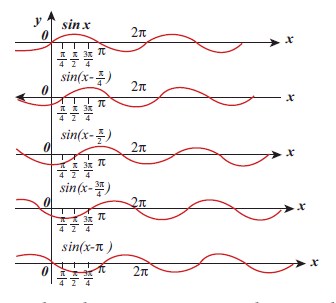
From the above picture we observe that y = sin (x−a) for a = 0, a =\(\frac { \pi }{ 4 } ,a=\frac { \pi }{ 2 } ,a=\frac { 3\pi }{ 2 } \)and a = \(\pi\), the function y = sin (x−a) shifts towards right. Further, we can take a = vt and v = \(\frac{\pi}{4}\) , and sketching for different times t = 0s, t = 1s, t = 2s etc., we once again observe that y = sin(x−vt) moves towards the right. Hence, y = sin(x−vt) is a travelling (or progressive) wave moving towards the right. If y = sin(x+vt) then the travelling (or progressive) wave moves towards the left. Thus, any arbitrary function of type y = f(x−vt) characterising the wave must move towards right and similarly, any arbitrary function of type y = f(x+vt) characterizing the wave must move towards left.
21.
A black body is the one which absorbs completely heat radiations of all wavelengths when heated. A black body neither reflects nor transmits any radiation. Its absorptive power is unity.
22.
Reynold's number is a dimensionless number. It is used to find the nature of the flow of fluid, whether it is streamlined or turbulent.
Reynold's number \(R_{e}=\frac{\rho v D}{\eta }\)
ρ - denotes the density of the fluid v - denotes the velocity of the fluid
D - denotes the diameter of the pipe
η - denotes the coefficient of viscosity the fluid
23.
(i) Torque about point D is zero. (as F passes through D).
Torque about point C is zero. (as F passes through C).
Torque about point O is \((\overrightarrow {OC})\times \overrightarrow{F}\) and direction is along GH.
Torque about point B is \((\overrightarrow {BD})\times \overrightarrow{F}\) and direction is along GH.
(The perpendicular distance of \(\overrightarrow {BD}\) with respect to \(\overrightarrow {F}\) is \(\overrightarrow {OC}\).
(ii) Torque about axis CD is zero (as F is parallel to CD).
Torque about axis OC is zero (as F intersects OC).
Torque about axis AB is zero (as F is parallel to AB).
Torque about axis GH is \((\overrightarrow {OC})\times \overrightarrow{F}\) and direction is along GH.
24.
Initial momentum of the object Pi = 10 \(\times\)15 = 150 kgm s-1
Final momentum of the object pf = 0
Δp = 150 - 0 = 150 kg ms-1
(a) Impulse J = Δp = 150 N s and Average force \({ F }_{ avg }=\frac { \triangle p }{ \triangle t } =\frac { 150 }{ 0.03 } \)= 5000N
b) Impulse J = Δp = 150 N s and Average force Favg =\(\frac { 150 }{ 10 } \)= 15N
25.
Yes, if body has no linear and angular acceleration then a body in uniform straight line of motion will be in equilibrium.
26.
Total energy at A = Total energy at Q
\({v}^{2}={1\over2}{mv}^{2}+mgh=0+mgR\)
v2 = 2g(R-b) or \(v=\sqrt{2g(R-k)}\)
27.
(i) Tangential acceleration = g sin θ
(ii) mg cos θ acts along OP (outwards)
(iii) tension (T) acts along PO (inwards)
Net force on the body at P acting along
PO = T- mg cos θ
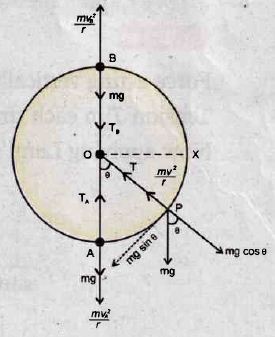
This must provide the necessary centripetal force. \(\frac{mv^2}{r}\)
\(\therefore T -mg \ cos \ \theta=\frac{mv^2}{r} \)
Centripetal acceleration (a⊥) = \(\frac { T-mg \ cos\theta }{ m } \)
28.
(i) 1 Mega ohm (M\(\Omega\)) = 106\(\Omega\)
(ii) 1 milliampere (mA) = 10-3A
(iii) 1 deca gram (da g) = 10g
(iv) 1 nano second (ns) = 10-9s
(v) 1 microvolt (\(\mu\)Y) = 10-6y
(vi) 1 centimetre (cm) = 10-2m
29.
| 1. \(\omega ={ \omega }_{ 0 }+\alpha t\) | \(\omega \) = Final angular velocity |
| 2. \(\theta ={ \omega }_{ 0 }t+\frac { 1 }{ 2 } { \alpha t }^{ 2 }\) | \({ \omega }_{ 0 }\) = initial angular velocity |
| 3. \({ \omega }^{ 2 }={ \omega }_{ 0 }^{ 2 }+2\alpha \theta \) | \(\theta \) = Angular displacement |
| 4. \(\theta =\frac { \left( { \omega }_{ 0 }+\omega \right) t }{ 2 } \) | \(\alpha \) = angular acceleration t = time |
30.
Graphical representation of displacement, velocity and acceleration of a particle vibrating simple harmonically with respect to time t.
(i) Displacement graph is a sine curve. Maximum displacement of the particle is y =+a
(ii) The velocity of the vibrating particle is maximum at the mean position i.e v =+ aw and it is zero at the extreme position.
(iii) The acceleration of the vibrating particle is zero at the mean position and maximum at the extreme position (i.e) ± aw2.
The velocity is ahead of displacement by a phase angle of \(\frac { \pi }{ 2 } \) . The acceleration is ahead of the velocity by a phase angle \(\frac { \pi }{ 2 } \) or by aw2 phase \(\pi\) ahead of displacement. (i.e) When the displacement has its greatest positive value, acceleration has its negative maximum value or vice versa.
31.
F ∝ ma vb rc ;
F = k ma vb rc
where k is a dimensionless constant of proportionality. Rewriting above equation in terms of dimensions and taking k= 1, we have
[MLT-2] = [M]a [LT-1]b [L]c
= [MaLbT-bLc]
[MLT-2] = [MaLb+cT-b]
Comparing the powers of M, L and T on both sides
a = 1 ; b + c = 1; -b =-2
2 + c = 1 ; b = 2;
a = 1 b = 2 and c = -1
From the above equation we get
F = mavbrc
F =m1v2r-1
or F = \(\frac { m{ v }^{ 2 } }{ r } \)
32.
Given:
During t1 = 0.1s, distance covered is s1 = 0.3m
During next t2 = 0.1s, distance covered is s2= 0.398m
We know \(s=ut+\frac{1}{2}at^2\)
In this case u = 0, a = g, \(s=\frac{1}{2}gt^2\)
t = t1+ t2 = 0.1 + 0.1 = 0.2
\(\therefore g=\frac{2s}{t^2}\)
For this problem,
\(g=\frac{2(s_2-s_1)}{t^2}\)
\(g=\frac{2(0.398-0.3)}{(0.2)^2}=\frac{2\times(0.098)}{0.04}=\frac{0.196}{0.04}\)
\(g=\frac{19.6}{4}=4.9m/s^2\)
∴ Acceleration due to gravity in that planet = 4.9 m/s2
33.
(i) When a rigid body moves, its center of mass will also move along with the body. For kinematic quantities like velocity (vCM) and acceleration (aCM) of the center of mass, we can differentiate the expression for position of center of mass with respect to time once and twice respectively. For, simplicity, let us take the motion along, X direction only.
\(\overset { \rightarrow }{ v } _{ CM }=\frac { d\overset { \rightarrow }{ x } _{ CM } }{ dt } =\frac { \sum { { m }_{ i }\left( \frac { d\overset { \rightarrow }{ x } _{ i } }{ dt } \right) } }{ \sum { { m }_{ i } } } =\frac { \sum { { m }_{ i }\overset { \rightarrow }{ v } _{ i } } }{ \sum { { m }_{ i } } } \)
\(\overset { \rightarrow }{ v } _{ CM }=\frac { \sum { { m }_{ i }\overset { \rightarrow }{ { v }_{ i } } } }{ \sum { { m }_{ i } } } \)
\(\overset { \rightarrow }{ a } _{ CM }=\frac { d }{ dt } \left( \frac { d\overset { \rightarrow }{ x_{ CM } } }{ dt } \right) =\left( \frac { d\overset { \rightarrow }{ v } _{ CM } }{ dt } \right) =\frac { \sum { { m }_{ i }\left( \frac { d\overset { \rightarrow }{ v_{ i } } }{ dt } \right) } }{ \sum { { m }_{ i } } } \)
=\(\frac { \sum { { m }_{ i }\overset { \rightarrow }{ a_{ i } } } }{ \sum { { m }_{ i } } } \)
(ii) In the absence of external force, i.e. \(\overset { \rightarrow }{ F_{ ext } } \)= 0 the individual rigid bodies of a system can move or shift only due to the internal forces.
(iii) This will not affect the position of the center of mass. This means that the center of mass will be in a state of rest or uniform motion. Hence, \(\overset { \rightarrow }{ { v }_{ CM } } \) will be zero when center of mass is at rest and constant when center of mass has uniform motion (\(\overset { \rightarrow }{ v_{ CM } } =0 \ or \ \overset { \rightarrow }{ v_{ CM } } \)=constant). There will be no acceleration of center of mass, \(\left( \overset { \rightarrow }{ a_{ CM } } =0 \right) \).
From equation
\(0=\frac { \sum { { m }_{ i }\overset { \rightarrow }{ v_{ i } } } }{ \sum { { m }_{ i } } } \)
\(\overset { \rightarrow }{ v_{ CM } } =\frac { \sum { { m }_{ i }\overset { \rightarrow }{ v_{ i } } } }{ \sum { { m }_{ i } } } ;\overset { \rightarrow }{ a_{ CM } } =0\)
(vi) Here, the individual particles may still move with their respective velocities and accelerations due to internal forces
34.
(i) A body of mass (m) attached to one end of a massless and inextensible string executes circular motion in a vertical plane with the other end of the string fixed. The length of the string becomes the radius \(\vec{r}\) of the circular path.
(ii) The motion of the body by taking the free body diagram (FBD) at a position where the position vector \(\vec{r}\) makes an angle θ with the vertically downward direction and the instantaneous velocity is as shown in Figure.
There are two forces acting on the mass.
1. Gravitational force which acts downward
2. Tension along the string.
Applying Newton's second law on the mass, In the tangential direction,
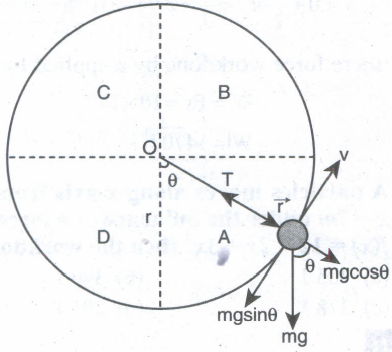
mg sinθ = mat
mg sinθ = -m \((\frac{dv}{dt})\)
where, at = -\((\frac{dv}{dt})\) is tangential retardation
In the radial direction,
T - mg cosθ = m ar
T - mg cosθ = \(\frac{mv^{2}}{r}\)
where, ar = \(\frac{v^{2}}{r}\) is the centripetal acceleration.
35.
Consider an object thrown with initial velocity \(\overrightarrow{u}\) at an angle \(\theta\) with the horizontal.
Then,
\(\overrightarrow{u}=u,\overrightarrow{i}+u,\overrightarrow{j}\)
where ux =u cos \(\theta\) is the horizontal component and uy = u sin \(\theta\) the vertical component of velocity.
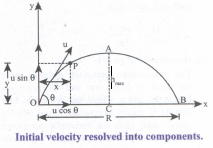
Since the acceleration due to gravity acts in the direction opposite to the direction of vertical component uy, this component will gradually reduce to zero at the maximum height of the projectile. At this maximum height, the same gravitational force will push the projectile to move downward and fall to the ground.
But, there is no acceleration along the x direction throughout the motion. So, the horizontal component of velocity (ux = u cos \(\theta\)) remains the same till the object reaches the ground.
After anytime t, the velocity along horizontal motion
vx = ux + axt = ux = u cos\(\theta\) [∴ ax = 0]
The horizontal distance travelled by projectile in time t is
sx = \({u}_{x}t+{{1}\over{2}}a_n{t}^{2}\)
[∴ sx = x and an = 0]
∴ t = \(\frac{x}{u \cos \theta} \) ......(1)
For the vertical motion the velocity after time t is vy = uy + ayt
vy = u sin \(\theta\) - gt........(2)
(∴ ug = u sin \(\theta\) and ay = - g)
The vertical distance travelled by the projectile in the same time t is
sy = \({u}_{y}t{{1}\over{2}}{a}_{y}{t}^{2}\)
y = sin \(\theta\ t-{{1}\over{2}}{gt}^{2}\)
(Here, (Here, sy = y, uy = u sin \(\theta\) and ay = - g)
Substitute the value of t from equation (1) in equation (3), we have
\(y=u\ \sin\theta{{x}\over{u\ \cos\ \theta}}-{{1}\over{2}}g{{x^2}\over{u^2{cos}^{2}\theta}}\)
\(y=x\ \tan\theta-{{1}\over{2}}g{{x^2}\over{u^2{cos}^{1}\theta}}\)
Thus the path followed by the projectile is an inverted parabola.
2. Maximum height: The maximum vertical distance travelled by the projectile during its journey is called maximum height.
For the vertical part of the motion. \({v}_{y}^{2}={u}_{y}^{2}+2{a}_{y}s\)
Here, uy = u sin \(\theta\), ay = -g, S = hmax and at the maximum height vy = 0.
Hence,
∴ 0 = u2 sin2 = 2ghmax
\({h}_{max}={{{u}^{2}{sin}^{2}\theta}\over{2g}}\)
3. Horizontal Range (R): The maximum horizontal distance between the point of projection and the point on the horizontal plane where the projectile hits the ground is called horizontal range (R).
Range R = Horizontal component of velocity x time of flight
= u cos \(\theta\times{T}_{f}\)
\(R=u\ \cos\theta\times{{2u\ \sin\theta}\over{g}}={{2{u}^{2}\sin\theta\cos\theta}\over{}g}\) \([\therefore T_f=\frac {2u\ sin \theta}{g}]\)
\(\therefore\ R={{u^2\sin 2\theta}\over{g}}\)
36.
The duration for which the sound persists is called reverberation time.
37.
The tension in the string is T = m g = 1.2\(\times\)9.8 = 11.76 N
The mass per unit length is μ = 0.25 kg m-1 Therefore, velocity of the wave pulse is
\(v=\sqrt { \frac { T }{ \mu } } =\sqrt { \frac { 11.76 }{ 0.25 } } =6.858 \ ms^{-1}=6.8 \ ms^{-1}\)
The time taken by the pulse to cover the distance of 30 cm is
t =\(\frac { d }{ v } =\frac { 30\times { 10 }^{ -2 } }{ 6.8 } =\)0 044 s = 44 ms Where, ms = milli second.
38.
39.
(a) The velocity
\(\vec { v } =\frac { d\vec { r } }{ dt } =\frac { dx }{ dt } \hat { i } +\frac { dy }{ dt } \hat { j } +\frac { dz }{ dt } \hat { k } \)
We obtain \(\vec { v } (t)=6t\hat { i } +5\hat { j } \)
The velocity has only two components vx = 6t, depending on time t and vy = 5 which is independent of time.
The velocity at t = 3 s is \(\vec { v } \)(3) =\(18\hat { i } +5\hat { j } \)
(b) The speed at t = 3 s is
\(v=\sqrt { { 18 }^{ 2 }+5^{ 2 } } =\sqrt { 349 } \approx \) 18.68 m s-1
(c) The acceleration \(\vec { a } \) is \(\vec { a } =\frac { { d }^{ 2 }\vec { r } }{ { dt }^{ 2 } } =6\hat { i } \)
The acceleration has only the x-component. Note that acceleration here is independent of t, which means \(\vec { a } \) is constant. Even at t = 3 s it has same value a = 6t. The velocity is non uniform, but the acceleration is uniform (constant) in this case.
40.
The first body is very much lighter than the second body \(\left( { m }_{ 1 }<<{ m }_{ 2 },\frac { { m }_{ 1 } }{ { m }_{ 2 } } <<1 \right) \)then the ratio \(\frac { { m }_{ 1 } }{ { m }_{ 2 } } \approx 0\) and also if the target is at rest (u2=0)
Dividing numerator and denominator of equation \({ v }_{ 1 }=\left( \frac { { m }_{ 1 }-{ m }_{ 2 } }{ { { m }_{ 1 }+m }_{ 2 } } \right) { u }_{ 1 }+\left( \frac { { 2m }_{ 2 } }{ { { m }_{ 1 }+m }_{ 2 } } \right) { u }_{ 2 }\) by m2 we get
\({ v }_{ 1 }=\left( \frac { \frac { { m }_{ 1 } }{ { m }_{ 2 } } -1 }{ \frac { { m }_{ 1 } }{ { m }_{ 2 } } +1 } \right) { u }_{ 1 }+\left( \frac { 2 }{ \frac { { m }_{ 1 } }{ { m }_{ 2 } } +1 } \right) \left( 0 \right) \)
\({ v }_{ 1 }=\left( \frac { 0-1 }{ 0+1 } \right) { u }_{ 1 }\)
v1=-u1
Similarly, dividing numerator and denominator of equation
\({ v }_{ 2 }=\left( \frac { { 2m }_{ 1 } }{ { { m }_{ 1 }+m }_{ 2 } } \right) { u }_{ 1 }+\left( \frac { { m }_{ 2 }-{ m }_{ 1 } }{ { { m }_{ 1 }+m }_{ 2 } } \right) { u }_{ 2 }\), by m2, we get
\({ v }_{ 2 }=\left( \frac { 2\frac { { m }_{ 1 } }{ { m }_{ 2 } } }{ \frac { { m }_{ 1 } }{ { m }_{ 2 } } +1 } \right) { u }_{ 1 }+\left( \frac { 1-\frac { { m }_{ 1 } }{ { m }_{ 2 } } }{ \frac { { m }_{ 1 } }{ { m }_{ 2 } } +1 } \right) \left( 0 \right) \)
\({ v }_{ 2 }=\left( 0 \right) { u }_{ 1 }+\left( \frac { 1-\frac { { m }_{ 1 } }{ { m }_{ 2 } } }{ \frac { { m }_{ 1 } }{ { m }_{ 2 } } +1 } \right) \left( 0 \right) \)
v2=0
41.
For measurement of small masses of atomic/subatomic particles etc., we make use of a mass spectrograph.
42.
Relation between angular momentum and rotational K.E.
Angular momentum, L = Iω.
Rotational K.E., EK = \(\frac{1}{2}\)
\(2I={ (I\omega ) }^{ 2 }\)
\({ x }_{ k }=\frac { { L }^{ 2 } }{ 2I } \)
\(\sqrt { { E }_{ k } } =\frac { L }{ \sqrt { 2I } } \)
\(\frac { \sqrt { { E }_{ k } } }{ L } =\frac { I }{ \sqrt { 2I } } =constant\)
If I = 1, graph will be hyperbola.
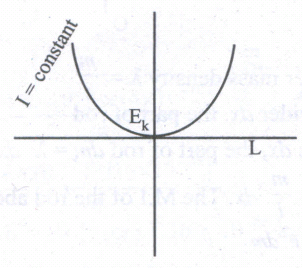
.png)
43.
The centrifugal force appears to act on the particle, only when we analyzes the motion from a rotating frame. With respect to an inertial frame there is only centripetal force which is given by the tension in the string. For this reason centrifugal force is called as a 'pseudo force'. A pseudo force has no origin, It arises due to the non-inertial nature of the frame considered.

11th Standard Syllabus & Materials
11th Standard
TN 11th Tamil பீடு பெற நில் - செய்யுள் - காவடிச்சிந்து Important Questions And Answers Study Material - QB365 Set A
NEW11th Standard
TN 11th Tamil பீடு பெற நில் - உரைநடை - மலை இடப்பெயர்கள் : ஓர் ஆய்வு Important Questions And Answers Study Material - QB365 Set A
NEW11th Standard
TN 11th Tamil மாமழை போற்றுதும் - துணைப்பாடம் - யானை டாக்டர் Important Questions And Answers Study Material - QB365 Set A
NEW11th Standard
TN 11th Tamil மாமழை போற்றுதும் - செய்யுள் - ஐங்குறுநூறு Important Questions And Answers Study Material - QB365 Set A



Tamilnadu Stateboard 11th Standard Subjects

Maths

Commerce

Economics

Biology

Business Maths and Statistics

Accountancy

Computer Science
Physics

Chemistry
Maths
Biology
Economics
Physics
Chemistry

History
Business Maths and Statistics

Computer Science
Accountancy

Computer Applications
History
Computer Technology
Commerce
Computer Applications
Computer Technology

Tamil

English

French
Tamilnadu Stateboard Standards

