
 100% FREE ACCESS
8th Standard CBSE Syllabus & Materials
8th Standard CBSE
CBSE 8th Social Science Theme D - Factors of Production - New Model Questions Papers Study Material - QB365 Set A
NEW8th Standard CBSE
CBSE 8th Social Science Theme C - Universal Franchise and India's Electoral System - New Model Questions Papers Study Material - QB365 Set A
NEW8th Standard CBSE
CBSE 8th Social Science Theme B - The Rise of the Marathas - New Model Questions Papers Study Material - QB365 Set A
NEW8th Standard CBSE
CBSE 8th Social Science Theme B - Reshaping India's Political Map - New Model Questions Papers Study Material - QB365 Set A
NEW8th Standard CBSE
CBSE 8th Social Science Theme A - Natural Resources and Their Use - New Model Questions Papers Study Material - QB365 Set A
NEW8th Standard CBSE
CBSE 8th Science Keeping Time with Skies - New Model Questions Papers Study Material - QB365 Set A

Published on: 15/12/2018
The Central Board of Secondary Education (CBSE) is a prestigious educational board which comes under the Union Government of India. Here, you will get the clue that from where and how the questions are being framed from the chapter Practical Geometry for CBSE Class 8 Mathematics. These questions can provide students a chapter wise preparation strategy so that they can prepare for their exam more efficiently.
The National Council of Education and Training sets the curriculum for all schools that follow the Central Board of Secondary Education (CBSE) across the nation. The important questions provided below will also make students familiar with the marking scheme and the difficulty level of the exam. The important questions for CBSE Class 8 Mathematics are prepared by subject experts according to the latest syllabus of CBSE. Students are advised to solve these important questions which can make them more focused on their exam and also bring a sense of discipline and seriousness in their exam preparation.
Creative questions were added in this question paper in order to enhance the student's knowledge and get the idea that how to answer strategic questions asked in the board exams. This question paper is designed based on the academic syllabus. Sample papers should be practiced in examination condition at home or school and also show it to your teachers for checking or compare with the answers provided.
Download CBSE Class 8th Standard CBSE Mathematics question papers, sample papers, important questions, and previous year solved papers in PDF format. Get free study materials, NCERT solutions, and exam preparation resources for Class 8th Standard CBSE Mathematics
Questions + Answers key
Take MCQ Mathematics Test
1.
Draw a circle of radius 3 cm and draw its diameter and label it as AC. Construct its perpendicular bisector and let it intersects the circle at B and D. What type of quadrilateral is ABCD? Justify your answer.
2.
Construct the following quadrilaterals. Quadrilateral MORE MO = 6 cm, OR = 4.5 cm. \(\angle \)M = 60°, \(\angle \)O = 105°, \(\angle \)R=105°
3.
Draw a rhombus ABCD having their diagonals of lengths BD = 6 cm and AC = 8 cm.
4.
In a parallelogram, the lengths of adjacent sides are known. Do we still need measures of the angles to construct as in the Q-1 above?
5.
Is it possible to construct a quadruaterat MATH in which MA = 3 cm, AT = 5 cm, TH = 6 cm, HM = 4 cm and diagonal MT = 9 cm? If not, why?
6.
In a parallelogram, the lengths of adjacent sides are known. Do we still need measures of the angles to construct?
7.
Can you construct a quadrilateral PQRS with PQ = 3 cm,RS = 3 cm, PS = 7.5 cm, PR = 8 cm and SQ = 4 cm?Justify your answer
8.
Can you draw a rhombus ZEAL, where ZE = 3.5 cm, diagonal EL = 5 cm? Why?
9.
Draw a square ABCD such that AB = 6.3 cm.
10.
Is it possible to draw a quadrilateral ABCD uniquely such that AB = 8 cm, BC = 12 cm, CD = 8 cm and DA = 12 cm? Why or why not?
11.
Construct a parallelogram ABCD in which AB = 4 cm, BC = 5 cm and \(\angle\)B = 60°.
12.
Construct a quadrilateral MORE with the given measurements ER = 6 cm, RO = 2 cm, EO = 7 cm, OM = 3 cm and MR = 4 cm
13.
Construct the following quadrilaterals. Quadrilateral TRUE TR = 3.5 cm, RU = 3 cm, UE = 4 cm, \(\angle \)R = 75°, \(\angle \)U = 120°
14.
Which of the following is the sum of all the interior angles of a ploynomial of sides 'n'?
(n + 2) \(\times\) 180°
(n + 2) \(\times\)x 90°
(n - 2) \(\times\) 190°
(n - 2)\(\times\) 180°
15.
The ratio of the interior angles of a pentagon and a decagon is:
1:2
3:4
3:5
2:3
16.
What will be the side of a rhombus whose diagonals are 10 em and 24 em long?
15 em
17 em
18 em
13 em
17.
The exterior angle of a regular polygon is one fifth of its interior angle. Which one of the followings is the number of sides of the polygon?
18
8
12
9
18.
The interior angle of a regular polygon is 108°. Which one of the followings is the number of sides of the polygon?
5
6
8
12
19.
In a quadrilateral ABCD, the angles A, B, C and D are in the ratio 1: 2: 3: 4. The measure of smallest angle is:
36°
54°
72°
18°
20.
Which of the following is not a parallelogram?
Square
Rectangle
Trapezium
Rhombus
21.
Which of the following is a regular quadrilateral?
Rhombus
Rectangle
Parallelogram
Square
22.
Which of the following quadrilateral has only one pair of opposite sides parallel?
Trapezium
Kite
Rectangle
Rhombus
23.
Which of the following quadrilaterals does not have two pairs of adjacent sides equal and diagonals intersecting at right angle?
Rhombus
Square
Kite
Rectangle
1.
In cyclic quadrilateral,
\(\angle\)B = \(\angle\)D = 90°, [angle in a semi-circle]
\(\angle\)A = \(\angle\)C = 90° \(\Rightarrow \) \(\angle\)B + \(\angle\)D = 180°
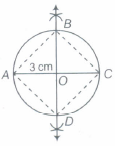
\(\because \) \(\angle \)A = \(\angle \)B = \(\angle \)C= \(\angle \)D = 90°
Also, AB = BC = CD = DA
So, quadrilateral ABCD is a square.
2.
Firstly, draw a rough sketch of quadrilateral MORE, which helps us in deciding steps of construction.
Steps of construction
Step I Draw MO = 6 cm.
Step II At O, draw a ray OX making \(\angle \)MOX = 105°.
Step III Cut OR = 4.5 cm on ray OX.
Step IV At M, draw a ray MY making \(\angle \)OMY =60°.
Step V At R, draw a ray RZ making \(\angle \)ORZ = 105°, which meets the ray MY at E.
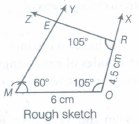
Thus, MORE is the required quadrilateral.
3.
Initially, it appears that only two measurements are available. Actually, the figure is a special quadrilateral, so we have many more details with us.
We know that, in a rhombus diagonals bisect each other at right angle.
Steps of construction
Step I First, draw AC=8 cm.
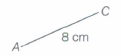
Step II Now, construct its perpendicular bisector.
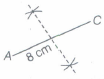
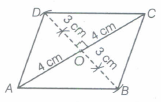
Step III Let them meet at O. Cut-off 3 cm lengths on either side of the drawn bisector. You now get B and D.
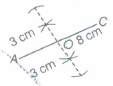
On joining AB, AB, BC and CD, we get the required rhombus.
4.
No, the measures of three angles are not necessary in case of a parallelogram as its opposite sides are parallel.
5.
No, here MA = 3 cm, AT = 5 cm and MT = 9 cm, which is not possible.
Since, in any triangle, sum of two sides is always greater than the third side.
\(\therefore\) MA + AT> MT, but 3 + 5 < 9
So, it is not possible to have such a quadrilateral.
6.
In a parallelogram, the lengths of adjacent sides are known. So, we do not still need measures of the angles to construct a parallelogram, because opposite sides of a parallelogram are equal and parallel.
7.
No, we cannot construct a quadrilateral PQRS, because we cannot draw the \(\Delta\)QSP as SQ + PQ \(\ngtr \)SP.
8.
Yes, we can draw a rhombus ZEAL, because all sides of a rhombus are equal and one of the diagonal is given. i.e. ZE = EA = AL = LZ = 3.5 cm and diagonal = 5 cm
9.
Steps of construction:
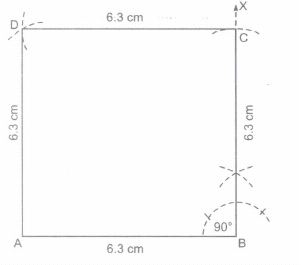
I. Draw AB = 6.3 em.
II. At B, draw \(\overrightarrow { BX } \) , such that \(\angle \)ABX = 90°
III. From \(\overrightarrow { BX } \), cut off BC = 6.3 cm.
IV. With centre C and radius = 6.3 cm, draw an arc.
V. With centre A and radius = 6.3 cm, draw another arc to intersect the previous arc at D.
VI. Join DA and CD.
Thus, ABCD is the required square.
10.
To draw a quadrilateral ABCD with AB = 8 cm, Be =12 cm, CD = 8 cm and DA =12 cm, we see that there can be possibility of the required quadrilateral to be a rectangle, parallelogram, etc. as shown below in figures.
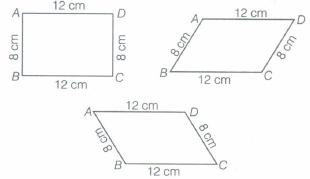
Thus, we cannot find a unique quadrilateral from the given information.
11.
Since, opposite sides of a parallelogram are equal.
\(\therefore\) AB = DC = 4 cm \(\Rightarrow\) BC = AD = 5 cm
Steps of construction
Step I Draw AB = 4 cm.
Step II Draw ray BX such that \(\angle\) ABX = 60°.
Step III Mark a point C such that, BC = 5 cm.
Step IV With C and A as centre, draw arcs of length 4 cm and 5 cm respectively.
Step V These axes intersecting at D. Join AD and CD.
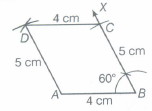
Hence, ABCD is the required parallelogram.
12.
Steps of construction
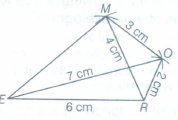
Step I Draw ER = 6 cm.
Step II Draw an arc of 2 cm with centre R and draw an arc of 7 cm with centre E.
StepIII Mark the intersection of both the arcs as O. Join OR and OE.
StepIV Draw an arc of 4 cm with centre R and draw an arc of 3 cm with centre O.
StepV Mark the intersection of both the arcs as M. Join OM and EM.
Thus, we get the quadrilateral MORE.
13.
Firstly, draw a rough sketch of quadrilateral DEAR, which helps us in deciding the steps of construction.
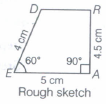
Steps of construction
Step I Draw EA = 5 cm.
Step II At A, draw a ray AX making and \(\angle \)EAX = 90 °
Step III Cut AR = 4.5 cm from ray AX.
Step IV At E, draw a ray EY making \(\angle \)AEY = 60°
Step V Join DR.
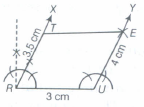
TRUE is the required quadrilateral.
14.
(d)
(n - 2)\(\times\) 180°
15.
(b)
3:4
16.
(d)
13 em
17.
(c)
12
18.
19.
20.
(c)
Trapezium
21.
(d)
Square
22.
(a)
Trapezium
23.
(d)
Rectangle

8th Standard CBSE Syllabus & Materials
8th Standard CBSE
CBSE 8th Science Particulate Nature of Matter - New Model Questions Papers Study Material - QB365 Set A
NEW8th Standard CBSE
CBSE 8th Science Pressure, Winds, Stroms and Cyclones - New Model Questions Papers Study Material - QB365 Set A
NEW8th Standard CBSE
CBSE 8th Mathematics Quadrilaterals - New Model Questions Papers Study Material - QB365 Set A
NEW8th Standard CBSE
CBSE 8th Mathematics A story of Numbers - New Model Questions Papers Study Material - QB365 Set A



CBSE 8th Standard CBSE Subjects
CBSE Standards




