
 100% FREE ACCESS
8th Standard CBSE Syllabus & Materials
8th Standard CBSE
CBSE 8th Social Science Theme D - Factors of Production - New Model Questions Papers Study Material - QB365 Set A
NEW8th Standard CBSE
CBSE 8th Social Science Theme C - Universal Franchise and India's Electoral System - New Model Questions Papers Study Material - QB365 Set A
NEW8th Standard CBSE
CBSE 8th Social Science Theme B - The Rise of the Marathas - New Model Questions Papers Study Material - QB365 Set A
NEW8th Standard CBSE
CBSE 8th Social Science Theme B - Reshaping India's Political Map - New Model Questions Papers Study Material - QB365 Set A
NEW8th Standard CBSE
CBSE 8th Social Science Theme A - Natural Resources and Their Use - New Model Questions Papers Study Material - QB365 Set A
NEW8th Standard CBSE
CBSE 8th Science Keeping Time with Skies - New Model Questions Papers Study Material - QB365 Set A

Published on: 31/07/2018
In this question paper prepared from the chapter Practical Geometry. The important questions are covers from the Higher Order Thinking Questions and Value Based Questions.
Download CBSE Class 8th Standard CBSE Mathematics question papers, sample papers, important questions, and previous year solved papers in PDF format. Get free study materials, NCERT solutions, and exam preparation resources for Class 8th Standard CBSE Mathematics
Questions + Answers key
Take MCQ Mathematics Test
1.
Government plans to make flats, children's playground, dispensary and space for greenery in a plane field, which is in rectangular shape ABCD with length AB = 800 m, breadth AD = 600 m. He distributed the triangular region ABC divided by diagonal AC for flats. He make altitude MD on AC, where M is a point on AC and give triangular area AMD for greenery. Further, make altitude MN on CD and distribute triangular region MND and MNC for dispensary and children's play ground respectively. Then, construct the figure from above data and what type of value depicted by government?
2.
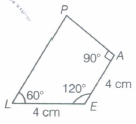
Construct a quadrilateral LEAP, where LE = 4 cm, EA=4 cm, \(\angle \)L=60°, \(\angle \)E = 120°,\(\angle \)A=90°.
3.
Can you construct the quadrilateral MIST, if we have 100° at \(\angle \)M instead of 75°. In the quadrilateral MIST, where MI = 3.5 cm, IS = 6.5 cm, \(\angle \)M = 75°, \(\angle \)I = 105° and \(\angle \)S = 120°?
4.
We used some five measurements to draw quadrilaterals so far. Can there be different sets of five measurements (other than seen so far) to draw a quadrilateral? The following problems may help you in answering the question. Quadrilateral PQRS with PQ = 4.5 cm, \(\angle\)P = 70°, \(\angle\)Q = 100°, \(\angle\)R = 80° and \(\angle\)S = 110°. Construct a few more examples of your own to find sufficiency/ insufficiency of the data for construction of a quadrilateral.
5.
In a parallelogram, the lengths of adjacent sides are known. Do we still need measures of the angles to construct?
6.
A student attempted to draw a quadrilateral PLAY, where PL = 3 cm, LA = 4 cm, AY = 4.5 cm, PY = 2 cm and LY = 6 cm but could not draw it. What is the reason?
7.
Arshad has five measurements of a quadrilateral ABCD. These are AB = 5 cm, \(\angle \)A = 50°, AC = 4 cm, BD = 5 cm and AD = 6 cm. Can he construct a unique quadrilateral? Give reasons for your answer.
8.
Construct the kite EASY, if AY = 8 cm, EY = 4 cm and SY = 6 cm. Which properties of the kite did you use in the process?
9.
Construct a parallelogram ABCD in which AB = 4 cm, BC = 5 cm and \(\angle\)B = 60°.
10.
Construct a trapezium ABCD in which AB II DC, \(\angle\)A = 105°, AD = 3 cm, AB = 4cm and CD = 8 cm.
11.
Construct a quadrilateral MORE with the given measurements ER = 6 cm, RO = 2 cm, EO = 7 cm, OM = 3 cm and MR = 4 cm
12.
Construct the following quadrilaterals. Quadrilateral TRUE TR = 3.5 cm, RU = 3 cm, UE = 4 cm, \(\angle \)R = 75°, \(\angle \)U = 120°
13.
Which of the following is not a parallelogram?
Square
Rectangle
Trapezium
Rhombus
14.
Which of the following is a regular quadrilateral?
Rhombus
Rectangle
Parallelogram
Square
15.
Which of the following is true for the adjacent angles of a parallelogram?
They are equal to each other
They are complementary angles
They are supplementary angles
None of the above
16.
Which of the following quadrilateral has only one pair of opposite sides parallel?
Trapezium
Kite
Rectangle
Rhombus
17.
Which of the following quadrilaterals does not have two pairs of adjacent sides equal and diagonals intersecting at right angle?
Rhombus
Square
Kite
Rectangle
18.
In a ______________ opposite sides are equal, opposite angles are equal and diagonals bisect one another.
19.
The diagonals of a square are __________________
20.
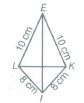
In a quadrilateral LIKE, LE = 10 cm, IK = 8 cm. Also, if LE = EK and LI = IK, then the quadrilateral is a ________________
21.
In a quadrilateral MORE, if \(\angle\)M = 120°, \(\angle\)R = 30° and \(\angle\)O= 150°, then \(\angle\)E =__________________
22.
_______________ is the sum of an exterior angle and its adjacent interior angle
23.
In a square, diagonals bisect each other at 90°.
24.
In a cyclic quadrilateral, sum of opposite angles is 180°.
25.
In a parallelogram, adjacent angles are equal.
26.
Sum of all the four angles in a quadrilateral is 360°.
27.
A unique quadrilateral can be constructed with any four given measurements.
1.
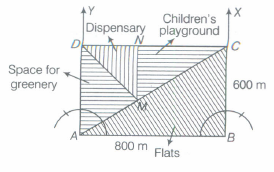
Steps of construction
Step I Draw a line AB = 8 cm. [\(\because\) 8 cm = 800 m]
Step II Draw rays BX and AY, such that \(\angle\) ABX = 90° and \(\angle\)BAY = 90°, respectively.
Step III Cut BC = 6 cm on AX and AD = 6 cm on AY.
Step IV Join C to D, then ABCD is the required rectangular field.
Step V Join A to C.
Step VI Make altitude MD on AC.
Step VII Make altitude MN on CD and write name of the regions.
The value depict, by this type of management of area by government is that they want to maintain all social, environmental aspects in society.
2.
First, we draw a rough sketch to visualise the quadrilateral, which is given below:
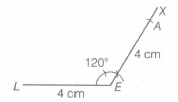
Steps of construction
Step I First draw LE = 4 cm and then, construct LE = 120° and cur the length EA = 4 cm on it.
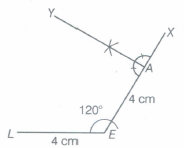
Step II Make \(\angle \)EAY =90 ° on A
Step III Make\(\angle \)ELZ=60° and then get the intersection point \(\angle \)ELZ and \(\angle \) EAY, which gives a point P.
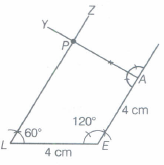
Thus, quadrilateral LEAP is constructed.
3.
Yes, the quadrilateral MIST can be constructed
with \(\angle\)M = 100°.
By angle sum property of a quadrilateral,
\(\angle\)M+ \(\angle\)I+ \(\angle\)S+ \(\angle\)T=360°
\(\Rightarrow\) 100°+105°+120°+ \(\angle\)T = 360°
\(\Rightarrow\) \(\angle\)T=35°
Thus, we have, MI = 3.5 cm, IS = 6.5 cm, \(\angle\)M =100°, \(\angle\)I = 105° and \(\angle\)S =120° and \(\angle\)T = 35°.
4.
The given data is insufficient for construction of a quadrilateral PQRS, because we cannot locate the points R and S with the help of given measurements.
e.g.
(a) Two sides and two angles i.e. if AD = 6 cm, BC = 5 cm, \(\angle\)A = 90° and \(\angle\)B = 80°.
(b) Three angle and two sides i.e. PQ = 4.5 cm, \(\angle\)P = 65°, \(\angle\)Q=110°,QR=4.7 cm and \(\angle\)R = 115°.
5.
In a parallelogram, the lengths of adjacent sides are known. So, we do not still need measures of the angles to construct a parallelogram, because opposite sides of a parallelogram are equal and parallel.
6.
The student could not draw a quadrilateral, because PL+PY
Actually, the sum of the length of any two sides of a triangle is always greater than the third side.
7.
No, he cannot construct a quadrilateral ABCD, because sides BC and DC are not given. Although five measurements are given. Yet these are not sufficient to construct a quadrilateral.
8.
Following properties are used in constructing the kite EASY:
(i) Two Diagonals intersect at right angles.
(ii) One of the diagonal bisects the other.
(iii) Pairs of consecutive sides are equal.
Let us draw a rough sketch to visualise the kite, which is given below.
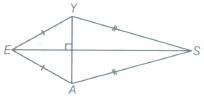
Steps of construction
Step I Draw a line segment AY = 8 cm.
Step II Draw a perpendicular bisector of AY.
Let it be MN.
Step III With centre as Y draw the arc of YE = 4 cm and with centre A, draw the arc of AE = YE = 4 cm on MN.
Step IV Join EY and EA.
Step V Draw the arc of 6 cm with centre Y and draw another arc of 6 cm with centre A on MN. The intersection point of arcs give a point S.
Step VI Join YS and AS.
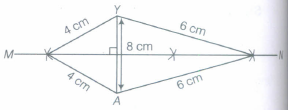
Thus, Easy is the required kite
9.
Since, opposite sides of a parallelogram are equal.
\(\therefore\) AB = DC = 4 cm \(\Rightarrow\) BC = AD = 5 cm
Steps of construction
Step I Draw AB = 4 cm.
Step II Draw ray BX such that \(\angle\) ABX = 60°.
Step III Mark a point C such that, BC = 5 cm.
Step IV With C and A as centre, draw arcs of length 4 cm and 5 cm respectively.
Step V These axes intersecting at D. Join AD and CD.
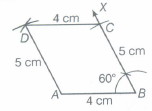
Hence, ABCD is the required parallelogram.
10.
\(\because\) \(\angle \)A+\(\angle \)D = 180°
\(\therefore\) 105°+\(\angle \)D=180° \(\Rightarrow\) \(\angle \)D = 75°
Steps of construction
Step I Draw AB = 4 cm.
Step II Draw \(\overline { AX } \) such that, \(\angle \)BAX = 105°.
Step III Mark a point D on AX such that AD = 3 cm.
Step IV Draw \(\overline { DY } \) such that \(\angle \)ADY = 75°.
Step V Mark a point C such that CD = 8 cm.
Step VI Join BC.
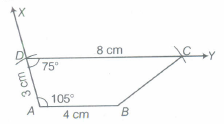
Hence, ABCD is the required trapezium.
11.
Steps of construction
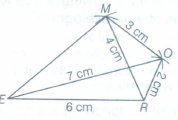
Step I Draw ER = 6 cm.
Step II Draw an arc of 2 cm with centre R and draw an arc of 7 cm with centre E.
StepIII Mark the intersection of both the arcs as O. Join OR and OE.
StepIV Draw an arc of 4 cm with centre R and draw an arc of 3 cm with centre O.
StepV Mark the intersection of both the arcs as M. Join OM and EM.
Thus, we get the quadrilateral MORE.
12.
Firstly, draw a rough sketch of quadrilateral DEAR, which helps us in deciding the steps of construction.
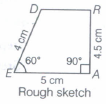
Steps of construction
Step I Draw EA = 5 cm.
Step II At A, draw a ray AX making and \(\angle \)EAX = 90 °
Step III Cut AR = 4.5 cm from ray AX.
Step IV At E, draw a ray EY making \(\angle \)AEY = 60°
Step V Join DR.
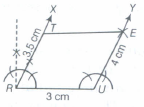
TRUE is the required quadrilateral.
13.
(c)
Trapezium
14.
(d)
Square
15.
(c)
They are supplementary angles
16.
(a)
Trapezium
17.
(d)
Rectangle
18.
()
Parallelogram
19.
()
Equal
20.
()
Kite, In a kite, two pairs of adjacent sides are equal.
21.
()
\(\because \angle M+\angle R+\angle O+\angle E=360°\)
\(\Rightarrow120°+30°+150°+\angle E=360°\Rightarrow 300°+\angle E=360°\)
\(\therefore\angle E=360°-300°=60°\)
22.
()
Straight angle
23.
(a)
24.
(a)
25.
(b)
26.
(a)
27.
(b)

8th Standard CBSE Syllabus & Materials
8th Standard CBSE
CBSE 8th Science Particulate Nature of Matter - New Model Questions Papers Study Material - QB365 Set A
NEW8th Standard CBSE
CBSE 8th Science Pressure, Winds, Stroms and Cyclones - New Model Questions Papers Study Material - QB365 Set A
NEW8th Standard CBSE
CBSE 8th Mathematics Quadrilaterals - New Model Questions Papers Study Material - QB365 Set A
NEW8th Standard CBSE
CBSE 8th Mathematics A story of Numbers - New Model Questions Papers Study Material - QB365 Set A



CBSE 8th Standard CBSE Subjects
CBSE Standards




