
 100% FREE ACCESS
12th Standard Syllabus & Materials
12th Standard
TN 12th Maths Applications of Matrices and Determinants Sample Question Papers Study Material - QB365 Set A
NEW12th Standard
TN 12th Computer Applications மின்னணு தரவு பரிமாற்றம் Sample Question Papers Study Material - QB365 Set A
NEW12th Standard
TN 12th Computer Applications மின் - வணிக பாதுகாப்பு அமைப்புகள் Sample Question Papers Study Material - QB365 Set A
NEW12th Standard
TN 12th Computer Applications மின்னணு செலுத்தல் முறைகள் Sample Question Papers Study Material - QB365 Set A
NEW12th Standard
TN 12th Computer Applications மின் - வணிகம் Sample Question Papers Study Material - QB365 Set A
NEW12th Standard
TN 12th Computer Applications திறந்த மூல கருத்துருக்கள் Sample Question Papers Study Material - QB365 Set A

Published on: 29/07/2019
Download Tamil Nadu 12th Standard Maths question papers, model tests, one-mark questions, important questions, and public exam papers in PDF format. Free study materials and answer keys for TN State Board students.
Questions + Answers key
Take MCQ Maths Test1.
Write the following in the rectangular form:
\(\overline { \left( 5+9i \right) +\left( 2-4i \right) } \)
2.
Simplify the following
i1947+ i1950
3.
If α, β, and γ are the roots of the equation x3 + px2 + qx + r = 0, find the value of \(\Sigma \frac { 1 }{ \beta \gamma } \) in terms of the coefficients.
4.
If α, β and γ are the roots of the cubic equation x3+ 2x2+ 3x + 4 = 0, form a cubic equation whose roots are −α, -β, -γ
5.
Obtain the Cartesian form of the locus of z in in each of the following cases.
|2z - 3 - i| = 3
6.
Find the quotient \(\frac { 2\left( cos\frac { 9\pi }{ 4 } +isin\frac { 9\pi }{ 4 } \right) }{ 4\left( cos\left( \frac { -3\pi }{ 2 } + \right) isin\left( \frac { -3\pi }{ 2 } \right) \right) } \) in rectangular form
7.
Solve the following systems of linear equations by Cramer’s rule:
5x − 2y +16 = 0, x + 3y − 7 = 0
8.
Solve the following system of linear equations, using matrix inversion method:
5x + 2y = 3, 3x + 2y = 5.
9.
If |z| = 1, show that \(2\le \left| { z }^{ 2 }-3 \right| \le 4\)
10.
Find solution, if any, of the equation 2cos2x - 9cosx + 4 = 0
11.
Find the rank of the following matrices by row reduction method:
\(\left[ \begin{matrix} 1 \\ \begin{matrix} 2 \\ 5 \end{matrix} \end{matrix}\begin{matrix} 1 \\ \begin{matrix} -1 \\ -1 \end{matrix} \end{matrix}\begin{matrix} 1 \\ \begin{matrix} 3 \\ 7 \end{matrix} \end{matrix}\begin{matrix} 3 \\ \begin{matrix} 4 \\ 11 \end{matrix} \end{matrix} \right] \)
12.
Show that the points 1, \(\frac { -1 }{ 2 } +i\frac { \sqrt { 3 } }{ 2 } ,\) and \(\frac { -1 }{ 2 } -i\frac { \sqrt { 3 } }{ 2 } \) are the vertices of an equilateral triangle.
13.
If |z| = 2 show that \(3\le \left| z+3+4i \right| \le 7\)
14.
Which one of the points i, −2 + i, and 3 is farthest from the origin?
15.
Find the rank of the matrix \(\left[ \begin{matrix} 2 \\ \begin{matrix} -3 \\ 6 \end{matrix} \end{matrix}\begin{matrix} -2 \\ \begin{matrix} 4 \\ 2 \end{matrix} \end{matrix}\begin{matrix} 4 \\ \begin{matrix} -2 \\ -1 \end{matrix} \end{matrix}\begin{matrix} 3 \\ \begin{matrix} -1 \\ 7 \end{matrix} \end{matrix} \right] \) by reducing it to an echelon form.
16.
Find the matrix A for which A\(\left[ \begin{matrix} 5 & 3 \\ -1 & -2 \end{matrix} \right] =\left[ \begin{matrix} 14 & 7 \\ 7 & 7 \end{matrix} \right] \).
17.
Show that if p, q, r are rational the roots of the equation x2 − 2px + p2 − q2 + 2qr − r2 = 0 are rational.
18.
Form a polynomial equation with integer coefficients with \(\sqrt { \frac { \sqrt { 2 } }{ \sqrt { 3 } } } \) as a root.
19.
20.
Find the value of the real numbers x and y, if the complex number (2+i)x+(1−i)y+2i −3 and x+(−1+2i)y+1+i are equal
21.
Solve the following system of homogenous equations.
2x + 3y − z = 0, x − y − 2z = 0, 3x + y + 3z = 0
22.
Find the fourth roots of unity.
23.
If z = x + iy and arg\(\left( \frac { z-1 }{ z+1 } \right) =\frac { \pi }{ 2 } \), then show that x2 + y2 = 1.
24.
Investigate for what values of λ and μ the system of linear equations x + 2y + z = 7 , x + y + λz = μ , x + 3y − 5z = 5 has
(i) no solution
(ii) a unique solution
(iii) an infinite number of solutions
25.
Solve the following system of linear equations, by Gaussian elimination method : 4x + 3y + 6z = 25, x + 5y + 7z = 13, 2x + 9y + z = 1.
26.
In a T20 match, a team needed just 6 runs to win with 1 ball left to go in the last over. The last ball was bowled and the batsman at the crease hit it high up. The ball traversed along a path in a vertical plane and the equation of the path is y = ax2 + bx + c with respect to a xy-coordinate system in the vertical plane and the ball traversed through the points (10, 8), (20, 16) (40, 22) can you conclude that the team won the match?
Justify your answer. (All distances are measured in metres and the meeting point of the plane of the path with the farthest boundary line is (70, 0).)
27.
Find the inverse of A = \(\left[ \begin{matrix} 2 & 1 & 1 \\ 3 & 2 & 1 \\ 2 & 1 & 2 \end{matrix} \right] \) by Gauss-Jordan method.
28.
Solve the equation (x-2) (x-7) (x-3) (x+2)+19 = 0
29.
Obtain the condition that the roots of x3+ px2+ qx + r = 0 are in A.P.
30.
Solve the equation x4-9x2+20 = 0.
31.
If k is real, discuss the nature of the roots of the polynomial equation 2x2+ kx + k = 0, in terms of k.
32.
Prove that a line cannot intersect a circle at more than two points.
33.
Find the sum of squares of roots of the equation 2x4- 8x3+ 6x2-3 = 0.
34.
If A = \(\left[ \begin{matrix} 3 & -3 & 4 \\ 2 & -3 & 4 \\ 0 & -1 & 1 \end{matrix} \right] \), then adj(adj A) is
\(\left[ \begin{matrix} 3 & -3 & 4 \\ 2 & -3 & 4 \\ 0 & -1 & 1 \end{matrix} \right] \)
\(\left[ \begin{matrix} 6 & -6 & 8 \\ 4 & -6 & 8 \\ 0 & -2 & 2 \end{matrix} \right] \)
\(\left[ \begin{matrix} -3 & 3 & -4 \\ -2 & 3 & -4 \\ 0 & 1 & -1 \end{matrix} \right] \)
\(\left[ \begin{matrix} 3 & -3 & 4 \\ 0 & -1 & 1 \\ 2 & -3 & 4 \end{matrix} \right] \)
35.
The augmented matrix of a system of linear equations is \(\left[\begin{array}{cccc} 1 & 2 & 7 & 3 \\ 0 & 1 & 4 & 6 \\ 0 & 0 & \lambda-7 & \mu+5 \end{array}\right]\). The system has infinitely many solutions if
\(\lambda=7, \mu \neq-5\)
\(\lambda=-7, \mu=5\)
\(\lambda \neq 7, \mu \neq-5\)
\(\lambda=7, \mu=-5\)
36.
Which of the following is/are correct?
(i) Adjoint of a symmetric matrix is also a symmetric matrix.
(ii) Adjoint of a diagonal matrix is also a diagonal matrix.
(iii) If A is a square matrix of order n and λ is a scalar, then adj(λA) = λn adj(A).
(iv) A(adjA) = (adjA)A = |A| I
Only (i)
(ii) and (iii)
(iii) and (iv)
(i), (ii) and (iv)
37.
The rank of the matrix \(\left[ \begin{matrix} 1 \\ \begin{matrix} 2 \\ -1 \end{matrix} \end{matrix}\begin{matrix} 2 \\ \begin{matrix} 4 \\ -2 \end{matrix} \end{matrix}\begin{matrix} 3 \\ \begin{matrix} 6 \\ -3 \end{matrix} \end{matrix}\begin{matrix} 4 \\ \begin{matrix} 8 \\ -4 \end{matrix} \end{matrix} \right] \) is
1
2
4
3
38.
If (AB)-1 = \(\left[ \begin{matrix} 12 & -17 \\ -19 & 27 \end{matrix} \right] \) and A-1 = \(\left[ \begin{matrix} 1 & -1 \\ -2 & 3 \end{matrix} \right] \), then B-1 =
\(\left[ \begin{matrix} 2 & -5 \\ -3 & 8 \end{matrix} \right] \)
\(\left[ \begin{matrix} 8 & 5 \\ 3 & 2 \end{matrix} \right] \)
\(\left[ \begin{matrix} 3 & 1 \\ 2 & 1 \end{matrix} \right] \)
\(\left[ \begin{matrix} 8 & -5 \\ -3 & 2 \end{matrix} \right] \)
39.
If P = \(\left[ \begin{matrix} 1 & x & 0 \\ 1 & 3 & 0 \\ 2 & 4 & -2 \end{matrix} \right] \) is the adjoint of 3 × 3 matrix A and |A| = 4, then x is
15
12
14
11
40.
If \(\omega =cis\cfrac { 2\pi }{ 3 } \), then the number of distinct roots of \(\left| \begin{matrix} z+1 & \omega & { \omega }^{ 2 } \\ \omega & z+{ \omega }^{ 2 } & 1 \\ { \omega }^{ 2 } & 1 & z+\omega \end{matrix} \right| \)=0
1
2
3
4
41.
The value of \(\left( \cfrac { 1+\sqrt { 3 } i}{ 1-\sqrt { 3}i } \right) ^{ 10 }\) is
\(cis\cfrac { 2\pi }{ 3 } \)
\(cis\cfrac { 4\pi }{ 3 } \)
\(-cis\cfrac { 2\pi }{ 3 }\)
\(-cis\cfrac { 4\pi }{ 3 }\)
42.
If \(\alpha \) and \(\beta \) are the roots of x2+x+1 = 0, then \({ \alpha }^{ 2020 }+{ \beta }^{ 2020 }\) is
-2
-1
1
2
43.
The principal argument of \(\cfrac { 3 }{ -1+i } \) is
\(\cfrac { -5\pi }{ 6 } \)
\(\cfrac { -2\pi }{ 3 } \)
\(\cfrac { -3\pi }{ 4 } \)
\(\cfrac { -\pi }{ 2 } \)
44.
z1, z2 and z3 are complex number such that z1 + z2 + z3 = 0 and |z1| = |z2| = |z3| = 1 then z12 + z22 + z33 is
3
2
1
0
45.
46.
The polynomial x3 + 2x + 3 has
one negative and two imaginary zeros
one positive and two imaginary zeros
three real zeros
no zeros
47.
48.
According to the rational root theorem, which number is not possible rational zero of 4x7 + 2x4 - 10x3 - 5?
-1
\(\frac { 5 }{ 4 } \)
\(\frac { 4 }{ 5 } \)
5
49.
A polynomial equation in x of degree n always has
n distinct roots
n real roots
n complex roots
at most one root
50.
If |z1| = 1, |z2| = 2, |z3| = 3 and |9z1z2 + 4z1z3 + z2z3| = 12, then the value of |z1+z2+z3| is
1
2
3
4
51.
If |z - 2 + i | ≤ 2, then the greatest value of |z| is
\(\sqrt { 3 } -2\)
\(\sqrt { 3 } +2\)
\(\sqrt { 5 } -2\)
\(\sqrt { 5 } +2\)
52.
If \(z=\cfrac { \left( \sqrt { 3 } +i \right) ^{ 3 }\left( 3i+4 \right) ^{ 2 } }{ \left( 8+6i \right) ^{ 2 } } \) , then |z| is equal to
0
1
2
3
53.
The value of \(\sum_{n=1}^{13}\left(i^{n}+i^{n-1}\right)\) is
1+ i
i
1
0
1.
\(\overline { \left( 5+9i \right) +\left( 2-4i \right) } \)
= \(\overline { (5+2)+(9i-4i) } =\overline { 7+5i } \)
= 7 - 5i [∵ Conjugate of 7 + 5i is 7 - 5i]
2.
i1947+ i1950
i1947+i1950 = i1944.i3+i1948.i2
[∴ 1944 is a multiple of 4, or 1948 is also a multiple of 4]
= (i4)486.i2.i1+(i4)487.i2 [i4 = 1]
= (1486)(-1) + (1)487(-1) [i2= -1]
= -i-1
= -(1- i)
3.
Since α, β, and γ are the roots of the equation x3+ px2+ qx + r = 0, we have
Σ1 α + β + γ = -p and Σ3 αβγ = -r
\(\Sigma \frac { 1 }{ \beta \gamma } =\frac { 1 }{ \beta \gamma } +\frac { 1 }{ \gamma \alpha } +\frac { 1 }{ \alpha \beta } =\frac { \alpha +\beta +\gamma }{ \alpha \beta \gamma } =\frac { -p }{ -r } =\frac { p }{ r } \).
4.
The roots of x3+2x2+3x+4 = 0 are ∝, β, ૪
∴ ∝ + β + ૪ = -co-efficient of x2 = -2 ...(1)
∝β + β૪ + ૪∝ = co-effficient of x = 3 ...(2)
-∝β૪ = +4 ⇒ ∝β૪ = -4 ...(3)
Form the equation whose roots are ∝-β-૪
∴ -∝-β-૪ = -(∝+β+૪)
= -(-2) = 2
∝β + β૪ + ૪∝ = 3
(-∝)(-β)(-૪) = -(∝β૪) = -(-4) = 4
∴ The required cubic equation is
x3-(-∝-β-૪)x2+(∝β+β૪+૪∝)
x-[(-∝)(-β)(-૪)] = 0
⇒ x3-(2)x2+3x-4 = 0
⇒ x3-2x2+3x-4 = 0
5.
We have |2z-3-i| = 3
|2(x + iy)-3 - i| = 3
Squaring on both sides, we get
|(2x - 3) + (2y - 1)i|2 = 9
\(\Rightarrow\) (2x - 3)2 + (2y - 1)2 = 9
\(\Rightarrow\) 4x2 + 4y2 -12x - 4y + 1 = 0, the locus of z in Cartesian form
6.
\(\frac { 2\left( cos\frac { 9\pi }{ 4 } +isin\frac { 9\pi }{ 4 } \right) }{ 4\left( cos\left( \frac { -3\pi }{ 2 } + \right) sin\left( \frac { -3\pi }{ 2 } \right) \right) } \)
= \(\frac { 1 }{ 2 } \left( cos\left( \frac { 9\pi }{ 4 } -\left( \frac { -3\pi }{ 2 } \right) \right) +isin\left( \frac { 9\pi }{ 4 } -\left( \frac { -3\pi }{ 2 } \right) \right) \right) \)
= \(\frac { 1 }{ 2 } \left( cos\left( \frac { 9\pi }{ 4 } +\frac { 3\pi }{ 2 } \right) +isin\left( \frac { 9\pi }{ 4 } +\frac { 3\pi }{ 2 } \right) \right) \)
= \(\frac { 1 }{ 2 } \left( cos\left( \frac { 15\pi }{ 4 } \right) +isin\left( \frac { 15\pi }{ 4 } \right) \right) =\frac { 1 }{ 2 } \left( cos\left( 4\pi -\frac { \pi }{ 4 } \right) +isin\left( 4\pi -\frac { \pi }{ 4 } \right) \right) \)
= \(\frac { 1 }{ 2 } \left( cos\left( \frac { \pi }{ 4 } \right) -isin\left( \frac { \pi }{ 4 } \right) \right) =\frac { 1 }{ 2 } \left( \frac { 1 }{ \sqrt { 2 } } +i\frac { 1 }{ \sqrt { 2 } } \right) \)
\(\frac { 2\left( cos\frac { 9\pi }{ 4 } +isin\frac { 9\pi }{ 4 } \right) }{ 4\left( cos\left( \frac { -3\pi }{ 2 } + \right) sin\left( \frac { -3\pi }{ 2 } \right) \right) } \) = \(\frac { 1 }{ 2\sqrt { 2 } } -i\frac { 1 }{ 2\sqrt { 2 } } =\frac { \sqrt { 2 } }{ 4 } +i\frac { \sqrt { 2 } }{ 4 } \) Which is in rectangular form.
7.
5x − 2y + 16 = 0, x + 3y − 7 = 0
Given Δ = \(\left| \begin{matrix} 5 & -2 \\ 1 & 3 \end{matrix} \right| \) = 15+2 = 17
Δ1 = \(\left| \begin{matrix} -16 & -2 \\ 7 & 3 \end{matrix} \right| \) = -48+14 = -34
Δ2 = \(\left| \begin{matrix} 5 & -16 \\ 1 & 7 \end{matrix} \right| \) = 35+16 = 51
∴ x = \(\frac { \triangle _{ 1 } }{ \triangle } =\frac { -34 }{ 7 } \) = -2
y = \(\frac { { \triangle }_{ 2 } }{ \triangle } =\frac { 51 }{ 17 } \)
∴ Solution set is {-2, 3}
8.
The matrix form of the system is AX = B , where A = \(\left[ \begin{matrix} 5 & 2 \\ 3 & 2 \end{matrix} \right] \), X = \(\left[ \begin{matrix} x \\ y \end{matrix} \right] \), B = \(\left[ \begin{matrix} 3 \\ 5 \end{matrix} \right] \)
We find |A| = \(\left| \begin{matrix} 5 & 2 \\ 3 & 2 \end{matrix} \right| \) = 10 - 6 = 4 ≠ 0. So, A−1 exists and A−1 = \(\frac { 1 }{ 4 } \left[ \begin{matrix} 2 & -2 \\ -3 & 5 \end{matrix} \right] \)
Then, applying the formula X = A−1B, we get
\(\left[ \begin{matrix} x \\ y \end{matrix} \right] =\frac { 1 }{ 4 } \left[ \begin{matrix} 2 & -2 \\ -3 & 5 \end{matrix} \right] \left[ \begin{matrix} 3 \\ 5 \end{matrix} \right] =\frac { 1 }{ 4 } \left[ \begin{matrix} -4 \\ 16 \end{matrix} \right] =\left[ \begin{matrix} \frac { -4 }{ 4 } \\ \frac { 16 }{ 4 } \end{matrix} \right] =\left[ \begin{matrix} -1 \\ 4 \end{matrix} \right] \).
So the solution is (x = −1, y = 4).
9.
|z2-3| ≤ |z2|+|-3| [Triangle law of inequality]
≤ |z|2+3≤1+3 [∴ |z| = 1]
|z2-3| ≤ 4 ..............(1)
Also, |z2- 3| ≥ ||z2|-|-3||
≥ ||z|2-3| [∵ |-3| = 3]
≥ |12-3| [∵ |z| = 1]
≥ |-2| .
|z2-3| ≥ 2.............(2)
From (1) and (2) we get 2 ≤ |z2-3| ≤ 4
Hence proved.
10.
2cos2x - 9cosx + 4 = 0 ............ (1)
The left hand side of this equation is not a polynomial in x. But it looks like a polynomial. In fact, we can say that this is a polynomial in cos x. However, we can solve the equation (1) by using our knowledge on polynomial equations. If we replace cos x by y, then we get the polynomial equation 2y2- 9y + 4 = 0 for which 4 and \(\frac{1}{2}\) are solutions.
From this we conclude that x must satisfy cos x = 4 or cos x = \(\frac{1}{2}\).
But cos x = 4 is never possible, if we take cos x = \(\frac{1}{2}\), then we get infinitely many real numbers x satisfying cos x = \(\frac{1}{2}\); in fact, for all n\(\in \)Z, x = 2nπ ±\(\frac { \pi }{ 3 } \) are solutions for the given equation (1).
If we repeat the steps by taking the equation cos2x - 9 cosx + 20 = 0, we observe that this equation has no solution.
11.
\(\left[ \begin{matrix} 1 \\ \begin{matrix} 2 \\ 5 \end{matrix} \end{matrix}\begin{matrix} 1 \\ \begin{matrix} -1 \\ -1 \end{matrix} \end{matrix}\begin{matrix} 1 \\ \begin{matrix} 3 \\ 7 \end{matrix} \end{matrix}\begin{matrix} 3 \\ \begin{matrix} 4 \\ 11 \end{matrix} \end{matrix} \right] \)
Let A =\(\left[ \begin{matrix} 1 \\ \begin{matrix} 2 \\ 5 \end{matrix} \end{matrix}\begin{matrix} 1 \\ \begin{matrix} -1 \\ -1 \end{matrix} \end{matrix}\begin{matrix} 1 \\ \begin{matrix} 3 \\ 7 \end{matrix} \end{matrix}\begin{matrix} 3 \\ \begin{matrix} 4 \\ 11 \end{matrix} \end{matrix} \right] \)
A =\(\left[ \begin{matrix} 1 \\ 2 \\ 5 \end{matrix}\begin{matrix} 1 \\ -1 \\ -1 \end{matrix}\begin{matrix} 1 \\ 3 \\ 7 \end{matrix}\begin{matrix} 3 \\ 4 \\ 11 \end{matrix} \right] \overset { { R }_{ 2 }\rightarrow { { R } }_{ 2 }-2{ { R } }_{ 1 } }{ \longrightarrow } \left[ \begin{matrix} 1 \\ 0 \\ 5 \end{matrix}\begin{matrix} 1 \\ -3 \\ -1 \end{matrix}\begin{matrix} 1 \\ 1 \\ 7 \end{matrix}\begin{matrix} 3 \\ -2 \\ 11 \end{matrix} \right] \)
\(\overset { { { R } }_{ 3 }\rightarrow { { R } }_{ 3 }-5{ { R } }_{ 1 } }{ \longrightarrow } \left[ \begin{matrix} 1 \\ 0 \\ 0 \end{matrix}\begin{matrix} 1 \\ -3 \\ -6 \end{matrix}\begin{matrix} 1 \\ 1 \\ 2 \end{matrix}\begin{matrix} 3 \\ -2 \\ -4 \end{matrix} \right] \)
\(\overset { { R }_{ 3 }\rightarrow { { R } }_{ 3 }-2{ { R } }_{ 2 } }{ \longrightarrow } \left[ \begin{matrix} 1 \\ 0 \\ 0 \end{matrix}\begin{matrix} 1 \\ -3 \\ 0 \end{matrix}\begin{matrix} 1 \\ 1 \\ 0 \end{matrix}\begin{matrix} 3 \\ -2 \\ 0 \end{matrix} \right] \)
The last equivalent matrix is in row echelon form it ha two non-zero row \(\rho \)(A) = 2
12.
It is enough to prove that the sides of the triangle are equal.
Let z1 = 1, \({ z }_{ 2 }=\frac { -1 }{ 2 } +i\frac { \sqrt { 3 } }{ 2 }\) and \({ z }_{ 3 }=\frac { -1 }{ 2 } -i\frac { \sqrt { 3 } }{ 2 }\)
The length of the sides of the triangles are
\(\left| { z }_{ 1 }-{ z }_{ 2 } \right| =\left| 1-\left( \frac { -1 }{ 2 } +i\frac { \sqrt { 3 } }{ 2 } \right) \right| =\left| \cfrac { 3 }{ 2 } -\cfrac { \sqrt { 3 } }{ 2 } i \right| =\sqrt { \frac { 9 }{ 4 } +\frac { 3 }{ 4 } } =\frac { 2\sqrt { 3 } }{ 2 } =\sqrt { 3 }\)
\(\left\lfloor { z }_{ 2 }-{ z }_{ 3 } \right\rfloor =\left| \left( \frac { -1 }{ 2 } +i\frac { \sqrt { 3 } }{ 2 } \right) -\left( \frac { -1 }{ 2 } -i\frac { \sqrt { 3 } }{ 2 } \right) \right| =\sqrt { \left( \sqrt { 3 } \right) ^{ 2 } } =\sqrt { 3 }\)
\(\left| { z }_{ 3 }-{ z }_{ 1 } \right| =\left| \left( \frac { -1 }{ 2 } +i\frac { \sqrt { 3 } }{ 2 } \right) -1 \right| =\left| \frac { -3 }{ 2 } -\frac { \sqrt { 3 } }{ 2 } i \right| =\sqrt { \frac { 9 }{ 4 } +\frac { 3 }{ 4 } } =\sqrt { 3 }\)
Since the sides are equal, the given points form an equilateral triangle
13.

\(\left| z+3+4i \right| \le \left| z \right| +\left| 3+4i \right| =2+5=7\)
\(\left| z+3+4i \right| \le 7\) .............. (1)
\(\left| z+3+4i \right| \ge \left| \left| z \right| -\left| 3+4i \right| \right| =\left| 2-5 \right| =3\)
\(\left| z+3+4i \right| \ge 3\) ............ (2)
From (1) and (2) we get, \(3\le \left| z+3+4i \right| \le 7\)
14.
The distance between origin to z = i, −2 + i, and 3 are
|z| = |i| = 1
|z| = |−2+i| = \(\sqrt { \left( -2 \right) ^{ 2 }+{ 1 }^{ 2 } } =\sqrt { 5 }\)
|z| = |3| = 3
Since \(1<\sqrt { 5 } <3\), the farthest point from the origin is 3 .
15.
Let A be the matrix. Performing elementary row operations, we get
A = \(\left[ \begin{matrix} 2 \\ \begin{matrix} -3 \\ 6 \end{matrix} \end{matrix}\begin{matrix} -2 \\ \begin{matrix} 4 \\ 2 \end{matrix} \end{matrix}\begin{matrix} 4 \\ \begin{matrix} -2 \\ -1 \end{matrix} \end{matrix}\begin{matrix} 3 \\ \begin{matrix} -1 \\ 7 \end{matrix} \end{matrix} \right] \)\(\overset { { R }_{ 2 }\longrightarrow 2{ R }_{ 2 } }{ \longrightarrow } \left[ \begin{matrix} 2 \\ \begin{matrix} -6 \\ 6 \end{matrix} \end{matrix}\begin{matrix} -2 \\ \begin{matrix} 8 \\ 2 \end{matrix} \end{matrix}\begin{matrix} 4 \\ \begin{matrix} -4 \\ -1 \end{matrix} \end{matrix}\begin{matrix} 3 \\ \begin{matrix} -2 \\ 7 \end{matrix} \end{matrix} \right] \overset { \begin{matrix} { R }_{ 2 }\longrightarrow { R }_{ 2 }+3{ R }_{ 1 } \\ { R }_{ 3 }\longrightarrow { R }_{ 3 }-3{ R }_{ 1 } \end{matrix} }{ \longrightarrow } \left[ \begin{matrix} 2 \\ \begin{matrix} 0 \\ 0 \end{matrix} \end{matrix}\begin{matrix} -2 \\ \begin{matrix} 2 \\ 8 \end{matrix} \end{matrix}\begin{matrix} 4 \\ \begin{matrix} 8 \\ -13 \end{matrix} \end{matrix}\begin{matrix} 3 \\ \begin{matrix} 7 \\ -2 \end{matrix} \end{matrix} \right] \).
\(\overset { { R }_{ 3 }\longrightarrow { R }_{ 3 }-4{ R }_{ 2 } }{ \longrightarrow } \left[ \begin{matrix} 2 \\ \begin{matrix} 0 \\ 0 \end{matrix} \end{matrix}\begin{matrix} -2 \\ \begin{matrix} 2 \\ 0 \end{matrix} \end{matrix}\begin{matrix} 4 \\ \begin{matrix} 8 \\ -45 \end{matrix} \end{matrix}\begin{matrix} 3 \\ \begin{matrix} 7 \\ -30 \end{matrix} \end{matrix} \right] \overset { { R }_{ 3 }\longrightarrow { R }_{ 3 }\div \left( -15 \right) }{ \longrightarrow } \left[ \begin{matrix} 2 \\ \begin{matrix} 0 \\ 0 \end{matrix} \end{matrix}\begin{matrix} -2 \\ \begin{matrix} 2 \\ 0 \end{matrix} \end{matrix}\begin{matrix} 4 \\ \begin{matrix} 8 \\ 3 \end{matrix} \end{matrix}\begin{matrix} 3 \\ \begin{matrix} 7 \\ 2 \end{matrix} \end{matrix} \right] \).
The last equivalent matrix is in row-echelon form. It has three non-zero rows. So, ρ(A) = 3.
16.
Given A\(\left[ \begin{matrix} 5 & 3 \\ -1 & -2 \end{matrix} \right] =\left[ \begin{matrix} 14 & 7 \\ 7 & 7 \end{matrix} \right] \)
Let B =\(\left[ \begin{matrix} 5 & 3 \\ -1 & -2 \end{matrix} \right] \) and
C = \(\left[ \begin{matrix} 14 & 7 \\ 7 & 7 \end{matrix} \right] \)
∴ AB = C
Post multiply by B-1 we get
A(BB-1) = CB-1
⇒ A = CB-1 [∵ BB-1 = 1]
|B| = \(\left| \begin{matrix} 5 & 3 \\ -1 & -2 \end{matrix} \right| \)
= -10 + 3 = -7 ≠ 0
∴ B-1 exists
B-1 = \(\frac { 1 }{ |B| } adjB=\frac { -1 }{ 7 } \left[ \begin{matrix} -2 & -3 \\ 1 & 5 \end{matrix} \right] \)
A = CB-1
=\(\left[ \begin{matrix} 14 & 7 \\ 7 & 7 \end{matrix} \right] \left( \frac { -1 }{ 7 } \right) \left[ \begin{matrix} -2 & -3 \\ 1 & 5 \end{matrix} \right] \)
= \(7\left[ \begin{matrix} 2 & 1 \\ 1 & 1 \end{matrix} \right] \left( \frac { -1 }{ 7 } \right) \left[ \begin{matrix} -2 & -3 \\ 1 & 5 \end{matrix} \right] \)
= \(-\left[ \begin{matrix} 2 & 1 \\ 1 & 1 \end{matrix} \right] \left[ \begin{matrix} -2 & -3 \\ 1 & 5 \end{matrix} \right] \)
= \(-\left[ \begin{matrix} -4+1 & -6+5 \\ -2+1 & -3+5 \end{matrix} \right] =-\left[ \begin{matrix} -3 & -1 \\ -1 & 2 \end{matrix} \right] \)
A = \(\left[ \begin{matrix} 3 & 1 \\ 1 & -2 \end{matrix} \right] \).
17.
The roots are rational if Δ = b2−4ac = (−2p)2−4(p2−q2+2qr−r2).
But this expression reduces to 4(q2−2qr+r2) or 4(q−r)2 which is a perfect square.
Hence the roots are rational.
18.
Since \(\sqrt { \frac { \sqrt { 2 } }{ \sqrt { 3 } } } \) is a root, x-\(\sqrt { \frac { \sqrt { 2 } }{ \sqrt { 3 } } } \) is a factor. To remove the outermost square root, we take x +\(\sqrt { \frac { \sqrt { 2 } }{ \sqrt { 3 } } } \) as another factor and find their product.
\(\left( x+\sqrt { \frac { \sqrt { 2 } }{ \sqrt { 3 } } } \right) \left( x-\sqrt { \frac { \sqrt { 2 } }{ \sqrt { 3 } } } \right) ={ x }^{ 2 }-\frac { \sqrt { 2 } }{ \sqrt { 3 } } \)
Still we didn’t achieve our goal. So we include another factor x2+\(\sqrt { \frac { \sqrt { 2 } }{ \sqrt { 3 } } } \) and get the product.
\(\left( { x }^{ 2 }-\frac { \sqrt { 2 } }{ \sqrt { 3 } } \right) \left( { x }^{ 2 }+\frac { \sqrt { 2 } }{ \sqrt { 3 } } \right) ={ x }^{ 4 }-\frac { 2 }{ 3 } \)
So, 3x4- 2 = 0 is a required polynomial equation with the integer coefficients.
Now we identify the nature of roots of the given equation without solving the equation. The idea comes from the negativity, equality to 0, positivity of Δ = b2- 4ac.
19.
20.
Let z1 = (2+i)x + (1−i)y + 2i−3 = (2x+y−3) + i(x−y+ 2)and
z2 = x+(−1+2i)y+1+i = (x−y+1) + i(2y+1)
Given that z1 = z2
Therefore (2x+y−3) + i(x−y+2) = (x−y+1) + i(2y+1).
Equating real and imaginary parts separately, gives
2x+y−3 = x−y+1 \(\Rightarrow\) x+2y = 4
x−y+2 = 2y +1 \(\Rightarrow\) x−3y = −1
Solving the above equations, gives
x = 2 and y = 1.
21.
2x + 3y − z = 0, x − y − 2z = 0, 3x + y + 3z = 0
Reducing the augmented matrix to row - echelon form we get
[A|0]=\(\left[ \begin{matrix} 2 & 3 & -1 \\ 1 & -1 & -2 \\ 3 & 1 & 3 \end{matrix}|\begin{matrix} 0 \\ 0 \\ 0 \end{matrix} \right] \)
\(\overset { { R }_{ 1 }\leftrightarrow { R }_{ 2 } }{ \longrightarrow } \left[ \begin{matrix} 1 & -1 & -2 \\ 2 & 3 & -1 \\ 3 & 1 & 3 \end{matrix}|\begin{matrix} 0 \\ 0 \\ 0 \end{matrix} \right] \)
\(\overset { { R }_{ 2 }\rightarrow { R }_{ 2 }-2{ R }_{ 1 }\\ { R }_{ 3 }\rightarrow { R }_{ 3 }-3{ R }_{ 1 } }{ \longrightarrow } \left[ \begin{matrix} 1 & -1 & -2 \\ 0 & 5 & 3 \\ 0 & 4 & 9 \end{matrix}|\begin{matrix} 0 \\ 0 \\ 0 \end{matrix} \right] \)
\(\overset { { R }_{ 3 }\rightarrow { R }_{ 3 }-\frac { 4 }{ 5 } { R }_{ 2 } }{ \longrightarrow } \left[ \begin{matrix} 1 & -1 & -2 \\ 0 & 5 & 3 \\ 0 & 0 & \frac { 33 }{ 5 } \end{matrix}|\begin{matrix} 0 \\ 0 \\ 0 \end{matrix} \right] \)
Here \(\rho \)(A) = 3 and \(\rho \)[A|0] = 3
So, \(\rho \)(A) = \(\rho \)(A|0]) = 3 = Number of unknowns Hence, the system is consistent with unique solutions.
Thus, the system has trivial solution only.
x = 0, y = 0, z = 0
22.
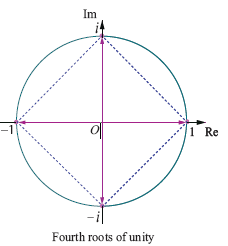
We have to find \(1^{\frac{1}{4}}\). Let z4 = \(1^{\frac{1}{4}}\). Then z4 = 1.
In polar form, the equation z = 1 can be written as
\(z^4=cos\left( 0+2k\pi \right) +isin\left( 0+2k\pi \right) ={ e }^{ i2k\pi }\), k = 0, 1, 2,...
Therefore,\({ \left( z \right) }^{ \frac { 1 }{ 4 } }=cos\left( \frac { 2k\pi }{ 4 } \right) +isin\left( \frac { 2k\pi }{ 4 } \right) ={ e }^{ i\frac { 2k\pi }{ 4 } }\), k=0,1,2,3.
Taking k = 0, 1, 2, 3, we get
k = 0, z = cos 0 + isin 0 = 1
k = 1, \(z=cos\left( \frac { \pi }{ 2 } \right) +isin\left( \frac { \pi }{ 2 } \right) =i\)
k = 2, \(z=cos\pi +isin\pi =-1\)
k = 3, \(z=cos\frac { 3\pi }{ 2 } +isin\frac { 3\pi }{ 2 } =-cos\frac { \pi }{ 2 } -isin\frac { \pi }{ 2 } =-i\)
Fourth roots of unity are 1, i, −1, −i \(\Rightarrow\) 1, \(\omega \), \({ \omega }^{ 2 }\) and \({ \omega }^{ 3 }\), where \(\omega ={ e }^{ i\frac { 2\pi }{ 4 } }=i\)
23.
Now, \(\frac { z-1 }{ z+1 } =\frac { x+iy-1 }{ x+iy+1 } =\frac { \left( x-1 \right) +iy }{ \left( x+1 \right) +iy } =\frac { \left[ \left( x-1 \right) +iy \right] \left[ \left( x+1 \right) -iy \right] }{ \left[ \left( x+1 \right) +iy \right] \left[ \left( x+1 \right) -iy \right] } \)
\(\Rightarrow \frac { z-1 }{ z+1 } =\frac { \left( { x }^{ 2 }+{ y }^{ 2 }-1 \right) +i\left( 2y \right) }{ \left( x+1 \right) ^{ 2 }+{ y }^{ 2 } } \)
Since, arg \(\left( \frac { z-1 }{ z+2 } \right) =\frac { \pi }{ 2 } \Rightarrow { tan }^{ -1 }\left( \frac { 2y }{ { x }^{ 2 }+{ y }^{ 2 }-1 } \right) \)= \(\frac { \pi }{ 2 } \)
\(\Rightarrow \frac { 2y }{ { x }^{ 2 }+{ y }^{ 2 }-1 } =tan\frac { \pi }{ 2 } \) ⇒ x2+ y2 − 1 = 0
\(\Rightarrow { x }^{ 2 }+{ y }^{ 2 }=1\)
24.
Here the number of unknowns is 3.
The matrix form of the system is AX = B, where A = \(\left[ \begin{matrix} 1 & 2 & 1 \\ 1 & 1 & \lambda \\ 1 & 3 & -5 \end{matrix} \right] \), X = \(\left[ \begin{matrix} x \\ y \\ z \end{matrix} \right] \), B = \(\left[ \begin{matrix} 7 \\ \mu \\ 5 \end{matrix} \right] \).
Applying elementary row operations on the augmented matrix [A | B], we get
[A | B] = \(\left[ \begin{matrix} 1 & 2 & 1 \\ 1 & 1 & \lambda \\ 1 & 3 & -5 \end{matrix}|\begin{matrix} 7 \\ \mu \\ 5 \end{matrix} \right] \overset { { R }_{ 2 }\leftrightarrow { R }_{ 3 } }{ \longrightarrow } \left[ \begin{matrix} 1 & 2 & 1 \\ 1 & 3 & -5 \\ 1 & 1 & \lambda \end{matrix}|\begin{matrix} 7 \\ 5 \\ \mu \end{matrix} \right] \overset { \begin{matrix} { R }_{ 2 }\longrightarrow { R }_{ 2 }-{ R }_{ 1 }, \\ { R }_{ 3 }\longrightarrow { R }_{ 3 }-{ R }_{ 1 } \end{matrix} }{ \longrightarrow } \left[ \begin{matrix} 1 & 2 & 1 \\ 0 & 1 & -6 \\ 0 & -1 & \lambda -1 \end{matrix}|\begin{matrix} 7 \\ -2 \\ \mu -7 \end{matrix} \right] \overset { { R }_{ 3 }\longrightarrow { R }_{ 3 }+{ R }_{ 2 } }{ \longrightarrow } \left[ \begin{matrix} 1 & 2 & 1 \\ 0 & 1 & -6 \\ 0 & 0 & \lambda -7 \end{matrix}|\begin{matrix} 7 \\ -2 \\ \mu -9 \end{matrix} \right] \).
(i) If λ =7 and μ \(\neq\) 9, then ρ(A) = 2 and ρ([A | B]) = 3. So ρ(A) ≠ ρ([A | B]) Hence the given system is inconsistent and has no solution.
(ii) If λ ≠ 7 and μ is any real number, then ρ(A) = 3 and ρ([A | B]) = 3.
So, ρ(A) = ρ([A | B]) = 3 = Number of unknown. Hence the given system is consistent and has a unique solution.
(iii) If λ = 7 and μ = 9, then ρ(A) = 2 and ρ([A | B]) = 2.
So, ρ(A) = ρ([A | B]) = 2 < Number of unknown. Hence the given system is consistent and has infinite number of solutions.
25.
Transforming the augmented matrix to echelon form, we get
\(\left[ \begin{matrix} 4 & 3 & 6 \\ 1 & 5 & 7 \\ 2 & 9 & 1 \end{matrix}|\begin{matrix} 25 \\ 13 \\ 1 \end{matrix} \right] \overset { { R }_{ 1 }\leftrightarrow { R }_{ 2 } }{ \longrightarrow } \left[ \begin{matrix} 1 & 5 & 7 \\ 4 & 3 & 6 \\ 2 & 9 & 1 \end{matrix}|\begin{matrix} 13 \\ 25 \\ 1 \end{matrix} \right] \overset { \begin{matrix} { R }_{ 2 }\longrightarrow { R }_{ 2 }-4{ R }_{ 1 } \\ { R }_{ 3 }\longrightarrow { R }_{ 3 }-2{ R }_{ 1 } \end{matrix} }{ \longrightarrow } \left[ \begin{matrix} 1 & 5 & 7 \\ 0 & -17 & -22 \\ 0 & -1 & -13 \end{matrix}|\begin{matrix} 13 \\ -27 \\ -25 \end{matrix} \right] \)\(\overset { \begin{matrix} { R }_{ 2 }\longrightarrow { R }_{ 2 }\div \left( -1 \right) \\ { R }_{ 3 }\longrightarrow { R }_{ 3 }\div \left( -1 \right) \end{matrix} }{ \longrightarrow } \left[ \begin{matrix} 1 & 5 & 7 \\ 0 & 17 & 22 \\ 0 & 1 & 13 \end{matrix}|\begin{matrix} 13 \\ 27 \\ 25 \end{matrix} \right] \overset { { R }_{ 3 }\longrightarrow 17{ R }_{ 3 }-{ R }_{ 2 } }{ \longrightarrow } \left[ \begin{matrix} 1 & 5 & 7 \\ 0 & 17 & 22 \\ 0 & 0 & 199 \end{matrix}|\begin{matrix} 13 \\ 27 \\ 398 \end{matrix} \right] \).
The equivalent system is written by using the echelon form:
x + 5y + 7 = 13, … (1)
17y + 22z = 27, … (2)
199z = 398..... (3)
From (3), we get z = \(\frac { 398 }{ 199 } \) = 2.
Substituting z = 2 in (2), we get y = \(\frac { 27-22\times 2 }{ 17 } =\frac { -17 }{ 17 } \) = -1
Substituting z = 2, y = -1, in (1), we get x = 13 - 5 x (-1) - 7 \(\times\) 2 = 4.
So, the solution is (x = 4, y = -1, z = 2).
26.
The path y = ax2 + bx + c passes through the points (10, 8), (20, 16), (40, 22). So, we get the system of equations 100a + 10b + c = 8, 400a + 20b + c = 16, 1600a + 40b + c = 22. To apply Cramer’s rule, we find
Δ = \(\left| \begin{matrix} 100 & 10 & 1 \\ 400 & 20 & 1 \\ 1600 & 40 & 1 \end{matrix} \right| =1000\left| \begin{matrix} 1 & 1 & 1 \\ 4 & 2 & 1 \\ 16 & 4 & 1 \end{matrix} \right| \) = 1000 [-2 + 12 - 6] = -6000,
Δ1 = \(\left| \begin{matrix} 8 & 10 & 1 \\ 16 & 20 & 1 \\ 22 & 40 & 1 \end{matrix} \right| =20\left| \begin{matrix} 4 & 1 & 1 \\ 8 & 2 & 1 \\ 11 & 4 & 1 \end{matrix} \right| \) = 20[-8 + 3 + 10] = 100,
Δ2 = \(\left| \begin{matrix} 100 & 8 & 1 \\ 400 & 16 & 1 \\ 1600 & 22 & 1 \end{matrix} \right| =200\left| \begin{matrix} 1 & 4 & 1 \\ 4 & 8 & 1 \\ 16 & 11 & 1 \end{matrix} \right| \) = 200[-3 + 48 - 84] = -7800,
Δ3 = \(\left| \begin{matrix} 100 & 10 & 8 \\ 400 & 20 & 16 \\ 1600 & 40 & 22 \end{matrix} \right| =2000\left| \begin{matrix} 1 & 1 & 4 \\ 4 & 2 & 8 \\ 16 & 4 & 11 \end{matrix} \right| \) = 2000[-10 + 84 - 64] = 20000.
By Cramer’s rule, we get a = \(\frac { { \Delta }_{ 1 } }{ \Delta } =-\frac { 1 }{ 60 } \), b = \(\frac { { \Delta }_{ 2 } }{ \Delta } =\frac { 7800 }{ 6000 } =\frac { 78 }{ 60 } =\frac { 13 }{ 10 } \), c = \(\frac { { \Delta }_{ 3 } }{ \Delta } =\frac { 20000 }{ 6000 } =-\frac { 20 }{ 6 } =-\frac { 10 }{ 3 } \).
So, the equation of the path is y = \(\frac { 1 }{ 60 } { x }^{ 2 }+\frac { 13 }{ 10 } x-\frac { 10 }{ 3 } \).
When x = 70, we get y = 6. So, the ball went by 6 metres high over the boundary line and it is impossible for a fielder standing even just before the boundary line to jump and catch the ball. Hence the ball went for a super six and the team won the match.
27.
Applying Gauss-Jordan method, we get
[A | I3] =\(\left[ \begin{matrix} 2 & 1 & 1 \\ 3 & 2 & 1 \\ 2 & 1 & 2 \end{matrix}|\begin{matrix} 1 & 0 & 0 \\ 0 & 1 & 0 \\ 0 & 0 & 1 \end{matrix} \right] \overset { { R }_{ 1 }\longrightarrow \frac { 1 }{ 2 } { R }_{ 1 } }{ \longrightarrow } \left[ \begin{matrix} 1 & \left( 1/2 \right) & \left( 1/2 \right) \\ 3 & 2 & 1 \\ 2 & 1 & 2 \end{matrix}|\begin{matrix} \left( 1/2 \right) & 0 & 0 \\ 0 & 1 & 0 \\ 0 & 0 & 1 \end{matrix} \right] \)
\(\overset { \begin{matrix} { R }_{ 2 }\longrightarrow { R }_{ 2 }-3{ R }_{ 1 } \\ { R }_{ 3 }\longrightarrow { R }_{ 3 }-2{ R }_{ 1 } \end{matrix} }{ \longrightarrow } \left[ \begin{matrix} 1 & \left( 1/2 \right) & \left( 1/2 \right) \\ 0 & \left( 1/2 \right) & -\left( 1/2 \right) \\ 0 & 0 & 1 \end{matrix}|\begin{matrix} \left( 1/2 \right) & 0 & 0 \\ -\left( 3/2 \right) & 1 & 0 \\ -1 & 0 & 1 \end{matrix} \right] \)
\(\overset { { R }_{ 2 }\longrightarrow 2{ R }_{ 2 } }{ \longrightarrow } \left[ \begin{matrix} 1 & \left( 1/2 \right) & \left( 1/2 \right) \\ 0 & 1 & -1 \\ 0 & 0 & 1 \end{matrix}|\begin{matrix} \left( 1/2 \right) & 0 & 0 \\ -3 & 2 & 0 \\ -1 & 0 & 1 \end{matrix} \right] \)
\(\overset { { R }_{ 1 }\longrightarrow { R }_{ 1 }-\frac { 1 }{ 2 } { R }_{ 2 } }{ \longrightarrow } \left[ \begin{matrix} 1 & 0 & 1 \\ 0 & 1 & -1 \\ 0 & 0 & 1 \end{matrix}|\begin{matrix} 2 & -1 & 0 \\ -3 & 2 & 0 \\ -1 & 0 & 1 \end{matrix} \right] \overset { \begin{matrix} { R }_{ 1 }\longrightarrow { R }_{ 1 }-{ R }_{ 3 } \\ { R }_{ 2 }\longrightarrow { R }_{ 2 }+{ R }_{ 3 } \end{matrix} }{ \longrightarrow } \left[ \begin{matrix} 1 & 0 & 0 \\ 0 & 1 & 0 \\ 0 & 0 & 1 \end{matrix}|\begin{matrix} 3 & -1 & -1 \\ -4 & 2 & 1 \\ -1 & 0 & 1 \end{matrix} \right] \).
So, A-1 = \(\left[ \begin{matrix} 3 & -1 & -1 \\ -4 & 2 & 1 \\ -1 & 0 & 1 \end{matrix} \right] \).
28.
We can solve this fourth degree equation by rewriting it suitably and adopting a technique of substitution. Rewriting the equation as
(x−2)(x−3)(x−7)(x+2)+19 = 0
the given equation becomes
(x2−5x+6)(x2−5x−14)+19 = 0 .
If we take x2 − 5x as y, then the equation becomes (y+6)(y−14)+19 = 0;
that is, y2-8y-65 = 0
Solving this we get solutions y = 13 and y = −5. Substituting this we get two quadratic equations
x2-5x-13 = 0 and x2-5x+5 = 0
which can be solved by usual techniques. The solutions obtained for these two equations together give solutions as \(\frac { 5\pm \sqrt { 77 } }{ 2 } ,\frac { 5\pm \sqrt { 5 } }{ 2 } \).
29.
Let the roots be in A.P. Then, we can assume them in the form α-d, α, α+d
Applying the Vieta’s formula (α-d)+α+(α+d) = \(\frac{p}{1}\) = p ⇒ 3α = -p ⇒ α = -\(\frac{p}{3}\).
But, we note that α is a root of the given equation. Therefore, we get
\(\left( -\frac { p }{ 3 } \right) ^{ 3 }+p\left(- \frac { p }{ 3 } \right) ^{ 3 }+q\left(- \frac { p }{ 3 } \right) ^{ 3 }+r\) = 0 ⇒ 9 pq = 2p3+27r.
30.
The given equation is
x4- 9x2 + 20 = 0
This is a fourth degree equation. If we replace x2 by y then we get the quadratic equation
y2- 9y + 20 = 0
It is easy to see that 4 and 5 as solutions for y2- 9y + 20 = 0. Now taking x2 = 4 and x2 = 5, we get 2, -2, \(\sqrt{5}\), -\(\sqrt{5}\) as solutions of the given equation.
We note that the technique adopted above can be applied to polynomial equations like x6-17x3+30 = 0, ax2k+ bxk + c = 0 and in general polynomial equations of the form anxkn + an-1xk(n-1) + .... + a1xk + a0 = 0 where k is any positive integer.
31.
Given equation is 2x2 + kx + k = 0
Here a = 2, b = k, c = k
\(\therefore\) Discriminant
∆ = b2-4ac = k2-4 (2)(k)
= k2-8k = 0
k (k - 8) = 0
Since k is real, the possible values of k are
k < 0, k = 0 or 8
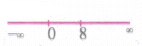
case (i) when 0< k< 8, ∆ < 0
⇒ The roots are imaginary
case (ii) when k = 0 or 8, ∆ = 0,
∴ The roots are real and equal
Case (iii) When k > 8, ∆ = k (k - 8) > 0
⇒ The roots are real and distinct
32.
By choosing the coordinate axes suitably, we take the equation of the circle as x2+ y2 = r2 and the equation of the straight line as y = mx + c. We know that the points of intersections of the circle and the straight line are the points which satisfy the simultaneous equation
x2 + y2 = r2
y = mx + c .......... (2)
If we substitute mx + c for y in (1), we get
x2+(mx + c)2- r2 = 0
which is same as the quadratic equation
(1+m2)x2+2mcx+(c2- r2) = 0 ............(3)
This equation cannot have more than two solutions, and hence a line and a circle cannot intersect at more than two points.
It is interesting to note that a substitution makes the problem of solving a system of two equations in two variables into a problem of solving a quadratic equation.
Further we note that as the coefficients of the reduced quadratic polynomial are real, either both roots are real or both imaginary. If both roots are imaginary numbers, we conclude that the circle and the straight line do not intersect. In the case of real roots, either they are distinct or multiple roots of the polynomial. If they are distinct, substituting in (2), we get two values for y and hence two points of intersection. If we have equal roots, we say the straight line touches the circle as a tangent. As the polynomial (3) cannot have only one simple real root, a line cannot cut a circle at only one point.
33.
Given equation is 2x4- 8x + 6x2- 3 = 0
Here a = 2, b = -8, c = 6, d = 0, e = -3
Let ∝, β, ૪ and \(\delta \) be the roots of equation (1)
Then by Vieta's formula,
\(\sum { _{ 1 }= } \alpha +\beta +\gamma +\delta =\frac { -b }{ a } =\frac { -(-8) }{ 2 } =4\)
\(\sum { _{ 2 } } =\alpha \beta +\alpha \gamma +\alpha \delta +\beta \gamma +\beta \delta +\gamma \delta =\frac { c }{ a } =\frac { 6 }{ 2 } =3\)
\(\sum { _{ 3 } } =\alpha \beta \gamma +\alpha \beta \delta +\alpha \gamma \delta +\beta \gamma \delta =\frac { -d }{ a } =\frac { 0 }{ a } \)
\(\sum { _{ 4 } } =\alpha \beta \gamma \delta =\frac { e }{ a } =\frac { -3 }{ 2 } \)
Now, (a+b+c+d)2 = a2+b2+c2+d2+2(ab+ac+ad+bc+cd)
⇒ n∝2+β2+૪2+\(\delta\)2 = (∝ + β + ૪ + \(\delta\))2-2(\(\alpha \beta +\alpha \gamma +\alpha \delta +\beta \gamma +\beta \delta +\gamma \delta \))
∝2 + β2 + ૪2 = 42-2(3) = 16 - 6 = 10
34.
(a)
\(\left[ \begin{matrix} 3 & -3 & 4 \\ 2 & -3 & 4 \\ 0 & -1 & 1 \end{matrix} \right] \)
35.
(d)
\(\lambda=7, \mu=-5\)
36.
(d)
(i), (ii) and (iv)
37.
(a)
1
38.
(a)
\(\left[ \begin{matrix} 2 & -5 \\ -3 & 8 \end{matrix} \right] \)
39.
(d)
11
40.
Comparing the two given lines with
\(\vec { r } =\vec { a } +t\vec { b } ,\vec { r } =\vec { c } +s\vec { d } \)
we have, \(\vec { a } =-\hat { -1 } -3\hat { j } -5\hat { k } ,\vec { b } =3\hat { i } +5\hat { j } +7\hat { k } ,\vec { c } =2\hat { i } +4\hat { j } +6\hat { k } \) and \(\vec { d } =\hat { i } +4\hat { j } +7\hat { k } \)
We know that the two given lines are coplar, if \((\vec { c } -\vec { a } ).(\vec { b } \times \vec { d } )\)=0
Here, \(\vec { b } \times \vec { d } \left| \begin{matrix} \hat { i } & \hat { j } & \hat { k } \\ 3 & 5 & 7 \\ 1 & 4 & 7 \end{matrix} \right| =7\hat { i } -14\hat { j } +7\hat { k } \) and \(\vec { c } -\vec { a } =3\hat { i } +7\hat { j } +11\hat { k } \)
Then, \((\vec { c } -\vec { a } ).(\vec { b } \times \vec { d } )=(3\hat { i } +7\hat { j } +11\hat { k } )(7\hat { i } -14\hat { j } +7\hat { k } )\)
Therefore the two given lines are coplanar.Then we find the non parametric form of vector equation of the plane containing the two given coplanar lines. We know that the plane containing the two given coplanar lines is
\((\vec { r } -\vec { a } ).(\vec { b } \times \vec { d } )\)=0
which implies that \((\vec { r } -(-\hat { i } -3\hat { j } -5\hat { k } )).(7\hat { i } -14\hat { j } +7\hat { k } )\)=0. Thus, the required non-parametric vector equation of the plane containing the two given coplanar lines is \(\vec { r } .(\hat { i } -2\hat { j } +\hat { k } )\)=0.
41.
(a)
\(cis\cfrac { 2\pi }{ 3 } \)
42.
(b)
-1
43.
(c)
\(\cfrac { -3\pi }{ 4 } \)
44.
(d)
0
45.
(a)
46.
(a)
one negative and two imaginary zeros
47.
(a)
48.
(c)
\(\frac { 4 }{ 5 } \)
49.
(c)
n complex roots
50.
(b)
2
51.
(d)
\(\sqrt { 5 } +2\)
52.
(c)
2
53.
(a)
1+ i

12th Standard Syllabus & Materials
12th Standard
TN 12th Computer Applications வலையமைப்பு வடமிடல் Sample Question Papers Study Material - QB365 Set A
NEW12th Standard
TN 12th Computer Applications களப்பெயர் முறைமை (DNS) Sample Question Papers Study Material - QB365 Set A
NEW12th Standard
TN 12th Computer Applications வலையமைப்பு எடுத்துக்காட்டுகள் மற்றும் நெறிமுறைகள் Sample Question Papers Study Material - QB365 Set A
NEW12th Standard
TN 12th Computer Applications கணினி வலையமைப்பு ஓர் அறிமுகம் Sample Question Papers Study Material - QB365 Set A



Tamilnadu Stateboard 12th Standard Subjects
Maths

Chemistry

Physics

Biology

Computer Science

Business Maths and Statistics

Economics

Commerce

Accountancy

History

Computer Applications
Biology
Computer Technology
Computer Applications
Computer Science
Business Maths and Statistics
Commerce
Economics
Maths
Chemistry
Physics
Computer Technology
History
Accountancy

Tamil

English

French
Tamilnadu Stateboard Standards

