
 100% FREE ACCESS
12th Standard Syllabus & Materials
12th Standard
TN 12th Computer Applications மின்னணு தரவு பரிமாற்றம் Sample Question Papers Study Material - QB365 Set A
NEW12th Standard
TN 12th Computer Applications மின் - வணிக பாதுகாப்பு அமைப்புகள் Sample Question Papers Study Material - QB365 Set A
NEW12th Standard
TN 12th Computer Applications மின்னணு செலுத்தல் முறைகள் Sample Question Papers Study Material - QB365 Set A
NEW12th Standard
TN 12th Computer Applications மின் - வணிகம் Sample Question Papers Study Material - QB365 Set A
NEW12th Standard
TN 12th Computer Applications திறந்த மூல கருத்துருக்கள் Sample Question Papers Study Material - QB365 Set A
NEW12th Standard
TN 12th Computer Applications வலையமைப்பு வடமிடல் Sample Question Papers Study Material - QB365 Set A

Published on: 23/11/2019
preparatory exam-23/11/19
Download Tamil Nadu 12th Standard Chemistry question papers, model tests, one-mark questions, important questions, and public exam papers in PDF format. Free study materials and answer keys for TN State Board students.
Questions + Answers key
Take MCQ Chemistry Test
1.
If x is the amount of adsorb ate and m is the amount of adsorbent, which of the following relations is not related to adsorption process?
x/m = f(P) at constant T
x/m = f(T) at constant P
P = f(T) at constant x/m
x/m = PT
2.
Collodion is a 4% solution of which one of the following compounds in alcohol – ether mixture?
Nitroglycerine
Cellulose acetate
Glycoldinitrate
Nitrocellulose
3.
The phenomenon observed when a beam of light is passed through a colloidal solution is_______.
Cataphoresis
Electrophoresis
Coagulation
Tyndall effect
4.
Hair cream is _____.
gel
emulsion
solid sol
sol.
5.
Which of the following is incorrect for physisorption?
reversible
increases with increase in temperature
low heat of adsorption
increases with increase in surface area
6.
Formation of water due to the reaction of H2 and O2 in the presence of Cu proceeds as follows. Steps in the reaction H2 + 1/2O2 → H2O can be given as
7.
Thermal decomposition of KClO3 in presence of MnO2 proceeds as follows.
Steps in the reaction 2KClO3 → 2KCl + 3O2 can be given as
8.
Explain any one method for coagulation.
9.
What is the difference between a sol and a gel?
10.
What happens when a colloidal sol of Fe(OH)3 and As2S3 are mixed?
11.
Heat of adsorption is greater for chemisorptions than physisorption. Why?
12.
Which will be adsorbed more readily on the surface of charcoal and why? NH3 or CO2?
13.
Give two important characteristics of physisorption.
14.
Describe adsorption theory of catalysis
15.
Explain intermediate compound formation theory of catalysis with an example.
16.
Describe some feature of catalysis by Zeolites.
17.
What are enzymes? Write a brief note on the mechanism of enzyme catalysis.
18.
Differentiate physisorption and chemisorption.
19.
Addition of Alum purifies water. Why?
20.
Why are lyophillic colloidal sols are more stable than lyophobic colloidal sol.
1.
(d)
x/m = PT
2.
Pyroxylin(nitro cellulose)
3.
Scattering of light
4.
Emulsion-Dispersed phase
Dispersion meduun -liquid
5.
The incorrect statement is option (n)
Physisorption is an exothermic process. Hence increases in temperature decreases the Physisorption
6.
2Cu + \(\frac{1}{2}\)O2 → Cu2O
It is an intermediate.
Cu2O + H2 → H2O + 2Cu
7.
2KClO3 + 6MnO2 → 6MnO3 + 2KCl
It is an intermediate
6MnO3 → 6MnO2 + 3O2
8.
Addition of electrolytes:
A negative ion causes the precipitation of positively charged sol and vice versa. When the valency of ion is high, the precipitation power is increased.
For example, the precipitation power of some cations and anions varies in the following order
\(\mathrm{Al}^{3+}>\mathrm{Ba}^{2+}>\mathrm{Na}^{+} \text {, Similarly }\left[\mathrm{Fe}\left(\mathrm{CN}_{6}\right)\right]^{3-}>\mathrm{SO}_{4}{ }^{2-}>\mathrm{Cl}^{-}\)
The precipitation power of electrolyte is determined by finding the minimum concentration (millimoles/lit) required to cause precipitation of a sol in 2 hours. This value is called flocculation value. The smaller the flocculation value greater will be precipitation.
9.
| S.no | Sol | Gel |
| (a) | The liquid state of collidal solution | The solid (or) semi solid stage of a colloidal solution. |
| (b) | Very low viscosity | Very high viscosity |
| (c) | It does not have definite structure. | It possesses definite structure. |
10.
(i) Neutralisation of chargers of ion will taken place and hence precipitation will take place (ie) Fe3+ and S2- ion changes are neutralized. No new compounds are formed.
(ii) Fe(OH)3 is a positive Sol
(iii) As2S3 is a negative Sol
11.
In Chemisorptions the molecules are held on the surface by attractive forces by formation of chemical bonds. As strong bond is formed nearly 400 kJ / mol is given out as heat of adsorption chemical bonds are much stronger, whereas the Vander Waal's forces in physisorption is weaker.
12.
The critical temperature of NH3 is 406 K and that of CO2 is 304 K. So, NH3 has higher critical temperature and greater VanderWaal's forces of attraction than CO2. So NH3 will be more adsorbed than CO2.
13.
(i) It is instantaneous.
(ii) It is non-specific.
(iii) No transfer of electrons.
(iv) Multilayer of adsorbate is formula.
14.
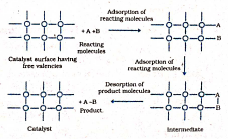
1. Langmuir explained the action of catalyst in heterogeneous catalysed reactions based on adsorption. The reactant molecules are adsorbed on the catalyst surfaces, so this can also be called as contact catalysis.
2. According to this theory, various steps involved in a heterogeneous catalyse reaction are given as follows:
(i) Reactant molecules diffuse from bulk to the catalyst surface.
(ii) The reactant molecules are adsorbed on the surface of the catalyst.
(iii) The adsorbed reactant molecules are activated and form activated complex which is decomposed to form the products.
(iv) The product molecules are desorbed.
(v) The product diffuse away from the surface of the catalyst.
15.
The intermediate compound formation theory :
A catalyst acts by providing a new path with low energy of activation. In homogeneous catalysed reactions a catalyst may combine with one or more reactant to form an intermediate which reacts with other reactant or decompose to give products and the catalyst is regenerated.
Consider the reactions :
A+B➝AB; C is the catalyst .............(1)
A + C ➝ AC (intermediate) ..........(2)
AC + B ⟶ AB + C ...............(3)
Example 1:
The mechanism of Fridel crafts reaction is given below
\({ C }_{ 6 }{ H }_{ 6 }+{ { CH }_{ 3 }Cl\overset { anhydrous\\ { AlCl }_{ 3 } }{ \longrightarrow } }{ C }_{ 6 }{ H }_{ 5 }{ CH }_{ 3 }+HCl\)
The action of catalyst is explained as follows
CH3Cl + AlCl3 ⟶ [CH3]+ [AlCl4]-
It is an intermediate.
\({ C }_{ 6 }{ H }_{ 6 }+\left[ { CH }_{ 3 }^{ + } \right] \left[ { AlCl }_{ 4 } \right] ^{ - }\longrightarrow { C }_{ 6 }{ H }_{ 5 }{ CH }_{ 3 }+{ AlCl }_{ 3 }+Hcl\)
Example 2:
\({ { 2KClO }_{ 3 }\overset {\\ { MnO }_{ 3 } }{ \longrightarrow } }{ 2KCl }+{ 3O }_{ 2 }\)
Thermal decomposition of KCIO3 in the presence of MnO2 proceeds as follows. Steps in the reaction
2KCIO3 ⟶ 2KCI + 3O2 Can be given as
2KClO3 + 6MnO2 → 6MnO3 + 2KCl
It is an intermediate
6MnO3 → 6MnO2 + 3O2
Example 3:
Formation of water due to the reaction of H2 and O2 in the presence of Cu can be given as
H2 + 1/2O2 → H2O
2Cu + \(\frac{1}{2}\)O2 → Cu2O
It is an intermediate.
Cu2O + H2 → H2O + 2Cu
Advantages:
This theory describes
(a) The specificity of a catalyst and
(b) The increase in the rate of the reaction with increasc inthe concentration of a catalyst
Limitations:
(a) The intermediate compound theory fails to explain the action of catalytic poison and activators (promoters).
(b) This theory is unable to explain the mechanism of heterogeneous catalysed reactions.
16.
(i) Zeolites are microporous, crystalline, hydrated, alumino silicates, made of silicon and aluminium tetrahedra.
(ii) There are about 50 natural zeolites and 150 synthetic zeolites.
(iii) As silicon is tetravalent and aluminium is trivalent, the zeolite matrix carries extra negative charge.
(iv) To balance the negative charge, there are extra framework cations for example H+or Na+ons. Zeolites carrying protons are used as solid acids, catalysis and they are extensively used in the petrochemical industry for cracking heavy hydrocarbon fractions into gasoline, diesel, etc.,
(v) Zeolites carrying Na+ ions are used as basic catalysis.
(vi) One of the most important applications of zeolites is their shape selectivity.
(vii) In zeolites, the active sites namely protons are lying inside their pores. So, reactions occur only inside the pores of zeolites.
Reactant selectivity:
When bulkier molecules in a reactant mixture are prevented from reaching the active sites within the zeolite crystal, this selectivity is called reactant shape selectivity.
Transition state selectivity:
If the transition state of a reaction is large compared to the pore size of the zeolite, then no product will be formed.
Product selectivity:
It is encountered when certain product molecules one too big to diffuse out of the zeolite pores.
17.
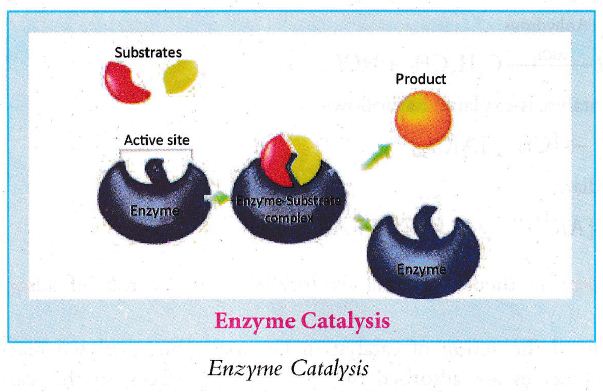
(i) Enzymes are complex protein molecules with three dimensional structures. They catalyse the chemical reaction in living organism. They are often present in colloidal state and extremely specific in catalytic action. Each enzyme produced in a particular living cell can catalyse a particular reaction in the cell.
Some common examples for enzyme catalysis:
(ii) The peptide glycyl L-glutamyl L-tyrosin is hydrolysed by an enzyme called pepsin.
(iii) The enzyme diastase hydrolyses starch into maltose
\(2\left(\mathrm{C}_{6} \mathrm{H}_{10} \mathrm{O}_{5}\right)_{\mathrm{n}}+\mathrm{nH}_{2} \mathrm{O} \rightarrow \mathrm{nC}_{12} \mathrm{H}_{22} \mathrm{O}_{11}\)
(iv) The yeast contains the enzyme zymase which converts glucose into ethanol.
\(\mathrm{C}_{6} \mathrm{H}_{12} \mathrm{O}_{6} \rightarrow 2 \mathrm{C}_{2} \mathrm{H}_{5} \mathrm{OH}+2 \mathrm{CO}_{2}\)
(v) The enzyme micoderma aceti oxidises alcohol into acetic acid.
\(\mathrm{C}_{2} \mathrm{H}_{5} \mathrm{OH}+\mathrm{O}_{2} \rightarrow \mathrm{CH}_{3} \mathrm{COOH}+\mathrm{H}_{2} \mathrm{O}\)
(vi) The enzyme urease present in soya beens hydrolyses the urea.
\(\mathrm{NH}_{2}-\mathrm{CO}-\mathrm{NH}_{2}+\mathrm{H}_{2} \mathrm{O} \rightarrow 2 \mathrm{NH}_{3}+\mathrm{CO}_{2}\)
Mechanism of enzyme catalysed reaction
(vii) The following mechanism is proposed for the enzyme catalysis
\(\mathrm{E}+\mathrm{S} \rightleftharpoons \mathrm{ES} \rightarrow \mathrm{P}+\mathrm{E}\).
(viii) Where E is the enzyme, S the substrate (reactant), ES represents activated complex and P the products.
18.
| S.No | Physical adsorption or vander waals adsorption or Physisorption | Chemical adsorption or Chemisorption or Activated adsorption |
|---|---|---|
| 1. | It is instantaneous | It is very slow |
| 2. | It is non-specific | It is very specific depends on nature of adsorbent and adsorbate |
| 3. | In Physisorption, when pressure increases the amount of adsorption increases | Chemical adsorption is fast with increase pressure, it can not alter the amount. |
| 4. | Physisorption decreases with increase in temerature | When temperature is raised chemisorption first increases and then decreases |
| 5. | No transfer of electrons | Chemisorption involves transfer of electrons between the adsorbent and adsorbate |
| 6. | Heat of adsorption is low in the order of 40kJ/ mole. | Heat of adsorption is high i.e., from 40- 400kJ/mole. |
| 7. | Multilayer of the adsorbate is formed on the adsorbent. | Monolayer of the adsorbate is formed |
| 8. | It occurs on all sides | Adsorption occurs at fixed sites called active centres. It depends on surface area |
| 9 | Activation energy is insignificant. | Chemisorption involves the formation of activated complex with appreciable activation energy. |
19.
(i) Purification of drinking water is activated by coagulation of suspended impurities in water by using alums containing \(\mathrm{Al}^{3+}\left(\mathrm{K}_{2} \mathrm{SO}_{4} \mathrm{Al}_{2}\left(\mathrm{SO}_{4}\right)_{3} \cdot 24 \mathrm{H}_{2} \mathrm{O}\right)\) Alum has a negative charge and tends to disperse in water very fast.
(ii) The increased size as well as the lack of repelling charges cause the alum particles to settle down at the bottom or rise up and float in water. After the particles are neutralized, they clump together because of the London dispersive force which are part of vander Waal's forces. The weak inter molecular force arising from quantum induced instantaneous polarisation multi poles in molecules causes even non polar particles to attract each other due to the corelated movements of the electrons in interacting molecules. Then they settle down.
20.
(i) In lyophillic colloids or sols definite attractive force or affinity exists between dispersion medium and dispersed phase. Examples: sols of protein and starch. They are more stable and will not get precipitated easily.
(ii) In a lyophobic colloids, no attractive force exists between the dispersed phase and dispersion medium. They are less stable and precipitated readily, but cannot be produced again by just adding the dispersion medium.
Examples: sols of gold, silver, platinum and copper.

12th Standard Syllabus & Materials
12th Standard
TN 12th Computer Applications களப்பெயர் முறைமை (DNS) Sample Question Papers Study Material - QB365 Set A
NEW12th Standard
TN 12th Computer Applications வலையமைப்பு எடுத்துக்காட்டுகள் மற்றும் நெறிமுறைகள் Sample Question Papers Study Material - QB365 Set A
NEW12th Standard
TN 12th Computer Applications கணினி வலையமைப்பு ஓர் அறிமுகம் Sample Question Papers Study Material - QB365 Set A
NEW12th Standard
TN 12th Computer Applications PHP-உடன் MySQL-ஐ இணைத்தல் Sample Question Papers Study Material - QB365 Set A



Tamilnadu Stateboard 12th Standard Subjects

Maths
Chemistry

Physics

Biology

Computer Science

Business Maths and Statistics

Economics

Commerce

Accountancy

History

Computer Applications
Biology
Computer Technology
Computer Applications
Computer Science
Business Maths and Statistics
Commerce
Economics
Maths
Chemistry
Physics
Computer Technology
History
Accountancy

Tamil

English

French
Tamilnadu Stateboard Standards
